Moving beyond the traditional annual appraisal, 360-degree feedback offers a panoramic view of an employee’s performance by gathering insights from everyone they work with: managers, peers, direct reports, and even external stakeholders. This holistic approach uncovers crucial development areas and hidden strengths that a top-down review might miss, fostering a more transparent and collaborative work environment. But how do you implement it effectively? The key lies in using the right questions and frameworks to elicit meaningful, constructive responses.
This guide provides a comprehensive list of 360-degree feedback examples to help you build a culture of continuous improvement. We will move beyond generic templates, offering actionable examples and strategic insights for specific roles, competencies, and organisational goals. You will discover how to structure questions for maximum impact, interpret results accurately, and transform feedback into tangible growth plans for your team members. Understanding the general best practices for giving employee feedback is a great foundation, and this article will build upon that by focusing specifically on the multi-rater process.
We’ll also explore how to integrate these powerful feedback loops directly into your existing workflows. For UK organisations using the Microsoft ecosystem, we will demonstrate how to deploy these examples within Dynamics 365 Performance modules and connect them with Microsoft Teams and SharePoint. This creates a seamless, data-driven system for performance management that supports genuine professional development and aligns individual contributions with strategic business objectives.
1. Multi-Rater Competency Assessment
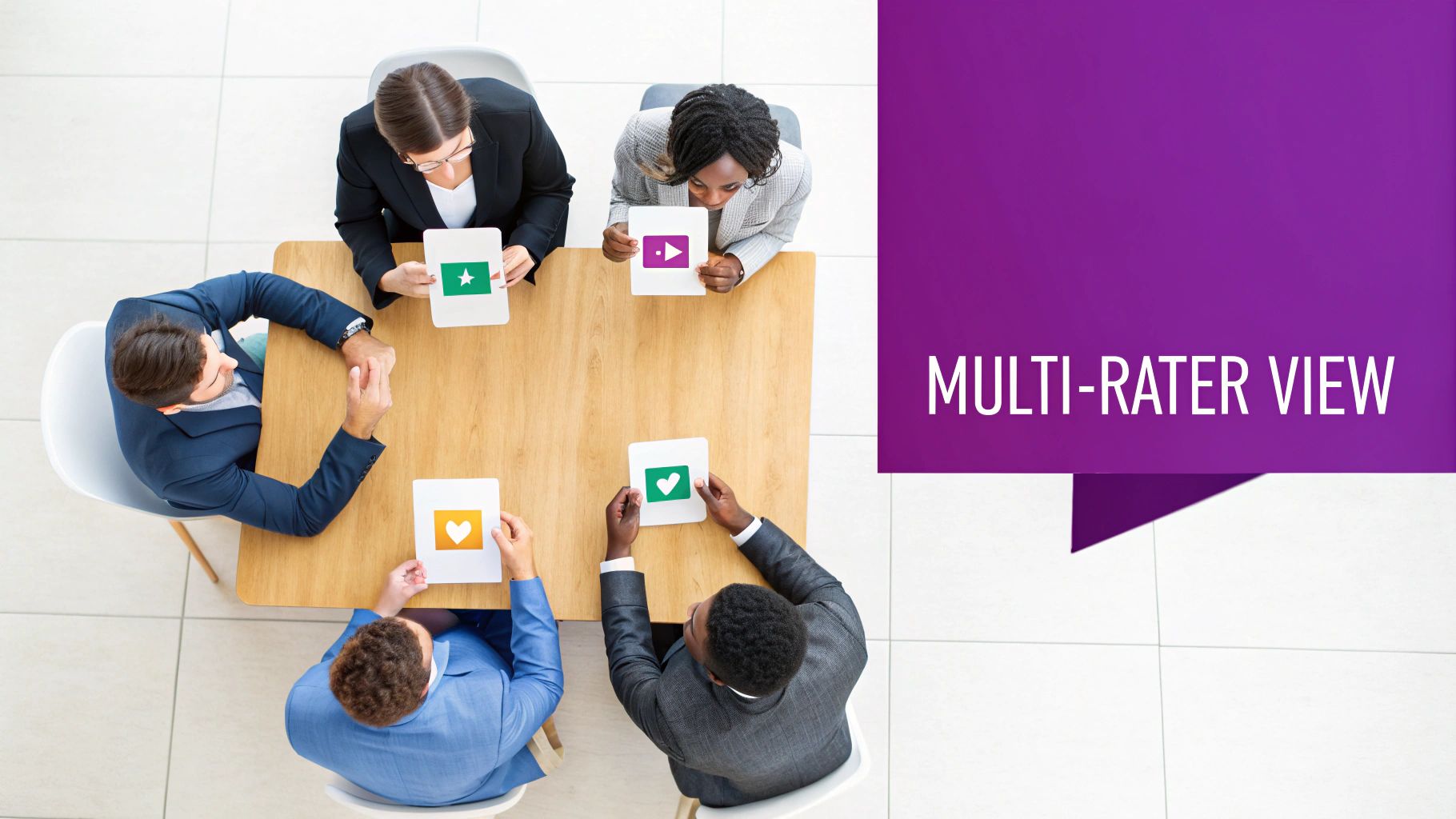
The Multi-Rater Competency Assessment is a foundational and highly effective example of 360-degree feedback. This method gathers evaluations on an employee’s performance from a circle of colleagues, including their line manager, peers, direct reports, and sometimes external stakeholders like clients. The feedback is structured around a specific set of competencies, such as ‘Strategic Thinking’ or ‘Team Collaboration’, that are crucial for their role and the organisation’s success.
This approach provides a holistic, panoramic view of an individual’s skills and behaviours, moving beyond the single perspective of a line manager. By collecting diverse viewpoints, it uncovers blind spots and highlights hidden strengths, offering a more balanced and objective basis for professional development. Companies like Google and Microsoft have successfully integrated this model into their leadership and management development programmes to build well-rounded, self-aware leaders.
Strategic Breakdown & Analysis
Why It Works: The power of this model lies in its structured objectivity. Tying feedback directly to pre-defined, role-relevant competencies prevents the process from becoming a vague popularity contest. It forces raters to assess specific behaviours, leading to more actionable and targeted insights. For instance, instead of just saying a manager is “good,” feedback is focused on how well they “delegate tasks effectively” or “provide constructive coaching.”
Key Insight: Its multi-rater nature mitigates the bias inherent in a single-source review. A manager might see an employee as highly effective at meeting deadlines, while peers may provide crucial feedback on their collaborative spirit during the project’s execution. This comprehensive data is invaluable for personal growth.
Actionable Takeaways
To implement this method effectively:
- Define Relevant Competencies: Work with department heads to select or create a competency framework that aligns directly with specific roles and organisational values. A junior software developer’s framework will differ significantly from a sales director’s.
- Curate Rater Groups: Ensure a balanced mix of raters. Aim for 3-5 peers, 3-5 direct reports (if applicable), and their line manager to get a well-rounded view. Anonymity is key to encourage honest responses.
- Use Clear Rating Scales: Employ a defined scale (e.g., 1-5 from ‘Needs Development’ to ‘Exceptional’) and provide clear behavioural examples for each point on the scale to standardise feedback.
- Integrate with Your Systems: Within Dynamics 365 Human Resources, you can configure these competency models and feedback templates directly in the Performance module, automating the distribution and collection process. Explore our guide for crafting effective 360-degree feedback questions to use in your framework.
2. Behavioural Examples and Storytelling Approach
The Behavioural Examples and Storytelling Approach moves beyond quantitative ratings to capture the qualitative ‘why’ behind an employee’s performance. This method asks raters to provide specific, narrative examples of situations where an individual demonstrated a particular strength or an area for development. Instead of simply rating ‘Team Collaboration’ as a 4 out of 5, a peer would describe a specific project where the employee successfully mediated a conflict or brought a disjointed team together.
This qualitative technique provides rich context that numbers alone cannot convey, making feedback more personal, memorable, and impactful. It transforms abstract competencies into tangible actions. Companies like Amazon famously use this approach by tying feedback directly to their Leadership Principles, asking for specific stories that exemplify principles like ‘Dive Deep’ or ‘Have Backbone’. This grounds the feedback in the company’s core values and makes it highly actionable.
Strategic Breakdown & Analysis
Why It Works: Stories are powerful. Our brains are wired to remember narratives far better than isolated data points. When feedback is delivered as a story (“I remember when you stayed late to help me with the Q3 report…”), it lands with greater emotional resonance and is easier for the recipient to recall and learn from. This approach sidesteps the ambiguity of rating scales, where one person’s ‘good’ is another’s ‘average’.
Key Insight: This method is exceptionally effective for reinforcing organisational culture. By encouraging stories that highlight desired behaviours, you are not just assessing an individual; you are actively codifying and celebrating the company’s values in action. Constructive feedback also becomes less confrontational, framed as an observation of a specific event rather than a judgement of character.
Actionable Takeaways
To implement this method effectively:
- Craft Specific Prompts: Don’t just ask for “examples.” Use prompts like, “Describe a specific time when [Employee Name] demonstrated exceptional problem-solving skills” or “Share an instance where [Employee Name] could have communicated more proactively with the team.”
- Train Your Raters: Coach participants to use the STAR method (Situation, Task, Action, Result) to structure their stories. This ensures the examples are clear, concise, and focused on behavioural outcomes.
- Create Psychological Safety: This method requires a high degree of trust. Emphasise that the goal is developmental, not punitive, and guarantee anonymity to encourage candid, constructive storytelling from all raters.
- Theme and Debrief: During the feedback session, group anonymous stories into key themes (e.g., ‘Initiative’, ‘Client Management’). Discussing these thematic clusters helps the individual see clear patterns in their behaviour and their impact on others.
3. Self-Other Agreement Analysis
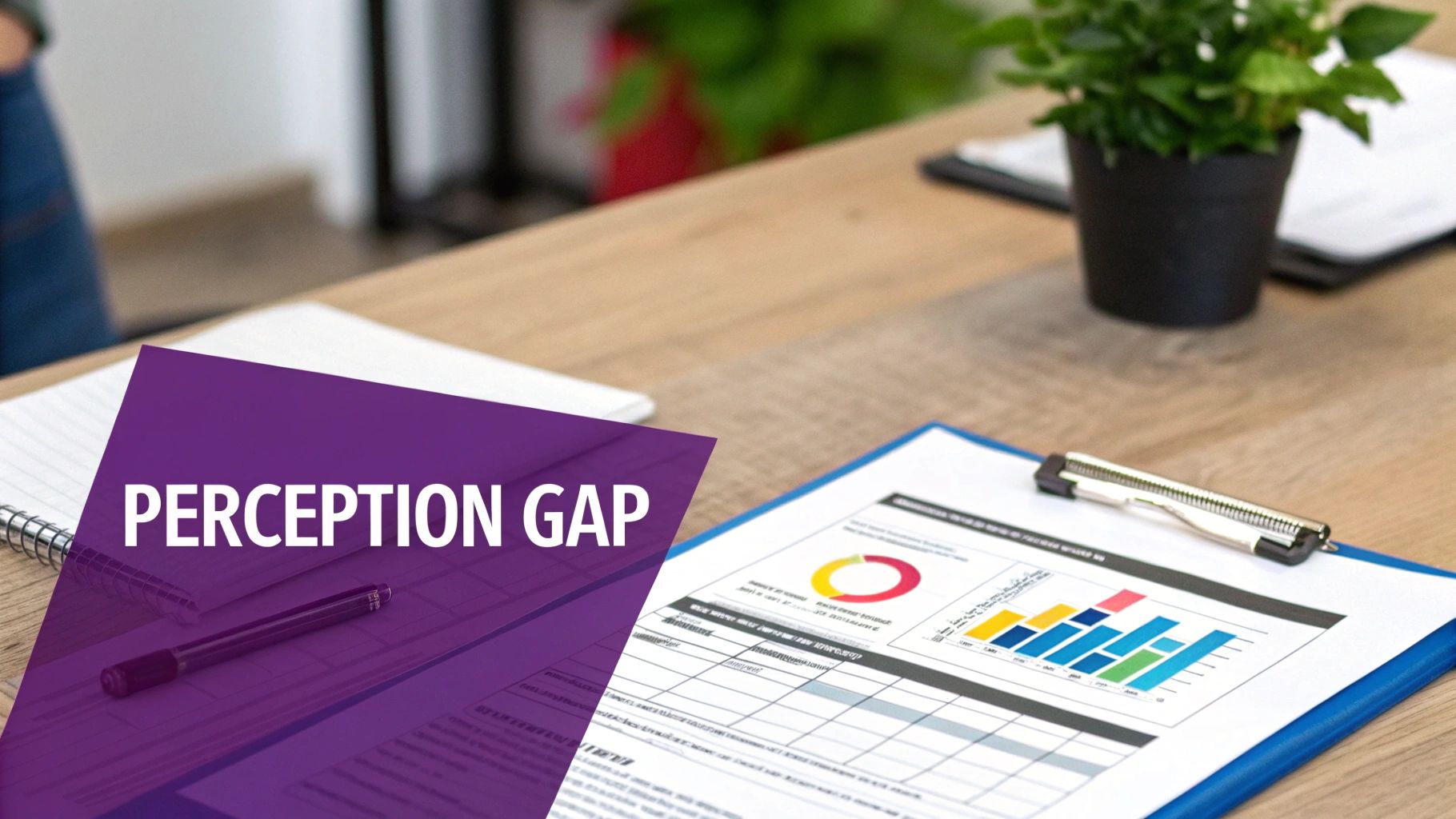
Self-Other Agreement Analysis is a powerful psychological tool adapted for 360-degree feedback. It directly compares how employees rate their own performance and behaviours against how others, such as their manager, peers, and direct reports, rate them. This structured comparison is designed to illuminate perception gaps and uncover critical blind spots.
The core purpose is to enhance an individual’s self-awareness, which is a cornerstone of effective leadership and personal development. By pinpointing discrepancies between self-perception and external feedback, this method provides a clear, data-driven starting point for targeted coaching conversations. Renowned leadership programmes at institutions like Harvard and Stanford often utilise this form of analysis to help executives understand their true impact versus their intended impact.
Strategic Breakdown & Analysis
Why It Works: This method moves beyond simple feedback collection to a more profound analysis of perception itself. It is rooted in concepts like the Johari Window, which explores the relationship between what we know about ourselves and what others know. By visually representing the “gap,” it makes abstract concepts like “blind spots” tangible and impossible to ignore, fostering a greater motivation for change.
Key Insight: The largest gaps often reveal the most significant opportunities for growth. For example, if an employee rates themselves highly on “clear communication” but their team rates them poorly, it signals a critical disconnect that is likely impacting team performance and morale. This insight is far more impactful than a standalone low score.
Actionable Takeaways
To implement this method effectively:
- Frame as a Learning Tool: Present the gap analysis data in a private, one-to-one coaching session. Emphasise that the goal is not criticism but self-discovery and development.
- Focus on High-Impact Gaps: Don’t try to address every discrepancy. Work with the employee to identify the 2-3 perception gaps that have the biggest negative impact on their role and team dynamics.
- Explore the ‘Why’: The conversation shouldn’t stop at acknowledging the gap. Coach the individual to explore why their perception might differ from others. Are there specific behaviours or situations that could be misinterpreted?
- Track Perception Over Time: Within Dynamics 365 Human Resources, you can run this analysis at different intervals (e.g., annually). This allows you to track whether the perception gaps are narrowing over time as a direct result of development efforts, providing a clear measure of progress.
4. Stakeholder-Specific 360-Feedback
Stakeholder-Specific 360-Feedback is a sophisticated and highly contextualised approach to performance evaluation. Instead of using a one-size-fits-all questionnaire, this method tailors questions to the specific relationship each rater group has with the employee. This acknowledges that a direct report, a peer, and an external client will observe and value different aspects of an individual’s performance and behaviour.
This customised model provides deeper, more relevant insights by asking the right questions to the right people. For example, direct reports might be asked about a manager’s coaching and delegation skills, while peers might be questioned on their collaborative contributions. Global professional services firm Accenture frequently tailors its feedback instruments, recognising that an internal project partner’s perspective is fundamentally different from that of an external client, leading to more nuanced and actionable development plans.
Strategic Breakdown & Analysis
Why It Works: Its effectiveness stems from its precision. By customising questions for each stakeholder group, the feedback avoids generic or irrelevant queries, increasing the quality and relevance of the responses. A customer’s view on an account manager’s responsiveness is far more valuable than a peer’s, who may have no visibility of this interaction. This makes the resulting data far more targeted and impactful for role-specific development.
Key Insight: This model reveals how an employee manages different relationships and adapts their behaviour to various contexts. An individual might excel at upward management (as seen by their supervisor) but struggle with peer collaboration or team leadership (as revealed by peers and direct reports). Uncovering these relational dynamics is crucial for senior leadership and client-facing roles where managing diverse stakeholders is a core competency.
Actionable Takeaways
To implement this method effectively:
- Conduct Stakeholder Analysis: Before designing the survey, map out the key stakeholder groups for the role in question. Consider supervisors, peers, direct reports, internal clients from other departments, and external partners or customers.
- Maintain a Common Core: While customising questions, retain a small set of core, universal competency questions across all rater groups. This provides a consistent baseline for comparison and tracks overarching organisational values.
- Frame Questions Appropriately: Write questions that reflect the unique interaction each group has with the individual. For example, ask direct reports, “How effectively does your manager provide you with the autonomy to complete your work?” and ask peers, “How reliably does this person contribute to shared team goals?”
- Provide Clear Context: In your system setup, clearly label feedback reports by stakeholder group (e.g., ‘Peer Feedback’, ‘Client Feedback’). Within Dynamics 365 Human Resources, you can create distinct feedback templates and assign them to specific rater categories, ensuring the process is organised and the results are easy to interpret.
5. 360-Feedback with Development Plan Integration
This approach elevates 360-degree feedback from a simple assessment tool into a catalyst for tangible growth. It systematically links the insights gathered from the feedback process directly to an employee’s Individual Development Plan (IDP). This method ensures that feedback isn’t just reviewed and forgotten; it becomes the foundation for setting specific, actionable goals supported by resources, coaching, and clear accountability.
The core principle is to close the loop between insight and action. By integrating the two processes, organisations create a continuous cycle of improvement where feedback directly informs development priorities. Companies like Johnson & Johnson use this model to connect feedback not only to IDPs but also to their wider succession planning, ensuring that development efforts align with long-term business needs. This makes it one of the most strategic 360-degree feedback examples available.
Strategic Breakdown & Analysis
Why It Works: This model’s strength lies in its explicit link to action. It transforms abstract feedback, such as “needs to improve strategic thinking,” into a concrete development goal like, “Complete a strategic planning course and lead one cross-departmental project by Q3.” This structured connection provides clarity, motivation, and a clear path forward for the employee, preventing the feedback from feeling like unhelpful criticism.
Key Insight: Integrating feedback with development plans institutionalises a growth mindset. It signals that the organisation is invested in an employee’s professional journey beyond just measuring their past performance. This commitment significantly boosts engagement and retention by showing individuals a clear pathway for advancement within the company.
Actionable Takeaways
To implement this method effectively:
- Facilitate a Debrief Session: Arrange a meeting between the employee and their manager or an HR coach within two weeks of receiving the feedback report to discuss the findings and co-create the development plan.
- Prioritise Goals: Focus on the most critical development areas. Limit the IDP to 2-3 key, high-impact goals to avoid overwhelming the employee and ensure concentrated effort.
- Define SMART Objectives: Ensure each development goal is Specific, Measurable, Achievable, Relevant, and Time-bound. For instance, instead of “improve communication,” specify “present at three team meetings with positive peer feedback.”
- Establish a Cadence for Check-ins: Schedule regular monthly or quarterly follow-up meetings to track progress against the IDP, discuss challenges, and adjust the plan as needed. This process mirrors the structured follow-up common in effective annual appraisal examples.
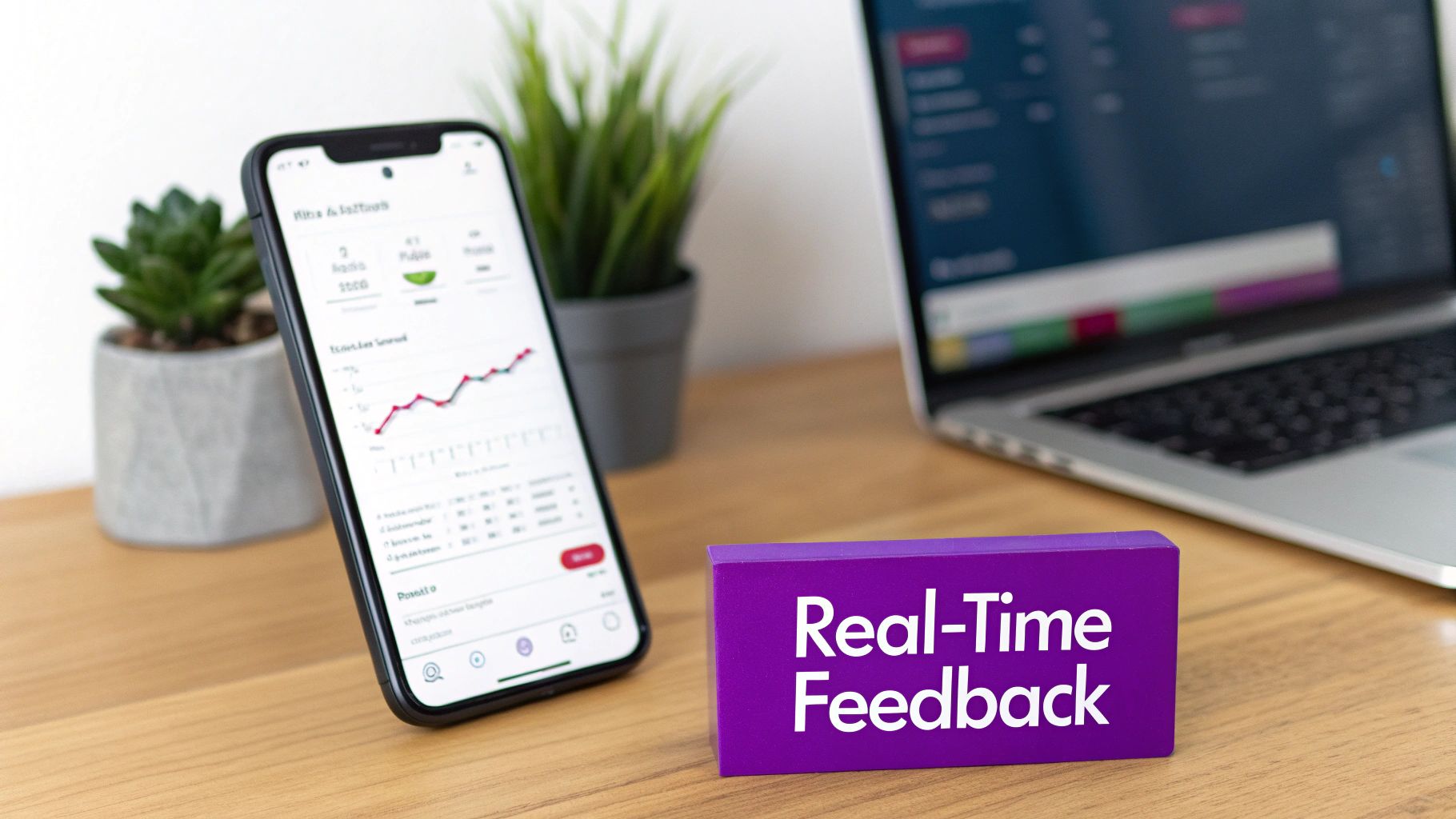
6. Real-Time 360-Feedback and Continuous Listening
Real-Time 360-Feedback and Continuous Listening shifts the traditional annual review paradigm towards an agile, ongoing dialogue. This modern approach uses digital platforms, pulse surveys, and regular check-ins to capture immediate reactions to performance and behaviour. Instead of waiting months for a formal review, feedback is collected and shared in a continuous loop, allowing for faster adjustments and more timely recognition.
This method transforms feedback from a scheduled event into a cultural norm, fostering an environment of constant learning and improvement. Companies like Adobe, which famously replaced its annual review process with continuous feedback, have seen significant increases in employee engagement and retention. By providing timely insights, this model helps employees and managers address challenges and celebrate successes as they happen, making development a more dynamic and integrated part of daily work.
Strategic Breakdown & Analysis
Why It Works: Its power lies in immediacy and relevance. Feedback provided closer to the actual event is more specific, memorable, and actionable than feedback given months later. This approach reduces recency bias, where reviewers only recall the last few weeks of performance, and provides a much more accurate, trend-based picture of an individual’s contribution over time.
Key Insight: Continuous listening creates a psychologically safer environment for feedback. When feedback becomes a frequent, low-stakes interaction rather than a high-pressure annual event, both givers and receivers become more comfortable with the process. This encourages greater candour and builds a more resilient, feedback-driven culture.
Actionable Takeaways
To implement this method effectively:
- Start with a Cadence: Begin with quarterly or monthly pulse surveys before moving to more frequent check-ins. This allows your organisation to adapt to the new rhythm without feeling overwhelmed.
- Keep Prompts Brief: Design real-time prompts to be short and focused on a single behaviour or event (e.g., “How well did [Name] facilitate today’s team meeting?”). This encourages higher participation rates.
- Train Your Managers: Equip managers with the skills to interpret continuous data streams and facilitate productive, ongoing performance conversations. The goal is coaching, not constant evaluation.
- Leverage Technology: Use dedicated employee performance management software to automate the collection and analysis of real-time data. Platforms integrated with Microsoft Teams can embed feedback requests directly into daily workflows, making the process seamless.
7. Peer-to-Peer 360-Feedback Networks
Peer-to-Peer 360-Feedback Networks shift the focus from traditional top-down and bottom-up evaluations to a more collaborative, lateral approach. This model organises employees into structured cohorts or networks to provide mutual feedback. The emphasis is on peer learning, shared accountability, and fostering a culture of continuous development among colleagues at similar organisational levels.
This method democratises the feedback process, empowering individuals to support each other’s growth. By creating a dedicated space for peer exchange, it helps break down silos and builds stronger, more supportive team relationships. Agile teams often use peer retrospectives as an informal version of this, while companies like Zappos have used peer feedback circles to enhance team cohesion and drive collective performance improvements.
Strategic Breakdown & Analysis
Why It Works: This model thrives on psychological safety and shared context. Peers often have a more nuanced understanding of the day-to-day challenges and contributions of their colleagues than a manager might. This shared perspective leads to highly relevant, empathetic, and practical feedback that can be immediately applied. The focus is less on formal performance ratings and more on collaborative problem-solving and skill development.
Key Insight: Its power lies in creating a culture of mutual ownership for development. When peers are responsible for helping each other grow, feedback becomes a continuous, supportive dialogue rather than a one-off, hierarchical event. This approach is heavily influenced by the principles of ‘Radical Candor’ and ‘Dare to Lead’, where direct, caring feedback is the foundation of high-performing teams.
Actionable Takeaways
To implement this model effectively:
- Establish Psychological Safety: Before launching, facilitate sessions to establish clear ground rules for constructive, non-judgemental feedback. This is the most critical step for success.
- Provide Facilitation Training: Equip peer leaders or network champions with the skills to guide conversations, manage difficult dynamics, and ensure discussions remain productive and focused.
- Use a Structured Protocol: Provide a simple framework or set of guiding questions to structure the conversations. This prevents them from becoming unstructured complaint sessions.
- Integrate with Recognition: Connect peer feedback with informal recognition. Complementing formal 360-feedback by establishing systems to build effective peer-to-peer recognition programs can amplify the positive impact and reinforce supportive behaviours.
- Capture Actions in Dynamics 365: While the conversations are peer-led, encourage employees to log their key development goals and action items in the Dynamics 365 Human Resources Performance module to track progress and maintain alignment with broader organisational objectives.
8. Values-Aligned and Cultural Fit 360-Feedback
The Values-Aligned and Cultural Fit assessment is a specialised 360-degree feedback example that moves beyond pure performance metrics. It evaluates how effectively an employee embodies the organisation’s core values and contributes to its desired culture. This method gathers insights on behaviours that reinforce the company’s identity, assessing an individual’s alignment with principles like integrity, customer obsession, or sustainability.
This approach is crucial for organisations where culture is a key strategic asset. It provides a structured way to measure and develop the very behaviours that define the employee experience and brand promise. Companies like Zappos, renowned for their service culture, and Patagonia, which values environmental activism, use such feedback mechanisms to ensure their teams are not just high-performing, but are also true cultural ambassadors.
Strategic Breakdown & Analysis
Why It Works: This feedback model translates abstract values into tangible, observable behaviours. Instead of a vague assessment of “cultural fit,” it asks raters to evaluate specific actions, such as “Does this person proactively seek diverse perspectives to foster an inclusive environment?” or “Do they consistently prioritise long-term customer success over short-term gains?” This makes the feedback specific, developmental, and less prone to unconscious bias.
Key Insight: Its power lies in reinforcing that how work gets done is just as important as what gets done. It signals to employees that living the company values is a critical component of success, directly impacting career progression and recognition. This method helps prevent a culture where top performers are tolerated despite behaviour that undermines team morale or core principles.
Actionable Takeaways
To implement this method effectively:
- Articulate and Operationalise Values: Before designing the feedback, ensure your company values are clearly defined with specific behavioural examples for each. For instance, a value of ‘Ownership’ could be linked to behaviours like “taking initiative without being asked” and “seeing tasks through to completion.”
- Train Raters on Objectivity: Provide mandatory training for all participants on how to give values-based feedback and how to mitigate personal bias. Emphasise focusing on observable behaviours rather than subjective feelings about a person’s personality.
- Balance ‘Fit’ with Diversity: Frame the feedback around ‘culture contribution’ rather than ‘culture fit’. This encourages raters to value diverse perspectives that enrich the culture, preventing the creation of a homogenous, group-think environment.
- Integrate into Performance Cycles: Within Dynamics 365 Human Resources, you can create a dedicated section in your performance review templates for values-based competencies. This ensures the feedback is formally captured and linked to development planning and goal setting.
360° Feedback: 8-Approach Comparison
| Approach | Implementation complexity | Resource requirements | Expected outcomes | Ideal use cases | Key advantages |
|---|---|---|---|---|---|
| Multi-Rater Competency Assessment | Moderate–High (design + coordination) | Multiple raters, facilitation, analytics | Comprehensive competency profile; blind-spot identification | Leadership development, promotions, role assessments | Reduces individual bias; multi-perspective credibility |
| Behavioural Examples & Storytelling | Moderate (qualitative design & prompts) | Time-intensive responses; qualitative analysis | Rich, contextualised feedback; actionable narratives | Coaching, development conversations, culture change | Memorable, actionable stories that explain behaviours |
| Self‑Other Agreement Analysis | Moderate (parallel forms + gap analysis) | Data visualisation, coaching for interpretation | Identifies self-awareness gaps; tracks perception shifts | Executive coaching, self-awareness programmes | Directly highlights perception misalignment; drives reflection |
| Stakeholder‑Specific 360-Feedback | High (multiple tailored instruments) | Design multiple questionnaires, higher admin cost | Role-specific insights; higher relevance of responses | Senior leaders, customer-facing roles, complex stakeholder roles | Context-appropriate feedback; more actionable by relationship |
| 360-Feedback + Development Plan Integration | High (feedback + IDP linkage) | Coaches, manager time, ongoing monitoring | Behavioural change with tracked progress | Succession planning, high-potential development | Converts feedback into measurable development and accountability |
| Real‑Time 360-Feedback & Continuous Listening | Moderate (platform + cadence setup) | HR tech, integrations, change management | Fresher feedback; faster course correction; trend data | Agile teams, fast-paced or remote organisations | Timely, higher engagement and ongoing trend tracking |
| Peer‑to‑Peer 360-Feedback Networks | Low–Moderate (cohort setup & norms) | Facilitation, training on norms and safety | Peer learning, increased cohesion, mutual accountability | Team development, peer cohorts, learning networks | Builds psychological safety and peer accountability |
| Values‑Aligned / Cultural Fit 360-Feedback | Moderate (define values + anchors) | Training to reduce bias; alignment workshops | Assesses cultural alignment; identifies culture champions | Culture change initiatives, hiring and promotions | Reinforces values and cultural role-modelling when well-calibrated |
Bringing It All Together with DynamicsHub
Throughout this article, we have explored a comprehensive suite of 360-degree feedback examples, moving far beyond generic templates to provide strategically-grounded, actionable frameworks. We’ve seen how multi-rater competency assessments provide a structured baseline, while behavioural examples and storytelling add the crucial context that turns data into a development narrative. The power of this process is truly unlocked when these disparate elements are woven together into a cohesive, ongoing conversation about performance and growth.
From analysing self-other agreement to uncover blind spots, to tailoring feedback for specific stakeholders, the key is customisation. A one-size-fits-all approach to feedback is destined to fail. The most effective programmes, as demonstrated, are those that align directly with an organisation’s unique values, culture, and strategic objectives. They are not one-off events but are integrated into a continuous listening strategy, supported by real-time feedback loops and robust peer-to-peer networks.
Your Roadmap from Insight to Impact
The journey from understanding these examples to implementing them successfully requires a clear strategy. The ultimate goal is not merely to collect data, but to inspire meaningful action and foster a culture of continuous improvement. The examples provided serve as a robust toolkit, but their true value is realised when they are linked directly to tangible development plans, career progression, and organisational goals.
Here are the most critical takeaways to guide your next steps:
- Context is King: The most powerful feedback is specific and behavioural. Move away from vague ratings and encourage reviewers to provide concrete examples that illustrate their points. This transforms feedback from a judgement into a learning opportunity.
- Integration is Non-Negotiable: Feedback must live within the flow of work. Siloed surveys that require users to log into unfamiliar systems create friction and reduce participation. Integrating the feedback process within platforms like Microsoft Teams and SharePoint makes it a natural part of the daily routine.
- Actionability is the Goal: Every piece of feedback should be a starting point, not an endpoint. The examples we’ve reviewed, particularly those integrating with development plans, are designed to create clear, actionable pathways for improvement. Without this link, feedback becomes an academic exercise with little real-world impact.
- Technology as an Enabler: Manually managing a 360-degree feedback process for even a small team is a logistical nightmare. A robust HR management system is essential to automate workflows, ensure confidentiality, centralise data, and provide the analytics needed to identify trends at both the individual and organisational level.
Realising Your Feedback Vision with Dynamics 365
Implementing a robust 360-degree feedback programme requires more than just the right questions; it demands a powerful, integrated system to manage the process efficiently. These diverse 360-degree feedback examples demonstrate the flexibility and depth of modern feedback strategies, but their success hinges on seamless execution. The true challenge lies in operationalising these concepts at scale, ensuring the process is efficient, secure, and deeply connected to your core HR functions.
This is where a dedicated platform becomes indispensable. We are DynamicsHub.co.uk and we provide Transformative HR solutions customised to your unique workflows. Human Resource (HR) Management for Dynamics 365 is the leading hire to retire solution for the Microsoft Platform, enabling you to deploy any of these feedback models directly within the systems your team already uses. From competency assessments in Dynamics 365 Performance modules to real-time feedback captured via Teams, our platform centralises data, automates workflows, and empowers you to turn insight into action. By leveraging the power of the Microsoft ecosystem, you can build a feedback culture that is not only insightful but also sustainable and impactful.
Ready to build a high-performance culture driven by meaningful feedback? Phone 01522 508096 today or send us a message at https://www.dynamicshub.co.uk/contact/ to discover how our solutions can be tailored to your organisation.
Ready to transform these examples into a reality for your organisation? DynamicsHub provides the leading Human Resource Management solution for Dynamics 365, allowing you to seamlessly implement sophisticated 360-degree feedback programmes directly within the Microsoft platform. Visit our website at DynamicsHub to learn how we can help you build a more connected, insightful, and high-performing workforce.