At its core, workforce planning is about making sure you have the right people, with the right skills, in the right roles, at the right time. It’s a strategic process that goes way beyond just filling empty seats. It's about connecting your talent strategy directly to your long-term business goals, getting your organisation ready for whatever comes next.
What Is Workforce Planning and Why Does It Matter Now?
Forget the dry, textbook definitions for a moment. Think of workforce planning as creating the architectural blueprint for your company's future. You wouldn't dream of building a new office without a detailed plan laying out where the walls, wiring, and workspaces will go. In the same way, you shouldn't be building your team without a clear strategy for the skills, roles, and headcount you'll need to succeed.
It's a forward-looking discipline. It starts with a hard look at the team you have now, then forecasts what you'll need down the road based on your company's big-picture goals. From there, you spot the gaps between the two and, crucially, make a concrete plan to close them. It's a proactive, data-driven approach to managing your talent.
The Shift From Reactive Hiring to Strategic Planning
For years, many businesses have been stuck in a reactive hiring cycle. A key person leaves, a new project kicks off, and suddenly there's a frantic scramble to fill the role. While this approach might plug an immediate hole, it often leads to rushed decisions, poor cultural fits, and a team that’s always one step behind the business's real needs.
Workforce planning completely flips that script. It gets HR and business leaders to ask the big questions before a problem becomes an emergency:
- Where do we want the business to be in the next three to five years?
- What skills will we need to get there that we don't have today?
- Which roles might become redundant as technology or markets change?
- Have we got a solid succession plan for our most critical leaders?
Answering these questions moves you from simply filling seats to deliberately building a more resilient and adaptable organisation.
"Effective workforce planning is the difference between being prepared for the future and being surprised by it. It transforms HR from a cost centre into a strategic driver of business value."
Why It Is an Essential Tool for UK Businesses Today
For any UK organisation trying to navigate economic uncertainty, rapid technological change, and a tricky labour market, being proactive isn't just a 'nice-to-have'—it's essential for survival and growth. The last few years have shown just how risky it is to be caught unprepared.
Good workforce planning keeps your business agile. It helps you get ahead of skills shortages, manage the challenges of an ageing workforce, and embrace new tech without grinding everything to a halt. It’s about making sure your most valuable asset—your people—is perfectly aligned with your most important goals.
We are DynamicsHub.co.uk. We provide Transformative HR solutions customised to the unique way you work. Human Resource HR Management for Microsoft Dynamics 365 by Hubdrive is the leading hire-to-retire solution for the Microsoft Platform.
To start building your strategic HR blueprint, phone 01522 508096 today, or send us a message at https://www.dynamicshub.co.uk/contact/
The Core Components of an Effective Workforce Plan
Any solid workforce plan is built on a few essential pillars. It's not a single, giant task but a series of connected stages that flow from one to the next. Grasping these components turns workforce planning from a vague concept into a practical, powerful strategy for any UK business.
These four core components give you the framework to figure out where you are, where you're heading, and how to build a clear roadmap to get there. It’s a logical process that turns raw data into smart decisions.
1. Supply Analysis: Understanding Your Current Talent
First things first, you need to get a really clear picture of the team you have right now. This is much more than just a headcount. Supply analysis is about creating a detailed inventory of the skills, experience, qualifications, and potential sitting inside your organisation today.
Think of it as an internal audit of your people. You need to ask some honest questions:
- Who do we have? Look beyond names and job titles to demographics, tenure, and performance data.
- What are their skills? Map out the real-world competencies and qualifications across every department.
- Where are they going? Start thinking about career paths, who's ready for a bigger role, and, just as importantly, who might be a flight risk.
This analysis is your baseline. Without it, you're just guessing. Systems like the Human Resource HR Management solution from Hubdrive, which we implement for clients, are brilliant for this because they bring all this information into one place for a real-time view.
2. Demand Forecasting: Predicting Future Needs
Once you know exactly what you've got, the next step is demand forecasting. This is where you start looking into the future, connecting your big-picture business strategy to the people you’ll need to make it happen. You're predicting the skills and roles your business will need to hit its goals.
For example, a UK fintech start-up planning to launch a new product line will need to forecast its demand for more software engineers and data scientists. On the flip side, a high-street retailer moving towards a digital-first model has to predict its need for e-commerce experts, while anticipating a smaller requirement for in-store staff.
This part of the process involves digging into business plans, keeping an eye on market trends, and considering new technology to estimate the number and type of people you'll need down the line.
3. Gap Analysis: Pinpointing the Difference
You’ve got a clear picture of your supply and a forecast for your demand. Now it's time for the gap analysis. This is simply where you lay the two side-by-side to identify the critical differences between the team you have and the team you actually need.
A gap could be a surplus (too many people in a certain role) or, more often, a shortage (not enough people with the right skills). Your analysis might show that you have a fantastic sales team, but a critical shortage of project managers to actually deliver on all the work they're bringing in.
Identifying the gap is the lightbulb moment in workforce planning. It’s where potential problems become clear, actionable challenges you can start to solve.
To get this right, you really need to get to grips with the data. Mastering the principles of Workforce Analytics is what separates a hunch from a data-driven decision.
4. Solution Implementation: Crafting Your Action Plan
The final piece of the puzzle is solution implementation. This is where you roll up your sleeves and create targeted strategies to close the gaps you’ve just identified. It’s all about turning your analysis into a concrete plan of action.
Your solutions will be tailored to the specific gaps you've found. Common actions include:
- Recruitment to bring in fresh talent with skills you're missing.
- Training and Upskilling to develop the potential of your existing employees.
- Succession Planning to groom your high-performers for future leadership roles.
- Restructuring to realign teams and responsibilities to better fit new priorities.
This stage is all about practicalities. For instance, if your plan involves growing a department, you need to know exactly how many people that means. This often involves working out metrics like full-time equivalents, which you can learn more about in our guide on how to calculate FTE.
A Step-by-Step Guide to Implementing Workforce Planning
Knowing the theory behind workforce planning is one thing, but actually putting it into practice is a whole different ball game. To get it right, you need to move from theory to action with a clear, methodical approach.
This practical, five-step roadmap is designed to guide you through that process. We'll break down the complex challenge of strategic planning into a series of manageable, data-driven actions, helping you build a talent strategy that delivers real results for your UK organisation.
Step 1: Align with Business Strategy
First things first: your HR efforts must be perfectly in sync with the company's big-picture goals. A workforce plan can't exist in a vacuum; its entire purpose is to support and enable the business's long-term vision.
Start by getting answers to some fundamental questions:
- Where is the business heading in the next one to five years? Are we chasing market expansion, driving product innovation, or focusing on operational efficiency?
- What are the key financial targets or growth projections we need to hit?
- What external shifts, like new technology or market trends, could impact these goals?
By anchoring your plan in these strategic realities from day one, you ensure every talent decision—from recruitment to development—is actively pushing the company towards success.
Step 2: Analyse Your Current Workforce
With your strategic direction clear, it's time to take a detailed snapshot of the team you have today. This means doing a deep dive into your existing talent pool to understand not just who you have, but what they can really do.
This supply analysis is much more than a simple headcount. You need to map out the skills, competencies, qualifications, performance levels, and even potential flight risks across the entire organisation. This is where integrated systems, like the HR solutions for Microsoft Dynamics 365 we provide at DynamicsHub, become indispensable. They centralise all that employee data, turning what would be a painful manual task into an efficient, insightful analysis. You can learn more about this in our article on the power of human resources analytics.
Step 3: Forecast Future Scenarios
Now it's time to look ahead. Forecasting your future talent needs isn't about gazing into a crystal ball; it's about using data and strategic thinking to model different business scenarios. What kind of team would you need to handle rapid growth? What about a market downturn or a major tech disruption?
This stage is all about building resilience. For instance, recent UK labour market data showed a significant drop in job vacancies—the 35th consecutive quarterly decline was noted in March-May 2025. This points to a shift towards efficiency and redeploying existing talent rather than aggressive hiring. By forecasting scenarios like this, you can proactively plan to upskill staff to meet new challenges, especially with predictions that AI could put millions of jobs at risk.
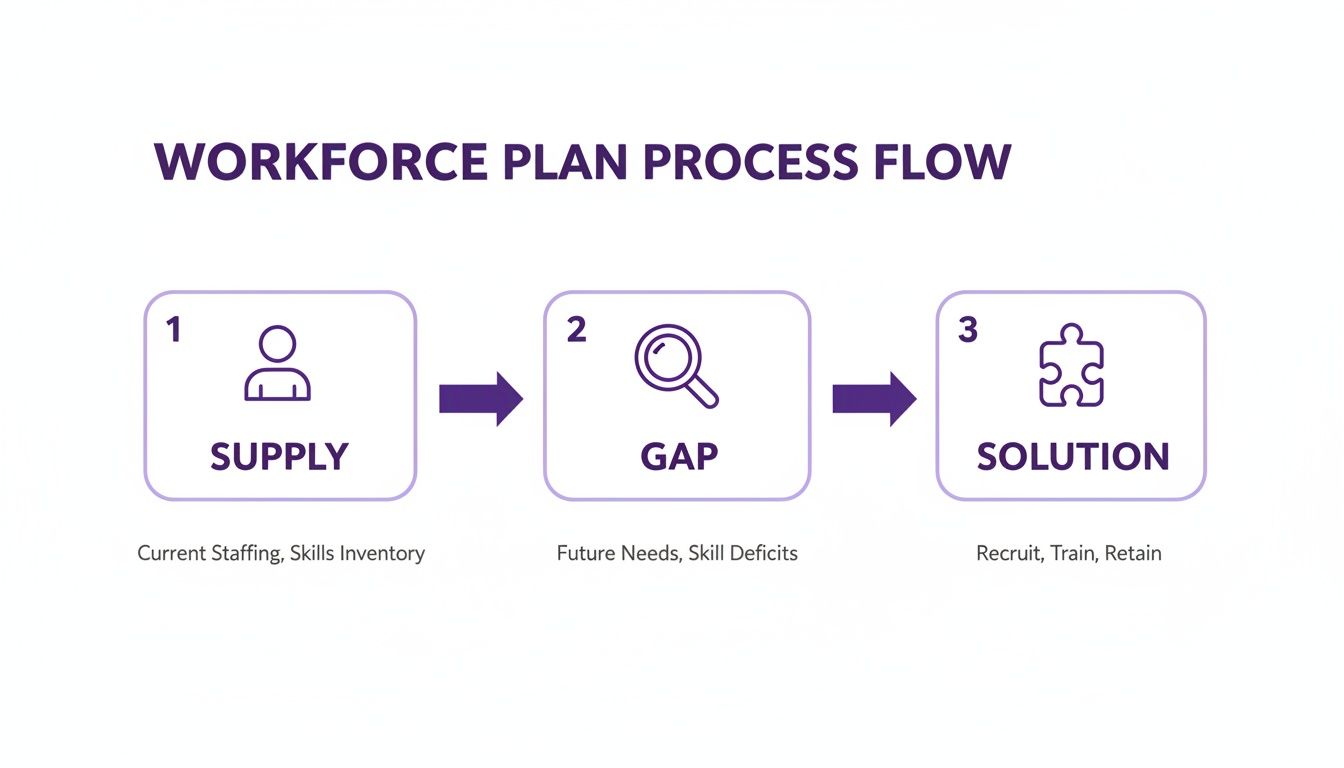
As this flow shows, identifying the gap between what you have and what you'll need is the crucial connection between analysis and action.
Step 4: Conduct a Gap Analysis
This is the moment of truth. Here, you lay your current workforce analysis (Step 2) alongside your future needs forecast (Step 3) to see where they don't line up. The gap analysis pinpoints the specific differences, whether that’s a shortage of critical skills, a surplus of roles that might become obsolete, or a weak leadership pipeline.
The goal is to emerge with a prioritised list of talent gaps. For example, you might discover a company-wide deficiency in data analysis skills, or suddenly realise you have no obvious successors for two of your most critical leadership roles. This clarity is what allows you to develop targeted, effective solutions.
A gap analysis transforms vague concerns into specific problems. It's the diagnosis that allows you to prescribe the right treatment, ensuring you invest resources where they will have the greatest impact.
Step 5: Monitor and Adapt Your Plan
Finally, and most importantly, remember that a workforce plan is not a static report you create once and file away. It’s a living, breathing process that needs constant attention, review, and adaptation.
Set key performance indicators (KPIs) to track your progress. These could be metrics like time-to-fill for critical roles, employee turnover rates, or the success rate of internal promotions. Review these numbers regularly and be ready to adjust your plan based on what the data is telling you. The business world never stands still, and your workforce plan needs to be agile enough to keep up.
Workforce Planning in Action Across UK Industries
It’s one thing to talk about the theory of workforce planning, but seeing it work in the real world is where the value truly clicks. This isn’t a one-size-fits-all template; it’s a flexible strategy that adapts to the unique pressures and ambitions of different sectors. Across the UK, from massive public bodies to nimble tech start-ups, organisations are using these principles to get ahead—and stay there.

By looking at a few examples, we can see how a clear workforce plan turns into tangible results. These stories show how planning helps organisations navigate everything from rapid growth to tricky transformations with a lot more confidence.
The Public Sector: A Case of Precision
The UK Civil Service provides a masterclass in highly targeted workforce planning. Despite facing broad financial constraints, it has managed to scale its workforce with surgical precision to meet specific policy demands. This is a far cry from blunt, organisation-wide hiring freezes or cuts.
This strategic approach really shines through in recent figures. While some areas saw reductions, the Ministry of Justice added 900 staff (a 0.93% rise) and the Department for Work and Pensions grew by 2,395 employees (a 2.5% increase). These two departments alone drove much of the total growth, proving how good departmental forecasting allows for precise hiring that aligns with national priorities.
This granular approach highlights a key principle of effective planning: It’s about making intelligent, data-driven decisions to invest in the right areas at the right time, ensuring resources go where they’ll have the most impact.
Private Sector Scenarios: Managing Change and Seizing Opportunity
In the private sector, the drivers for workforce planning are often more directly tied to market forces, new technology, and what the competition is up to. The challenges might look different, but the core principles of figuring out your supply, demand, and gaps are exactly the same.
Let’s walk through a couple of relatable scenarios for UK businesses.
The Manufacturing Firm and an Ageing Workforce
Picture a well-established manufacturing company in the Midlands. They have a classic problem on their hands: a big chunk of their most skilled engineers and machine operators are nearing retirement. The risk isn't just about losing people; it's about losing decades of vital, undocumented knowledge.
Their workforce plan is all about knowledge transfer and succession planning:
- Supply Analysis: They start by identifying every employee within ten years of retirement and carefully map their critical, specialised skills.
- Demand Forecasting: Next, they confirm that these exact skills will still be essential for their five-year production goals.
- Gap Analysis: The looming 'knowledge gap' is quickly flagged as the number one strategic risk to keeping operations running smoothly.
- Solution Implementation: A multi-year plan is put into action. It includes a robust apprenticeship programme to build a new talent pipeline and a formal mentorship scheme that pairs senior experts with mid-career employees. The goal? Make sure that crucial knowledge is passed on before it walks out the door.
The Tech Company and the Skills Race
Now, imagine a fast-growing tech company in Manchester. Their entire business strategy hinges on launching a new AI-driven analytics product. The only problem is they don’t have the machine learning and data engineering skills they need in-house.
Their workforce plan is built for speed and proactive talent acquisition:
- Supply Analysis: An internal skills audit confirms what they suspected—a critical shortage of advanced AI talent.
- Demand Forecasting: They project the need for 15 new AI specialists over the next 18 months to hit their product roadmap deadlines.
- Gap Analysis: The gap is clear and urgent. They decide that relying only on external hiring in a fiercely competitive market is too slow and too expensive.
- Solution Implementation: They opt for a hybrid strategy. A targeted recruitment campaign is launched to bring in a few senior AI architects. At the same time, they create an internal upskilling programme, offering specialised training and certifications to their most promising developers. They also start building relationships with local universities to attract the best graduates. This might also involve bringing in specialists on a temporary basis; for more on this, you can explore our guide on managing a contingent workforce.
Navigating Common Challenges in Workforce Planning
Even the best-laid workforce plans can run into trouble. When you start putting theory into practice, you'll almost certainly hit a few common, but very real, roadblocks. For UK businesses, these hurdles can derail progress if you don't see them coming.
The good news is that these challenges, from wrestling with messy data to getting leadership to actually care, are solvable. The trick is knowing what they are so you can build a plan to navigate around them and make sure your strategy delivers real-world results.
Overcoming Data Quality and Accessibility Issues
One of the first walls people hit is poor data. You can't plan for the future if you don't have a clear picture of the present, and for many organisations, that picture is incredibly fuzzy. Critical employee information is often scattered across clunky HR systems, endless spreadsheets, and siloed departmental databases. This makes getting a single, reliable view of your people almost impossible.
The first step is to tear down those silos. You need to get your systems talking to each other.
- Centralise your data: Bringing everything into one unified HR platform is a game-changer. Think of solutions like the Human Resource HR Management for Microsoft Dynamics 365 from Hubdrive, which creates a single source of truth for all your people data.
- Establish data governance: This sounds technical, but it just means setting clear rules for how information is entered and looked after. It’s about ensuring consistency and accuracy from day one.
- Automate reporting: Stop wasting hours pulling numbers together manually. Use automated dashboards to get a live look at your key metrics, which cuts out the risk of human error.
Securing Leadership Buy-In and Investment
Another classic hurdle is getting the leadership team on board. If the people at the top see workforce planning as just another "HR initiative" rather than a core business strategy, it will be starved of the resources and attention it needs to succeed.
To get their buy-in, you have to speak their language: risk and money.
Forget talking about HR processes. Frame your workforce plan as a vital risk mitigation tool. Show them the tangible financial cost of skill gaps, high staff turnover, or being caught flat-footed by market changes. Demonstrate how planning directly protects the bottom line.
A solid grasp of proactive human capital risk management is crucial here. Showing you understand these principles proves to leadership that your plan is built on a solid commercial foundation.
Adapting to Economic Uncertainty
The economy is always a moving target. A plan you created during a boom can become irrelevant almost overnight when things slow down. We’ve seen this happen as the UK labour market cools off—estimates for payrolled employees fell by 117,000 (0.4%) between September 2024 and September 2025. This kind of shift shows just how important it is to be agile and avoid being overstaffed. You can dig into these figures in the latest UK labour market report from the ONS.
The best defence is to plan for different futures. Build scenarios into your strategy: one for growth, one for stagnation, and one for a downturn. This allows your organisation to pivot quickly without having to make reactive, disruptive decisions like sudden layoffs. It turns your workforce plan from a static document into a dynamic guide for navigating whatever the economy throws at you.
We are DynamicsHub.co.uk. We provide transformative HR solutions customised to the unique way you work. Human Resource HR Management for Microsoft Dynamics 365 by Hubdrive is the leading hire-to-retire solution for the Microsoft Platform.
To start building your strategic HR blueprint, phone 01522 508096 today, or send us a message at https://www.dynamicshub.co.uk/contact/
How We Turn Your HR Strategy into Reality
All the theory behind a solid workforce plan—understanding supply, forecasting demand, and closing the gaps—is brilliant on paper. But to make it work in the real world, you need the right tools. Without a unified system, your strategic blueprint can easily stay trapped in a web of disconnected spreadsheets and wishful thinking.
At DynamicsHub.co.uk, we build HR solutions that fit the unique way you operate. We achieve this by implementing Human Resource HR Management for Microsoft Dynamics 365 by Hubdrive, the top hire-to-retire solution developed entirely on the Microsoft Platform. This isn't just another piece of software; it's the central nervous system for your entire workforce strategy.
Turning Your Data into a Strategic Advantage
Our approach is all about automating and simplifying the fiddly, complex processes that come with workforce planning. We transform it from a major headache into a genuine competitive edge. By centralising all your employee data, we create a single source of truth, giving you an accurate, up-to-the-minute picture of your current workforce.
This integrated approach gives you the power to:
- Analyse your workforce with precision: Instantly get a clear view of the skills, qualifications, and performance data across every team in your organisation.
- Forecast future needs with confidence: Use powerful analytics to model different business scenarios and pinpoint the exact roles and skills you’ll need down the line.
- Manage the entire employee journey: From recruitment and onboarding to professional development and succession planning, every step is linked directly back to your overarching strategic plan.
We believe technology should make your strategy possible, not more complicated. By bringing your people, data, and processes together on one platform, we help you build a resilient, forward-thinking workforce that’s perfectly aligned with your business goals.
We are DynamicsHub.co.uk, and we specialise in HR solutions customised to the way you work, using the leading hire-to-retire solution for the Microsoft Platform: Human Resource HR Management for Microsoft Dynamics 365 by Hubdrive.
To start building a workforce ready for tomorrow, give us a call on 01522 508096 today, or send us a message to get started.
Your Workforce Planning Questions Answered
We get it. Moving from the idea of workforce planning to actually doing it brings up a lot of practical questions. Let's tackle some of the most common ones we hear from UK businesses.
What’s the Difference Between Workforce Planning and Recruitment?
Think of it this way: workforce planning is like an architect designing the blueprint for an entire building. Recruitment is like the site manager hiring the bricklayers for a specific wall that needs building today.
Workforce planning is the big-picture, strategic thinking that looks three to five years down the road. It’s all about figuring out the skills, roles, and number of people you’ll need to hit your long-term business goals. It helps you spot gaps before they become emergencies.
Recruitment, on the other hand, is the immediate, operational task of filling an empty seat. It’s a vital piece of the puzzle, but it’s just one action that comes out of a good workforce plan.
In a nutshell: Workforce planning decides the what, when, and why of your future team. Recruitment handles the who for right now.
How Often Should We Review Our Workforce Plan?
A workforce plan isn't a "set it and forget it" document. It’s a living guide that needs to keep pace with your business. For most organisations, a full, deep-dive review should happen annually. This usually lines up nicely with your main business strategy and budgeting cycle.
But don't just leave it on a shelf for a year. We strongly recommend a lighter quarterly check-in. This is your chance to look at your key metrics, see what's changed, and make small course corrections. It keeps the plan from becoming outdated and irrelevant, especially if you hit an unexpected bump in the road or a brilliant new opportunity lands on your desk. In a fast-moving industry, you might even need to check in more often.
How Can Small Businesses Benefit from Workforce Planning?
It’s a common myth that workforce planning is just for big corporations with huge HR departments. The truth is, smaller businesses often have the most to gain. It’s about shifting from panicked, reactive hiring to calm, proactive thinking.
For a small business, a simple workforce plan could mean:
- Pinpointing that one crucial skill gap that’s really holding you back, and making a clear plan to hire or train someone to fill it.
- Mapping out a basic succession plan for the founder or a key team member, so the business isn't left vulnerable.
- Getting ahead of seasonal peaks and troughs so you’re not caught short-staffed when you're busiest.
The core ideas are exactly the same, just applied on a more focused scale. It gives you the foresight to make smart decisions that directly fuel your growth, rather than just plugging leaks.
At DynamicsHub.co.uk, we provide HR solutions that are built around the unique way you work. Human Resource HR Management for Microsoft Dynamics 365 by Hubdrive is the leading hire-to-retire solution for the Microsoft Platform.
Ready to build your strategic HR blueprint? Call us today on 01522 508096, or send us a message.