An Applicant Tracking System (ATS) is a piece of software that brings your entire recruitment process under one roof. Think of it less like a simple database and more like a dedicated command centre for hiring. It’s designed to take the often chaotic, manual grind of managing applications and turn it into a smooth, organised, and far more strategic operation.
What an Applicant Tracking System Actually Is
Picture your recruitment efforts as a busy train station at rush hour. You've got candidate applications arriving from all directions—your website, job boards, social media—like trains pulling into dozens of platforms at once. An ATS is the central signal box that brings order to that chaos. It's not just a digital filing cabinet for CVs; it's a smart platform that helps you manage the entire hiring journey from start to finish.
The main problem an ATS solves is the sheer time and effort swallowed up by traditional recruiting. We’ve all been there, sifting through mountains of CVs, juggling endless email chains, and trying to keep track of who’s who in a spreadsheet. An ATS gives you a single, unified system to manage every single stage of the hiring process.
For a deeper dive into the nuts and bolts, this What Is ATS? Complete Guide is an excellent resource. It really breaks down the core ideas behind this powerful technology.
From Chaos to Control: The ATS Transformation
Before systems like these became common, HR departments were often buried under paperwork, relying on filing cabinets and clunky spreadsheets. This old-school approach wasn't just slow; it made it nearly impossible to get any real insight into your hiring successes and failures. A modern ATS injects much-needed structure and intelligence into the process.
The difference an ATS makes becomes clear when you look at how it changes everyday recruitment tasks. Instead of drowning in admin, your team can finally focus on what really matters: finding and connecting with the best people for your organisation.
Applicant Tracking System at a Glance
This table shows the practical shift from manual work to automated efficiency across key recruitment activities.
| Manual Recruitment Task | How an ATS Transforms It |
|---|---|
| Juggling emails and CVs from multiple sources. | Gathers all applications from your careers page, job boards, and agencies into one central, searchable database. |
| Manually reading every single CV to find a match. | Automatically parses CVs for skills and experience, then screens them against job criteria to shortlist top candidates. |
| Sending individual emails for acknowledgements and interview requests. | Automates communication, sending instant acknowledgements and simplifying interview scheduling so no one is left in the dark. |
In short, an ATS frees up your team from repetitive tasks so they can spend their time on high-value work.
Essentially, an applicant tracking system empowers your team to move away from administrative burdens and focus on what truly matters: finding and engaging with the best talent for your organisation.
Solutions like Hubdrive’s HR Management for Microsoft Dynamics 365 take this even further. By integrating directly into the tools your business already relies on, like Outlook and Teams, the hiring process becomes a seamless part of your daily workflow, not a separate, disconnected activity. Once you understand what an applicant tracking system is, you start to see how it can shift recruitment from a reactive chore to a proactive, strategic advantage.
How an Applicant Tracking System Works Step-by-Step
So, what actually happens inside an Applicant Tracking System? To get a real feel for it, let's follow a single application on its journey from the moment a candidate hits ‘submit’ to the point they land on your shortlist. Think of an ATS as your team's digital recruitment coordinator, one that works around the clock to turn a chaotic pile of admin into a smooth, straightforward process.
When someone applies for one of your open roles, their details don't just land in a random inbox. Instead, their CV enters a central system where the real work begins.
Step 1: Job Posting and Application Aggregation
The process actually kicks off before you receive a single application. Your recruiter drafts one job description inside the ATS. Then, with a couple of clicks, the system pushes that same advert out to multiple places at once – your company careers page, big job boards like LinkedIn and Reed, and even your social media channels.
This alone is a massive time-saver, cutting out hours of tedious, manual posting. But more importantly, as the applications start rolling in from all these different sources, the ATS acts as the single source of truth. It gathers every single candidate into one organised, searchable database. No more juggling different spreadsheets or digging through cluttered inboxes; every applicant for every role is right there in one place.
Step 2: CV Parsing and Profile Creation
As soon as an application arrives, the ATS gets to work with something called CV parsing. In simple terms, it scans the candidate’s CV and cover letter, intelligently pulling out the most important information and slotting it into a neat, structured digital profile.
It automatically identifies and organises key details into standard fields, such as:
- Contact Information: Name, email, phone number, and location.
- Work Experience: Previous job titles, company names, and dates of employment.
- Education and Qualifications: Degrees, professional certifications, and the institutions attended.
- Skills: Technical abilities, languages spoken, and other key competencies.
This automated step completely removes the soul-crushing task of manual data entry, which not only saves time but also ensures all your candidate profiles are accurate and consistent. As a bonus, it builds you a rich, searchable talent pool for any future vacancies that come up.
This image shows the fundamental shift an ATS brings, transforming recruitment from a mess of disorganised files into a streamlined, orderly operation.
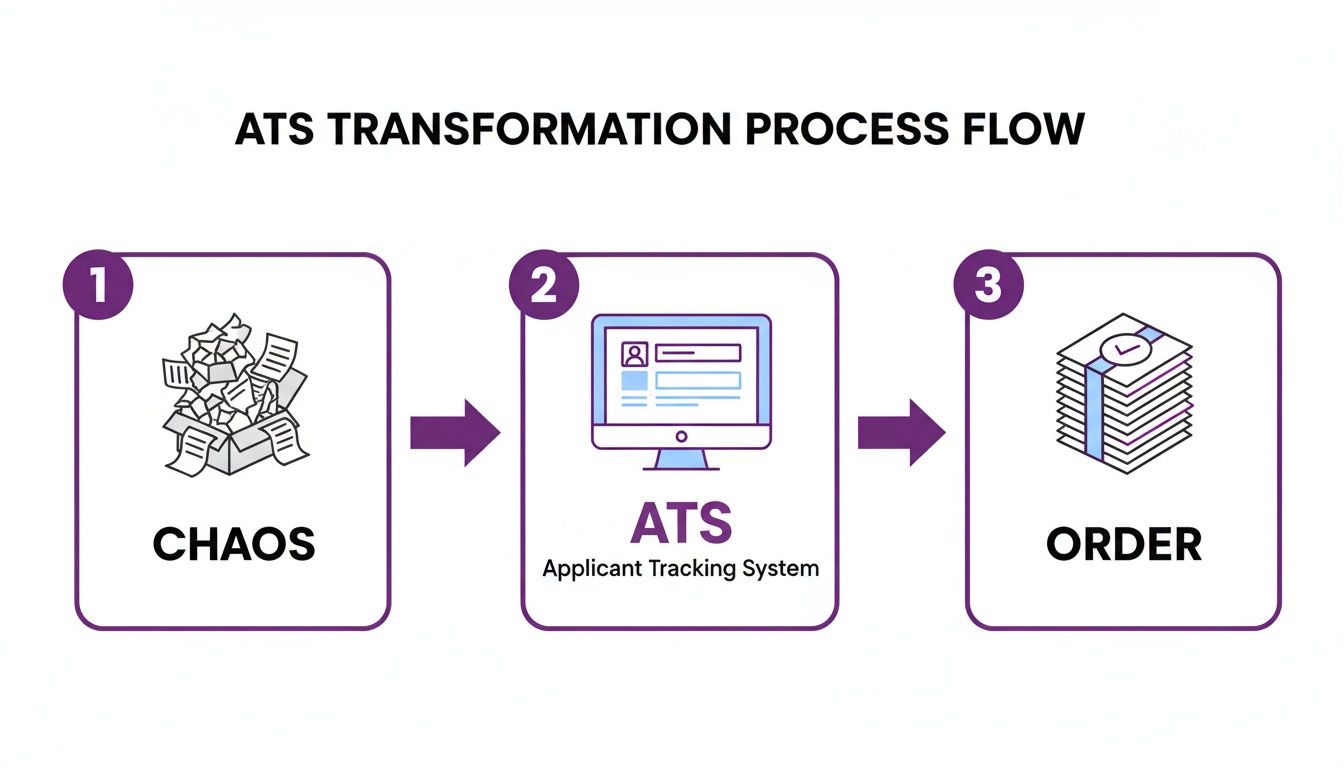
You can see how the system centralises everything, turning scattered documents into a single, manageable workflow.
Step 3: Automated Screening and Ranking
This is where you see the real power of an ATS in action. Instead of a recruiter having to manually read through hundreds of CVs just to find a handful of maybes, the system does the initial heavy lifting for you.
Using the keywords, skills, and experience levels you defined for the role, the ATS automatically scores and ranks every candidate. This instantly generates a shortlist of the most promising people, freeing up your hiring team to focus their time and energy where it truly counts: talking to top-tier talent. It's worth getting to grips with how this works, and learning about things like the ATS Filter 90 10 Rule can give you some great insight into the screening process.
By automating the first pass, an ATS doesn't replace recruiters; it empowers them. It takes on the high-volume, repetitive tasks, freeing them up to focus on building relationships with the best-qualified individuals.
Step 4: Communication and Workflow Management
From this point forward, the ATS is your central command centre for all candidate-related activity. Every single interaction is logged, which helps you deliver a professional and seamless experience from start to finish.
The system makes managing the next steps much easier:
- Automated Communication: You can set up instant acknowledgement emails, so applicants know their CV has been safely received and isn't lost in cyberspace.
- Interview Scheduling: Coordinating diaries between candidates and hiring managers can be done right inside the platform, often connecting directly with calendars like Outlook.
- Team Collaboration: Hiring managers can jump in to review profiles, leave notes, and share feedback in one place, which means an end to confusing, back-and-forth email chains.
This organised workflow ensures no candidate gets forgotten and everyone involved is kept in the loop. It turns what can be a hectic process into a well-oiled, efficient business function.
Essential ATS Features for UK Businesses
A modern Applicant Tracking System is much more than a digital filing cabinet. Think of it as the command centre for your entire recruitment operation. While many systems boast a dizzying list of functions, only a handful are truly essential for delivering real business value, especially for UK companies. These core features are what turn a simple database into a genuine strategic asset.
At its heart, any effective ATS gives you a centralised talent pool. Imagine every person who has ever applied to your company—whether they got the job or not—being instantly searchable. This is a game-changer. It means when a new role opens up, your first move isn't posting an expensive job ad; it's rediscovering great candidates who are already in your system and have shown interest in you.
This simple shift saves a huge amount of time and money, letting you re-engage with people who already know and like your organisation.
Customisable Workflows and Automation
Let’s be honest, no two companies hire in exactly the same way. That's why customisable workflows are a non-negotiable feature. A great ATS should bend to your unique hiring process, not force you into a rigid, one-size-fits-all box.
This means you can map out the specific stages of your recruitment journey, from the first application review right through to the final offer, and automate key actions at each step. This kind of control brings consistency and efficiency to hiring across the board.
Automation is really the engine that makes these workflows hum. A few automated features make all the difference:
- Automated Interview Scheduling: This puts an end to the frustrating email tennis of trying to coordinate diaries. By syncing directly with calendars like Microsoft Outlook, the system finds times that work for everyone and pings out the invitations automatically.
- Templated Communications: You can ensure every applicant gets a professional, timely response without lifting a finger. Automated acknowledgements, polite rejection emails, and interview reminders all help maintain a positive candidate experience.
- Job Ad Distribution: Post a vacancy once in the ATS, and it will push it out across multiple job boards, your social media channels, and your own careers page.
These features liberate your recruiters from tedious admin, giving them back the time to focus on what they do best: talking to people.
The Critical Role of Microsoft Integration
For businesses already running on the Microsoft ecosystem, the single most important feature is how well an ATS integrates with the tools your team uses every single day. This is where solutions built on the Microsoft Power Platform, like the HR Management solution from Hubdrive, have a massive advantage.
Instead of being another separate piece of software that operates in its own little world, a natively integrated ATS becomes a natural extension of your digital workplace.
An ATS that lives inside your Microsoft environment isn't just another tool to learn; it's an enhancement of the tools you already know. This deep integration unlocks a new level of productivity and collaboration that standalone systems simply cannot match.
Suddenly, your HR processes flow effortlessly through familiar applications. You can manage candidates within Microsoft Teams, schedule interviews directly from your Outlook calendar, and store documents securely in SharePoint. Crucially, all your recruitment data stays within your own Microsoft 365 tenant, giving you far greater security and control. For a guide on creating effective job adverts that feed into this system, you can learn more about how to write a job description in our detailed article.
This unified approach breaks down the walls between HR and the rest of the business, creating a single, cohesive environment. When your ATS is part of your core technology, it stops being just a recruitment tool and becomes a central pillar of your organisation's operational strength.
We are DynamicsHub.co.uk. Experience HR transformation built around your business. Hubdrive’s HR Management for Microsoft Dynamics 365 is the premier hire‑to‑retire solution—more powerful, more flexible, and more future‑ready than Microsoft Dynamics 365 HR.
To find out how these essential features can be tailored to your business, phone 01522 508096 today, or send us a message to begin your HR transformation.
The Real-World Benefits of Using an ATS
Let’s move past the feature lists. The true worth of an Applicant Tracking System is measured by the real, tangible impact it has on your business. Bringing an ATS on board isn’t just about making your hiring process feel a bit more organised; it’s a strategic move that delivers powerful, data-backed results. For HR Directors and business leaders, these benefits translate directly into a stronger, more competitive organisation.
Think of an ATS as an engine for efficiency. It takes on the most repetitive, time-consuming parts of hiring and automates them. This fundamentally changes where your recruitment team spends its time and energy.
Instead of getting bogged down by manual data entry, sifting through endless CVs, and juggling interview schedules, your team is free to focus on what really matters: engaging with top candidates and building strong relationships with hiring managers. This shift has a direct and measurable effect on one of the most critical recruitment metrics out there—time-to-hire. In a competitive market, speed is everything. An ATS lets you identify, interview, and secure the best people before your competitors even know they're available.
Accelerating Your Hiring Cycle
What’s the single biggest time drain for any recruitment team? The sheer volume of manual work needed to sift through applications. An ATS tackles this problem head-on by automating the initial screening, instantly bringing the most relevant candidates to the surface.
This means your team starts with a pre-vetted shortlist, not an intimidating pile of hundreds of CVs. This automation continues throughout the hiring journey, from sending instant acknowledgements to applicants to coordinating complex interview schedules. Not only does this speed everything up, but it also guarantees a consistent and professional experience for every candidate, which is vital for protecting your employer brand.
An Applicant Tracking System doesn't just make your existing process faster; it transforms it. It turns recruitment from a slow, reactive administrative task into a fast, proactive, and strategic business function.
Improving the Quality of Hires
Speed is important, but quality is everything. A faster hiring process is pointless if it doesn't result in better employees. This is where an ATS gives you another huge advantage. By using intelligent screening and keyword matching, it makes sure that no top-tier candidate is missed because of human error or simple oversight.
The system casts a wider, more consistent net, evaluating every single applicant against the core requirements of the role. This data-driven approach helps to remove unconscious bias and focuses purely on skills and experience, leading to a more diverse and qualified talent pool. Better screening leads to better shortlists, which ultimately leads to better hires—people who are more likely to thrive and stay with your company for the long term.
The numbers don't lie. Recent studies show that an effective ATS can slash the average hiring cycle by as much as 60%. But it's not just about speed. 79% of recruiters report that the quality of their new hires has increased after implementing an ATS. On top of that, organisations using these systems see 40% less turnover among new hires, showing a clear link between a better recruitment process and improved employee retention. You can dive deeper into these findings by exploring the full research on applicant tracking system statistics.
Driving Strategic Business Impact
At the end of the day, an ATS is far more than just an HR tool; it's a strategic investment with a powerful return. A faster hiring cycle means critical roles are filled sooner, reducing productivity gaps and preventing project delays. Higher-quality hires lead to a more skilled and stable workforce, which directly fuels innovation and business growth.
The data captured by the system also offers invaluable insights. You can analyse which job boards deliver the best candidates, pinpoint bottlenecks in your hiring process, and make informed decisions to continuously improve your talent strategy. This transforms recruitment from a cost centre into a real source of competitive advantage.
Solutions like Hubdrive’s HR Management for Microsoft Dynamics 365 amplify these benefits. By integrating directly into the Microsoft tools your team already uses every day, the system becomes a seamless part of your operation, driving efficiency not just in HR but across the entire organisation.
We are DynamicsHub.co.uk. Experience HR transformation built around your business. Hubdrive’s HR Management for Microsoft Dynamics 365 is the premier hire‑to‑retire solution—more powerful, more flexible, and more future‑ready than Microsoft Dynamics 365 HR.
To see how these benefits can apply to your business, phone 01522 508096 today, or send us a message to discuss your requirements.
How an ATS Helps You Navigate UK Compliance
If you're hiring in the UK, you know that recruitment isn't just about finding the right person. It’s also about navigating a minefield of regulations, from Right to Work checks to the General Data Protection Regulation (GDPR). Getting this wrong isn't just bad practice—it's a serious legal risk.
This is where a modern Applicant Tracking System really proves its worth. It stops being just a recruitment tool and becomes your compliance partner, embedding those crucial checks and balances directly into your hiring process. It takes the guesswork and human error out of the equation, protecting you from hefty fines and damage to your reputation.

Automating Right to Work Checks
Confirming a candidate’s legal right to work in the UK is a non-negotiable step. The consequences of getting it wrong can be severe penalties from the Home Office. An ATS introduces a level of discipline and security that manual processes just can't match.
The system can prompt for and then securely store required documents like passports and visas. This creates a clear, time-stamped, and easily accessible audit trail for every hire, which is exactly what you need for complete peace of mind. For a deeper dive into this, check out our guide on digital Right to Work checks.
By centralising this step in an ATS, you guarantee that:
- Every hire goes through the exact same process, leaving no room for missed steps.
- Sensitive documents are stored safely and can be retrieved instantly if you're ever audited.
- A clear record proves when and how each check was completed.
Mastering GDPR and Data Retention
Under GDPR, the responsibility for how you handle candidate data rests squarely on your shoulders. You can't just keep CVs and personal details forever. An ATS with robust data management capabilities is essential here.
The right technology transforms compliance from a source of anxiety into a background process. It allows you to focus on finding the best talent, confident that your legal obligations are being met automatically and securely.
A GDPR-aware ATS will have features for managing candidate consent built-in. Critically, it will also enforce automated data retention policies. This means you can set rules to ensure you don't keep personal data longer than legally allowed. Once the time is up, the system can automatically anonymise or delete those records, reducing your risk without anyone having to lift a finger.
Solutions like Hubdrive’s HR Management for Microsoft Dynamics 365 take this a step further. All your sensitive candidate and compliance data stays within your own Microsoft 365 tenant, not on some third-party server you have no control over. This gives you total command and leverages the enterprise-grade security you already know and trust.
We are DynamicsHub.co.uk. Experience HR transformation built around your business. Hubdrive’s HR Management for Microsoft Dynamics 365 is the premier hire‑to‑retire solution—more powerful, more flexible, and more future‑ready than Microsoft Dynamics 365 HR.
To learn how an integrated ATS can secure your compliance processes, phone 01522 508096 today, or send us a message.
How to Choose the Right ATS for Your Business
Picking an Applicant Tracking System is one of those pivotal business decisions that will echo through your recruitment strategy for years. For UK companies with anywhere from 50 to 4,000 employees, the choice isn't just about ticking off features on a list. It’s about finding a genuine partner and a platform that can actually scale with you.
The market for these systems is absolutely booming. In 2023, the UK Applicant Tracking System market was valued at around £280 million. By 2029, it's projected to climb past £460 million. That’s not just noise; it’s a clear signal that this technology is now table stakes for any company serious about attracting top talent. Procrastinating on this means you're already falling behind the competition. You can dive deeper into these trends in this comprehensive report on the UK ATS market.
Look Beyond the Feature List
It's incredibly easy to get dazzled by flashy features and long comparison tables. But here’s the reality: the most important factors are often the most fundamental. What good is a slick user interface if your hiring managers find it clunky and refuse to log in? A powerful analytics engine is useless if the support team is in a different time zone and you can't get help when you desperately need it.
When you're evaluating your options, you need to zero in on these core pillars:
- Scalability: Will this system grow with you? A platform that’s perfect for 100 employees needs to be just as effective when you hit 1,000.
- User Experience: Is it genuinely intuitive for everyone involved, from seasoned recruiters to casual hiring managers? Adoption rates live and die by how easy a system is to use.
- UK-Based Support: Can you speak to an expert who understands UK compliance and business hours? This is non-negotiable.
The Power of Native Integration
For any business already invested in the Microsoft ecosystem, one consideration should trump almost all others: integration. Opting for an ATS built natively on a platform like Microsoft Dataverse is the secret to creating a truly connected workplace. Standalone systems inevitably create data silos, forcing your team to waste time toggling between different applications.
A natively integrated ATS isn't just another piece of software; it's an extension of the tools your team already relies on. It ensures your HR processes flow seamlessly within your existing Microsoft environment, making it a future-ready investment.
With a solution like Hubdrive’s HR Management for Microsoft Dynamics 365, all your recruitment activity takes place inside the applications you use every single day—Outlook, Teams, and SharePoint. This creates a single, secure source of truth, with all your sensitive candidate data residing safely within your own Microsoft 365 tenant. For more guidance on evaluating different options, check out our guide on the best applicant tracking systems in the UK.
Finding a Strategic Implementation Partner
Finally, remember that you’re not just buying a piece of software; you're investing in a new way of working. The right implementation partner is just as critical as the technology itself.
Working with a UK-based specialist like DynamicsHub ensures the system is moulded to your specific business processes, not the other way around. We take the time to understand your goals, configure the platform to your precise needs, and provide the ongoing support to guarantee your investment delivers real, long-term value.
We are DynamicsHub.co.uk. Experience HR transformation built around your business. Hubdrive’s HR Management for Microsoft Dynamics 365 is the premier hire‑to‑retire solution—more powerful, more flexible, and more future‑ready than Microsoft Dynamics 365 HR.
Phone 01522 508096 today, or send us a message to discuss how to choose the right ATS for your organisation.
Ready to Transform Your Hiring?
An Applicant Tracking System isn't just another piece of admin software—it’s the engine that drives modern, strategic recruitment. For any UK business, especially one already invested in the Microsoft ecosystem, the right ATS can unlock incredible efficiency and give you a crystal-clear view of your entire hiring pipeline. It's time to stop letting clunky spreadsheets and manual processes prevent you from building the best team possible.
Taking that next step means you can finally optimise your recruitment process, give candidates an experience they'll remember for the right reasons, and snap up top talent before your competitors even get a look-in. This is your chance to shift from just filling empty seats to building a proactive, data-led talent acquisition strategy that genuinely fuels your company's growth.
We are DynamicsHub.co.uk. We help businesses like yours transform their HR operations. Hubdrive’s HR Management for Microsoft Dynamics 365 is the complete hire-to-retire solution, offering more power, flexibility, and future-proofing than the standard Microsoft Dynamics 365 HR module.
To find out how we can configure this solution for your organisation, give us a call on 01522 508096 today, or send us a message to start the conversation.
Your Questions Answered
How much should we budget for an Applicant Tracking System in the UK?
That’s a classic "how long is a piece of string?" question. The cost of an ATS in the UK really depends on what you need—the features you choose, how big your company is, and how many of your team will be using it.
For a smaller business, you could be looking at a simple monthly subscription starting from around £40-£80. As you grow into the mid-market, you'll likely see prices in the £80-£400 per month range. The real game-changer, though, is when you choose a solution built on a platform you already use, like Microsoft Dynamics 365. This approach delivers fantastic value by building on your existing tech investment. The best way to get a firm figure is to have a chat about your specific requirements.
Won't an ATS make our hiring process feel cold and impersonal?
It's a common concern, but a well-implemented ATS actually has the opposite effect. Think of it as your recruitment team's super-powered assistant. It handles the repetitive, administrative tasks—sending out application acknowledgements, keeping candidates in the loop with status updates, and making sure nobody gets forgotten in a busy inbox.
This isn't about replacing human interaction; it's about enhancing it. By automating the low-level communication, your recruiters are freed up to spend their valuable time on what truly matters: building relationships and having meaningful conversations with your top candidates.
How long will it take to get an ATS up and running?
This isn't a months-long, disruptive IT project anymore. The timeline really hinges on the complexity of your needs, but modern systems have come a long way.
Platform-based solutions, like Hubdrive's HR Management, are designed for much faster deployment than old-school, standalone software. When you work with a specialist implementation partner like DynamicsHub, the whole process is guided and smooth. We're often talking a matter of weeks from start to finish, not the months you might expect.
At DynamicsHub, we’re focused on helping you transform your HR processes with technology that works for you. Hubdrive’s HR Management for Microsoft Dynamics 365 is the complete hire-to-retire solution—giving you more power, more flexibility, and a more future-ready platform than Microsoft’s own Dynamics 365 HR.
Ready to see how it works? Give us a call on 01522 508096 today, or send us a message to start the conversation.