

In the modern business world, we hear a lot about data. But what does human resources analytics actually mean? Simply put, it’s about collecting and making sense of your people data to drive better business outcomes. It’s the shift that turns HR from an administrative department into a genuine strategic partner in the business.
This isn’t about replacing human intuition; it’s about backing it up with hard evidence. It allows leaders to stop guessing and start making informed decisions about their most valuable asset: their people.
Moving Beyond Gut Instinct with Human Resources Analytics
For too long, crucial decisions about people—who to hire, who to promote, how to keep our best talent—have been based on little more than experience and a “gut feeling”. While that experience is undeniably valuable, it’s only half the picture.
Think of it this way: would you ever manage your company’s finances without a detailed profit and loss statement, relying only on a vague sense of cash flow? Of course not. It would be unthinkable. Yet, that’s precisely how many organisations have been running their HR functions for years. Human resources analytics is what gives you that detailed, evidence-based dashboard for your workforce.

This change—from simply reporting numbers to generating predictive insights—isn’t just a fleeting trend. It’s a fundamental shift in how successful businesses operate. Instead of just looking back at last quarter’s employee turnover, analytics helps you understand why it happened and, crucially, what might happen next.
The Evolution from Reporting to Strategic Insight
There’s a big difference between traditional HR reporting and true analytics. Reporting tells you what happened. Analytics digs deeper to explain why it happened and helps you model what if scenarios, letting you get ahead of problems before they even start.
Let’s look at a practical example:
- Reporting (The Past): “Our employee turnover was 15% last year.”
- Analytics (The Present & Future): “Our data shows that high-performers in the sales team are leaving after 18 months because they don’t see a clear path for career progression. We can predict a 20% flight risk in that team over the next six months if we don’t intervene.”
This deeper level of analysis is gaining serious momentum here in the UK. The UK HR analytics market was valued at around £165.7 million in 2022 and is set to grow significantly, fuelled by the pressing need to get talent retention and workforce planning right. If you want to dig into the numbers, you can explore the market trends to see just how vital these analytical tools in business are becoming.
Creating a Single Source of Truth
To truly move beyond gut feeling, you need to build a culture of data-driven decision making. And the cornerstone of that is having reliable, unified data. When your recruitment platform, payroll system, and performance reviews are all disconnected, you’re left with data silos that make it impossible to see the full picture.
We are DynamicsHub.co.uk we provide Transformative HR solutions customised to your unique workflows, Human Resource ( HR ) Management for Dynamics 365 is the leading hire to retire solution for the Microsoft Platform.
By bringing all your HR functions together into a single system, like Microsoft Dynamics 365, you get a complete, 360-degree view of the entire employee lifecycle. This is what finally moves you beyond guesswork, giving you the confidence to make strategic decisions that count.
Ready to start your journey toward data-driven HR? Phone 01522 508096 today or send us a message at https://www.dynamicshub.co.uk/contact/.
The Strategic Gains of Adopting HR Analytics
Moving beyond gut feelings and into data-driven decisions unlocks some serious advantages that can be felt right across the business. This isn’t just about churning out more reports. It’s about answering the big, tough questions with hard evidence, leading to smarter investments, smoother operations, and a happier, more committed workforce. Ultimately, these gains add up to a healthier bottom line and a more resilient organisation.
The real magic happens when you can draw a straight line from your people strategy to actual business outcomes. When you truly understand what drives the numbers, you can make focused changes that deliver real, measurable returns. For UK businesses wrestling with skills shortages and a fierce hiring market, these insights aren’t just a nice-to-have; they’re essential for survival and growth.
Proactively Boost Employee Retention
One of the quickest and most powerful wins from HR analytics is getting a grip on employee retention. A revolving door of staff is incredibly expensive, not just in recruitment fees but in lost knowledge, productivity, and the knock-on effect on team morale. Analytics lets you get ahead of the problem instead of just reacting to it.
By spotting patterns in the data—things like length of service, performance review scores, absence rates, or time since the last promotion—you can identify employees who are a high flight risk long before they’ve updated their CV. This gives you a critical window to step in, whether that’s a conversation about their career path, a change in responsibilities, or simply some well-deserved recognition.
Imagine a UK tech firm that kept losing its best developers after the two-year mark. By digging into the data, they discovered the problem wasn’t pay, but a lack of challenging new projects. They overhauled how they allocated work, and voluntary turnover dropped significantly, saving them a fortune in rehiring costs.
Optimise Recruitment and Hiring Quality
How can you be sure your recruitment budget is money well spent? HR analytics gives you the clarity you need by pinpointing which hiring channels bring in the best people for the long haul.
You can follow the journey of a candidate from their first application to their performance reviews, answering questions like:
- Which job boards consistently give us candidates who fly through probation and become top performers?
- Does our employee referral scheme actually lead to better retention?
- What’s our true cost per hire when we factor in the time our managers spend interviewing?
A UK retailer used its data to find that while a big-name job site brought in the most applications, the candidates sourced through a niche industry network stayed with the company 50% longer and had better performance ratings. They shifted their advertising budget accordingly, immediately improving the quality of their new hires and cutting first-year turnover.
Enhance Performance and Productivity
Analytics arms managers with the objective insights they need to have far more meaningful performance conversations. When you can see performance data alongside training records and engagement scores, it becomes much easier to spot coaching opportunities and get to the root cause of underperformance.
By connecting people data to measurable business results, organisations can make informed decisions that lower costs and improve employee outcomes. Top-performing organisations are often five times more effective at turning these HR insights into meaningful action.
This data-driven approach helps strip bias out of performance management and ensures that training budgets are spent where they’ll make the biggest difference. For instance, a logistics company might discover that teams led by managers who took a specific leadership course consistently smash their delivery targets. That’s a clear-cut business case for rolling out that training to more people.
Streamline Compliance and Reporting
For any UK business, compliance is simply not optional. We’re talking about everything from meeting Diversity, Equity, and Inclusion (DEI) reporting goals to staying on the right side of GDPR and Right-to-Work legislation. Trying to do all this manually is a recipe for headaches and errors.
Human resources analytics automates a huge chunk of this process. It gives you accurate, real-time dashboards that keep an eye on all the key compliance metrics. This doesn’t just free up administrative time; it gives the leadership team the confidence that the organisation is meeting its legal and ethical duties, massively reducing risk.
The HR Metrics That Actually Matter to Your Business
To get real value from HR analytics, you need to get specific. It’s about moving past the buzzwords and focusing on the numbers that tell you the real story of what’s happening with your people. Knowing what to measure is the first, most critical step.
These aren’t just abstract numbers for big corporations; they are vital for UK mid-market businesses trying to manage costs, keep staff happy, and stay ahead of the competition. Think of them as the vital signs for your organisation’s health. We can break down the most important Key Performance Indicators (KPIs) into three areas that follow the employee journey: Recruitment, Engagement & Retention, and Performance.
Recruitment Metrics
Hiring well is about so much more than filling a vacancy. It’s about finding the right person, efficiently and without breaking the bank. These metrics shine a light on how well your talent acquisition process is really working.
- Cost per Hire: This is your bottom-line recruitment figure. It tells you exactly what you’re spending, on average, to get a new person on board. If this number starts creeping up, it might be a sign you’re relying too heavily on expensive agencies or your process is becoming inefficient.
- Time to Hire: How many days does it take from posting a job ad to getting a signed contract? That’s your Time to Hire. A long delay can mean your top candidates get snapped up by competitors, leaving crucial roles empty and putting a strain on the rest of the team.
- Quality of Hire: This one is a bit trickier to measure, but it’s arguably the most important. It’s about how much value a new employee brings. You can get a good sense of this by looking at their first-year performance reviews, how quickly they get up to speed, and whether they are still with you 12 months later.
Engagement and Retention Metrics
You’ve hired brilliant people. Great. Now, how do you keep them? Losing good staff is a massive drain on company cash, morale, and knowledge.
It’s often said that replacing an employee can cost anywhere from six to nine months of their salary. For someone on a £40,000 salary, that’s a potential hit of £20,000 to £30,000 once you factor in recruitment fees, training, and lost productivity.
Keeping an eye on these KPIs can give you an early warning when things are going wrong:
- Employee Turnover Rate: This is the percentage of people leaving your business over a set period. The real insight comes when you dig deeper. Is turnover sky-high in one department? Are new starters leaving within their first year? Is one manager’s team a revolving door?
- Absence Rate: This tracks unplanned absences. A sudden spike can be a red flag for low morale, burnout, or widespread disengagement. Spotting these trends early means you can step in before a small problem becomes a major one.
- Employee Net Promoter Score (eNPS): A brilliantly simple way to gauge loyalty. It boils down to one question: “On a scale of 0-10, how likely are you to recommend our company as a place to work?” It gives you a quick, honest pulse check of how your people are feeling.
Performance and Productivity Metrics
Finally, you need to connect your people’s efforts to the company’s success. These metrics help you see how your teams are contributing to the bottom line.
- Performance vs Potential (9-Box Grid): A classic for a reason. This tool helps you map out your talent by plotting employees based on their current performance and future potential. It immediately shows you who your rising stars are, who your solid performers are, and who might need a bit more support or a different role.
- Revenue per Employee: This is a big-picture metric that shows how productive your workforce is as a whole. You simply divide the company’s total revenue by the number of employees. It’s a great way to track efficiency over time. Remember to account for part-time staff properly; for a closer look, see our guide on how to calculate Full-Time Equivalent (FTE).
- Training Effectiveness: Are your training budgets actually making a difference? This metric helps you find out. Are sales teams who took the new course closing more deals? Do managers who went on leadership training have happier, more stable teams? This is about making sure your investment in people delivers a real return.
Here’s a quick summary of some of the most powerful KPIs for UK businesses, broken down by category.
Key HR Analytics KPIs for UK Businesses
| Category | KPI (Key Performance Indicator) | How to Calculate It | Strategic Insight Provided |
|---|---|---|---|
| Recruitment | Cost per Hire | (Total Recruiting Costs / Total Hires) | Measures the financial efficiency of your talent acquisition process. |
| Time to Hire | (Date of Offer Acceptance – Date of Job Opening) | Highlights the speed and agility of your hiring pipeline. | |
| Quality of Hire | (Performance Score + Retention Rate + Productivity Metrics) / 3 | Assesses the long-term value a new hire brings to the business. | |
| Engagement & Retention | Employee Turnover Rate | (Leavers / Average Employee Count) x 100 | Indicates workforce stability and potential underlying issues with culture or management. |
| Absence Rate | (Days of Absence / Total Workdays) x 100 | Acts as a proxy for employee well-being, engagement, and potential burnout. | |
| eNPS | (% Promoters – % Detractors) | Provides a quick snapshot of employee loyalty and overall satisfaction. | |
| Performance & Productivity | Revenue per Employee | (Total Revenue / Total Number of Employees) | A high-level indicator of overall organisational productivity and efficiency. |
| Training Effectiveness | Post-training performance uplift vs. pre-training baseline | Determines the ROI of your learning and development investments. |
Tracking these metrics isn’t about creating more spreadsheets; it’s about gaining a clearer, data-backed understanding of your most valuable asset: your people. This is the foundation for making smarter, more strategic HR decisions.
Your Step-by-Step Roadmap to Implementing HR Analytics
Jumping into human resources analytics can feel like a massive undertaking, but it doesn’t have to be. By breaking the process down into a clear, manageable roadmap, UK businesses can build a powerful capability that delivers genuine value. The secret is to avoid trying to boil the ocean; instead, focus on taking deliberate, strategic steps.
The whole journey starts not with technology, but with a simple, powerful question: why? Getting to the heart of your core business objectives is the essential first move that gives your entire analytics programme purpose and direction.
Start with Your Business Objectives
Before you even glance at a spreadsheet or a dashboard, you have to define what you’re actually trying to achieve. Are you wrestling with high staff turnover in a critical department? Is your time-to-hire metric letting top candidates slip through your fingers? Are you worried about a looming skills gap in your workforce?
Pinpointing a specific, high-impact problem gives you a clear focus. This approach ensures you deliver tangible value quickly, which is absolutely crucial for building momentum and getting buy-in from senior leadership for a more ambitious, long-term programme.
A successful HR analytics initiative is built on solving real business problems, not just collecting data for the sake of it. Start small, prove the value, and then expand your efforts.
Once you have your “why,” you can then move on to the “what” and the “how.” This means figuring out what data you’ll need and ensuring you have the right foundations in place to use it responsibly and effectively.
Identify Data Sources and Ensure Governance
Chances are, your people data is scattered across several different systems—your HR Information System (HRIS), payroll software, recruitment platform, and maybe even a few performance review spreadsheets. The goal is to bring these separate sources together to create a single, unified view of the entire employee lifecycle.
This is also where data governance becomes non-negotiable, especially for UK businesses operating under strict regulations. You must establish clear rules for:
- Data Quality: Making sure the information you’re using is accurate, complete, and consistent.
- Data Access: Defining who can see what data to protect sensitive employee information.
- Data Security: Implementing robust measures to safeguard your data against breaches.
As you map out your implementation, think about how to keep your HR analytics compliant with data protection regulations. Consulting a practical AI GDPR compliance guide can offer some valuable direction here. Proper governance isn’t just a box-ticking exercise; it builds trust and guarantees the integrity of your insights.
The diagram below shows the key stages where HR metrics provide critical insights across the employee journey.
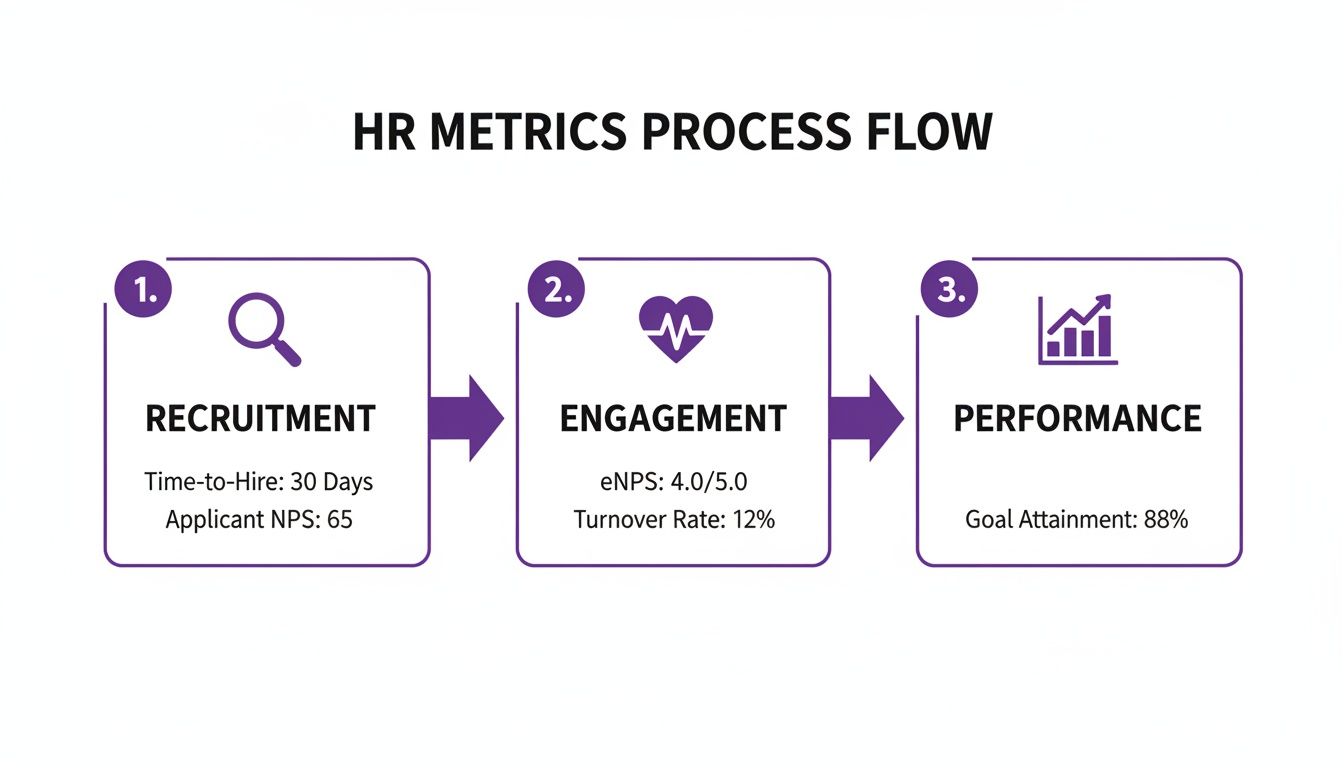
This process flow highlights how data from recruitment, engagement, and performance can be analysed to tell a complete story about your workforce.
Select the Right Technology
With your objectives defined and your data governance framework in place, you can finally choose the technology that will bring your vision to life. The ideal solution shouldn’t just collect and store data; it needs to make it easy to analyse and visualise. This is where tools like the Microsoft Power Platform really come into their own.
For example, Microsoft Dataverse can act as the central, secure hub for all your people data, creating that all-important single source of truth. From there, a tool like Power BI connects to this data, transforming raw numbers into interactive dashboards and compelling visual reports. If you’re new to these tools, you can learn more about Microsoft Power Platform and see how it can empower your HR team.
The shift towards data-driven HR solutions is clear. The UK HR Provision industry is on track to reach a market size of £1.6 billion in 2025. What’s more, the number of businesses in this sector has surged at a compound annual growth rate of 6.9% between 2020 and 2025, showing a definite trend towards specialised, data-focused HR services.
Build and Iterate Your Analytics Capability
Finally, remember that implementation isn’t a one-time project. It’s an ongoing process of building and refining your capabilities. Start with your initial pilot project—that high-impact problem you identified right at the beginning.
- Gather the Data: Collect the relevant datasets needed to analyse the problem.
- Analyse and Visualise: Use your chosen tools (like Power BI) to find patterns and create initial dashboards.
- Share Insights: Present your findings to stakeholders, telling a clear story with the data.
- Take Action: Use the insights to make a specific, measurable change in the business.
- Measure Impact: Track the results of your action to demonstrate the return on investment.
By following this iterative cycle, you create a loop of continuous improvement. Each success builds more confidence and proves the strategic value of human resources analytics, paving the way for a more data-driven culture across your entire organisation.
Powering Your People Strategy with Dynamics 365
It’s one thing to talk about theory and metrics, but the real magic of human resources analytics happens when you have the right technology to pull it all together. A unified system becomes the engine of your people strategy, turning what was once a mess of scattered data points into a clear, actionable picture of your entire workforce.
We are DynamicsHub.co.uk and we provide Transformative HR solutions customised to your unique workflows. Human Resource ( HR ) Management for Dynamics 365 is the leading hire to retire solution for the Microsoft Platform. Think of it as the central, secure hub for all your people data, finally breaking down the departmental silos that stop you from seeing the complete story.
Creating Your Single Source of Truth
To make confident decisions based on data, you need one thing above all else: a single, reliable source of truth. It’s a common problem. Your recruitment data is in one system, payroll is in another, and performance reviews are buried in spreadsheets. You’re left trying to piece together a puzzle with contradictory and incomplete pieces.
This is exactly the problem Microsoft Dataverse was built to solve. It securely connects every single stage of the employee lifecycle—from the moment someone applies to their very last day—within one cohesive platform. This creates an unshakeable data foundation where every bit of information is consistent, up-to-date, and accessible.

For a deep dive into how this platform can work for your business, take a look at our guide on Dynamics 365 for HR.
With a single source of truth in place, you can finally start asking the bigger, more strategic questions and actually trust the answers. You can track a new starter’s journey from the recruitment source that found them all the way through to their first-year performance, drawing a direct line between hiring quality and business outcomes.
Bringing Your Data to Life with Power BI
Getting all your data into one place is a huge first step. The next is to turn that raw data into meaningful insights that your managers and leaders can understand and act on in an instant. This is where a powerful visualisation tool like Microsoft Power BI steps in.
Power BI plugs directly into your data in Dataverse and transforms complex numbers into interactive, easy-to-digest dashboards. Suddenly, all those critical KPIs we’ve discussed—from Cost per Hire and Employee Turnover Rate to Absence Rate and training effectiveness—are no longer hidden away in static reports. They’re brought to life in real-time, visual formats.
With this level of clarity, your managers can spot emerging trends, identify potential risks, and uncover hidden opportunities with just a few clicks.
With a well-designed dashboard, a manager can instantly see if a department has a rising absenteeism problem or if a particular team is struggling with engagement. This empowers them to intervene proactively, long before the issue escalates.
But this isn’t just about looking backwards at historical data; it’s about dynamic, forward-looking analysis. You can drill down into the specifics, filter by department, location, or job role, and even ask “what if” questions to model different scenarios.
This is the capability that shifts HR from being a reactive, administrative function to a proactive, strategic partner. It equips your team with the tools to genuinely guide the business toward its goals. By combining Dynamics 365 with Power BI, you create a complete ecosystem for data-driven HR that is both incredibly powerful and genuinely accessible for your entire leadership team.
What’s Your First Move in Data-Driven HR?
So, where do you go from here? We’ve covered a lot, from the basics of human resources analytics to the practical steps for getting started. It might seem like a huge mountain to climb, but the journey doesn’t start with a massive, company-wide overhaul. It begins with a single, well-chosen question.
Think about the one nagging problem that keeps you up at night. Is it the constant churn in your sales team? Maybe you’re pouring money into recruitment channels without knowing which ones actually bring in people who stick around and perform well. Pick one of these questions. Answering it with data is the quickest way to show everyone the value of this approach and get them excited for more.
Making smarter, faster decisions about your people isn’t a vague aspiration. It’s about turning the complex data you already have into clear, actionable intelligence that directly impacts your bottom line.
This is where the right tools make all the difference. We are DynamicsHub.co.uk and we provide Transformative HR solutions customised to your unique workflows. Our Human Resource (HR) Management for Dynamics 365 is the leading hire to retire solution for the Microsoft Platform, built to give you that much-needed clarity. It brings all your people data together into one place, creating a single source of truth that you can finally rely on for proper analysis.
If you’re ready to stop guessing and start making strategic moves based on solid evidence, let’s talk.
Phone 01522 508096 today or send us a message.
Your HR Analytics Questions, Answered
Taking the first step into data-driven HR always sparks a few practical questions. What’s the real cost? Do we need to bring in a data specialist? And most importantly, how do we handle sensitive employee data safely? Let’s tackle some of the most common queries we hear from UK businesses thinking about HR analytics.
The aim here is to give you clear, straightforward answers so you can understand the practical side of things and move ahead with confidence.
What’s the Real Cost of HR Analytics Software?
There’s no one-size-fits-all price, as the cost really hinges on your company’s unique situation. The main things that will shape the price are your employee headcount, how complex your needs are, and the amount of customisation you’re looking for.
For most mid-sized UK businesses, you’ll find that software-as-a-service (SaaS) solutions typically use a per-employee, per-month pricing model.
- Smaller Businesses (50-150 employees): You can generally expect to budget between £5 to £15 per employee each month.
- Mid-Sized Organisations (150-500 employees): The cost often sits in the £4 to £12 per employee per month range, and you’ll usually see better per-head rates as your team grows.
Of course, if you’re looking at a larger project that needs a lot of custom work or has to connect with several older systems, there will be a bigger upfront investment for the initial setup. It’s helpful to see this less as a cost and more as an investment in making your business more efficient and strategically sharp.
Do I Need to Hire a Data Scientist?
This is a big one, and it holds a lot of businesses back. The short answer is: no, not usually. Modern analytics platforms, particularly tools like Microsoft Power BI, are built to be intuitive. They’re designed to empower your current HR team, turning them into capable “citizen data analysts.”
The magic really happens when you combine deep HR knowledge with user-friendly data tools. Your HR professionals already have the context behind the numbers; the right software just gives them a way to see, explore, and explain that data.
While a dedicated data scientist is fantastic for very advanced predictive work, your HR team can deliver incredible value right away. They can start by focusing on what happened and why, using simple drag-and-drop tools to get powerful insights.
How Can We Keep Employee Data Secure and GDPR Compliant?
Security and compliance are non-negotiable, especially when you’re dealing with personal employee information. This is precisely why picking a platform with a rock-solid foundation, like the Microsoft ecosystem, is so important.
When you use a solution like Human Resource Management for Dynamics 365, which is built on Microsoft Dataverse, all your data stays within your own secure Microsoft 365 environment. This gives you security on multiple fronts:
- Robust Security: Your data is protected by Microsoft Entra ID (what used to be Azure Active Directory), so you have granular control over who sees what. Only the right people get access.
- Built for GDPR: The platform comes with features that help you manage data retention rules and respond to subject access requests, making it far simpler to stay on top of your GDPR duties.
- Centralised Governance: By creating one single source of truth for your HR data, you get rid of the huge risks that come from having sensitive information spread across countless unsecured spreadsheets and siloed systems.
With this kind of integrated approach, security isn’t just an add-on; it’s baked into the very core of your HR analytics strategy.
We are DynamicsHub.co.uk and we provide Transformative HR solutions customised to your unique workflows. Human Resource ( HR ) Management for Dynamics 365 is the leading hire to retire solution for the Microsoft Platform.
Ready to unlock the power of your people data? Phone 01522 508096 today or send us a message.


