

A good employment handbook template isn't just another document; it’s the cornerstone of your company's policies, procedures, and the very culture you want to build. Think of it as the go-to guide for every employee, making sure everyone is treated fairly and consistently across the business. For any UK organisation, starting with a solid template is the first real step towards minimising legal headaches and fostering a truly transparent workplace.
Why Your UK Business Needs an Employment Handbook
Let's be clear: an employment handbook is so much more than a box-ticking exercise. It's the operational blueprint for your company culture and, frankly, a critical line of defence if legal issues arise. Trying to run a UK business without one is like setting sail without a map—you're leaving far too much to chance, paving the way for misunderstandings, patchy management, and expensive disputes down the line.

It’s the foundational agreement that gets your entire team aligned. Vague expectations become clear, actionable policies, so every single person, from a new starter to a senior manager, is on the same page from their first day. This clarity is invaluable, especially during those crucial first few weeks. A well-written handbook is a central part of any strong onboarding process, helping to set the right tone from the get-go. To really nail this initial phase, check out our guide on creating an effective onboarding checklist for new employees.
Establishing Consistency and Fairness
One of the biggest wins from having a staff handbook is its power to ensure everyone is treated fairly and consistently. When the process for everything—from booking holiday to raising a grievance—is clearly written down, it eliminates the guesswork and cuts down on the risk of managers making biased or ad-hoc decisions.
This consistency is crucial for several reasons:
- Managerial Guidance: It gives your managers a clear playbook for handling common workplace scenarios, ensuring their actions are always in line with company policy and UK employment law.
- Employee Confidence: People feel more secure when they know the rules apply equally to everyone. This builds trust and has a massive positive impact on morale.
- Operational Efficiency: Clear policies simply make day-to-day HR tasks run smoother, saving precious time for both your people and your administrative teams.
A well-implemented employment handbook acts as a central source of truth. It empowers employees by clarifying their rights and responsibilities, while simultaneously protecting the organisation by demonstrating a commitment to fair and lawful processes.
A Dynamic Tool for Modern HR
Ultimately, you shouldn't see the handbook as a dusty document that just sits on a shelf. It's a living, breathing tool for navigating the complexities of UK employment. When you integrate it into a modern HR system, such as the Human Resource HR Management for Microsoft Dynamics 365 solution from Hubdrive, it becomes a dynamic part of your company's ecosystem. This approach makes it far easier to update policies, track who has read and acknowledged them, and ensure compliance is an active, ongoing process—not just a chore you tackle once a year.
Building Your Handbook's Legal Foundation
Now that you understand why you need an employment handbook, it's time to get into the nuts and bolts of building it. This isn't about adding fluffy, nice-to-have policies. It's about laying a rock-solid legal foundation with the absolute essentials that protect your business and give your team much-needed clarity.
Think of these core policies as the steel frame of your handbook. Without them, the whole structure could easily crumble under the first sign of legal pressure.

These foundational policies are your first line of defence if a dispute arises. They prove you're committed to fair, lawful, and documented processes – something that’s invaluable if you ever face a tribunal claim. Each one has a specific job to do, from managing workplace conduct to keeping everyone safe.
Disciplinary and Grievance Procedures
Right at the heart of your legal foundation, you'll find your disciplinary and grievance procedures. Let's be clear: these are not optional. They're a fundamental requirement laid out in the ACAS Code of Practice, and they provide a transparent, fair, and consistent way to handle misconduct and resolve disputes.
Your disciplinary procedure needs to spell out the steps you'll take to address performance issues or rule-breaking, from an informal chat all the way to formal dismissal. On the flip side, the grievance procedure must give employees a clear path to raise concerns, making sure they feel heard and that their issues are dealt with seriously and quickly. Getting this wrong can be incredibly expensive.
Following the ACAS Code of Practice isn't just good advice—it has real financial consequences. If you end up at a tribunal, they can increase or decrease an award by up to 25% based on whether you followed the code. This makes a well-drafted handbook an essential risk management tool.
Health, Safety and Wellbeing
Every single employer in the UK has a legal duty to protect the health, safety, and welfare of their people. Your handbook needs a robust policy that shows you take this duty of care seriously. This section needs to be more than a vague promise; it has to outline practical, real-world measures.
Make sure you cover the essentials:
- Risk Assessment Procedures: How you spot and manage hazards in the workplace.
- Emergency Protocols: Simple, clear instructions for fires, first aid, or other emergencies.
- Employee Responsibilities: What you expect from each person to help maintain a safe environment.
- Reporting Mechanisms: A straightforward way for people to report accidents or safety concerns without any fear of comeback.
This policy isn't just about ticking a box for the Health and Safety at Work etc. Act 1974. It’s about showing your team you genuinely care about their wellbeing.
Equality, Diversity and Inclusion
A strong Equality, Diversity, and Inclusion (EDI) policy is another non-negotiable. This policy does more than just say you're against discrimination; it actively promotes a culture of respect and equal opportunity, which is a legal requirement under the Equality Act 2010.
It should state, in no uncertain terms, that the company has zero tolerance for harassment or discrimination based on any of the protected characteristics (like age, disability, race, religion, sex, or sexual orientation). Just as importantly, it needs to detail how someone can report an incident and your commitment to investigating every claim thoroughly and impartially.
Managing Absence and Leave
Finally, you need clear and fair rules around absence to keep things running smoothly. This part of your employment handbook template should cover the two big areas: sickness absence and holiday entitlement.
The sickness absence policy must detail the reporting procedure (who to call and by when), when a fit note is required, and any information on sick pay. For holidays, the policy needs to be crystal clear on the annual leave entitlement, how to book time off, and any rules about carrying over leave or blackout periods during busy spells. Getting this all down in writing prevents misunderstandings and ensures everyone is managed consistently.
To help you get started, here’s a quick-glance table of the policies we’ve just covered. Think of this as your minimum-requirements checklist for a legally sound UK handbook.
Table: Essential Policies for Your UK Employment Handbook
| Policy Area | What It Achieves | Legal Importance |
|---|---|---|
| Disciplinary Procedures | Sets out a fair process for addressing employee misconduct or poor performance. | Mandatory. Required by the ACAS Code of Practice to ensure fair treatment and avoid unfair dismissal claims. |
| Grievance Procedures | Provides a formal channel for employees to raise and resolve workplace complaints. | Mandatory. Also required by the ACAS Code of Practice. A key part of fair dispute resolution. |
| Health & Safety | Outlines the company's commitment and procedures for ensuring a safe working environment. | Mandatory. A legal duty under the Health and Safety at Work etc. Act 1974. |
| Equality & Diversity | Promotes equal opportunities and prohibits discrimination, harassment, and victimisation. | Mandatory. Required to comply with the Equality Act 2010. |
| Sickness Absence Reporting | Details how and when employees should report sickness and provide medical evidence. | Highly Recommended. Prevents abuse of sick leave and ensures consistent management. |
| Holiday & Leave | Specifies annual leave entitlement, booking procedures, and other types of leave. | Highly Recommended. Clarifies statutory entitlements and prevents disputes over time off. |
Getting these core policies right from the outset is the single most important step in creating a handbook that not only protects your organisation but also builds a foundation of trust and clarity with your employees.
Policies for the Modern UK Workplace
Beyond the legal must-haves, a truly effective employment handbook needs to reflect the world we live in now. The modern UK workplace has been reshaped by technology, evolving family dynamics, and a whole new set of expectations around flexible working. If you want to attract the best people and run a compliant, forward-thinking business, your policies need to keep up.
Relying on an outdated handbook isn’t just a bit old-fashioned; it's a genuine risk. It can leave your organisation wide open to problems with data protection, discrimination claims, and inconsistent management of your remote teams. Tackling these modern issues head-on in your handbook sends a clear message: you're an employer that gets it.
Data Protection and GDPR
In our digital-first world, a clear Data Protection policy is non-negotiable. This is about much more than just dropping a line in about complying with the General Data Protection Regulation (GDPR). You need to give your employees a straightforward, practical guide to how their personal data is managed, from the day they apply to long after they’ve moved on.
Your policy needs to spell out, in plain English:
- Data Handling: What data are you collecting (e.g., bank details, emergency contacts)? Why do you need it, and how long are you going to keep it?
- Employee Monitoring: If you monitor emails, internet use, or have CCTV, you must be upfront about what’s being monitored and why. Transparency here is absolutely vital for maintaining trust and staying on the right side of the law.
- Subject Access Requests: You should clearly explain how an employee can ask for a copy of all the personal data you hold on them, which is their legal right.
Getting this right protects your employees’ privacy and shields your business from massive fines. The Information Commissioner's Office (ICO) has the power to issue penalties of up to £17.5 million or 4% of your annual global turnover for serious breaches. That’s a risk no one can afford to take.
Family-Friendly Policies
UK employment law has come a long way in supporting working families, and your handbook needs to reflect that progress. These policies aren't just a box-ticking exercise; they're a powerful signal about your company culture and how much you value your team's work-life balance.
Over the years, The Working Time Regulations 1998 laid the groundwork with things like the 48-hour maximum working week opt-out and a minimum of 5.6 weeks paid leave a year. Since then, we've seen statutory maternity leave extended to 52 weeks and the introduction of shared parental leave back in April 2015. Your handbook has to explain how all of this works in practice.
It should have simple, clear guides for:
- Maternity Leave and Pay
- Paternity Leave and Pay
- Adoption Leave and Pay
- Shared Parental Leave
- Parental Bereavement Leave
- Time off for Dependants
Remote Work and Digital Communication
The shift to hybrid and remote working is one of the biggest changes to the workplace in a generation. If you haven't formalised your approach, you're creating confusion and risk. It's now essential to have a well-defined policy, and you can get a great starting point by adapting a remote work policy template to fit your business.
This policy needs to set clear expectations on a few key things:
- Equipment and Security: Who’s providing the kit (laptops, monitors)? What are the absolute must-do security measures for home Wi-Fi and company data?
- Communication and Availability: Define your core working hours, what a reasonable response time looks like, and what your go-to communication tools are (e.g., Microsoft Teams, email).
- Social Media Usage: Be clear about what’s expected when employees identify themselves with the company online. A good social media policy helps protect your brand and stops online disagreements from becoming workplace issues.
By building these modern policies into your handbook, it stops being a dusty rulebook and becomes a genuinely useful tool—one that shows you run a contemporary, compliant, and supportive business.
Making the Handbook Your Own
Think of a template as the starting point, not the finished product. It gives you the solid foundation, but the real magic happens when you make it uniquely yours. A generic handbook just ticks a box; a customised one becomes a living, breathing reflection of your company's culture and identity.
This is your chance to move beyond dry, corporate jargon. By weaving in your company's voice and values, the handbook transforms from a list of rules into a genuine guide for your team. For a new hire, it's one of their first proper introductions to who you are as a business—make it count.
Weave Your Culture into Every Policy
Your company’s mission and values shouldn't just live on a plaque in the reception area. They need to be embedded in the DNA of your policies. This means taking a standard clause and asking, "How can we say this in a way that sounds like us?" It’s all about showing people what your culture feels like in practice.
Here are a few ways to do just that:
- Find Your Voice: Are you a formal, buttoned-up organisation or more casual and creative? Ditch the stiff, overly formal language if it doesn't match your vibe. Write in a way your team will actually connect with.
- Use Mission-Led Examples: When you're explaining a policy, bring it to life with examples that tie back to your core mission. If "customer obsession" is a value, your code of conduct could include real-world scenarios of what that looks like day-to-day.
- Put Values into Action: If you prize "collaboration," make sure your policies on communication and teamwork actively encourage it, rather than just laying down abstract rules.
Doing this turns your handbook from a passive document into an active tool. It guides not just what your employees do, but how they do it in a way that truly supports the culture you're building.
Spell Out Your Unique Benefits and Perks
Your benefits package is a massive part of what makes you a great employer, and a standard template simply can't capture that. This is where you need to get specific and really sell the value of working for you.
Your handbook is the perfect showcase for everything you offer. Clearly detailing everything from your bonus scheme to private health insurance not only informs employees but also constantly reminds them why they're a valued part of your team.
Get granular and list out every single benefit, explaining it in simple terms. This could cover things like:
- Company bonus or commission structures.
- Private medical and dental insurance plans.
- Enhanced pension contributions.
- The Cycle to Work scheme.
- Extra days off for birthdays or volunteering.
Tailor Policies for Different Roles
Let's be realistic—not every policy applies to every employee in the same way. A workshop-based engineer faces different health and safety risks than a remote marketing assistant. Your handbook needs to reflect these differences without creating inconsistencies or legal grey areas.
For example, you might have different probation period requirements depending on the seniority of the role. You can explore this topic further in our detailed guide on managing the probation period in UK employment.
The best approach is often to have a core set of policies that apply to everyone, then create specific sections or addendums for different departments or roles. This keeps things clear, relevant, and useful for every single person on your team.
Bringing Your Handbook to Life with Microsoft 365
Let's be honest, a modern employment handbook shouldn't be a static PDF, gathering digital dust in a forgotten server folder. For it to mean anything, it needs to be a living document – easy to find, simple to update, and woven into the fabric of your daily operations. The good news is, you can achieve this using technology your organisation probably already has.
Tools like Microsoft SharePoint are a fantastic starting point. Instead of the chaos of emailing different versions and losing track of who has what, SharePoint gives your handbook a central, secure home. It comes with powerful version control, so you can be confident everyone is looking at the most current policies. You can also set specific permissions, controlling exactly who can view or edit the document.
From Static Document to Dynamic HR Tool
But simple storage is just the beginning. The real game-changer is connecting your handbook to a proper HR solution, like the Human Resource HR Management for Microsoft Dynamics 365 solution from Hubdrive. This is where your handbook stops being a passive guide and becomes an active, intelligent part of your entire HR ecosystem.
Picture this: instead of your HR team manually chasing new starters to sign an acknowledgement form, the system automatically assigns the handbook as a task in their digital onboarding workflow. It captures their digital signature, date-stamps it, and files it away, creating a perfect audit trail without anyone lifting a finger. That’s how integration turns compliance from a headache into a smooth, automated process.
This journey from a generic template to a company-specific asset is what unlocks its true value.
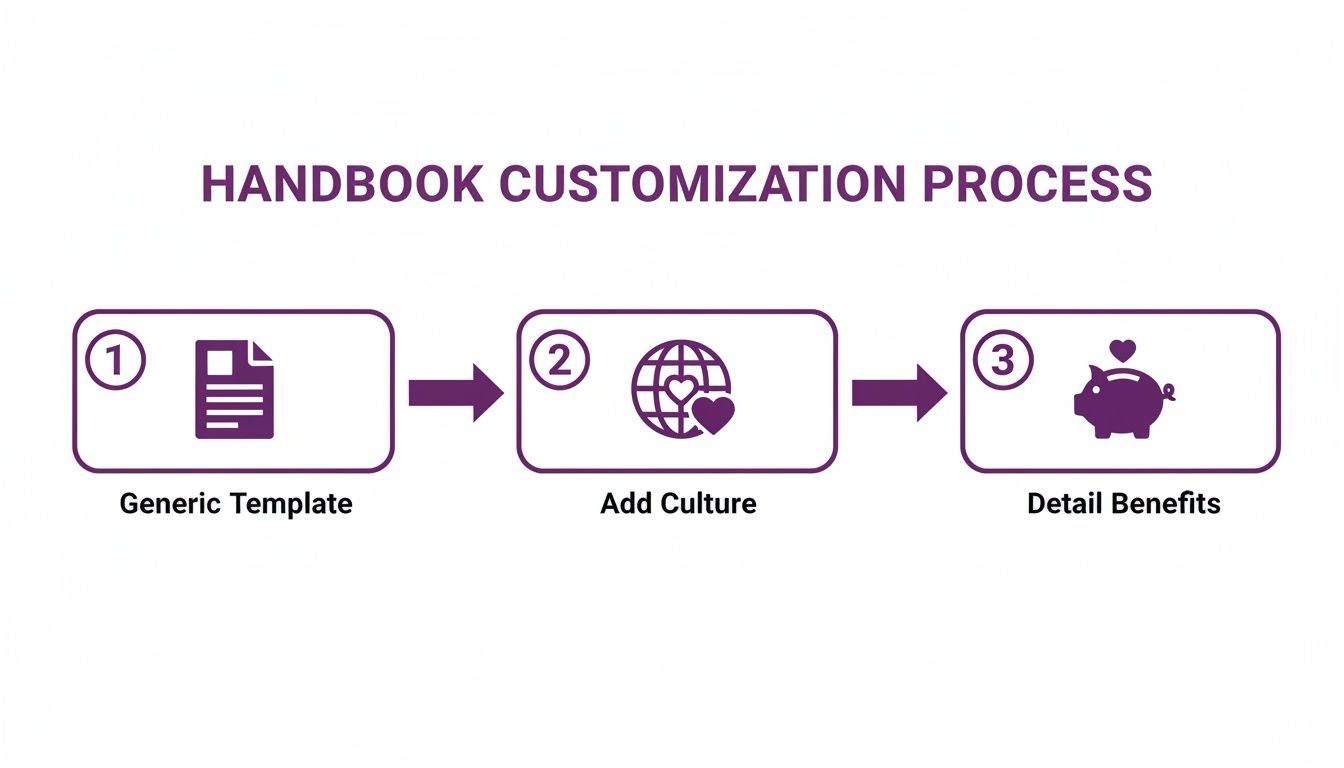
The key takeaway is simple: customisation transforms a standard document into a powerful tool that reflects your unique culture and reinforces how you operate.
Integrating Compliance into Daily Workflows
When your handbook is fully integrated, you can link policies directly to day-to-day HR processes. For example, when a manager opens a performance review form, the system can automatically pull up the relevant sections on performance standards and disciplinary procedures. When an employee requests holiday, the system checks that the request follows the rules laid out in the handbook.
The benefits here are massive:
- Less Admin Overload: Automating tasks like policy distribution and tracking acknowledgements frees up countless hours for your HR team to focus on more strategic work.
- Stronger Compliance: You get a clear, auditable trail that proves every employee has received and accepted your policies – a lifesaver in a dispute.
- Greater Consistency: Managers are guided by the correct procedures right when they need them, ensuring policies are applied fairly and consistently across the business.
For any organisation of scale, this kind of centralised control isn't just a nice-to-have; it's essential. The Civil Service, for instance, had a headcount of 549,660 staff as of March 2025 – a scale where consistent policy application is non-negotiable. With around 30.3 million payrolled employees across the UK, the need for efficient, scalable HR systems is undeniable. You can dig deeper into these figures in the official government statistics bulletin.
By managing your handbook within a platform like Microsoft Dynamics 365 for HR, you’re moving far beyond basic document management. You create a single source of truth that underpins the entire employee journey, from hire to retire, making sure your policies are not just written down, but actively followed. You can learn more about what the platform offers in our article on the capabilities of Dynamics 365 for HR.
At DynamicsHub.co.uk, we provide Transformative HR solutions customised to the unique way you work. Human Resource HR Management for Microsoft Dynamics 365 by Hubdrive is the leading hire-to-retire solution for the Microsoft Platform.
To see how we can help you integrate your HR processes, give us a call on 01522 508096 or send us a message to get started.
Bringing It All Together: Your Blueprint for a Thriving Workplace
We’ve walked through the essentials of creating an employment handbook, but it's important to remember this is more than just a box-ticking exercise. Think of it as the foundation of your entire HR strategy. It’s your chance to set a clear legal footing, introduce policies that reflect modern work life, and shape a document that truly mirrors your company’s unique culture.
When you bring all these elements together with the right technology, your handbook stops being a static document gathering dust on a shelf. It becomes a living, breathing asset for your business.
A well-crafted and easy-to-access handbook is one of your best tools for minimising risk, promoting fairness, and building a stronger, more cohesive organisation. It clearly defines expectations from the very beginning, helps shield the business from potential disputes, and shows your team you’re genuinely invested in their well-being and growth. This is how great, compliant workplaces are built.
To really embed these ideas, it's worth thinking about all the ways you communicate with your team. For instance, exploring different video applications for Human Resources can be a brilliant way to bring policies to life and make sure they’re understood across the business.
At its heart, your handbook should evolve right alongside your company. It isn't a "set it and forget it" project. It's an ongoing commitment to being clear, consistent, and building a culture where people feel trusted and secure. When you get it right, it becomes the go-to guide for everyone, from new starters to senior leaders.
At DynamicsHub.co.uk, we specialise in HR solutions that are built around the way you actually work. Human Resource HR Management for Microsoft Dynamics 365 by Hubdrive is the leading hire-to-retire solution on the Microsoft Platform, and it's designed to turn your carefully crafted policies into automated, everyday workflows. By integrating your handbook directly into the system, compliance simply becomes part of the daily routine.
Ready to take the next step? Give us a call on 01522 508096 or send us a message to have a chat about how we can help.
Frequently Asked Questions
When you're putting together an employment handbook, it's natural for a few key questions to pop up. Here are some straightforward answers to the things we get asked most often by UK businesses, helping you get the final document just right.
Is an Employment Handbook Legally Binding in the UK?
This is a great question, and the answer is a classic "it depends". Certain parts of your handbook can absolutely be legally binding, but only if you explicitly say so in the employee's contract of employment. Think of things that form part of their compensation or benefits package – enhanced sick pay or a specific commission structure, for instance. These are often made 'contractual'.
On the other hand, a lot of the handbook contains procedural guidance, like how you handle disciplinary issues or grievances. It's usually best to keep these 'non-contractual'. This distinction is incredibly important because it gives you the flexibility to update these processes as best practice evolves, without having to issue new contracts to every single person. We always suggest getting a legal expert to cast an eye over this, just to make sure the line between contractual and non-contractual is perfectly clear.
How Often Should We Update Our Employee Handbook?
Think of your handbook as a living document, not a "set it and forget it" task. As a rule of thumb, you should give it a thorough review at least once a year. This annual check-in is your chance to make sure everything still aligns with current UK employment law and reflects how your business operates today.
That said, sometimes you'll need to act faster. Major legal changes – like new rules on flexible working or adjustments to the national minimum wage – mean you need to update the relevant policies immediately. The same goes for big internal changes. This is where a modern, integrated system really proves its worth. Using a tool like the HR solutions we provide at DynamicsHub means you can push out updates instantly, ensuring everyone is always looking at the latest version.
A proactive approach to updates isn’t just good practice. An outdated handbook can quickly become a legal headache if its policies are no longer compliant with the law.
Do Employees Need to Sign to Acknowledge the Handbook?
In a word, yes. We can't recommend this strongly enough. Getting a signed acknowledgement from every employee is your proof that they’ve received the handbook, had the opportunity to read it, and know where to find it.
This little step is your safety net if a dispute ever arises. It makes it very difficult for an employee to claim they didn't know about a particular policy or procedure. Modern HR platforms, like the Human Resource HR Management for Microsoft Dynamics 365 solution from Hubdrive, can handle this for you automatically. The system can send out the handbook, track who has and hasn't acknowledged it, and keep a secure digital record, which saves a ton of administrative work while making you more compliant.
At DynamicsHub.co.uk, we provide Transformative HR solutions customised to the unique way you work. Human Resource HR Management for Microsoft Dynamics 365 by Hubdrive is the leading hire-to-retire solution for the Microsoft Platform.
Phone 01522 508096 today, or send us a message to discover how we can help.


