

Ever found yourself needing staff to put in a few extra hours to hit a deadline? Instead of paying out overtime, you can offer them that time back to use later. That, in a nutshell, is time in lieu.
Think of it like a flexible ‘time bank’ for your team. When an employee works beyond their contracted hours, they can ‘deposit’ that extra time. Later, they can ‘withdraw’ it as paid time off. This arrangement, commonly known as TOIL (Time Off In Lieu), is all about swapping extra hours worked now for time off in the future, based on a mutual agreement.
Getting to Grips with Time in Lieu

At its heart, time in lieu is a practical way to manage workload fluctuations. The name itself comes from the French phrase “en lieu,” which simply means “in place of.” Employees get time off in place of getting paid for their overtime.
For many UK businesses, this is a brilliant tool for handling busy periods without inflating the payroll. Imagine an employee is contracted for 40 hours a week but works 45 hours to get a project over the line. With a TOIL policy, those extra five hours are banked. They could then use that time to leave early one Friday or take a half-day off down the line, all with their manager’s approval.
To give you a clearer picture, here’s a quick summary of what a TOIL arrangement involves.
Time in Lieu (TOIL) At a Glance
| Aspect | Description |
|---|---|
| Concept | Employees receive paid time off instead of overtime pay for extra hours worked. |
| Legal Status | A contractual arrangement, not a statutory right in the UK. |
| Foundation | Must be based on a clear, mutual agreement outlined in a policy or contract. |
| Accrual Rate | Typically 1-for-1 (one hour overtime = one hour TOIL), but can be enhanced. |
| Usage Rules | Governed by company policy, often requiring manager approval and a usage timeframe. |
| Primary Benefit | Offers flexibility for employees and helps manage payroll costs for employers. |
As you can see, the whole system hinges on being a clearly defined and agreed-upon process.
It's a Contractual Agreement, Not a Legal Right
This is a critical point for any UK employer to grasp: TOIL is not a statutory right. There’s no law that says you have to offer it, unlike the legal minimum for holiday pay. It only exists if you create it as part of a contractual agreement.
What does this mean in practice? Without a specific clause in the employment contract or a formal company policy, you are not obligated to offer TOIL, and an employee can't demand it. Getting this down in writing from day one is the only way to prevent confusion and disputes.
The Core Features of a Good TOIL System
A solid, fair time in lieu system is built on a few key principles. Nailing these down is the first step to creating a policy that actually works.
- It Has to Be a Mutual Agreement: This is a two-way street. You can't force an employee to take TOIL if their contract states they get paid for overtime. Likewise, an employee can't just decide to stay late and bank the hours without getting it approved first.
- The Accrual Rules Must Be Clear: Your policy needs to spell out exactly how time is earned. Most companies keep it simple with a one-for-one exchange—one hour of overtime earns one hour of TOIL. Some, however, offer a better rate for unsociable hours, maybe 1.5 hours of TOIL for every hour worked on a weekend.
- There Are Rules for Taking the Time Back: You need to set clear expectations for how and when the banked time can be used. This usually involves needing a manager's sign-off and setting an expiry date, such as requiring TOIL to be used within three months of earning it.
Navigating the UK Legal Landscape for Time in Lieu
When it comes to time in lieu, one of the first things UK businesses look for is a specific "TOIL Act". But you won't find one. Instead, the rules are embedded within broader employment laws, most notably the Working Time Regulations 1998 and the National Minimum Wage Act 2015. Getting to grips with these is crucial if you want to stay compliant.
The guiding principle is simple: any time in lieu arrangement must be fair and can't leave an employee worse off financially. The absolute red line is that TOIL must never cause an employee’s average pay to dip below the National Minimum Wage (NMW) for the hours they’ve worked in a given pay period.
Think about it this way: if a lower-paid employee puts in a lot of extra hours, just giving them that time back later might not be enough to keep their average hourly rate above the legal minimum. In that situation, you’re legally on the hook to pay them for the overtime, even if you have a TOIL agreement in place.
The Importance of a Written Policy
Since time in lieu isn't a statutory right, the entire system hinges on what's agreed in the employment contract or a formal company policy. Relying on a verbal nod is just asking for trouble down the line. A clear, written policy is your best defence and the only way to ensure everyone is on the same page. It’s what turns an informal favour into a structured, fair, and legally robust system.
A solid TOIL policy should be the go-to guide for managers and staff, leaving no grey areas. This single document protects the business from legal headaches and reassures employees they’re being treated fairly, which is the foundation of a good working relationship.
At its core, a written agreement is non-negotiable. It must clearly outline every aspect of the TOIL process, from eligibility and accrual rates to usage rules and what happens when employment ends. This clarity prevents misunderstandings down the line.
Key Components of a Compliant Policy
To be truly effective and compliant, your written policy needs to cover several key bases. Skimping on the details here can create confusion and open you up to risk.
Your policy should explicitly spell out:
- Eligibility: Who is actually included in the scheme? Is it for specific roles or all staff?
- Accrual Rules: How is time earned? Is it a straight 1:1 swap, or do you offer an enhanced rate like 1.5:1 for weekend or evening work?
- Authorisation Process: Overtime can't be a free-for-all. Make it clear that it must be pre-approved by a line manager.
- Usage Conditions: Set clear expectations. How quickly must the time off be taken (e.g., within three months)? Are there any blackout periods during busy spells?
- Termination Clause: This is a big one. What happens to accrued TOIL when someone leaves? Will it be paid out with their final salary, or is it forfeited?
Putting these rules in writing is the cornerstone of managing time in lieu effectively and legally. For broader context on managing different types of employee leave, you might be interested in our guide on what PTO leave is and how to manage it.
Is a Time in Lieu Policy Right for Your Business?
Deciding whether to bring in a time in lieu policy is a big step, and it’s certainly not a one-size-fits-all solution. While it can be a brilliant way to handle fluctuating workloads and give your people more flexibility, you have to think it through carefully. Get it right, and it’s a fantastic asset. Get it wrong, and it can create more headaches than it solves.
The main draw of TOIL is its flexibility. It gives your business a way to navigate those hectic periods—think project deadlines or seasonal rushes—without instantly racking up overtime pay. For employees, it’s a genuinely valued perk. The chance to get their time back is often more welcome than a bit of extra cash, which can do wonders for morale and job satisfaction.
The Advantages of Offering TOIL
When you put a well-structured TOIL system in place, the benefits really stack up. It can become a strategic part of what makes your company a great place to work.
- Cost Management: It’s a smart way to manage your wage bill. Instead of paying out for overtime, you convert those hours into paid leave that can be taken when things are quieter.
- Enhanced Flexibility: TOIL gives you the operational agility to handle unexpected surges in work without throwing your budgets out of kilter.
- Improved Employee Morale: Giving people the choice between extra pay and time off shows you trust them and respect their personal lives. That kind of thing builds real loyalty.
Potential Pitfalls and How to Avoid Them
Of course, it’s not all plain sailing. The potential downsides are just as real, and they need to be managed from the get-go. Without a solid system, TOIL can quickly become a hidden liability, leading to untracked hours, arguments over what’s owed, and a huge backlog of leave that becomes a nightmare to manage.
An unmanaged TOIL balance can also mask deeper problems. If the same teams are constantly banking hours, it might be a sign that they’re chronically understaffed or that workflows are inefficient, not just that it’s a temporary busy patch.
There's also a serious risk of burnout. What's the point of employees working extra hours if they can never find a good time to take their leave? This is even more important now, as UK workers are getting much better at taking their statutory time off. Recent figures show a massive 71% drop in unused annual leave over the last five years. People now leave just 5.3 days on average, down from 18.5 days.
This shift shows a growing recognition that people need proper breaks. A TOIL system has to support that, not work against it. If you're interested, you can explore more about these annual leave trends to see just how vital rest has become.
Ultimately, a time in lieu policy is only right for your business if you have the culture and the systems ready to manage it fairly and transparently.
How to Create a Fair and Effective TOIL Policy
Building a solid time in lieu policy isn't about writing a rigid rulebook; it's about creating a framework of clarity and trust. A well-thought-out policy acts as a shared blueprint for fairness, making sure everyone—from senior leaders to the newest hire—is on the same page. Without one, you're opening the door to confusion, disputes, and a whole lot of administrative headaches.
The aim is simple: design a policy that's transparent, fair, and easy to understand. This document should become the go-to resource for everything TOIL, giving both employees and managers the confidence to use the system properly.
Defining Eligibility and Authorisation
First things first, you need to be crystal clear about who is eligible. Is your TOIL scheme open to everyone, or is it reserved for certain roles or departments? For instance, you might exclude senior managers who are already on higher salaries and expected to work the hours needed to fulfil their duties. On the other hand, junior team members might be the primary group you want to offer it to. Spell it out to avoid any grey areas.
Just as critical is the authorisation process. An employee can't simply decide to stay late and bank the hours. Your policy must state that all overtime intended for TOIL has to be pre-approved by a line manager. This is a non-negotiable step. It keeps you in control of workloads, prevents misuse, and helps managers spot potential resourcing issues before they spiral.
This flowchart maps out the key things to consider when you're weighing up a TOIL scheme, balancing the need for flexibility against the real risks of getting it wrong.
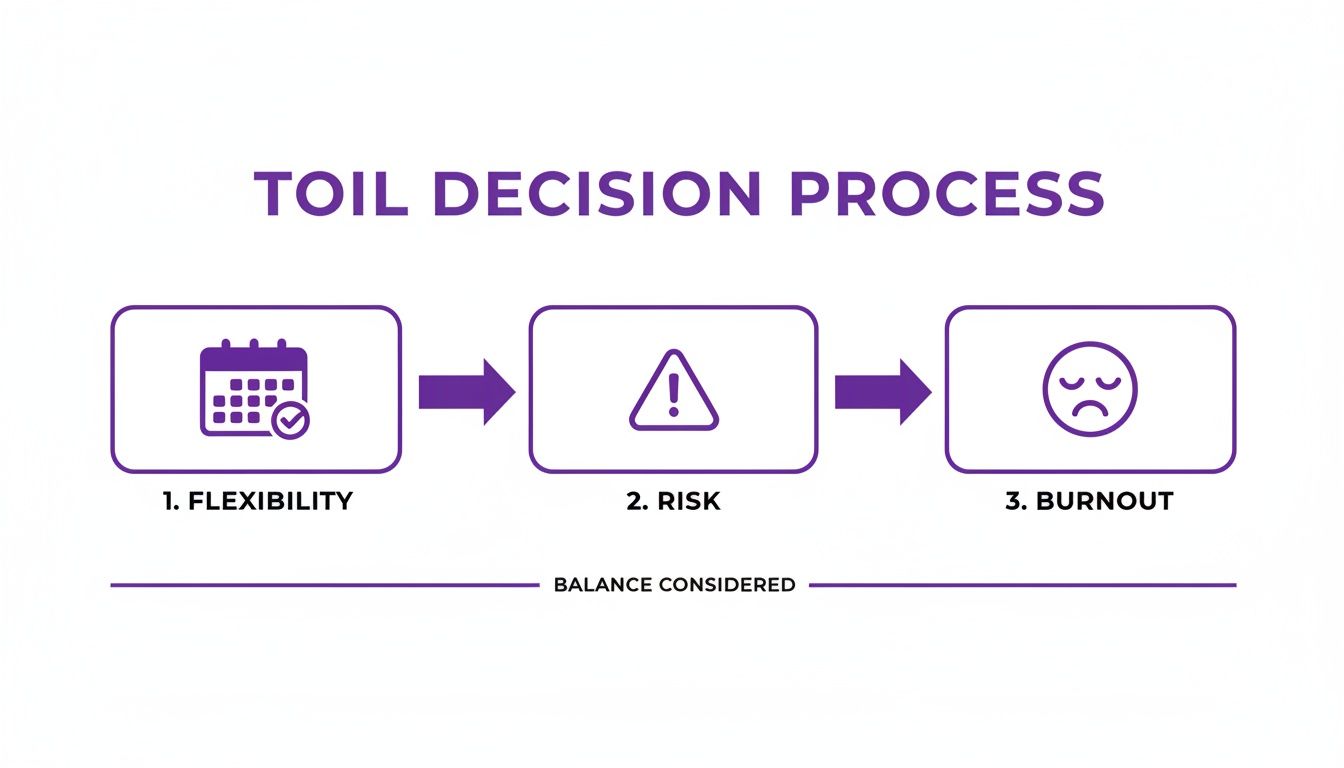
As the graphic shows, while TOIL can be a great perk, it needs careful handling to sidestep problems like employee burnout and getting bogged down in admin.
Setting Accrual and Usage Rules
Next, it’s time to get into the nuts and bolts of how time is earned and used. This is where the specifics really matter.
- Accrual Rate: Are you going for a straightforward 1:1 trade, where one hour of overtime equals one hour of TOIL? Or will you offer something more generous, like 1.5:1, for unsociable hours like weekends or bank holidays? An enhanced rate is a great way to properly thank staff for giving up their personal time.
- Usage Window: To stop a huge, unmanageable backlog of leave from building up on your books, set a time limit. It's common to state that TOIL must be taken within a set period, such as three months from the date it was earned.
- Booking Process: Make it clear that taking TOIL isn't a free-for-all. It should follow the same procedure as booking annual leave, requiring a manager's approval to ensure the team still has enough cover.
Clarifying What Happens at Termination
This is a big one that often gets missed: the termination clause. What happens to an employee's banked TOIL when they hand in their notice? Your policy must be explicit here. You generally have two choices: pay out the value of the accrued hours in their final pay packet, or implement a "use it or lose it" rule. Whichever route you take, getting it in writing protects the business and ensures a fair and clean exit for the departing employee.
For more guidance on structuring your policies, a well-defined employment handbook is essential. You can learn more about crafting one with our guide on creating a comprehensive employment handbook template.
Putting Time in Lieu into Practice: Real-World Calculations
Theory is all well and good, but let's get down to brass tacks. Seeing how time in lieu works on the ground is where it all clicks into place. The maths is usually simple, but getting it right is non-negotiable for keeping things fair, transparent, and legally sound.
Let's walk through a couple of common scenarios you'll likely encounter.
The most popular approach by far is a straight one-for-one swap. It’s clean, easy for everyone to understand, and forms the foundation of most TOIL policies.
Example 1: The Standard 1-to-1 Rate
Meet David. He’s on a salary of £35,000 a year for a standard 37.5-hour week. A big project deadline is looming, and his manager asks him to stay late on a Thursday. With prior approval, he works an extra five hours.
- Extra Hours Worked: 5 hours
- Agreed Rate: 1:1 (one hour of leave for every extra hour worked)
- The Sum: 5 hours × 1.0 = 5 hours
- The Result: David has just banked 5 hours of time in lieu. He can now book a half-day off later, once the dust has settled and his manager gives it the green light.
Example 2: The Enhanced 1.5-to-1 Rate
Now, what about when the work is more disruptive? You might want to sweeten the deal for weekend or bank holiday work to recognise the extra personal sacrifice.
Let's say another team member, Sarah, has to come in for four hours on a Sunday to deal with an unexpected client emergency. Your policy offers an enhanced rate for this kind of work.
- Extra Hours Worked: 4 hours
- Agreed Rate: 1.5:1 (1.5 hours of leave for every hour of weekend work)
- The Sum: 4 hours × 1.5 = 6 hours
- The Result: For her four hours of Sunday work, Sarah earns 6 hours of time in lieu. It’s a great way to show you appreciate her flexibility.
The All-Important National Minimum Wage Check
This is the one calculation you absolutely cannot afford to get wrong. A time in lieu arrangement can never result in an employee’s average pay dipping below the National Minimum Wage (NMW) for their pay period.
Your TOIL policy doesn't exist in a vacuum. If the extra, unpaid hours an employee works for TOIL drag their average hourly pay below the NMW, you are legally on the hook. You must pay them for enough of those hours to bring their average rate back up to the legal minimum.
Think about a lower-paid worker who does a lot of extra hours in one month. Even with TOIL as a reward, their effective hourly rate could easily fall below the legal floor. When that happens, you have to top up their pay to make it right. This isn't just good practice; it's a legal requirement that protects both your people and your business from serious trouble.
How Modern HR Systems Can Manage Time in Lieu
Let's be honest: relying on spreadsheets and manual notes to track time in lieu is asking for trouble. It's a system practically designed for errors, disputes, and hours of wasted admin time. These old-school methods simply can't offer the real-time visibility you need, leading to frustration for both your HR team and your employees.
A proper HR system takes all that manual effort off your plate. It automates the entire process, swapping guesswork for precision. Instead of someone having to calculate hours by hand, the system automatically logs approved overtime and converts it into accrued TOIL based on the rules you’ve set. This completely removes the risk of human error and guarantees every hour is accounted for, whether it's at a standard 1:1 rate or an enhanced rate for a bank holiday.
Centralised Tracking and Approval
One of the biggest wins with a modern HR platform is that it brings everything into one place. With solutions like Hubdrive’s HR Management for Microsoft Dynamics 365, which we specialise in at DynamicsHub, every single step is handled within one integrated system.
This platform, built on the Microsoft Power Platform, creates a workflow that just makes sense:
- Time Tracking: Employees log their extra hours through the system, which then pings their manager for approval.
- Automated Calculations: As soon as it's approved, the system does the maths and adds the correct TOIL to the employee's balance.
- Integrated Leave Requests: When an employee wants to use their banked time, they book it off through the same system. Simple. This creates a clear, auditable trail from start to finish.
Seamless Integration with Everyday Tools
Where these systems really shine, though, is in their integration with the tools your team already lives in. Because Hubdrive’s solution works within the Microsoft ecosystem, it connects directly with things like Microsoft Teams and Outlook.
This means managers can approve overtime or leave requests without ever leaving their inbox or Teams chat. Employees can check their TOIL balance in seconds. It’s that easy.
This integrated approach gives everyone total transparency. Employees can see their accrued time whenever they want, and managers have a clear view of team liabilities, which helps with workforce planning and prevents any nasty surprises. It turns TOIL from a headache into a genuinely well-managed employee benefit.
This level of automation and visibility is fundamental to good workforce management. If you’d like to dig deeper into this, you can read more about our approach to time and attendance management.
Your Time in Lieu Questions Answered
When you start digging into the details of a time in lieu system, a few common questions always pop up. Let's tackle some of the most frequent queries we hear from HR managers and employees to make sure your TOIL policy is both fair and compliant.
Is Time in Lieu a Legal Requirement in the UK?
In a word, no. Unlike statutory holiday pay, there's absolutely no legal obligation for a UK employer to offer time in lieu.
TOIL is a purely contractual arrangement. It only becomes a formal part of your relationship with an employee if it's written down, either in their employment contract or a clear, accessible company policy. Without that black-and-white agreement, employees can't demand it, and you aren't required to offer it.
What Happens to Unused TOIL When Someone Leaves?
This is a classic 'it depends' scenario, and what it depends on is your policy. Your contract or TOIL policy is king here.
If the policy says accrued TOIL will be paid out when someone leaves, you're bound to pay it. If it clearly states that banked hours are forfeited if not used before the employee’s final day, that’s also perfectly enforceable. The golden rule is to define this explicitly to prevent any confusion or disputes when an employee is on their way out.
Can an Employer Force an Employee to Take TOIL Instead of Overtime Pay?
Generally, this is a definite no. A time in lieu system is built on a foundation of mutual agreement.
If an employee's contract gives them the right to paid overtime, you can't unilaterally decide to give them time off instead. It has to be an option you offer and they willingly accept. Trying to force TOIL on someone could easily be considered a breach of their contract.
It’s crucial to get compensation for extra hours right, especially when you consider the scale of unpaid work in the UK. Research shows the average British employee works 215 hours of overtime a year. Shockingly, 42% of them get no extra pay for it, which works out to a donation of £4,022 in free labour each year. These figures really drive home the need for transparent and fair systems to manage those extra hours. You can discover more about these UK overtime statistics and see the full economic picture.
We are DynamicsHub.co.uk. Experience HR transformation built around your business. Hubdrive’s HR Management for Microsoft Dynamics 365 is the premier hire‑to‑retire solution—more powerful, more flexible, and more future‑ready than Microsoft Dynamics 365 HR.
Phone 01522 508096 today, or send us a message https://www.dynamicshub.co.uk/contact/


