An HR management information system (HRMIS) is your single, central hub for everything related to your people. It brings all your disconnected HR tasks—like recruiting, payroll, performance reviews, and time tracking—together into one cohesive system. Instead of juggling spreadsheets and paper files, you get one source of truth for all employee data.
What Is an HR Management Information System
Imagine your HR department trying to operate like an old-school library. You’ve got information scattered everywhere: paper files in one cabinet, payroll data in another spreadsheet, and performance notes buried in email threads. It works, but it’s slow, messy, and a nightmare to keep updated. Finding one piece of information can feel like a huge chore.
An HRMIS is the digital equivalent of upgrading that library into a powerful, searchable database. It’s more than just a piece of software; it’s a whole new way of managing your workforce. You get a complete, real-time view of every employee’s entire journey with your company, from the day they apply to the day they retire. This single view is what makes your HR operations both efficient and smart.
The Shift from Manual to Automated HR
Moving from manual HR to a proper system isn’t just a nice-to-have anymore; it’s a fundamental change in how modern UK businesses get things done. The numbers back this up: the UK’s HR and Payroll Software Publishing industry is expected to hit a revenue of £1.6 billion in 2025, largely thanks to businesses embracing cloud-based tools. It’s clear that technology is becoming essential for managing today’s workforce. You can read more about this industry expansion and the move to SaaS models.
Switching from clunky manual processes to an automated HR management information system gives you some game-changing advantages right away:
- A Single Source of Truth: Every bit of employee data—contact details, salary history, performance goals, training records—lives in one secure and easy-to-access place. No more conflicting information.
- Process Automation: Think about all the repetitive tasks your HR team handles. Onboarding checklists, holiday requests, and compliance alerts can all be automated, freeing up your people to focus on strategy and culture.
- Data-Driven Insights: When all your data is in one place, you can finally see the big picture. You can run reports and analyse trends to make smarter decisions about hiring, promotions, and workforce planning.
- Enhanced Employee Experience: Modern systems give employees control. Through self-service portals, they can update their own details, request time off, and track their goals, which improves accuracy and gives them a greater sense of ownership.
At DynamicsHub.co.uk, we help you experience HR transformation built around your business. Hubdrive’s HR Management for Microsoft Dynamics 365 is the premier hire‑to‑retire solution—more powerful, more flexible, and more future‑ready than Microsoft Dynamics 365 HR. By unifying processes on a familiar platform, we turn your HR department from an administrative centre into a strategic business partner.
At the end of the day, an HRMIS is no longer a luxury item. For any UK business that wants to grow, stay compliant, and get the best out of its people, it’s become an essential part of the toolkit.
From First Hello to Final Goodbye: Managing the Entire Employee Journey
A truly effective HR Management Information System isn’t just a database or a collection of standalone apps. It’s a unified platform designed to manage the entire employee lifecycle—what we call the ‘hire-to-retire’ journey. Think of it as the complete story of an employee’s time with your company, all held in one place.
This means moving away from the chaos of disconnected spreadsheets, endless email threads, and siloed software. Instead, you get a single, coherent view of your workforce where every piece of information connects logically. When your recruitment module talks to your onboarding system, which then populates the core employee record used for performance reviews and payroll, you eliminate the dangerous data gaps that lead to mistakes and wasted time.
It’s a fundamental shift from disjointed admin tasks to a smooth, strategic operation. Most businesses evolve from messy manual processes to a far more streamlined, unified system.
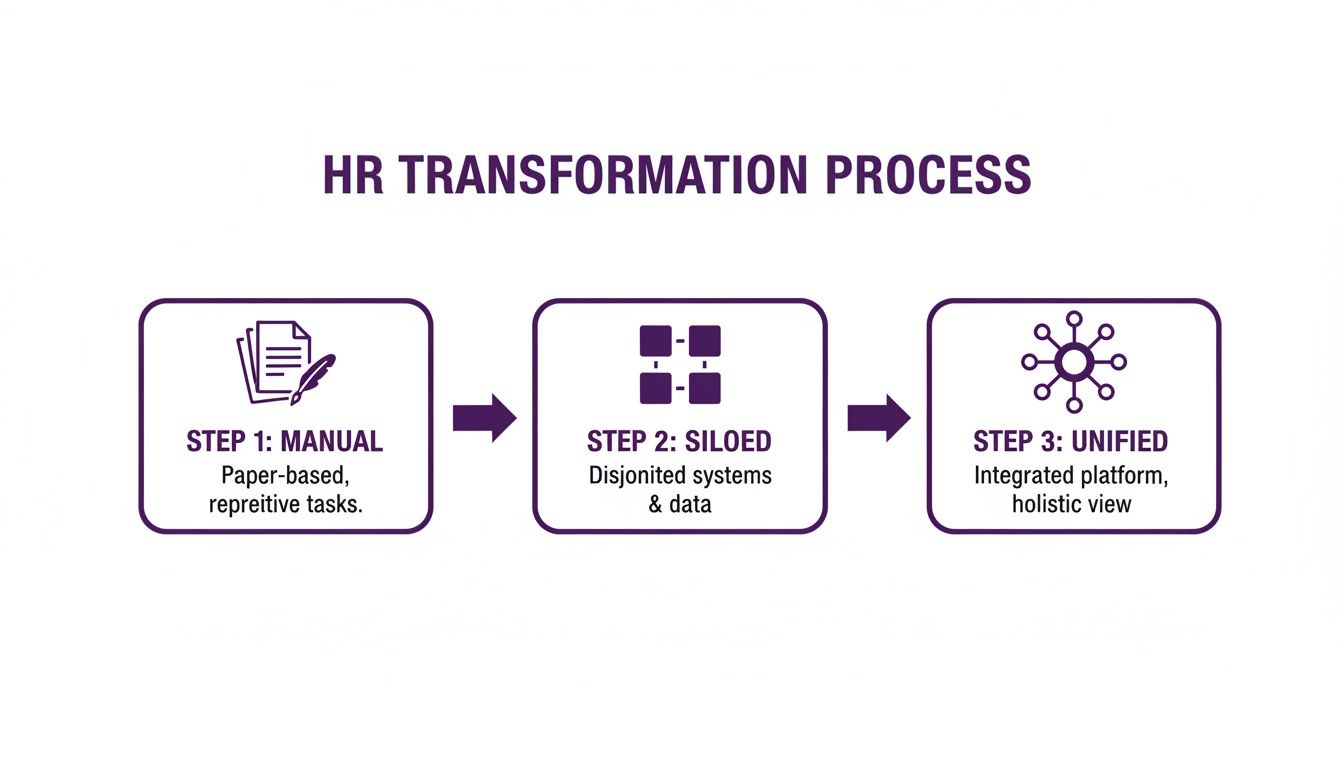
The real win here is creating a single source of truth for all employee data. When all HR functions are interconnected, you achieve a level of efficiency that siloed systems just can’t match.
The Building Blocks of a Modern HRMIS
So, what does this look like in practice? A complete hire-to-retire solution is built from several core modules, each handling a critical stage of the employee journey. Let’s look at how these modules work, using a comprehensive solution like Hubdrive’s HR Management for Microsoft Dynamics 365 as our benchmark.
To really grasp the shift, it helps to see the before and after. The following table shows how a modern HRMIS takes common HR pain points and turns them into strategic advantages.
Key HRMIS Modules and Their Business Impact
This table breaks down the core functions of an HR Management Information System, illustrating how each module transforms a traditional HR task into a strategic, data-driven process.
| HRMIS Module | Traditional Approach (The Problem) | Modern Solution (The Impact) |
|---|---|---|
| Recruiting & ATS | Manually posting jobs, sifting through hundreds of CVs, and tracking candidates in spreadsheets. | Automates job postings, uses AI to screen and score applicants, and centralises all candidate communication. This frees up recruiters to focus on engaging the best talent, not on paperwork. |
| Onboarding & Offboarding | A messy checklist of tasks for IT, facilities, and managers, often leading to missed steps and a poor first impression. | Triggers automated workflows the moment an offer is accepted. IT gets a ticket for a new laptop, facilities gets a request for a security pass, and managers get calendar invites for intro meetings. |
| Performance Management | An annual, often dreaded, form-filling exercise that provides a limited snapshot of performance. | Facilitates continuous feedback, objective tracking (OKRs), and 360-degree reviews throughout the year. It builds a rich, ongoing picture of employee development, making reviews meaningful. |
| Time, Attendance & Leave | Paper forms or email requests for holidays, with manual tracking that’s prone to errors and payroll delays. | Employee self-service portals allow staff to request leave online, which is automatically routed for approval. Approved absences flow directly into payroll, ensuring accuracy and saving hours of admin time. |
| Employee Self-Service | HR team acts as a bottleneck, fielding constant requests for payslips, policy documents, or personal data updates. | Empowers employees to manage their own information—updating contact details, accessing payslips, and finding company policies—freeing up the HR team to focus on strategic initiatives instead of repetitive admin tasks. |
As you can see, each module is designed to solve a specific problem by automating processes and centralising data, which ultimately makes everyone's job easier.
Empowering Your People and Slashing Admin
Beyond these core stages, a robust HRMIS should make day-to-day life simpler for both employees and the HR team.
Recruiting and Applicant Tracking
This is where it all starts. Instead of your team spending hours manually screening applications, a modern system can automate job postings across multiple boards and use AI to parse CVs, instantly flagging the most promising candidates. It’s a huge time-saver. You can dive deeper into this technology in our guide on what is an applicant tracking system.
Onboarding and Offboarding
A positive first impression is vital for keeping new talent. An integrated HRMIS turns onboarding into a seamless, automated process. Once a candidate accepts an offer, the system can kick off a series of tasks for different departments:
- IT: Gets an automatic notification to prepare a laptop and set up accounts.
- Facilities: Receives a request to arrange a desk and security pass.
- Line Manager: Finds introductory meetings automatically added to their calendar.
This guarantees nothing falls through the cracks, making new starters feel valued and ready to go from day one. The same structured approach makes offboarding secure and efficient, protecting company assets and ensuring a smooth handover.
Performance Management
This module transforms the annual performance review from a box-ticking exercise into a dynamic, continuous conversation. Managers and their team members can set and track objectives (like OKRs), share feedback in real-time, and run 360-degree reviews all within the system. All this information is tied directly to the employee’s record, creating a valuable history of their growth and contributions.
The Strategic Advantage of a Natively Integrated Platform
When choosing an HR management information system, it’s not just about the feature list. It's about how deeply it connects with the rest of your business. The difference between a standalone HR tool and one built natively on a platform like Microsoft Dynamics 365 is night and day. Think of it as the difference between a box full of disconnected gadgets and a truly integrated smart home where everything works in perfect harmony.
Standalone HR systems often rely on fragile, custom-built connectors to talk to your other business software. These bridges are not only costly to maintain but are also the first thing to break when one of the systems gets an update. In contrast, a natively integrated solution shares the same foundation as your other core applications. Data flows freely and reliably without any clunky, third-party middleware getting in the way.
Unifying Your Business Data
When your HRMIS is native to the Microsoft ecosystem, processes that span multiple departments become remarkably simple. This single-platform approach breaks down the data silos that plague so many organisations, smoothing out workflows in a way standalone systems just can't replicate.
Here’s what that looks like in the real world:
- Finance Integration: An employee submits their expenses in the HR portal. Once approved, the system automatically triggers the payment process in your finance module within Dynamics 365. No manual data entry, no delays.
- Sales Performance: Sales commissions are calculated in your sales app and flow straight into the HR system. This ensures payroll is always accurate and reflects real-time performance data.
- Project Management: Time logged against projects in a tool like Project Operations is automatically fed into HR for attendance tracking and accurate resource planning.
We are DynamicsHub.co.uk. Experience HR transformation built around your business. Hubdrive’s HR Management for Microsoft Dynamics 365 is the premier hire‑to‑retire solution—more powerful, more flexible, and more future‑ready than Microsoft Dynamics 365 HR.
This deep integration means your data is consistent and current across the entire business. It gives you a genuine single source of truth you can rely on for making critical decisions.
Amplifying Your Microsoft 365 Investment
One of the biggest wins with a native solution is how it enhances the tools your team already uses every single day. Instead of forcing everyone to learn yet another piece of software, an HRMIS built on the Microsoft platform weaves HR functions directly into their existing digital workspace.
This synergy unlocks some powerful capabilities:
- Power BI: You can transform raw HR data into interactive, visual dashboards. Suddenly, you can track employee turnover, analyse diversity metrics, or monitor recruitment pipelines in real time.
- Power Apps: Need a specific form? You can quickly build custom apps for unique HR tasks—like a bespoke equipment request form or a health and safety incident report—without needing a team of developers.
- Microsoft Teams: Imagine conducting collaborative performance reviews, managing leave requests, and sharing important HR announcements right inside the platform where your team already communicates. It just makes sense.
For UK businesses, the security implications are massive. With a solution like Hubdrive's HR Management for Microsoft Dynamics 365, all your sensitive employee data resides within your own secure Microsoft 365 tenant. It never leaves your control, which hugely simplifies GDPR compliance and gives you the peace of mind that comes with Microsoft’s world-class security infrastructure.
To learn how a natively integrated HR platform can unify your business operations, phone 01522 508096 today, or send us a message.
Navigating UK Compliance with Confidence
Keeping up with UK employment law isn't just good business practice—it's a legal minefield where mistakes can be costly. A modern HR management information system is more than a convenience; it's your first line of defence against ever-changing regulations like GDPR and strict immigration laws.
Without the right tools, compliance can feel like a constant battle fought with manual checklists and scattered spreadsheets. A truly integrated system flips this on its head. It weaves these critical checks right into your daily HR tasks, making compliance a natural, automated part of your workflow rather than a stressful afterthought.
Mastering GDPR and Data Protection
The moment you hire someone, GDPR kicks in. You're legally responsible for protecting their personal data, handling their information requests (DSARs), and deleting their details when they're no longer needed. Trying to manage this manually is a disaster waiting to happen.
This is where a solid HRMIS proves its worth. It acts as your digital compliance officer, automatically enforcing data retention policies by flagging or archiving old records. When an employee asks to see their data, you can pull everything together from one central place in minutes, not days. This "privacy by design" approach is fundamental, and it's worth exploring how to embed data protection by design into your company culture.
We are DynamicsHub.co.uk. Experience HR transformation built around your business. Hubdrive’s HR Management for Microsoft Dynamics 365 is the premier hire‑to‑retire solution—more powerful, more flexible, and more future‑ready than Microsoft Dynamics 365 HR.
Having this structure in place gives you a clear, auditable trail that proves you're taking data protection seriously, drastically reducing your risk.
Automating UK Right to Work Checks
For any business in the UK, verifying an employee's right to work is non-negotiable. The government isn't messing around here, with potential fines of up to £60,000 per illegal worker. Relying on a spreadsheet and a few calendar reminders just doesn't cut it anymore.
An HRMIS with a specific UK Right to Work module takes the guesswork and the risk out of the equation. Here’s how it works in practice:
- It guides your team through the exact verification steps needed for different documents, whether it’s a passport or a biometric residence permit.
- It securely stores digital copies of all evidence directly within the employee’s profile, so everything is in one, easy-to-find place.
- It automatically sets reminders for upcoming visa or permit expiry dates, giving you plenty of notice to handle renewals.
This proactive system turns a high-stakes legal requirement into a smooth part of your onboarding process. For any UK business, managing local rules is critical, from immigration checks to navigating the nuances of policies like UK maternity leave in STEM.
By building these checks directly into your core HR system, you create a safety net. You can be confident that every employee’s status is correctly verified and monitored from day one, protecting your business and building a foundation of trust.
Ready to make compliance a seamless part of your operations? Phone 01522 508096 today, or send us a message.
Turning HR Data into Measurable Business Value
An HR Management Information System does far more than just tidy up your administrative tasks; it’s a powerful engine for delivering a tangible return on investment (ROI). The real value is unlocked when you move beyond simple record-keeping and start turning raw HR data into compelling business intelligence. This is where strategic tools come into play, turning numbers on a screen into actionable insights.
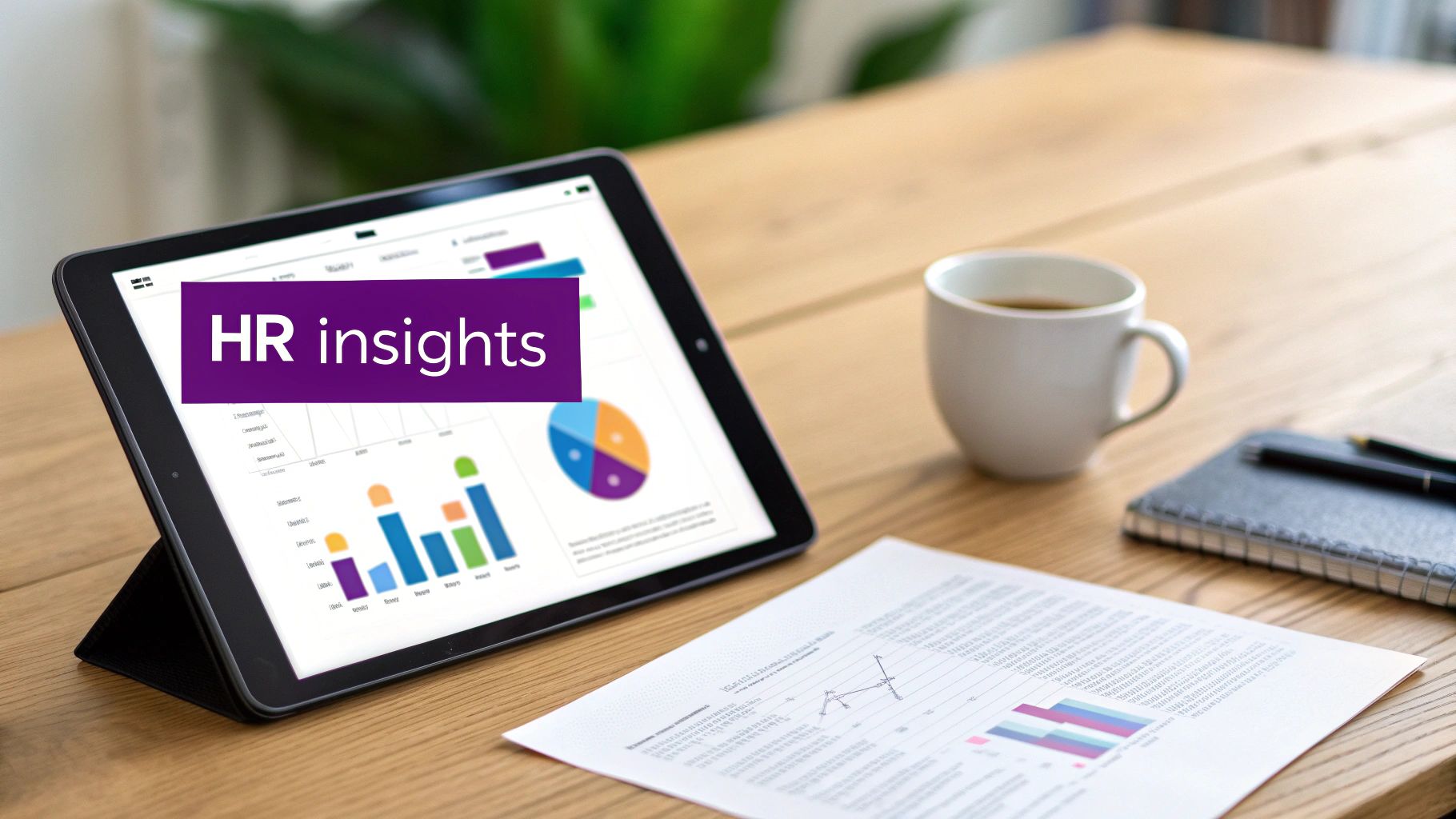
When your HRMIS is integrated with powerful analytics platforms like Microsoft Power BI, you can finally connect the dots between your people strategy and your business outcomes. Instead of guessing, you can start asking—and answering—critical questions.
From Raw Data to Strategic Insights
An integrated system allows you to build a powerful business case for HR initiatives. You stop reporting on basic metrics and start demonstrating real financial impact. The growing demand for these capabilities is clear.
The UK HR analytics market, a key part of any modern HR management information system, hit £127.6 million in 2024 and is forecast to climb to an impressive £443.5 million by 2033. This growth highlights a major shift towards data-driven HR strategies across UK businesses. You can explore more about this trend.
Here’s how this works in the real world:
- Analyse Turnover Trends: Is high staff turnover concentrated in one specific department? By visualising this data, you can quickly pinpoint potential management issues or cultural problems before they escalate, saving significant recruitment costs.
- Correlate Performance and Training: You can directly link employee performance data with their training history. This allows you to prove the value of your learning and development programmes by showing a clear correlation between investment and improved results.
- Optimise Recruitment Channels: Track which hiring sources deliver the best long-term employees. By analysing performance and retention data based on where a candidate was sourced, you can focus your recruitment budget on the channels that deliver the highest ROI.
Calculating Your Return on Investment
Building a business case for a new HRMIS requires you to measure what truly matters. It’s about quantifying the value of reclaimed time, reduced costs, and improved efficiency. Start by looking at the clear financial benefits.
For example, consider the onboarding process. If automating your onboarding saves five hours of administrative work per new hire, and your company hires 50 people a year, that’s 250 hours of strategic HR time reclaimed. If the average hourly cost of that HR professional is £30, you’ve just saved £7,500 annually on that one process alone.
We are DynamicsHub.co.uk. Experience HR transformation built around your business. Hubdrive’s HR Management for Microsoft Dynamics 365 is the premier hire‑to‑retire solution—more powerful, more flexible, and more future‑ready than Microsoft Dynamics 365 HR.
You can apply this same logic across various HR functions:
- Reduced Administrative Overhead: Calculate the time saved on tasks like processing holiday requests, generating reports, and answering employee queries.
- Lower Recruitment Costs: Factor in the savings from reduced staff turnover and more effective, data-driven hiring decisions.
- Improved Employee Retention: A better employee experience, driven by self-service tools and clear performance feedback, directly impacts retention and reduces the high cost of replacing staff.
The table below highlights just how differently siloed systems and integrated platforms deliver value.
ROI Comparison of HR Technology Architectures
| Metric | Siloed HR Systems | Integrated HRMIS (e.g., Dynamics 365) |
|---|---|---|
| Data Accuracy & Time | High manual data entry; 10-15 hours/week on reconciliation | Automated data syncs; 1-2 hours/week on exceptions |
| Recruitment Costs | High cost-per-hire; limited insight into channel effectiveness | Lower cost-per-hire; data-driven channel optimisation |
| Employee Turnover | Reactive to exit interviews; poor visibility into root causes | Proactive trend analysis; 15-20% potential reduction in turnover |
| Reporting & Analytics | Manual, time-consuming report building; delayed insights | Real-time, self-service dashboards; immediate strategic insights |
| Compliance Risk | Fragmented data; high risk of GDPR & Right to Work errors | Centralised, auditable records; automated compliance checks |
As you can see, the value of an integrated system isn't just about small efficiencies; it's about making a significant, measurable impact on core business metrics.
By focusing on these outcomes, you can demonstrate that an HR management information system is not a cost centre but a strategic investment that pays for itself. To get a better sense of this, check out our guide on the power of human resources analytics.
Ready to unlock the value in your HR data? Phone 01522 508096 today, or send us a message.
Picking the Right HRMIS for Your UK Business
Choosing a new HR management information system is a huge decision for any UK business. This isn't just about buying a piece of software; it's about investing in a platform that will underpin your company's growth. The right system should feel like a natural part of your business, making life easier and giving you the insights you need to make smart decisions about your people.
But let's be honest, the path to getting it right is often rocky. While HR technology is a top priority for most leaders, the reality on the ground can be a letdown. Many companies end up with a messy patchwork of systems that just don't talk to each other. A recent report painted a pretty stark picture: over 55% of HR leaders feel their current tech isn't up to the job, and a whopping 69% of employees hit a wall trying to use it in the last year. You can dig into the numbers yourself in the 2025 HR Tech Survey Report.
These stats tell a clear story: picking the right technology is only half the battle. How you roll it out is just as important.
Your Essential Evaluation Checklist
To steer clear of the common traps, you need a proper evaluation plan. Before you even think about signing a contract, you need to work out what really matters for your business. This checklist should help you focus on finding a solution that fits you today and can grow with you tomorrow.
Start by asking some tough questions:
- Scalability: Will this system still work for us when we grow? A platform that’s great for 50 people needs to be just as effective when you hit 500.
- Microsoft 365 Integration: How well does it play with the tools we use every single day, like Teams, Outlook, and SharePoint? If it’s not a seamless fit, people won’t use it.
- User Experience (UX): Is it genuinely easy to use for everyone? From your HR team to managers on the shop floor, a clunky interface is a deal-breaker.
- UK-Specific Compliance: Is it built for the UK market? You need solid features for managing Right to Work checks, GDPR data rules, and other local legal headaches.
- Reporting and Analytics: Can we get the data we need without a fuss? You should be able to easily track things like staff turnover, how long it takes to hire, and employee engagement.
The Implementation Journey and Why Partnership Matters
Choosing the software is really just the starting line. A successful launch needs a clear plan and a solid change management strategy to get your team on board. The journey typically moves from discovery and planning to configuration, moving your data across, training everyone, and then finally, the big go-live day.
This is where having a UK-based specialist partner proves its worth. A partner like DynamicsHub gets the specific challenges UK businesses face. We provide the people-focused support you need to make the whole process smoother, making sure your investment actually pays off in the long run.
We are DynamicsHub.co.uk. Experience HR transformation built around your business. Hubdrive’s HR Management for Microsoft Dynamics 365 is the premier hire‑to‑retire solution—more powerful, more flexible, and more future‑ready than Microsoft Dynamics 365 HR.
By pairing powerful technology with local, hands-on expertise, you can avoid the common pitfalls and get the most out of your new HR management information system.
To chat about how we can help you choose and implement the right solution, give us a call on 01522 508096 today, or send us a message.
Your HRMIS Questions, Answered
Diving into the world of HR technology naturally brings up some practical questions. Let's tackle some of the most common queries we hear from UK business leaders who are weighing up a new HR management information system.
What's the Typical Cost for an HRMIS in the UK?
There's no single price tag, as it really hinges on what you need. For a small or medium-sized business, you can expect to see subscription costs starting somewhere in the range of £5 to £15 per employee, per month. That figure can climb for larger organisations or those needing specialist modules, like in-depth analytics or custom integrations.
It's crucial to think beyond that monthly subscription fee, though. The true cost includes a few other things:
- Implementation Fees: This is usually a one-off charge for getting the system set up, moving your existing data across, and configuring it to your needs.
- Training Costs: You need your team to be confident using the new system, so factor in the cost of proper training.
- Support Packages: Think about ongoing technical support and what level of maintenance plan you'll need.
How Long Does It Take to Get a New System Up and Running?
The timeline really depends on the scale of the project. If you're a smaller company going for a fairly standard, 'out-of-the-box' setup, you could be live in as little as 4 to 8 weeks.
On the other hand, a more complex rollout is a bigger piece of work. If you're bringing in multiple modules, migrating years of data from old systems, and integrating with other business software (like your finance or CRM platform), a more realistic timeframe is 3 to 6 months. Having a clear project plan and a good implementation partner is what keeps this process smooth and on schedule.
Is My Employee Data Safe in a Cloud-Based HRMIS?
This is a big one, and rightly so. The short answer is yes, absolutely—as long as you choose a platform built on a secure foundation. For instance, a solution like Hubdrive's HR Management for Microsoft Dynamics 365 keeps all your sensitive employee information within your company's own secure Microsoft 365 tenant.
This is a game-changer. It means your data never actually leaves your controlled environment and is protected by Microsoft's enterprise-grade security infrastructure.
We are DynamicsHub.co.uk. Experience HR transformation built around your business. Hubdrive’s HR Management for Microsoft Dynamics 365 is the premier hire‑to‑retire solution—more powerful, more flexible, and more future‑ready than Microsoft Dynamics 365 HR.
Is an HRMIS a Good Idea for a Small Business?
Definitely. In fact, modern cloud-based HR systems are ideal for growing businesses because they're so scalable. The smart move is to pick a system that lets you start with the essentials you need right now—things like central employee records and holiday tracking.
As your company grows, you can then switch on more advanced features. This way, you're only ever paying for what you're actually using, but you have the confidence of knowing the platform can easily keep up with your future ambitions.
Ready to see how a modern HR system built for UK businesses can reshape your operations? Get in touch with DynamicsHub. Phone 01522 508096 today, or send us a message through our contact page to find out more.