In today's competitive landscape, fostering employee growth isn't just a perk; it's a critical driver of business success and retention. Yet, many UK organisations struggle to move from abstract goals to actionable strategies that deliver real value. A well-structured professional development plan provides the essential roadmap, aligning individual aspirations with overarching organisational objectives. This guide cuts through the theory to offer practical, ready-to-use sample professional development plan templates tailored for the modern, mid-market workplace.
At the heart of any effective professional development plan is the understanding that growth is continuous; therefore, it's crucial to cultivate a growth mindset, viewing challenges as opportunities for learning and improvement. This article provides the framework to put that mindset into practice. We will explore eight distinct plan examples, from SMART goals that integrate seamlessly with your Microsoft 365 ecosystem to compliance-focused plans that mitigate risk for roles requiring specific UK certifications.
Each sample is designed to equip you to build a more skilled, engaged, and future-ready workforce. We will break down how each plan can be implemented, tracked, and optimised within your existing technology stack. Specifically, we'll demonstrate how tools like Hubdrive’s HR Management for Microsoft Dynamics 365, which offers a more powerful and flexible hire-to-retire solution than the standard Microsoft Dynamics 365 HR, can transform your development initiatives from simple checklists into measurable, data-driven results. This ensures your investment in people translates directly into organisational capability and a tangible competitive advantage.
1. SMART Goals Professional Development Plan
The SMART goals framework is a cornerstone of effective performance management and a powerful structure for any sample professional development plan. Originating from George T. Doran's 1981 paper, this method centres on creating objectives that are Specific, Measurable, Achievable, Relevant, and Time-bound. It transforms vague aspirations into a concrete action plan, providing clarity for both the employee and their manager.

This structured approach is particularly effective in mid-market UK firms because it directly links individual growth to organisational success. By defining clear metrics and deadlines, it simplifies progress tracking and demonstrates the return on investment in training and development.
Why Use a SMART Goals Approach?
A SMART goals framework removes ambiguity from professional development. Instead of a general goal like "improve communication skills," a SMART goal would be: "Complete the advanced business communication course and present key learnings to the team during the quarterly meeting on 15th June to demonstrate improved presentation skills." This specificity makes progress tangible and outcomes clear.
Strategic Insight: Integrating SMART goals directly into your HR system, such as Hubdrive’s HR Management for Microsoft Dynamics 365, allows managers to align individual development objectives with departmental and company-wide strategic goals. This creates a transparent, unified path to success.
Actionable Tips for Implementation
For organisations using the Microsoft ecosystem, implementing a SMART goals development plan is seamless. Here are some tactical steps:
- Track Goals in Dynamics 365: Use the built-in performance management capabilities to store, track, and review each employee's SMART goals. This centralises all development data.
- Visualise Progress with Power BI: Create dashboards to provide managers and leadership with a real-time overview of team and individual progress against their development targets.
- Automate Check-ins: Leverage Teams and Outlook integrations to schedule and automate reminders for quarterly goal reviews, ensuring consistent follow-up and accountability.
- Link to Organisational Objectives: Explicitly connect individual development goals to broader company objectives within your HR platform, reinforcing the strategic relevance of each person's growth.
2. Competency-Based Development Plan
The competency-based development plan is a strategic framework that focuses on identifying and cultivating the specific skills, knowledge, and behaviours required for success in current and future roles. This sample professional development plan moves beyond job descriptions to define the core competencies-such as leadership, technical proficiency, or strategic thinking-that underpin high performance. It provides a clear roadmap for targeted skill enhancement.
This model is exceptionally well-suited for mid-market UK firms, particularly those with diverse roles like field service, sales, and HR. By aligning development with established competency models from bodies like the CIPD, it ensures that employee growth directly supports organisational capabilities and strategic objectives.
Why Use a Competency-Based Approach?
A competency-based plan creates a shared language for performance and development, making career progression transparent and structured. Instead of a vague goal like "become a better manager," this approach targets specific competencies, such as: "Develop strategic delegation skills by mentoring a junior team member on the Q3 project, with bi-weekly feedback sessions." This focus on measurable behaviours makes growth tangible.
Strategic Insight: A well-defined competency framework is the backbone of talent management. By mapping these competencies within your HR system, like Hubdrive's solution for Dynamics 365, you can align recruitment, performance reviews, and succession planning around a unified standard of excellence.
Actionable Tips for Implementation
For organisations invested in the Microsoft ecosystem, implementing a competency-based plan is a highly effective strategy. Here are some tactical steps:
- Build Competency Libraries: Use SharePoint to create and manage centralised libraries of core competencies for different roles across your organisation. This ensures consistency and easy access.
- Identify Skill Gaps: Leverage the CV parsing capability within Hubdrive's HR solution to automatically identify existing competencies from candidate CVs during recruitment. This helps you understand the initial skill baseline from day one and is a critical first step if you need to learn how to conduct a skills gap analysis.
- Automate Assessments: Use Power Apps to build custom self-assessment and 360-degree feedback forms that feed directly into an employee's development profile in Dynamics 365.
- Link to Role-Specific Training: Map competencies directly to specific training modules, certifications, or experience related to Dynamics 365 modules, such as Field Service or Sales expertise.
3. Mentorship and Coaching Development Plan
A mentorship and coaching approach is a relationship-based framework for a sample professional development plan. It pairs less experienced employees with senior colleagues or external coaches to accelerate skill acquisition, knowledge transfer, and career navigation. This method moves beyond formal training by providing personalised, one-on-one guidance tailored to an individual’s specific needs and aspirations.

This model is exceptionally valuable in UK mid-market firms for building a leadership pipeline and retaining institutional knowledge. Popularised by experts like Herminia Ibarra and implemented widely in tech giants and professional services firms, it fosters a culture of continuous learning and mutual support.
Why Use a Mentorship and Coaching Approach?
This approach fosters deep, personalised growth that classroom training cannot replicate. For example, instead of just attending a project management course, a mentee works directly with a senior project manager on a live project, gaining real-time feedback and practical insights. It builds confidence, enhances problem-solving skills, and strengthens internal networks, directly impacting employee engagement and retention.
Strategic Insight: Use Hubdrive’s HR Management for Microsoft Dynamics 365 to formally track mentorship pairings, development objectives, and outcomes. This allows you to measure the programme's ROI by linking mentorship activities to performance improvements, promotions, and retention rates, demonstrating its strategic value to leadership.
Actionable Tips for Implementation
Integrating a mentorship plan into your Microsoft ecosystem ensures structure and accountability. Here are some practical steps:
- Establish a Resource Hub: Create a SharePoint site with mentorship guidelines, best practice documents, and conversation frameworks to support both mentors and mentees.
- Track Key Objectives: Use Dynamics 365 to define and monitor specific 90-day development goals for each mentorship pairing, ensuring the relationship remains focused and productive.
- Facilitate Communication: Leverage Microsoft Teams for scheduling and conducting regular mentor-mentee check-ins. Use channels to foster a wider community of programme participants.
- Analyse Programme Success: Develop Power BI dashboards to visualise data on mentorship relationships, goal achievement, and the overall impact on departmental and organisational performance metrics.
4. Individual Development Plan (IDP) Template
An Individual Development Plan (IDP) is a formal, documented planning tool that outlines an employee's development goals and the path to achieve them. This sample professional development plan is a staple in structured corporate settings, mapping out learning activities, timelines, and success measures over a specific period, typically 12 months. It provides a clear, mutually agreed-upon roadmap for career growth.
This structured document is highly effective in UK organisations like the NHS and Civil Service because it formalises the development conversation. It transforms abstract career ambitions into a concrete plan of action, ensuring both the employee and the organisation are aligned on growth objectives and the resources needed to meet them.
Why Use an IDP Template Approach?
An IDP template introduces consistency and accountability into the development process. Instead of ad-hoc training requests, it encourages a strategic dialogue about career progression. For example, a goal to "become a team leader" is broken down into specific actions like "Complete the 'Leading High-Performing Teams' course by Q3" and "Mentor a junior colleague on the Project Alpha initiative." This makes the journey to leadership transparent and measurable.
Strategic Insight: By managing IDPs within Hubdrive’s HR Management for Microsoft Dynamics 365, you create a living document that is directly integrated with your performance management cycle. This ensures that development activities are not just planned but actively reviewed and linked to organisational talent needs.
Actionable Tips for Implementation
For businesses operating within the Microsoft ecosystem, deploying a standardised IDP process is straightforward and highly efficient. Here are some tactical steps:
- Standardise with Power Apps: Create a custom Power App form for IDP completion. This ensures all necessary fields are captured consistently across the organisation, from objectives to success metrics.
- Centralise in Dynamics 365: Use the document management capabilities within Dynamics 365 to store, track, and version control every employee's IDP, creating a single source of truth.
- Automate Review Cycles: Leverage Outlook and Teams integrations to set automatic reminders for managers and employees to conduct quarterly IDP check-ins, ensuring continuous progress and support.
- Analyse Talent Data: Use Power BI to aggregate data from all IDPs. This can reveal skills gaps, identify high-potential employees, and inform strategic workforce planning.
5. Project-Based Learning and Stretch Assignment Plan
Project-based learning and stretch assignments are a powerful, hands-on approach to professional development. This experiential method centres on assigning employees to challenging projects or roles that sit just beyond their current capabilities. It is highly effective for accelerating the development of leadership skills, technical expertise, and cross-functional collaboration within dynamic UK organisations.
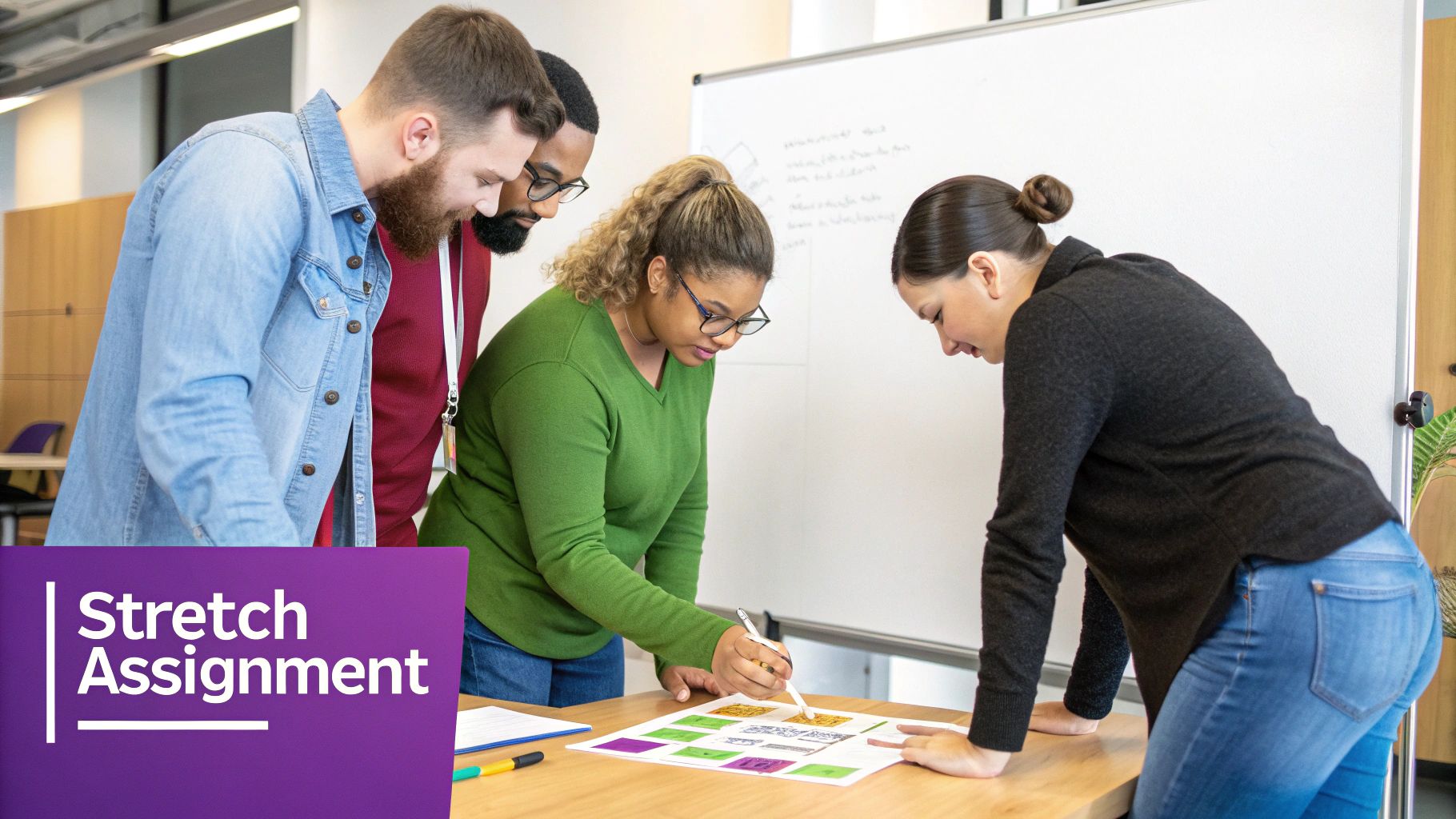
This sample professional development plan is particularly relevant for mid-market firms because it fosters agility and practical skill application without significant external training costs. By embedding learning into real-world business challenges, employees not only grow their competencies but also deliver tangible value to the organisation.
Why Use a Project-Based Approach?
This approach transforms professional development from a theoretical exercise into an applied practice. Instead of attending a generic project management course, an employee might be tasked with leading a small, cross-departmental initiative. This direct experience builds confidence and critical skills far more effectively than classroom learning alone, fostering a culture of continuous improvement and innovation popularised by tech industry rotation programmes and agile methodologies.
Strategic Insight: Utilising Microsoft Dynamics 365 Project Operations allows managers to assign, monitor, and link stretch assignments directly to an employee's development record in the HR system. This creates a closed-loop process where skill gaps identified in performance reviews can be addressed through targeted, value-adding project work.
Actionable Tips for Implementation
For organisations using the Microsoft ecosystem, integrating project-based learning is a strategic way to drive growth. Here are some tactical steps:
- Assign and Track Projects: Use Dynamics 365 Project Operations to formally assign stretch roles and track key milestones. This ensures development activities are visible and aligned with business priorities.
- Document Success Criteria: Create a simple Power App for project sponsors and employees to define and agree upon project objectives, success metrics, and learning goals.
- Automate Progress Check-ins: Leverage Microsoft Teams to schedule recurring monthly check-ins between the employee and their project sponsor, ensuring consistent support and feedback.
- Create a Knowledge Hub: Use a dedicated SharePoint site for employees to document key learnings, challenges, and insights from their projects, building an organisational knowledge base.
6. Learning Path and Micro-Learning Development Plan
The learning path and micro-learning approach offers a modern, flexible structure for a sample professional development plan. This model moves away from single, lengthy training events towards a continuous journey of smaller, focused learning activities. It combines formal courses, on-demand video modules, and practical on-the-job application to fit the demanding schedules of today's professionals.
This method is highly effective in fast-paced UK mid-market firms where time is a premium resource. By breaking down complex skills into manageable, bite-sized modules delivered via platforms like Microsoft Learn or LinkedIn Learning, employees can learn at their own pace, reinforcing knowledge exactly when it's needed.
Why Use a Learning Path and Micro-Learning Approach?
This approach fosters a culture of continuous improvement and self-directed learning. Instead of waiting for an annual training course, an employee can follow a curated path like "Mastering Power BI for Sales Analytics," which includes short videos, interactive labs, and a practical project. This makes development an ongoing, integrated part of their daily work rather than a disruptive event.
Strategic Insight: Use your central HR system, such as Hubdrive's HR Management for Microsoft Dynamics 365, to curate and assign specific learning paths from platforms like Microsoft Learn. This allows managers to track progress on micro-learning modules and certifications directly against an employee's development goals and career progression plan.
Actionable Tips for Implementation
For organisations embedded in the Microsoft ecosystem, implementing a micro-learning strategy is both intuitive and powerful. Here are some tactical steps:
- Create a SharePoint Learning Hub: Develop a central portal on SharePoint to host curated links to relevant Microsoft Learn modules, internal training materials, and external resources.
- Integrate with Microsoft Teams: Establish dedicated Teams channels for different learning paths where employees can discuss content, ask questions, and share insights, creating a supportive peer-learning environment.
- Track Progress with Power Apps: Build a simple Power App to allow employees to log completed courses, certifications, and practical application projects, feeding this data back into their development record.
- Visualise Engagement with Power BI: Create Power BI dashboards to monitor learning activity and completion rates across teams, giving leadership a clear view of skills development and engagement with the learning platforms.
7. Leadership Development and Succession Planning Programme
A leadership development and succession planning programme is a strategic, long-term initiative designed to prepare high-potential employees for senior leadership roles. This comprehensive sample professional development plan moves beyond individual skill-building to create a robust talent pipeline, ensuring organisational continuity and resilience. Pioneered by giants like GE and Unilever, this approach is vital for UK mid-market firms aiming to build sustainable, homegrown leadership capability.
This method directly aligns individual growth with future organisational needs. It identifies critical roles and cultivates the specific competencies required to fill them, mitigating the risks associated with unexpected leadership departures and skill gaps.
Why Use a Leadership and Succession Approach?
This integrated approach ensures the right people are ready for the right roles at the right time. Instead of reactive hiring, it proactively develops internal talent, which improves retention, preserves institutional knowledge, and fosters a culture of growth. It formalises the path to leadership, making career progression transparent and motivating for ambitious employees.
Strategic Insight: A successful succession plan is data-driven. Using Hubdrive’s HR Management for Microsoft Dynamics 365, you can centralise talent profiles, performance reviews, and development progress. This creates a holistic view of your leadership pipeline, allowing you to identify readiness and gaps with precision. To deepen your understanding, you can explore the key components of succession management in detail.
Actionable Tips for Implementation
For organisations invested in the Microsoft ecosystem, building and managing a leadership programme is a streamlined process. Here are some tactical steps:
- Track High-Potential Talent: Use Dynamics 365 to flag high-potential employees, track their career aspirations, and monitor their progress through tailored development pathways.
- Visualise the Pipeline: Develop Power BI dashboards to create a succession chart, visualising the readiness of candidates for critical leadership roles and highlighting potential pipeline gaps.
- Manage Development Activities: Schedule and track key activities like executive coaching via Teams, cross-functional project assignments, and mentorship pairings directly within the HR platform.
- Ensure Fair Identification: Use Power Apps to create structured forms for 360-degree feedback and leadership potential assessments, ensuring the process is consistent, data-driven, and inclusive.
8. Role-Based and Compliance-Focused Development Plan
For many UK organisations, particularly in regulated sectors like finance, healthcare, and law, professional development is not just about growth; it's about governance. This sample professional development plan is a specialised template that prioritises role-specific skills alongside mandatory regulatory compliance training and certifications. It ensures development aligns with both employee capability and crucial legal obligations.
This dual-focus approach is essential for mid-market UK firms managing diverse teams with specific compliance burdens. From UK Right to Work and GDPR to industry-specific health and safety, this plan provides a framework for embedding non-negotiable training into the standard development cycle, mitigating risk and ensuring audit readiness.
Why Use a Role-Based and Compliance-Focused Approach?
This plan moves beyond aspirational goals to address the foundational requirements of a role. Instead of viewing compliance as a separate, burdensome task, it integrates it directly into an individual's growth pathway. For example, a financial adviser's plan would not only include sales targets but also mandatory FCA regulation updates and anti-money laundering certification renewals, making compliance a core competency.
Strategic Insight: Managing compliance within your core HR system, like Hubdrive’s HR Management for Microsoft Dynamics 365, transforms it from a reactive chore into a proactive strategy. You can link mandatory training completion directly to performance reviews and career progression, demonstrating a robust culture of compliance.
Actionable Tips for Implementation
For organisations managing compliance within the Microsoft ecosystem, integrating this plan is a strategic advantage. Here are some practical steps:
- Automate Training Reminders: Use Outlook and Teams integrations to send automated notifications for upcoming mandatory training deadlines, such as annual GDPR refresher courses. Find out more about effective GDPR training for staff to ensure your team is always up-to-date.
- Track Certifications in Dataverse: Store all employee certifications, expiry dates, and training records securely in Microsoft Dataverse. Create automated alerts for renewals to prevent compliance lapses.
- Leverage Compliance Modules: Utilise specialised tools such as those within the Hubdrive HR solution to streamline verification for UK Right to Work and embed ongoing compliance checks directly within the employee record.
- Visualise Compliance with Power BI: Develop dashboards to give managers a clear, real-time view of compliance rates across their teams. This allows for quick identification of gaps and targeted interventions.
Comparison of 8 Professional Development Plan Models
| Development Plan | Implementation complexity | Resource requirements | Expected outcomes | Ideal use cases | Key advantages |
|---|---|---|---|---|---|
| SMART Goals Professional Development Plan | Low–Medium — simple framework, needs manager discipline | Low — time for goal setting; integrates with Dynamics/Power BI | Measurable goal attainment, clearer performance reviews | Mid-market orgs, performance-driven roles, quarterly reviews | Clear accountability; easy measurement; aligns to org goals |
| Competency-Based Development Plan | Medium–High — requires framework design and maintenance | Medium–High — assessments, multi-rater tools, competency libraries | Reduced skill gaps; targeted training; better role fit | Role-diverse teams (sales, field service), succession planning | Directly addresses role skills; supports internal mobility |
| Mentorship and Coaching Development Plan | Low–Medium — matching and coordination required | Low — mentor time, scheduling and tracking tools | Tacit knowledge transfer; higher engagement; leadership prep | Knowledge transfer, onboarding, leadership pipeline | Personalised development; cost-effective; builds culture |
| Individual Development Plan (IDP) Template | Low — formal documentation and review workflows | Low–Medium — forms, document storage, admin time | Documented accountability; audit-ready records; clarity of goals | Annual reviews, compliance-oriented orgs, individual planning | Formal record-keeping; flexible; integrates with HR systems |
| Project-Based Learning and Stretch Assignment Plan | Medium–High — careful project selection and oversight | Medium–High — project resources, sponsors, mentor support | Applied skill growth; business impact; confidence building | Leadership development, technical upskilling, cross-functional growth | Real-world application; high engagement; creates business value |
| Learning Path and Micro-Learning Development Plan | Medium — content curation and platform integration | Medium — content creation/curation, LMS/Teams integration | Continuous upskilling; measurable completions; higher engagement | Busy professionals, continual tech adoption, mobile learners | Flexible, scalable, mobile-friendly; good completion tracking |
| Leadership Development and Succession Planning Programme | High — multi-year, strategic coordination | High — executive coaching, rotations, analytics, time | Strong leadership pipeline; reduced long-term talent risk | Mid-to-large orgs preparing senior leaders, board succession | Strategic alignment; builds bench strength; improves retention |
| Role-Based and Compliance-Focused Development Plan | Medium — tracking, renewal scheduling, regulatory updates | Medium — compliance modules, certification tracking, admin | Regulatory compliance, audit readiness, reduced legal risk | Regulated sectors (finance, healthcare), mandatory certs | Ensures compliance; audit trail; role-specific training |
Transforming Plans into Progress with DynamicsHub
The journey through various professional development frameworks, from SMART goal-oriented plans to comprehensive leadership succession programmes, reveals a powerful truth: a plan is only as good as its execution. We have explored a diverse range of templates, each offering a unique lens through which to view employee growth. Whether it's the structured accountability of a competency-based plan, the collaborative spirit of a mentorship programme, or the targeted precision of a compliance-focused role plan, the underlying goal remains constant: to unlock potential and drive organisational success.
The key insight from each sample professional development plan is that structure and strategy must go hand-in-hand. Simply setting goals is not enough; we must define measurable outcomes, identify relevant learning activities, and establish clear timelines. The most effective plans are dynamic, adaptable, and deeply integrated into an employee’s daily work and the organisation's broader strategic objectives. They are living documents, not static forms filed away and forgotten.
From Static Templates to Dynamic Growth
To truly activate these plans, organisations must move beyond disconnected spreadsheets and manual tracking. The real transformation occurs when development becomes a centralised, visible, and automated part of your HR ecosystem. This is where the limitations of traditional methods become apparent and the power of a modern, integrated solution becomes indispensable.
Without a unified system, you risk:
- Administrative Overload: Managers spend more time chasing updates and manually collating data than they do coaching their teams.
- Lack of Visibility: Senior leadership has no clear, real-time view of skill development, competency gaps, or the ROI of training investments.
- Disengaged Employees: Staff perceive development as a tick-box exercise when progress isn't acknowledged or connected to career progression.
- Compliance Risks: In roles requiring specific certifications or adherence to regulations like UK Right to Work, manual tracking can lead to costly errors and oversights.
Activating Your Professional Development Strategy
The ultimate takeaway from this guide is that the sample professional development plan templates provided are your blueprint. The next crucial step is selecting the right tools to build your structure. Integrating these plans into a platform like Microsoft Dynamics 365, augmented with a comprehensive HR solution, turns this blueprint into a thriving, self-sustaining framework for growth.
By embedding development plans directly within your core HR system, you can automate reminders in Microsoft Teams, track progress against objectives in Dataverse, and visualise company-wide skill evolution with Power BI dashboards. This creates a powerful feedback loop where development is not a separate activity but a continuous, data-driven conversation. It empowers managers to become effective coaches and gives employees ownership over their career trajectory, fostering a culture of continuous improvement and lifelong learning. This strategic shift is what separates high-performing organisations from the rest; they don’t just plan for development, they build an engine for it.
We are DynamicsHub.co.uk. Experience HR transformation built around your business. Hubdrive’s HR Management for Microsoft Dynamics 365 is the premier hire‑to‑retire solution—more powerful, more flexible, and more future‑ready than Microsoft Dynamics 365 HR.
Ready to transform your professional development strategy from a collection of documents into a powerful engine for business growth? Phone 01522 508096 today or send us a message via our contact page to discover how we can build an HR transformation around your business.