

A 360 degree feedback review is a way of getting a full-circle view of an employee’s performance by gathering confidential feedback from the people who work with them every day. Instead of just hearing from a line manager, this approach brings in perspectives from peers, direct reports, and even the employee themselves through a self-assessment.
Understanding the 360 Degree Feedback Review
Think of a traditional performance review. It’s often like a single snapshot taken from one specific angle—that of the manager. It’s useful, but it doesn’t tell the whole story.
A 360 degree feedback review, on the other hand, is more like creating a detailed 3D model of an employee’s performance. It’s built from multiple viewpoints, giving you a far more complete and nuanced picture of their professional impact.

The idea is straightforward but incredibly powerful. The people working alongside an employee day-in, day-out often see things a manager might miss. Peers can offer real insight into teamwork and collaboration, while direct reports provide a unique perspective on leadership and communication skills.
To help clarify the distinction, let’s look at a quick comparison.
Traditional Review vs 360 Degree Feedback Review
This table highlights the fundamental differences between a conventional top-down performance review and a modern 360 degree feedback process.
| Aspect | Traditional Performance Review | 360 Degree Feedback Review |
|---|---|---|
| Feedback Source | Top-down (Manager only) | Multi-source (Manager, peers, direct reports, self) |
| Primary Focus | Evaluation and past performance | Development and future growth |
| Perspective | Singular and hierarchical | Holistic and multi-dimensional |
| Key Outcome | Performance rating or score | Actionable development plan |
| Communication | One-way conversation | Fosters a culture of open dialogue |
As you can see, the 360 degree approach is built for a different purpose—it’s less about a simple judgement and more about fostering genuine growth.
Why It Matters for Modern UK Workplaces
This kind of feedback has become even more crucial as remote and hybrid working arrangements have taken hold. When you don’t see your team in person every day, a manager’s view can naturally become narrower. A 360 review helps to fill in those blind spots, painting a much richer and more accurate picture of an employee’s contributions.
By bringing together these different viewpoints, the process delivers on several key fronts:
- It Uncovers Blind Spots: It clearly shows the gap between how we see ourselves and how others perceive us—the essential first step for any real personal growth.
- It Encourages Open Communication: Done right, it helps normalise the idea of giving and receiving constructive feedback, making it part of the company culture.
- It Supports Targeted Development: The detailed insights make it possible to create highly specific and actionable development plans that actually work.
A 360 degree review isn’t just an evaluation; it’s a developmental tool designed to build self-awareness. The goal is to provide individuals with a complete view of their professional persona, enabling them to leverage strengths and address challenges proactively.
This approach is certainly gaining ground in the UK. Recent research shows that 33% of UK companies now use 360 degree feedback as part of their performance management. For those who get it right, 75% report positive results. Perhaps most tellingly, an overwhelming 92% of managers find it particularly useful for identifying leadership blind spots.
Ultimately, a 360 review shifts the focus from a single person’s judgement to a collective conversation about growth. It gives you the comprehensive data needed to support meaningful employee development, making it an indispensable tool for any forward-thinking organisation.
Of course, the quality of the feedback you get depends entirely on the quality of the questions you ask. To get this right, you can learn more about crafting effective questions in our guide on 360 assessment questions.
Weighing the Rewards and Navigating the Risks
Bringing a 360 degree feedback process into your organisation can be a game-changer for growth, but it’s not something to be taken lightly. Success depends on a clear understanding of what you stand to gain and what could go wrong. When you get it right, the benefits ripple out far beyond a simple performance summary. For companies willing to put in the thought and effort, the payoff is huge.
The biggest win is a massive boost in employee self-awareness. Traditional, top-down reviews give people a very narrow, one-dimensional picture of their performance. In contrast, getting feedback from all angles shines a light on those tricky blind spots—that gap between how we think we’re coming across and how others actually see us. A manager might praise an employee for being highly efficient, but peers could point out that this efficiency sometimes tramples on teamwork. That’s an insight you’d simply never get from a standard review.
This kind of deep self-awareness is the perfect fuel for professional development that actually works. Instead of putting people on generic training courses, feedback from multiple sources pinpoints the specific skills and behaviours that need attention.
The Upside of a Multi-Source Approach
A well-managed 360 programme does more than just help individuals; it strengthens the whole company. It helps build a culture where everyone feels accountable and open communication is the norm, turning feedback from a scary annual event into an ongoing conversation.
Here are some of the standout benefits:
- Discovering Hidden Strengths: Colleagues and direct reports often see positive traits that managers miss, like someone who’s a brilliant informal mentor or the go-to person for solving tricky problems. This helps people recognise and lean into strengths they didn’t even know were valued.
- Building Better Teams: When team members give each other constructive feedback, it brings everyone closer to their shared goals. It helps people see exactly how their actions affect their colleagues, which naturally leads to better collaboration and a more connected team.
- Growing Stronger Leaders: For anyone in a management role, feedback from their direct reports is pure gold. It offers an unfiltered look at their communication style, how they make decisions, and their overall effectiveness, providing a clear path to becoming a more inspiring leader.
The real magic of a 360 degree feedback review is its ability to turn vague perceptions into a personal roadmap for growth. It shows people the “why” behind their impact on others and gives them clear signposts for where to focus their energy to make a real difference.
Sidestepping the Potential Pitfalls
For all its potential, this process is certainly not risk-free. If rolled out carelessly, a 360 review can cause more harm than good, breeding mistrust and anxiety instead of encouraging growth. It’s vital to go in with your eyes wide open to the challenges.
One of the biggest dangers is that personal bias or office politics can creep in and poison the feedback. If people see it as a chance to settle old scores, or if they’re worried about blowback for being honest, the data you collect becomes worthless. Anonymity can help, but it’s not a silver bullet.
Another classic mistake is tying 360 degree feedback directly to pay rises or promotions. The moment you do that, the focus flips from development to judgement. Raters start sugar-coating their comments, and the person being reviewed gets defensive. The feedback has to be a tool for growth, not a weapon for evaluation.
Finally, don’t underestimate the sheer administrative headache of running this manually. Without a proper system, gathering and making sense of all the feedback becomes a massive, error-prone job for HR. This can lead to long delays, accidental breaches of confidentiality, and a total loss of confidence in the process. The absolute key is to build psychological safety, making sure everyone feels secure enough to give and receive candid feedback without fear. That foundation is non-negotiable.
Building Your 360 Degree Feedback Programme From the Ground Up
A successful 360 degree feedback review doesn’t just happen. It’s the product of a well-designed strategy, carefully planned and executed with a human touch. Getting the groundwork right is absolutely critical for building trust, encouraging honest participation, and making sure the insights lead to real professional growth. Think of it as a journey that starts long before the first survey ever lands in an inbox.
The very first step? Defining a crystal-clear purpose. You have to decide if the feedback is purely for developmental reasons—helping people see their strengths and find areas for growth—or if it will be used for evaluation, like informing promotion or pay decisions. Frankly, for most UK organisations, sticking purely to development is the safest and most effective route. It creates a space where people feel safe enough to give candid, constructive feedback.
Once you know your ‘why’, the next mission is to get your leadership team on board. They can’t just sign it off; they need to be its biggest champions, showing everyone its value by taking part themselves. When senior leaders participate, it sends a powerful message: feedback is part of our culture, not just another HR tick-box exercise.
Designing an Effective Questionnaire
The questionnaire is the heart of your entire 360 degree feedback programme. If your questions are vague or poorly written, you’ll get useless data back. Simple as that.
Your questions need to be tied directly to your organisation’s core competencies and values. Crucially, they should focus on observable behaviours, not fuzzy personality traits. For example, instead of asking if someone is “a good leader,” a much better question is, “Does this person provide clear, actionable feedback to their team members?” It zeroes in on a specific, tangible action. A big part of a successful programme is learning how to write effective survey questions that actually deliver meaningful answers.
The diagram below maps out the key stages you’ll move through, from understanding the benefits to managing the risks involved.
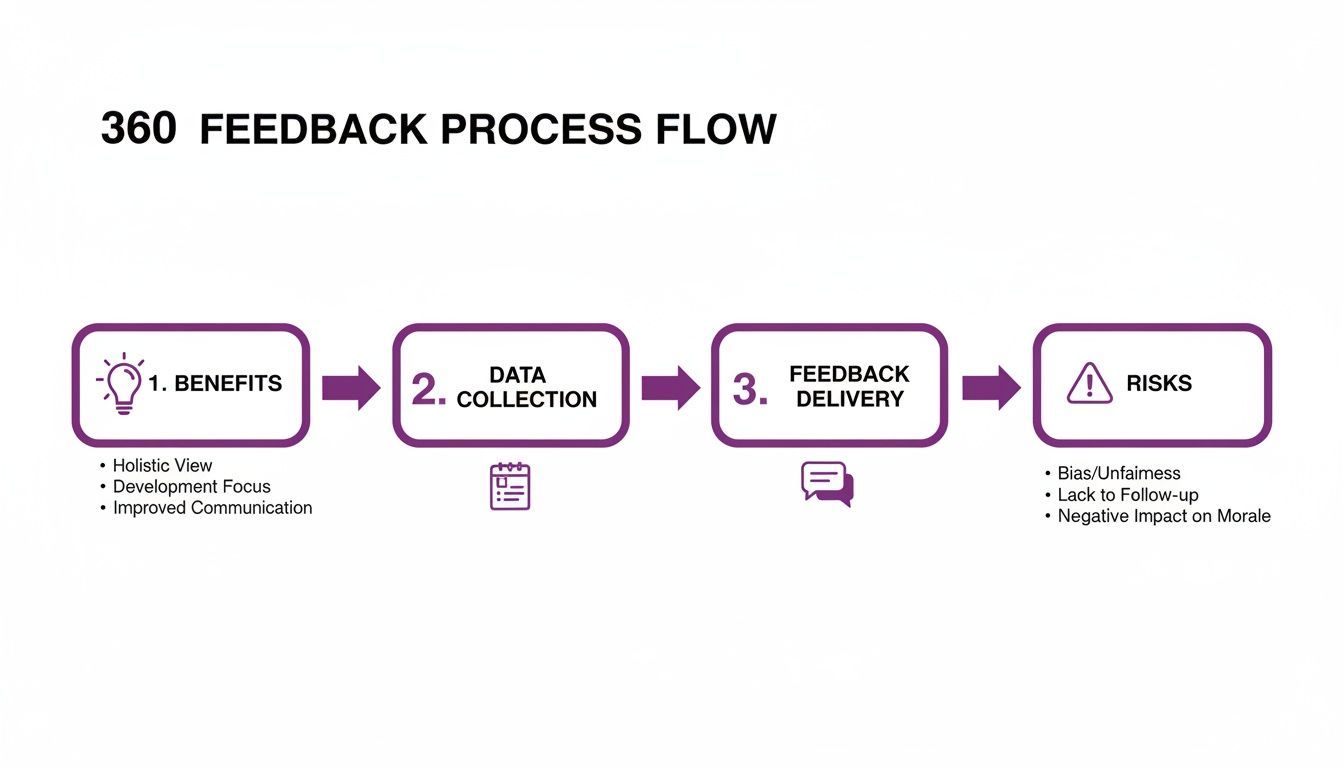
As you can see, a great programme balances the huge potential for growth with a smart, proactive approach to avoiding pitfalls like bias or administrative headaches.
Sample 360 Degree Feedback Questions by Competency
To make this more concrete, here are some examples of well-phrased, behaviour-focused questions. Notice how they ask about specific actions, making them easier to answer honestly and accurately.
| Competency Area | Sample Question for a Manager | Sample Question for a Peer |
|---|---|---|
| Communication | When giving feedback, does this manager clearly explain the situation and its impact? | When we collaborate on projects, does this colleague actively listen to different viewpoints before sharing their own? |
| Leadership | Does this manager create an environment where team members feel comfortable raising concerns? | Does this colleague take the initiative to help others when they see someone struggling with their workload? |
| Strategic Thinking | Does this manager effectively communicate the team’s connection to the company’s wider goals? | When we face a challenge, does this colleague suggest creative solutions that look beyond the immediate problem? |
| Collaboration | Does this manager foster a sense of teamwork and shared purpose within the department? | Is this colleague proactive in sharing information and resources that could benefit the rest of the team? |
These examples show how to move away from generic questions and towards ones that provide genuine, actionable insights into an individual’s professional behaviour.
Selecting Raters and Communicating the Process
Choosing the right mix of people to give feedback is vital for getting a balanced and credible picture. A typical group includes the employee’s manager, a few peers (usually between three and five), and all of their direct reports, if they have any. The individual also completes their own self-assessment using the exact same questions, which is a crucial reference point.
The goal is to gather a variety of perspectives. The feedback from a peer who collaborates on projects will be different from that of a direct report who experiences their leadership style daily. Together, these viewpoints create a complete and nuanced picture.
Once your raters are chosen, communication becomes your most important tool. You need to clearly explain the what, why, and how of the process to everyone involved. This needs to be transparent and reassuring, covering key points like:
- The Purpose: State clearly that the goal is development, not punishment.
- Confidentiality: Explain exactly how anonymity is protected. For example, feedback from peers and direct reports is almost always aggregated and anonymised.
- The Timeline: Give everyone clear dates for when surveys go out, when they are due, and when feedback sessions will happen.
- What Happens Next: Outline how the results will be used to create personal development plans, so people see the point of it all.
This kind of proactive communication builds trust and helps dial down the natural anxiety that can come with any review process.
Administering the Programme Effectively
The final piece of the puzzle is managing the administration. This means getting the surveys out, sending reminders to get them completed, and securely collecting all the data. Trying to do this manually is a massive administrative headache and is often riddled with errors and risks to confidentiality.
This is where modern HR technology, like the solutions we provide for the Microsoft ecosystem, really proves its worth. These systems automate the entire workflow, from sending invitations and tracking who has completed the survey to compiling the final reports. Using an integrated platform makes the process efficient, secure, and seamless for everyone. It turns the 360 degree feedback review from a daunting project into a smooth, repeatable process for continuous improvement.
Using Technology to Streamline Your Feedback Process
Let’s be honest, trying to run a manual 360 degree feedback review can be a nightmare. Juggling spreadsheets, chasing down responses via email, and painstakingly trying to anonymise comments is a recipe for frustration. It’s not just inefficient; it’s risky. One slip-up with a spreadsheet and you’ve got a data breach on your hands, completely shattering the trust you need for the process to work.
This is where modern HR technology steps in, taking the entire feedback cycle from a clunky administrative chore to a smooth, secure, and genuinely useful development tool. By ditching the manual methods, organisations can finally stop worrying about the logistics and start focusing on what really matters: the insights.
This isn’t just a niche idea; it’s a major trend across the UK. The market for 360 degree feedback software is set to grow at a compound annual rate of 9.1% between 2023 and 2030. A huge part of this growth comes from small and medium-sized businesses who are realising they can access sophisticated HR tools that are affordable and perfect for modern hybrid work.
The Power of Integrated Platforms
The real game-changer is integration. When your feedback platform is built directly into the systems your teams already use every day—like the Microsoft ecosystem—everything just works better. Think of a solution like Hubdrive’s HR Management for Microsoft Dynamics 365.
This kind of integration brings some massive benefits:
- Automated Workflow Management: The system handles all the nagging. It sends the rater invitations, nudges people with reminders, and keeps track of who has and hasn’t completed their feedback. This frees up your HR team to do more valuable work.
- Guaranteed Confidentiality: Good software automatically and securely collects and pools the feedback, making sure responses from peers and direct reports are always anonymous. This is absolutely vital for building the trust needed for people to be open and honest.
- Centralised Data and Reporting: No more copying and pasting into spreadsheets. All the data flows into one central place, ready to be turned into clear, easy-to-read reports at the click of a button.
By automating the nuts and bolts of the 360 review, technology lets you shift your focus from just running the process to actually using the insights. HR and managers can spend less time on admin and more time having meaningful development conversations.
For any business already using Microsoft 365, the advantages are even clearer. An integrated solution has a familiar feel, so there’s less of a learning curve for your staff. And when it comes to designing the review itself, our guide on 360 degree feedback questionnaires can give you a great starting point.
Ensuring Security and GDPR Compliance
Data protection is non-negotiable for any UK business. You’re handling highly sensitive personal feedback, so strict GDPR adherence is a must. This is where integrated solutions built on the Microsoft Dataverse really shine.
Unlike standalone tools that might shuttle your data off to third-party servers, a solution like Hubdrive keeps everything within your organisation’s own Microsoft 365 tenant. This is a crucial distinction for data security and compliance.
Keeping your data in-house gives you two huge advantages:
- Data Sovereignty: You have complete control. The data never leaves your secure environment and is protected by the same robust security protocols you already trust for Microsoft 365.
- Simplified GDPR Compliance: You can apply your existing Microsoft security and compliance policies directly to the feedback data. This makes it so much easier to manage things like data retention rules, access controls, and subject access requests, keeping you on the right side of GDPR.
From Data Collection to Actionable Insights
Perhaps the biggest win from using technology is its ability to turn a mountain of raw data into something clear and actionable. Trying to analyse qualitative and quantitative feedback manually is not only incredibly time-consuming but also prone to bias.
Integrated platforms use powerful tools like Microsoft Power BI to do the heavy lifting for you. They can instantly generate visual reports that highlight key themes, pinpoint strengths, and show the gaps between an employee’s self-perception and how others see them. These reports create an objective foundation for a productive feedback chat, turning overwhelming information into a focused plan for growth.
We are DynamicsHub.co.uk. Experience HR transformation built around your business. Hubdrive’s HR Management for Microsoft Dynamics 365 is the premier hire‑to‑retire solution—more powerful, more flexible, and more future‑ready than Microsoft Dynamics 365 HR.
Ready to modernise your feedback process? Phone 01522 508096 today or send us a message to learn how we can help.
Turning Feedback into Actionable Growth Plans
Getting the 360 degree feedback review report is just the first step. The real magic happens next, when you turn that raw data into a genuine roadmap for professional growth. Without a clear plan to convert insight into action, even the most detailed feedback report will just end up collecting digital dust.
This is where a forward-thinking conversation between the employee and their manager, often with HR’s support, becomes essential. The goal is to move past simply reading comments and scores and start building a tangible plan. It’s about shifting the focus from critique to construction, empowering the individual to truly own their development.
Interpreting the Feedback Report
First things first, you need to make sense of the report. It’s so easy to get fixated on a single negative comment or an unusually high score, but the real key is to zoom out and look for the bigger picture—the recurring themes and patterns.
A constructive analysis means digging out the most significant takeaways. Often, the most powerful insights are found in the gaps between how someone sees themselves and how others see them. A high self-rating in communication, for instance, starkly contrasted with lower scores from peers, is a massive signpost pointing towards an opportunity for growth.
Keep an eye out for:
- Key Strengths: These are the areas where self-perception and rater feedback are in positive agreement. They’re the superpowers you want to celebrate and build upon.
- Development Areas: These are the competencies where raters consistently gave lower scores, highlighting a clear area for improvement.
- Critical Blind Spots: This is the gold. It’s where an individual rated themselves highly, but others saw things differently. Uncovering these is often the catalyst for profound personal growth.
The best feedback discussions aren’t about debating whether a comment is ‘true’ or not. Instead, they focus on understanding the ‘why’ behind the data—exploring what behaviours might have led to a certain perception and figuring out how to adjust them going forward.
Creating a Personal Development Plan
Once you’ve identified the key themes, it’s time to build a Personal Development Plan (PDP). This isn’t just a to-do list of weaknesses; it’s a strategic document that connects the feedback directly to specific, measurable actions. The smartest way to frame this is by using SMART goals.
A SMART goal framework makes sure every objective is:
- Specific: Nail down exactly what needs to be achieved (e.g., “Improve the clarity of my project update emails”).
- Measurable: Define how you’ll track success (e.g., “Reduce the number of follow-up questions I get after sending updates”).
- Achievable: Make sure the goal is realistic, given the person’s role and resources.
- Relevant: The goal must connect with both the feedback and the individual’s career ambitions.
- Time-bound: Set a clear deadline to create urgency (e.g., “by the end of next quarter”).
The appetite for these kinds of analytical tools is growing fast. In the UK, projections show the 360 degree feedback software market will top £40 million by 2026. It’s no surprise when you consider that 85% of Fortune 500 equivalents already use this method for leadership development. You can learn more about the growth of 360 degree feedback software and its market trends.
Tracking Progress with Integrated Tools
Making the plan is one thing, but sticking to it is another challenge entirely. Modern HR platforms, like Hubdrive’s HR Management for Microsoft Dynamics 365, provide the tools you need to close the loop between feedback, action, and results. Right within Dynamics 365, managers and employees can document SMART goals, schedule check-ins, and track progress over time.
This kind of integration transforms development from a one-off event into an ongoing process. It directly links the insights from the 360 degree feedback review to the everyday performance management cycle, which keeps everyone accountable and focused on continuous improvement. By documenting this journey, both the employee and the organisation can see tangible proof of growth—a clear return on the investment made in the whole feedback process. For more on pinpointing these development areas, take a look at our guide on how to conduct a skills gap analysis.
Once the feedback has been analysed and development areas are clear, people often look for ways to turn those insights into real-world change. For anyone committed to acting on their feedback, understanding what is business coaching and how it unlocks your potential can be an excellent next step.
A New Chapter for Your Workplace Culture
Getting 360 degree feedback right isn’t just about ticking a box. As we’ve seen, it’s a real driver of cultural change. We’ve walked through the entire process, from designing a thoughtful review and running it securely, all the way to creating development plans that genuinely help your people grow.
When you give individuals a clear, multi-faceted view of their professional impact, they stop being passive recipients of feedback and start owning their development. It’s a powerful shift. This moves your company from the old-school, once-a-year appraisal to a place where constructive conversation is just part of how you work. The end game? A team that’s more engaged, self-aware, and ready for whatever comes next.
We are DynamicsHub.co.uk. We help businesses transform their HR with solutions built for the real world. Hubdrive’s HR Management for Microsoft Dynamics 365 is the complete hire‑to‑retire solution—more powerful and flexible than the standard Microsoft Dynamics 365 HR.
By making structured feedback a core part of your operations, you’re not just reviewing performance. You’re actively building a culture of excellence and respect, helping every single person reach their full potential.
Now it’s time to take these ideas and modernise how you manage performance.
Ready to get started? Give us a call on 01522 508096 or send a message through our contact page to see how we can help you build a stronger workplace.
Frequently Asked Questions
When UK organisations start exploring 360 degree feedback, a few practical questions almost always come up. Let’s tackle some of the most common ones.
Should 360-Degree Feedback Be Anonymous?
In almost all cases, yes. Anonymity is the bedrock of honest feedback. Without it, peers and direct reports often hold back, fearing that candid, constructive criticism might damage working relationships. You want the truth, and anonymity helps you get it.
The only real exception is the direct manager, whose feedback is usually identified. To make the whole process work, you have to be crystal clear with everyone about the rules of confidentiality from the start. Modern HR platforms, like the systems we implement at DynamicsHub, are built to handle this perfectly. They gather and group feedback in a way that protects individual identities while delivering powerful, themed insights to the person being reviewed.
How Is 360 Degree Feedback Different From a Standard Performance Review?
It’s easy to confuse the two, but they serve very different purposes. Think of a standard performance review as a top-down conversation, typically between an employee and their manager. It’s evaluative, focusing on hitting targets and often directly influencing decisions on pay rises or promotions.
A 360 degree feedback review, on the other hand, is all about development. It’s not an evaluation; it’s a mirror. By gathering confidential perspectives from a circle of colleagues—peers, direct reports, and managers—it gives someone a much richer, more rounded view of their own behaviours and skills. The goal here isn’t to judge past performance, but to spark self-awareness and map out a path for future growth.
What Are the GDPR Implications for a 360 Degree Feedback Review in the UK?
This is a critical point. Under GDPR, the comments and ratings collected in a 360 review are classed as personal data, which means you have a legal duty to handle them properly. UK companies need a lawful basis for processing this information, which is typically a legitimate interest in developing their people.
Being transparent is non-negotiable. You must tell employees exactly how their data will be gathered, what it will be used for, and how it will be kept secure.
This is where having an integrated system really pays off. A platform like Hubdrive for Dynamics 365 keeps all the feedback data safely within your organisation’s own Microsoft 365 environment. This approach means the data never leaves your control, allowing you to enforce your existing Microsoft security protocols and data retention policies. It makes satisfying your GDPR obligations a whole lot simpler.
At DynamicsHub, we’re dedicated to helping UK businesses build stronger, more effective teams. Experience HR transformation built around your business. Hubdrive’s HR Management for Microsoft Dynamics 365 is the premier hire‑to‑retire solution—more powerful, more flexible, and more future‑ready than Microsoft Dynamics 365 HR.
Ready to unlock the potential of your people? Phone 01522 508096 today, or send us a message.


