Days off in lieu, or TOIL as it's commonly known, is a pretty straightforward concept. Instead of paying staff for overtime, you give them that time back as paid leave. It’s a popular arrangement for salaried employees here in the UK, especially when they need to put in extra hours to hit a tight deadline or navigate a particularly busy spell. For it to really work for everyone, though, the whole approach needs to be crystal clear and fair.
Understanding Days Off in Lieu

When managed well, time off in lieu is a fantastic bit of flexibility that works for both sides of the table. For the business, it's a practical way to handle essential overtime without the immediate cash-flow hit of paying out enhanced rates. And for employees? It gives them a chance to reclaim their personal time, which is a massive plus for maintaining a healthy work-life balance.
Let’s take a real-world example. A marketing manager burns the midnight oil for three nights straight to get a major campaign over the line. Under their company's TOIL policy, instead of filing an overtime claim, they can bank those extra hours. Later on, they can cash them in for a long weekend or just a spontaneous day off, all without touching their actual annual leave allowance.
The Legal Context in the UK
Here’s the most important thing to remember: there is no automatic legal right to days off in lieu in the UK. The entitlement only kicks in if it’s specifically written into an employee's employment contract. Without that contractual clause or a solid company-wide policy, you’re under no obligation to offer TOIL at all.
This is why having a well-defined policy is your best friend. It guards against misunderstandings and stops potential disputes in their tracks. It needs to clearly spell out:
- Who is eligible? Is it for specific roles or all staff?
- How is it earned? Is it a simple hour-for-hour swap, or do you offer a better rate for weekend or evening work?
- Who signs it off? All overtime must be pre-approved by a manager to count.
- How is it booked? What’s the process for an employee to request their TOIL days?
- Is there a time limit? Does the accrued time need to be used by a certain date?
By setting these ground rules from the outset, you create a transparent and fair system where everyone knows where they stand. A clear policy is vital for morale, as it prevents people from feeling their extra effort has gone unnoticed.
The Evolution of Paid Leave in Britain
The workplace flexibility we often take for granted today is a world away from the conditions of the past. The whole idea of paid holidays in Britain really changed in the 1930s when the government stepped in to fix a huge inequality. Before the Holidays with Pay Act of 1938, a staggering 14.5 million manual workers in the UK earning less than £250 a year had zero right to any paid holiday.
Summer holidays were something only white-collar workers enjoyed; for manual labourers, the only time off was statutory bank holidays, which were unpaid. The act became law on 29th July 1938, and it completely changed the game for workers' rights in Britain, laying the groundwork for the entitlements we have today.
This history really puts things into perspective. Modern arrangements like TOIL and other forms of paid time off are now a core part of employment. There are also plenty of resources for understanding employee compensatory time, which offer a slightly different perspective on similar schemes.
Ultimately, a well-managed and fair TOIL policy isn't just good admin; it's the mark of a forward-thinking employer who genuinely cares about their team's wellbeing.
Crafting Your Fair and Compliant TOIL Policy

Without a formal, written policy, any approach to days off in lieu can quickly unravel into a mess of confusion and disputes. A solid policy is your best defence. It creates a transparent framework that protects both the business and your employees, turning a vague "gentleman's agreement" into a clear, manageable process.
Putting this policy in writing is non-negotiable. It needs to be a clear, accessible document that lives in your employee handbook or is referenced in their contract. This simple step ensures everyone understands the rules from day one, preventing mismatched expectations down the line.
Defining Eligibility and Accrual Rates
First things first: who gets to earn TOIL? Is it a perk for everyone, or is it reserved for certain roles or salary bands? Many businesses offer TOIL mainly to salaried staff who aren't usually paid for overtime, but you absolutely have to spell this out.
Next, you need to set the ground rules for how time is earned. The most straightforward route is a direct hour-for-hour swap—one hour of overtime equals one hour of TOIL. However, you might want to think about offering a better rate to reward people for working unsociable hours.
- Standard Rate: An employee stays late for two hours to finish a report and earns two hours of TOIL. Simple.
- Enhanced Rate: An employee works a four-hour shift on a Sunday and earns six hours of TOIL (a time-and-a-half rate).
Whatever you decide, consistency is king. Document the accrual rates clearly so there’s no guesswork involved when your team calculates their earned time.
The Importance of Pre-Authorisation
One of the biggest headaches with an informal TOIL system is staff banking unapproved hours. It’s a fast track to problems, from employees working beyond their capacity to blurring the lines between necessary overtime and poor time management. The solution? A mandatory pre-authorisation rule.
Your policy must state that all overtime must be approved in advance by a line manager to qualify for TOIL. This gives managers a handle on workloads and budgets, ensuring extra hours are only worked when genuinely needed. It also stops those "superhero" employees from burning themselves out and prevents the system from being taken for a ride.
A pre-authorisation clause isn't about micromanagement; it's about responsible resource planning. It makes sure overtime is a deliberate business decision, not an uncontrolled habit that could be masking bigger workload issues.
Setting Clear Expiry Dates
Letting employees stockpile days off in lieu forever is a huge risk, both financially and operationally. Imagine someone building up weeks of leave, which then becomes a nightmare if they want to take it all at once or when they hand in their notice.
To sidestep this, your policy must include a clear expiry date for any accrued TOIL. A common and fair window is requiring the time to be used within three to six months of being earned. This nudges employees to take regular breaks and stops a massive leave liability from building up on your books.
Before we go any further, here's a quick rundown of the essential clauses you'll want to include in your TOIL policy. Getting these right from the start will save you a world of trouble later on.
Essential Components of a UK TOIL Policy
| Policy Component | Key Considerations and Best Practices |
|---|---|
| Eligibility | Clearly define which employees (e.g., salaried, specific departments) are eligible. State if it's not applicable to staff who receive overtime pay. |
| Accrual Rate | Specify the rate at which TOIL is earned (e.g., hour-for-hour, time-and-a-half for weekends). Be consistent. |
| Approval Process | Mandate pre-approval from a line manager for all overtime. This is non-negotiable for control and fairness. |
| Booking Procedure | Outline how to request TOIL. It should usually follow the same process as booking annual leave, subject to business needs. |
| Expiry Period | Set a firm "use by" date for accrued time, typically 3-6 months. This prevents excessive accumulation. |
| Leavers' Policy | State what happens to unused TOIL when an employee leaves. Best practice is to pay out any outstanding, approved hours in their final salary. |
| Maximum Accrual | Consider capping the total amount of TOIL an employee can hold at any one time to manage operational impact. |
This table covers the core foundations of a robust policy. For a small business, managing these details is a crucial part of effective HR. Creating fair and compliant frameworks is a big responsibility, and you can find more guidance on the fundamentals of human resources for small business in our dedicated article.
Booking Time Off and Handling Leavers
The process for actually using TOIL should be just as clear as the one for earning it. The easiest way is to have it follow your standard procedure for requesting annual leave, subject to the usual line manager approval and business needs. This keeps things fair and ensures you always have enough cover.
Finally, your policy must be explicit about what happens when an employee leaves. What becomes of their unused TOIL? The accepted best practice is to state that any outstanding, approved TOIL will be paid out with their final salary. This avoids messy disputes and ensures you're compensating them fairly for the extra hours they put in.
Ready to build a better approach to employee leave and attendance? Phone 01522 508096 today or send us a message to see how we can help.
Getting the Numbers Right: Calculating and Tracking TOIL
The backbone of any good system for days off in lieu is getting the numbers right. If your calculations are off or your records are a mess, even the most well-intentioned policy will create headaches. This is where the practical side of HR administration really shows its value—accuracy is everything.
How you calculate TOIL says a lot about your company culture. The most common approach is a simple 'hour-for-hour' model. One hour of approved overtime equals one hour of TOIL. It’s clean, it’s simple, and everyone gets it.
That said, some businesses choose to offer an enhanced rate, especially for work done during unsociable hours. It's a great way to show staff you appreciate their flexibility and can be a real morale booster.
Standard vs Enhanced TOIL: What's the Difference?
Let’s put this into a real-world context. Imagine an employee has to work an extra four hours to get a critical project over the line. The TOIL they walk away with can look very different depending on your policy.
- Hour-for-Hour Model: If they put in those four extra hours on a normal weekday, they simply get four hours of TOIL.
- Enhanced Rate Model: But what if those four hours were on a Sunday morning? A policy offering time-and-a-half would give them six hours of TOIL.
This enhanced rate is a powerful way to acknowledge the bigger personal sacrifice that weekend work involves. Whichever route you take, make sure it’s spelled out clearly in your policy so that everything is fair, transparent, and consistent for the whole team.
Picking the Right Tracking Method
Once your calculation method is locked in, you need a reliable way to track it all. The best tool for the job often comes down to the size and complexity of your business.
For a tiny start-up, a shared spreadsheet might be perfectly fine to begin with. It’s a low-cost, quick-start solution for logging hours worked, TOIL earned, time taken, and the running total.
But as your team gets bigger, spreadsheets can become a real liability. They're prone to human error, manual data entry eats up valuable time, and version control can turn into a nightmare, often leading to confusion and disputes. That’s usually the point where dedicated software becomes a necessity.
A proper HR system takes the guesswork out of the equation by automating the whole process. From logging pre-approved overtime to calculating accruals and updating balances instantly, it gives you a single source of truth that protects both your employees and the business.
Why Accurate Tracking is a Legal Must-Have
Keeping meticulous records isn't just about good housekeeping; it's a legal requirement. Under the UK's Working Time Regulations, most employees can’t work more than an average of 48 hours per week (calculated over a 17-week period) unless they’ve formally opted out in writing.
Your TOIL records are your proof that you’re monitoring these hours and staying within the legal limits. They also help you spot worrying trends, like individuals consistently working excessive overtime, which could signal a burnout risk or a deeper issue with workload distribution.
This all ties back to the legal right to rest. UK law provides a minimum holiday entitlement of 28 days a year for full-timers, which equates to 5.6 weeks. This figure only reached its current level in April 2009, increasing from 24 days. Before October 2007, it was just 20 days. You can even explore how UK holiday entitlement measures up internationally for some perspective. A robust TOIL system ensures this statutory rest isn't chipped away by unmanaged overtime.
Ultimately, precise calculations and diligent tracking are non-negotiable. They keep your system fair, prevent burnout, and ensure you’re compliant, so your team can take the rest they’ve rightfully earned.
Ready to streamline your HR processes and ensure accuracy? Phone 01522 508096 today or send us a message to find out how we can help.
Managing TOIL Requests and Responsibilities
Having a great policy for days off in lieu is one thing, but making it work day-to-day is a different challenge altogether. This is where your line managers step in. They are the linchpins of the entire system, constantly balancing the needs of their team with the operational demands of the business. Their role in approving overtime and handling TOIL requests is absolutely critical.
A smooth, fair workflow prevents confusion and keeps everyone on the same page. In my experience, the best systems start with an employee getting pre-approval for any overtime from their manager. It's a simple but crucial first step. Once the extra hours are worked and approved, they're logged accurately. Later, when the employee wants to use that accrued time, they submit a request, which the manager then approves based on team capacity and project deadlines.
This structured approach strips out any ambiguity. It ensures every hour of TOIL is earned and taken legitimately, transforming what could be an administrative headache into a well-oiled machine that supports both flexibility and productivity.
The whole process really boils down to three core stages if you want to get it right and stay compliant.
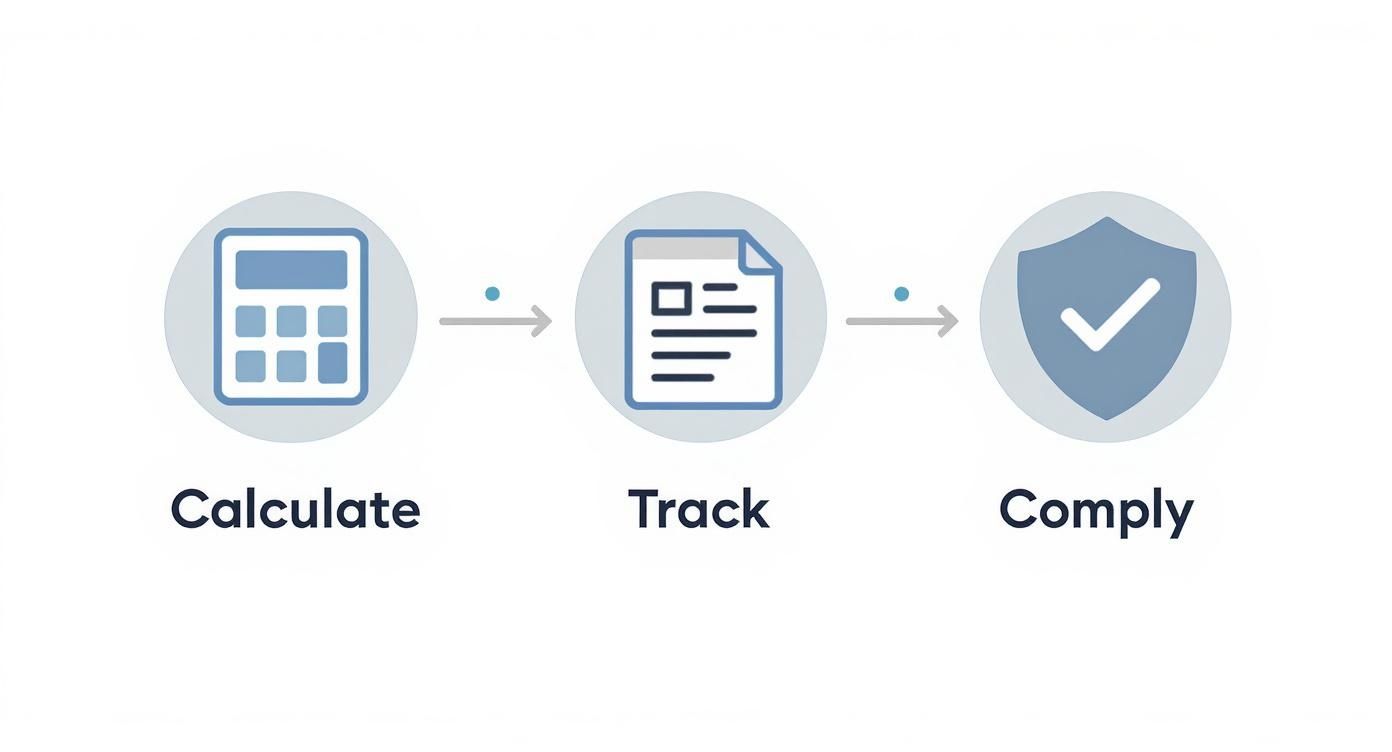
As you can see, a successful system always comes back to accurate calculation, diligent tracking, and unwavering compliance with both your own policy and UK law.
The Manager’s Role in Communication
Clear communication from managers is what truly makes or breaks a TOIL policy. It’s not just about rubber-stamping requests. It's about having proactive conversations about workload. If you see one of your team members constantly needing to work late, that’s a massive red flag. It warrants a proper discussion, not just another overtime approval.
Managers should be trained to spot these patterns and get to the root cause. A candid chat about workload distribution, time management, or whether they have the right resources is far more valuable than simply letting chronic overtime become the norm. It's about preventing burnout before it even gets a chance to set in.
By the same token, managers need to feel empowered to decline a TOIL request when necessary. Saying "no" can feel awkward, but sometimes it's essential for the business.
Managerial Tip: When you have to decline a TOIL request because it’s a busy period, always explain why and immediately suggest alternative dates. Try framing it as, "Let's find a time that works for you," rather than a flat rejection. This keeps things positive and shows you still value their need for a break.
For a smooth and compliant process, understanding how to handle time off requests is crucial. There are some fantastic resources out there that explain how to craft effective employee time off request forms to support this very workflow.
Avoiding Burnout and Presenteeism
One of the biggest hurdles with any leave policy is getting people to actually use their time off. A culture of ‘presenteeism’—where employees feel they have to be constantly visible and working—can completely torpedo the benefits of offering days off in lieu. Before you know it, staff are banking hours they never feel comfortable taking, which is a fast track to burnout.
Actively encouraging staff to take their earned time is vital for their wellbeing and, frankly, for your team's productivity. This is especially true when you look at the worrying trends in how UK workers use their statutory holiday. Recent analysis revealed that only 35% of UK workers used all their holiday days. Even more concerning, a staggering 57% admitted to working during their annual leave, meaning they never properly switch off. You can find more details in the full analysis of annual leave statistics.
To fight this, leaders have to lead by example. When managers take their own TOIL and annual leave, it sends a powerful message across the company that rest is valued and necessary.
- Regularly review TOIL balances: Managers should keep an eye on accrued hours. If someone's balance is getting high, give them a friendly nudge to book some time off.
- Plan leave proactively: Encourage your teams to plan their leave well in advance. It makes arranging cover so much easier and ensures everyone gets a proper break.
- Celebrate time off: Frame taking leave as a positive and essential part of a healthy work culture, not a sign of someone slacking off.
Ultimately, managing TOIL effectively is an active, ongoing responsibility. It demands clear processes, open communication, and a genuine commitment to the wellbeing of your people.
Ready to improve how you manage leave and attendance? Phone 01522 508096 today or send us a message to find out how we can help.
Automating TOIL Management for Your Business
Are you still wrestling with messy spreadsheets to manage days off in lieu? If you are, you know the drill. Manual tracking is not just a headache; it’s a minefield of potential errors, disputes, and wasted hours.
Thankfully, there's a much smarter way to handle it. You can automate the entire TOIL process, from the moment extra hours are worked to the day an employee takes their well-deserved break.
Imagine this: an employee logs pre-approved overtime through a simple online portal. The system instantly calculates the TOIL they've earned based on your company's rules—whether that's a straight hour-for-hour swap or an enhanced rate for weekend shifts. Their leave balance updates in real-time, completely visible to them. This isn't some far-off dream; it's exactly what modern HR platforms like DynamicsHub are designed to do.
A Smoother Workflow for Everyone
An automated system takes the administrative slog off the shoulders of managers and HR teams. When someone puts in a request for overtime or books a TOIL day, their line manager gets an instant notification to approve it. Gone are the days of chasing people for a signature or losing requests in a crowded inbox.
For your team, the difference is night and day. They can see their TOIL balance whenever they like, understand exactly how it was calculated, and book time off without having to kick off a long email chain. That kind of transparency builds trust and makes people feel genuinely valued.
The dashboard below gives you a sense of the clarity a modern HR system provides.
With a clean interface like this, managers and HR staff get a complete overview of employee data and any pending actions, making it simple to handle leave requests without any fuss.
The Real Advantage Is Integration
True efficiency kicks in when your TOIL management tool connects with the software your team already uses every day. When it’s built on a platform like Microsoft Dynamics 365, it can link up seamlessly with other applications. Integrating with Microsoft Teams, for example, means approvals can be sorted directly within a chat, making the whole process feel completely natural.
Here’s what that integrated approach actually looks like in practice:
- Less Admin: It drastically reduces the time spent on manual data entry.
- Fewer Mistakes: Automation gets rid of the human errors that creep into calculations.
- Full Transparency: Staff can check their live balances whenever they need to.
- Clearer Oversight: HR gains an accurate, real-time view of leave liabilities across the business.
By ditching standalone spreadsheets for a connected system, you create a single, reliable source for all leave data. This doesn't just save time; it gives you the solid reporting you need for proper workforce planning and compliance.
Choosing the right platform is the key. For any business thinking about updating its processes, looking into the best time and attendance software is a great starting point to see what's possible. Ultimately, automating your TOIL system frees up your people to focus on what they do best, improving both productivity and morale.
If you're ready to get a proper handle on your leave management with a modern, automated solution, we can help.
Give us a call on 01522 508096 today or send us a message to see how DynamicsHub can reshape your approach to days off in lieu.
Let's Get Your TOIL System Under Control
A well-managed system for days off in lieu is a fantastic tool for flexibility and motivation. But when it's all a bit chaotic, you're opening the door to legal risks, employee burnout, and a mountain of admin headaches.
The secret to getting TOIL right is surprisingly simple: build it on solid, clear foundations.
It all boils down to having a transparent policy that everyone understands, backed up by an accurate tracking system where every hour is properly accounted for. And crucially, your managers need the right tools and training to oversee the whole thing fairly and consistently.
A great TOIL system isn't just another HR process. Think of it as a direct investment in your team's wellbeing and your company's operational health. It protects the business while showing your people that their extra effort is genuinely valued.
Still wrestling with messy spreadsheets and chasing approvals through email chains? It’s probably time for an upgrade. An efficient, automated system doesn't just improve work-life balance for your team; it directly boosts your bottom line by cutting out mistakes and administrative drain.
Taking control of TOIL turns what can be a real problem into a powerful asset for keeping your best people happy.
Ready to sort out your approach to managing days off in lieu? Give us a call on 01522 508096 today or send us a message to see how we can help you build a system that actually works.
Your TOIL Questions Answered
Let's clear up some of the most common questions we hear from both managers and staff about how days off in lieu work in the UK.
Is Time Off in Lieu a Legal Requirement in the UK?
In short, no. There’s no automatic legal right to TOIL in the UK. It’s purely a contractual matter. An employee can only expect to get days off in lieu if it's explicitly written into their employment contract or a company-wide policy.
Without that formal agreement in place, an employer has no obligation to offer it. This is precisely why a clear, written policy is so important—it turns an informal handshake deal into a transparent process that protects everyone from misunderstandings down the road.
Can My Boss Make Me Take TOIL Instead of Overtime Pay?
This all comes down to what your contract says. If your employment agreement clearly states the company offers TOIL for extra hours, then that's the established process. But if your contract promises paid overtime, your employer can't just decide to give you time off instead.
The employment contract is the ultimate authority here. If a company wanted to change from paid overtime to a TOIL system, it would need to formally amend the contract, and you would have to agree to it.
What Happens to My Accrued TOIL if I Leave the Company?
The best way to handle this is to have a policy that spells it out clearly. The standard, and fairest, approach is for any outstanding and approved days off in lieu to be paid out with the employee's final paycheque.
This ensures people are properly compensated for the extra time they've put in and avoids any nasty disputes during their final weeks. Leaving this detail out of your policy is just asking for confusion and potential legal headaches.
Ready to bring your leave management into the 21st century and build a TOIL policy that's fair, compliant, and easy to manage? The team at DynamicsHub is here to help.
Phone 01522 508096 today or send us a message to see how our integrated HR tools can give you total clarity and control over your team's time.