It's one of the first questions we ask about a new job, yet the answer isn't as straightforward as you might think. So, how many hours is full time? In the UK, you won't find a single, legally-mandated number. Instead, the common standard sits somewhere between 35 and 40 hours per week, but what really counts is what’s written in your employment contract.
What Does Full Time Really Mean in the UK?

When you're hired, your employment contract is the single most important document. It's the agreement that lays out your responsibilities, your pay, and, critically, your expected working hours. While no law explicitly states "full time is X hours," a strong consensus has naturally emerged over decades of business practice.
This means the real-world definition of full-time work is shaped more by company policies and industry traditions than by government legislation. It’s this flexibility that allows different sectors—from a tech start-up to a busy hospital—to set schedules that make sense for their unique needs.
The Unofficial Standard: The 37.5-Hour Week
If you were to walk into a typical UK office, you'd find that the standard full-time week is 37.5 hours. This usually breaks down into a familiar Monday to Friday, 9:00 AM to 5:30 PM routine, with an hour for lunch. It has become the default for countless professional, administrative, and service-based jobs.
But it’s just a benchmark, not a hard-and-fast rule. Plenty of organisations consider 35 hours a week to be full time. On the other hand, sectors like logistics or retail management might set their standard at 40 hours or more.
The key takeaway for both employers and employees is that the employment contract is the ultimate source of truth. It solidifies expectations around availability, workload, and pay.
Why Do Full-Time Hours Vary?
The variation you see across the job market isn't random. Several factors influence what a company decides to classify as full-time work, explaining why one company’s 35 hours is another’s 40.
- Industry Norms: A creative agency might thrive on a 35-hour week to boost creativity and work-life balance. In contrast, a construction firm might need a 40-hour week to keep projects on schedule and make the most of site access.
- Company Culture: Some businesses intentionally offer a shorter working week as a perk to attract top talent. They see it as an investment in employee wellbeing, which often leads to better productivity.
- Operational Demands: Think about customer-facing roles in hospitality or healthcare. These often need shift patterns that add up to a 40-hour week simply to ensure there's always someone available to help.
To quickly grasp the common statuses, here’s a quick reference guide.
Typical UK Working Hour Classifications
| Status | Typical Weekly Hours | Key Considerations |
|---|---|---|
| Full-Time | 35–40 hours | Entitled to all statutory benefits like holiday pay and sick pay. The contract defines the exact hours. |
| Part-Time | Under 35 hours | Benefits are usually pro-rated based on hours worked. Protected from less favourable treatment. |
| Zero-Hours Contract | 0 (Variable) | No guaranteed hours. The worker can accept or decline shifts. Still entitled to statutory leave. |
| Compressed Hours | 35–40 hours | Standard full-time hours worked over fewer days (e.g., a 4-day week). |
This table helps illustrate that while the lines can blur, the classification has significant implications for pay, benefits, and workplace rights.
Ultimately, while no law fixes the number, long-standing custom has settled "full time" as working somewhere in the 35 to 40 hours per week range. As you can discover more insights about UK working time arrangements, this inherent flexibility is a core feature of the country's employment landscape.
Your Rights Under UK Working Time Regulations
While your contract lays out what ‘full-time’ means for your specific job, there’s a much bigger safety net in place for every worker in the UK. This is the Working Time Regulations 1998, a set of rules designed to stop employers from demanding excessive hours and to protect your wellbeing.
The headline rule is the cap on weekly hours. Your employer can't legally ask you to work more than an average of 48 hours per week. This average is usually calculated over a 17-week period, so it’s not a hard stop each week, but it prevents you from being consistently overworked and heading towards burnout.
The 48-Hour Week and The 'Opt-Out'
Of course, rules often have exceptions. You can choose to work more than the 48-hour average, but only if you voluntarily sign an 'opt-out' agreement.
This has to be a formal, written agreement, and it’s completely your choice. Your employer can't make it a condition of your job offer or pressure you into signing it. The power is in your hands.
Best of all, you can change your mind. If you sign an opt-out but later decide it’s not for you, you have the right to cancel it. You just need to give your employer notice – usually between one week and three months, as specified in the agreement. They absolutely cannot penalise you for doing so.
The 48-hour weekly average is a fundamental protection, not a target. The opt-out agreement gives employees flexibility, but the power to revoke that agreement always remains with the individual worker, ensuring they maintain control over their work-life balance.
Core Rights Beyond the Working Week
The regulations go much further than just the 48-hour limit. They establish a foundation of rights for every single worker, whether they’re full-time or part-time. Knowing these is key to making sure you get the rest you're entitled to.
Think of these as your non-negotiables:
- Minimum Daily Rest: You have a right to 11 consecutive hours of rest between shifts. This is the legally protected downtime you need to switch off before your next working day begins.
- Weekly Rest Period: You must get at least one uninterrupted 24-hour break each week, or a 48-hour break each fortnight. This is your proper weekend, your chance to fully disconnect from work.
- Paid Annual Leave: Every full-time worker gets a minimum of 5.6 weeks of paid holiday each year. If you work a typical five-day week, that works out to 28 days. Part-time workers get the same entitlement, just calculated on a pro-rata basis.
These rules are the bedrock of fair working life in the UK. They ensure that no matter what your contract says about 'full-time' hours, your health and safety are always protected.
Contracted Hours vs. The Hours You Actually Work: What's the Real Story?
Let’s be honest for a moment. Your employment contract might neatly state you work a 37.5-hour week, but how often does your actual time on the job match that number? For many of us, there's a huge gap between the hours on paper and the hours we really put in.
This isn't just a case of being busy. It's a deep-rooted feature of UK work culture, where deadlines, project pressures, and an unspoken expectation to "go the extra mile" have become the norm. This ‘always-on’ mindset has quietly turned unpaid overtime into a standard practice across countless industries, leading to serious burnout, plummeting productivity, and a real hit to employee wellbeing. For businesses, ignoring this trend isn't just bad for morale; it opens the door to hidden legal and operational risks.
While it might feel like everyone is doing it, there are important legal protections in place to prevent excessive working hours and safeguard your time.
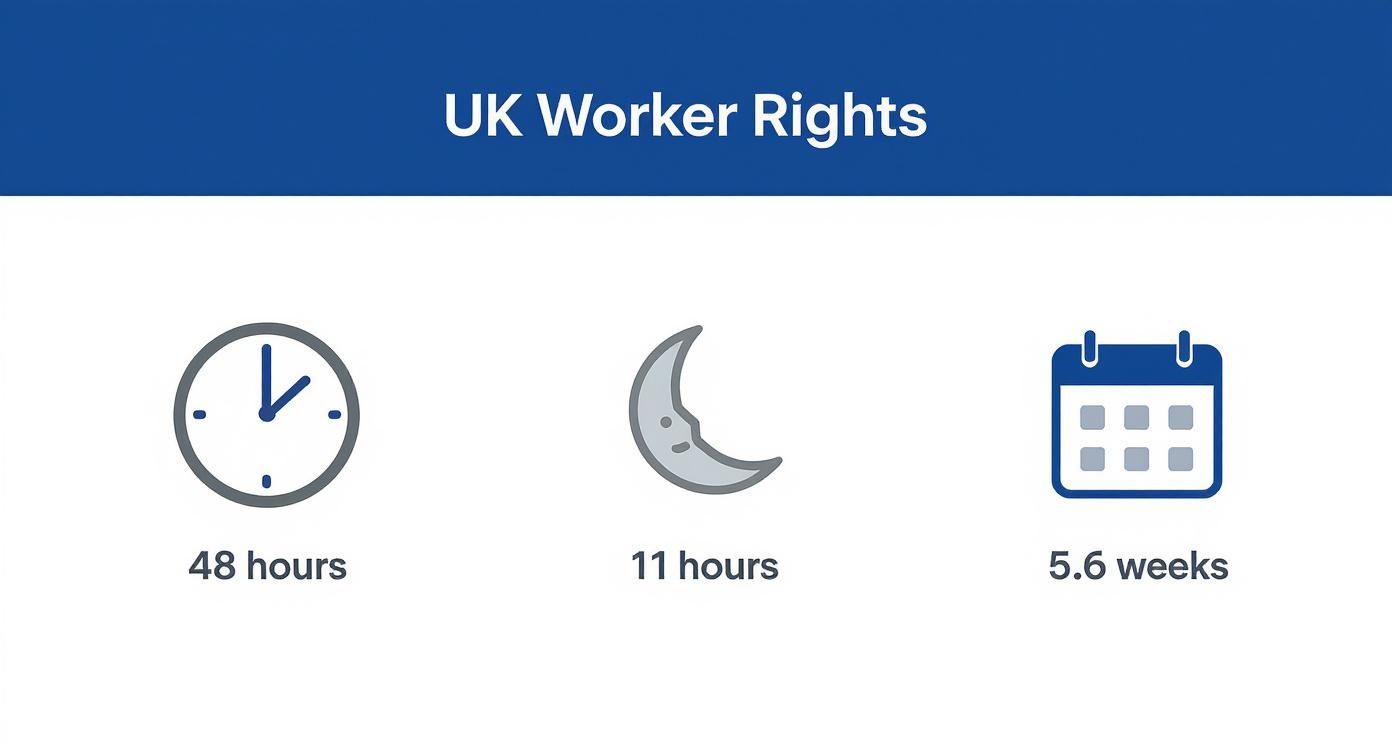
These rules, like the 48-hour average weekly limit and guaranteed rest periods, are a critical safety net. They exist for a reason.
The True Picture of UK Working Hours
Officially, the average full-time week in the UK is about 36.5 hours. But the real-world data paints a much starker picture. A startling 94% of UK workers admit to working beyond their contracted hours, and what's more, 65% feel pressured to do so.
When you factor in all that unpaid labour, the average working week for a full-time employee balloons to around 43 hours. That’s a massive difference. You can dive deeper into the data on the working hours culture in the UK to see the full extent of the issue.
This relentless overtime takes a toll. Even though every full-time worker is entitled to 5.6 weeks of paid annual leave, a staggering 41% don't take their full allowance. This only makes the risk of stress and exhaustion worse. When extra hours are unavoidable, managing that time becomes essential. Some employers have systems for tracking this, and understanding how to claim days off in lieu is a powerful way to get some of that work-life balance back.
Working consistently beyond your contracted hours isn't a badge of honour—it's a clear warning sign of burnout. For a business, this creates a false economy where short-term gains are won at the cost of long-term employee health, engagement, and retention.
Turning a blind eye to this is a major gamble for any company. It leads directly to burnout, where tired employees make more mistakes and productivity nosedives. It also breeds resentment when people feel their extra effort is taken for granted. And, from a legal standpoint, it puts the business at serious risk of breaching the Working Time Regulations if hours aren't tracked and managed correctly.
How to Calculate Full-Time Equivalent for Your Team
When your team is a mix of full-timers and part-timers, just counting heads doesn't really tell you what your workforce can achieve. You might have ten people on the payroll, but what does that mean in terms of actual working hours? This is where the Full-Time Equivalent (FTE) comes in – it’s an essential tool for getting an accurate read on your team's capacity.
Think of FTE as a common currency for workload. It converts the hours put in by your part-time staff into the equivalent number of full-time positions. For instance, if your company's full-time week is 40 hours, an employee working 20 hours is contributing 0.5 FTE. Someone working 30 hours is a 0.75 FTE.
This simple bit of maths lets you standardise your workforce data. Instead of just seeing a headcount, you start to understand your true labour capacity, which is the key to making smarter decisions about staffing, budgeting, and project planning.
The Basic FTE Calculation
Working out FTE is surprisingly straightforward. The formula is designed to give you a clear, immediate snapshot of how part-time hours stack up against your full-time standard. You just need two numbers.
Here’s the calculation:
Total Part-Time Hours Worked ÷ Number of Full-Time Hours in a Period = FTE
Let's run through a quick example. Say your business defines full-time as 37.5 hours a week. You have two part-time employees—one works 15 hours, and the other works 22.5 hours.
- First, add their hours together: 15 + 22.5 = 37.5 hours.
- Then, divide by your full-time standard: 37.5 ÷ 37.5 = 1.0 FTE.
So, in this case, those two part-timers are equivalent to one full-time member of staff. It's that simple. For more complex situations, you can dive deeper in our complete guide on how to calculate FTE.
To make this even clearer, here are a few more examples.
Sample FTE Calculations (Based on a 40-Hour Full-Time Week)
This table shows how different part-time schedules translate into FTE, assuming a standard full-time week of 40 hours.
| Employee Weekly Hours | Calculation | Resulting FTE |
|---|---|---|
| 10 Hours | 10 ÷ 40 | 0.25 |
| 16 Hours (2 days) | 16 ÷ 40 | 0.40 |
| 24 Hours (3 days) | 24 ÷ 40 | 0.60 |
| 32 Hours (4 days) | 32 ÷ 40 | 0.80 |
| 35 Hours | 35 ÷ 40 | 0.875 |
As you can see, the FTE figure gives you a much more nuanced view of each person's contribution than a simple "part-time" label ever could.
FTE isn't just an abstract number for a spreadsheet; it's a practical tool for ensuring fairness. It guarantees that part-time employees receive the correct pro-rata holiday pay, pension contributions, and other benefits, preventing compliance headaches and building a truly equitable workplace.
Why FTE Is So Important for Your Business
Getting a handle on FTE calculations helps you manage your team more effectively and fairly. It touches almost every core area of the business, from finance right through to legal compliance. For any HR or operations manager, it's a non-negotiable metric.
Here are a few real-world examples of FTE in action:
- Annual Budgeting: You can forecast salary costs with pinpoint accuracy because you’re funding actual labour capacity, not just a certain number of employees.
- Benefits Administration: It ensures your part-time staff get their fair, pro-rata share of benefits like paid leave and pension schemes, which is crucial for staying on the right side of UK employment law.
- Resource Planning: Wondering if you have enough cover for that big upcoming project? Look at your total FTE, not just your headcount, to get the real answer.
- Statutory Reporting: While some countries have strict rules based on FTE for healthcare, the UK has its own important thresholds for things like gender pay gap reporting, which can be influenced by your mix of full- and part-time staff.
Ultimately, using FTE creates a level playing field where every hour worked is accounted for properly, giving you the clarity needed to run your business well.
How Full-Time Status Affects Your Pay and Benefits
Being classed as ‘full-time’ is about much more than just the hours you put in. It’s often the key that unlocks a whole different tier of pay, benefits, and job security. This status directly shapes your salary, the perks you're entitled to, and your overall financial picture, so it’s vital for everyone to understand the connection.
The most obvious difference often lies in how you get paid. Full-time positions are usually salaried, meaning you earn a fixed annual sum paid in regular chunks. It provides a steady, predictable income, even if your weekly hours fluctuate a little. In contrast, part-time roles are often paid by the hour, which means your earnings are directly tied to the shifts you work—great for flexibility, but less stable.
What the Law Guarantees for Full-Time Staff
In the UK, your full-time status automatically grants you a set of statutory rights. These are the non-negotiable legal protections and benefits that every qualifying employee receives. While part-time workers have similar protections, their entitlements are typically calculated on a pro-rata basis.
For full-time employees, the core legal entitlements include:
- Statutory Sick Pay (SSP): If you’re too unwell to work for more than four days in a row, your employer is legally required to pay you a minimum weekly amount.
- Pension Auto-Enrolment: All eligible full-time staff must be automatically enrolled into a workplace pension scheme, with the employer making mandatory contributions.
- Parental Leave: This covers maternity, paternity, adoption, and shared parental leave, all of which give you job-protected time off to welcome a new child into your family.
Think of these as the legal foundation of your employment package, ensuring a fundamental level of support.
The Real Financial Value: Company-Specific Perks
This is where the true value of a full-time contract often shines. On top of the legal minimums, most companies offer their own suite of extra benefits, which are frequently reserved for—or significantly enhanced for—their full-time workforce. These perks are powerful tools for attracting and keeping good people.
A strong benefits package for a full-timer might include things like:
- Private Health Insurance: Giving you and your family faster access to medical care when you need it.
- Enhanced Pension Contributions: Many employers will contribute more than the legal minimum, for instance, by matching your own contributions up to 5% or even higher.
- Life Insurance or 'Death in Service' Benefit: This provides a tax-free lump sum to your loved ones, often calculated as a multiple of your salary (e.g., 4x your salary).
- Company Car or Car Allowance: A common perk for senior roles or those who travel for work, potentially worth thousands of pounds a year.
From a business perspective, an employee's cost is far more than just their salary. To get the full picture, you need to calculate your true fully burdened labor rate, which factors in National Insurance, pension payments, and the cost of all these benefits. It’s this total figure that represents the company's real investment in each full-time team member.
Why Accurate Time Tracking Is No Longer Optional
Let's move from theory to practice. In today's world, relying on manual timesheets isn't just old-fashioned—it's a genuine risk. For any modern business, proper hour tracking is a cornerstone of good management, essential for accurate payroll, staying on the right side of the law, and gaining real insight into how your business actually runs. It's about so much more than just clocking in and out.
Think of it this way: keeping precise records is your best defence against accidentally falling foul of the Working Time Regulations. Without a reliable, automated log of hours worked, including breaks and any overtime, you're essentially flying blind. This kind of guesswork leaves your business wide open to payroll disputes and potential legal headaches down the road.

Beyond Compliance to Strategic Insight
The real magic of smart time tracking happens when you look past the legal necessities. The data you gather is a goldmine of business intelligence that can lead to smarter decisions and a much healthier, more productive work environment. It turns a chore into a competitive advantage.
For instance, when you track hours against specific projects or clients, you suddenly have the power to calculate profitability with pinpoint accuracy. This clarity helps you quote new work more confidently, allocate your team's time where it matters most, and see which types of jobs are actually making you money. For more on this, it's worth exploring some established time tracking best practices.
Accurate time tracking isn’t about micromanagement; it's about clarity. It gives businesses the data needed to protect themselves legally while helping them spot burnout risks before they escalate, ensuring fairness for everyone.
This data also acts as a brilliant early-warning system for employee wellbeing. If you notice someone is consistently logging hours far beyond what their contract states, it’s a clear sign to step in and have a conversation. This proactive approach helps you tackle burnout before it takes hold, which in turn reduces staff turnover and builds a culture where people feel genuinely supported.
Modern systems make all of this incredibly straightforward. Choosing from the best time and attendance software gives you the tools to automate the whole process, ensuring everything is fair, accurate, and gives you complete legal peace of mind.
Your Questions on UK Working Hours Answered
Even with the main definitions covered, a few common questions always pop up. Let's tackle some of the most frequent queries we hear from both employers and employees about full-time work in the UK.
What Are the Average Weekly Hours in the UK?
While individual contracts are king, it's useful to know what's typical across the country. According to recent data, the average full-time employee in the UK clocks in at around 36.5 hours per week.
This number has been pretty stable for a while, which explains why you see so many employment contracts built around a 35 or 37.5-hour week. For a deeper dive into these figures, you can learn more about UK employment trends and see how your policies stack up.
Are Salaried Employees Entitled to Overtime Pay?
This is a big one. In the UK, there's no automatic legal right for a salaried employee to get paid for overtime. It all comes down to what's in your employment contract.
If your contract doesn't say anything about overtime pay, your employer generally doesn't have to pay you extra for those additional hours. The one major exception is that your average hourly pay for the total hours worked must never dip below the National Minimum Wage.
What's the Real Difference Between a Zero-Hour and a Full-Time Contract?
Think of it as the difference between guaranteed stability and total flexibility. A full-time contract gives an employee a set number of hours and, with it, a predictable, steady income. You know what you're working and what you're earning each week.
A zero-hour contract, on the other hand, offers no minimum hours at all. Work is offered if and when it's available, and the individual has the freedom to accept or decline it. It’s a trade-off: flexibility for predictability.
Can My Boss Force Me to Work More Than 48 Hours a Week?
In short, no. An employer cannot legally compel you to work more than the 48-hour average weekly limit. This is a fundamental protection under the Working Time Regulations.
The only way around this is if you have voluntarily signed an "opt-out" agreement. Without your explicit, written consent to waive this right, you cannot be forced to work beyond that cap.
Ready to Take Control of Your Team's Hours?
Juggling working hours, staying on top of compliance, and getting payroll right every single time is a massive headache for any business. It’s a lot to handle, and mistakes can be costly. If you feel like you're constantly chasing timesheets and second-guessing your data, maybe it's time for a better way.
We specialise in modern time and attendance systems built to take the pain out of the process. Imagine automated tracking, reporting that actually makes sense, and a system that fits right in with how you already work. It’s about swapping the guesswork for genuine confidence.
Let us help you finally put the question of "how many hours is full time?" to bed with total clarity and control.
Phone 01522 508096 today or send us a message to see how we can help.