A probation period in the UK is essentially a getting-to-know-you phase for a new job. It’s a set timeframe, usually lasting three to six months, where a new starter and their employer can test the waters.
Think of it as an extended interview, but with real work. It gives the business a chance to see if the new hire has the skills and temperament they advertised, and it allows the employee to decide if the job and the company are genuinely the right fit for them.
What’s a Probation Period Really For?
A probation period is far more than just a box-ticking exercise in an employment contract. It’s a fundamental part of building a solid, long-term working relationship. It creates a formal space for both the new starter and the employer to make a fully informed decision before committing for the long haul.
For the company, it’s a smart way to manage the risk of a mis-hire. Getting recruitment wrong is expensive, not just in cash but in lost time and team morale. This initial period is all about confirming that the employee’s abilities, work ethic, and personality truly match what the business needs. It moves past the hypotheticals of the interview and into the reality of the day-to-day job, asking one simple question: “Can this person do the work and fit in with our team?”
It’s a Two-Way Street
It’s so important to remember that this isn’t a one-sided test. While the employer is sizing up the new employee, that employee is doing exactly the same in reverse. They’re getting a real feel for the role, the team dynamics, and the company culture. It’s their chance to ask themselves if the job lives up to the description and if the workplace is somewhere they can see themselves growing.
At its heart, a probation period is about making sure the fit is right for everyone. It’s a practical part of onboarding that swaps uncertainty for clarity, paving the way for a productive relationship from the very beginning.
The Main Goals of a Probation Period
A well-run probation period isn’t about catching people out; it’s about setting them up for success. It provides a structured opportunity for support and guidance, rather than just throwing a new person in at the deep end.
The key objectives are usually:
- Checking Performance: Can the new employee perform the core duties of their role to the required standard?
- Assessing Cultural Fit: How well do they gel with the team and align with the company’s way of working?
- Verifying Skills: Do the skills and experience they talked about in their interview actually translate to the job?
- Providing Support: It’s the perfect time to offer targeted training, regular feedback, and help to iron out any early teething problems.
By treating the probation period as a supportive and constructive phase of onboarding, businesses create a much more positive and transparent experience. This not only helps make better hiring decisions but also boosts the new employee’s confidence and sets the foundation for a successful, long-term career with the company.
Understanding Your Legal Rights During a Probation Period
It’s a common misconception that employees on probation have a completely different set of legal rights. The reality is much simpler: standard UK employment law applies from day one. There isn’t a special legal rulebook just for probation.
That said, how certain rights kick in is different, particularly when it comes to notice periods and protection from unfair dismissal. These are the two areas where the probationary period really has legal teeth. From your first day, you’re entitled to the National Minimum Wage, statutory paid holiday, and protection from discrimination. But the crucial two-year service rule for unfair dismissal claims changes everything.
This summary offers a quick overview for both employers evaluating new hires and employees navigating their initial responsibilities.
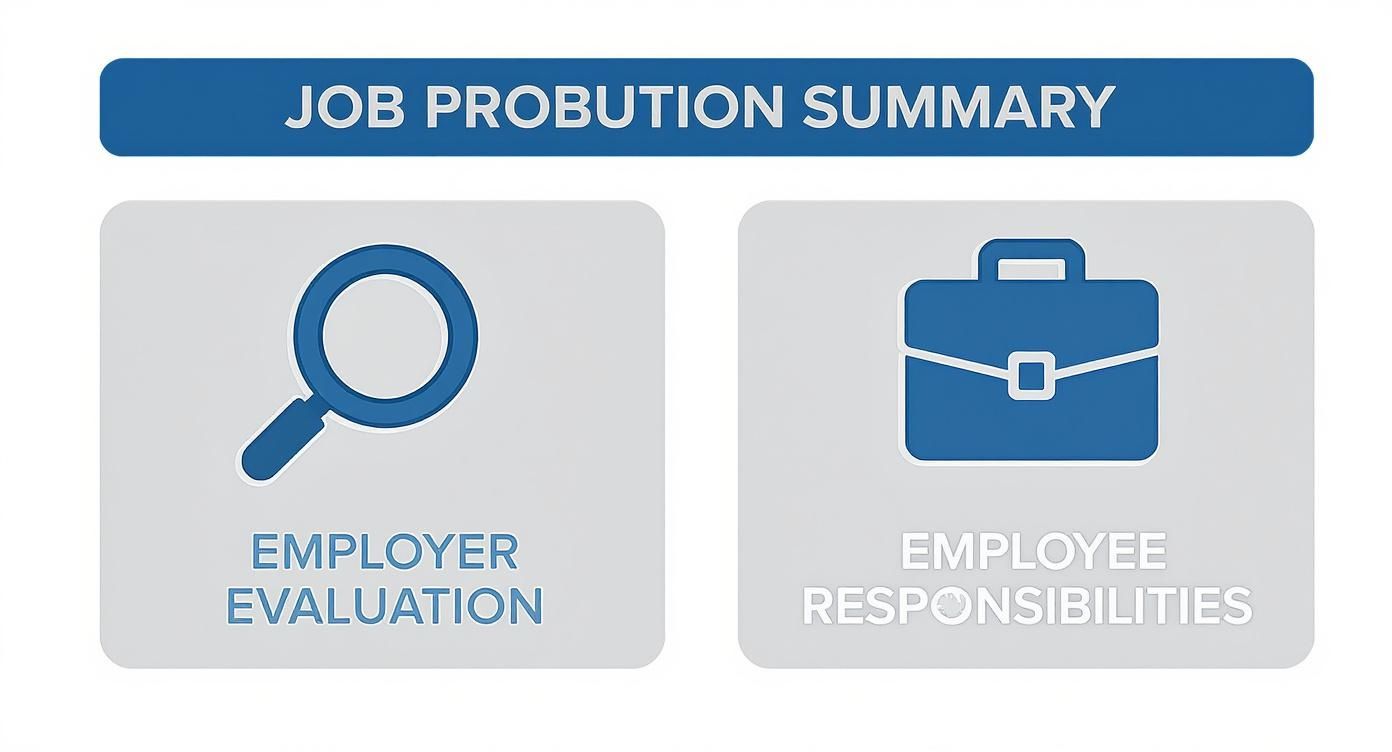
The graphic shows that probation is really a two-way street—a structured time for assessment and adjustment that sets the tone for a successful working relationship.
Notice Periods: Keeping Things Flexible
One of the most noticeable differences during probation is the notice period. The law sets out some very short minimums, although your contract might specify something a little longer.
Here are the statutory minimums:
- During the first month: Legally, no notice is required from either side.
- After one month but less than two years: The employer must give at least one week’s notice. An employee is also usually required to give one week.
Most companies write a one-week notice period into the contract for the probation. This gives both the employer and the employee an agile way to part company if it’s clear the role isn’t a good fit. Once probation is passed, this typically extends to a month or more.
Dismissal Rights and the Two-Year Rule
This is the big one. In the UK, an employee generally needs two years of continuous service before they can bring a claim for ordinary unfair dismissal.
Since most probation periods are between three and six months, an employee dismissed during this time simply won’t have the service length needed to make that kind of claim. This is what makes it legally more straightforward for an employer to end the employment if things aren’t working out.
But this doesn’t mean employers have free rein. Any dismissal, even during probation, must not be for an “automatically unfair” reason or discriminatory.
Where You Are Protected From Day One
Even without two years’ service, every employee has immediate protection against being dismissed for specific reasons. Firing someone on probation for any of the following is illegal:
- Asserting a statutory right (like asking to be paid the National Minimum Wage).
- Pregnancy or anything related to maternity leave.
- Whistleblowing (reporting serious wrongdoing at work).
- Raising legitimate health and safety concerns.
These are known as ‘automatically unfair’ reasons for dismissal, and this protection applies from the moment you start the job.
On top of this, the Equality Act 2010 protects every worker from discrimination based on protected characteristics like age, disability, race, religion, gender, or sexual orientation. A dismissal linked to any of these would be unlawful, no matter how long the employee has been there.
So, while letting someone go during their probation is simpler, employers must always have a legitimate, non-discriminatory reason and—crucially—have the paperwork to back it up.
Here’s a table breaking down how an employee’s rights evolve.
Employee Rights During vs After Probation
| Right or Entitlement | During Probation Period (Under 2 Years) | After Probation Period (Over 2 Years) |
|---|---|---|
| National Minimum Wage | Entitled from Day 1 | Entitled |
| Statutory Holiday Pay | Entitled from Day 1 | Entitled |
| Protection from Discrimination | Protected from Day 1 | Protected |
| Statutory Sick Pay | Entitled (if eligibility criteria met) | Entitled (if eligibility criteria met) |
| Statutory Notice Period | 1 week (after first month) | 1 week per year of service (up to 12 weeks) |
| Right to Claim Unfair Dismissal | No (unless for an automatically unfair reason) | Yes |
| Statutory Redundancy Pay | No | Yes |
| Maternity/Paternity/Adoption Leave | Entitled (if eligibility criteria met) | Entitled (if eligibility criteria met) |
As you can see, the most significant shift in an employee’s legal standing happens once they cross that two-year service threshold, which is well after the typical probation period ends.
How Long Should a Probation Period Be?
Figuring out the right length for a probation period is a bit of a balancing act. There’s no law in the UK that dictates a specific timeframe, which gives you the flexibility to set a duration that actually makes sense for the job in question. That said, some very clear industry standards have taken shape over the years.
The whole point is to give yourself enough time to make a proper assessment, without dragging things out unnecessarily. For most jobs, a three or six-month period hits the sweet spot. It’s usually enough time for a new starter to get past the initial whirlwind of onboarding and start showing you what they can do on their own.
Of course, for more senior or highly technical roles, you might need a bit longer. A new director, for instance, might be working on strategic goals where you won’t see real progress for more than six months. In those rare cases, you could consider a probation of up to a year, but you absolutely must have this clearly defined in the employment contract from day one.
The Most Common Durations in the UK
While you have options, most UK companies tend to stick to what’s tried and tested. For a long time, six months has been the go-to choice, as it gives a manager a solid two quarters to see how an employee performs, warts and all. And recent data shows that isn’t changing.
A 2025 survey from HR Centre, which polled 349 organisations, found that a significant 62.2% of employers use a six-month probationary period. Another 28.4% go for a shorter three-month term, which often works perfectly well for less complex roles where someone can get up to speed quickly. You can dig into the full probationary period research for a closer look at the trends.
This chart from the survey breaks down the findings visually:
As you can see, anything beyond six months is very much the exception. It shows a strong consensus that three or six months is the most practical and effective choice for most UK businesses.
Extending a Probation Period The Right Way
Sometimes, three or six months just isn’t quite enough. It’s important to see an extension not as a punishment, but as a constructive way to give a promising employee a little more time to find their feet. Maybe they’ve shown real potential but are struggling with one particular task, or perhaps a bout of sickness has thrown their training off track.
An extension is essentially a structured second chance. It tells the employee you see their potential and are willing to invest more time and support, but it has to be handled transparently to work.
If you find yourself needing to extend a probation, you have to follow a proper process. Simply letting the original end date drift by without saying anything creates a legal mess and completely undermines trust.
Here’s how to handle an extension fairly:
- Check the Contract: First things first, make sure the employment contract actually gives you the right to extend the probation period. If that clause isn’t in there, you’ll need to get the employee’s explicit agreement in writing.
- Have a Proper Meeting: Sit down with the employee before their original probation is due to end. This is a face-to-face conversation, not one for email.
- Explain Your Reasons Clearly: Be specific. Tell them exactly which objectives they haven’t met and why you feel more time is needed. Use concrete examples from their performance reviews to back it up.
- Set New, Achievable Goals: Work together to define clear, measurable targets for the extension period. They need to walk away knowing exactly what success looks like.
- Put It All in Writing: After the meeting, send a formal letter confirming the extension. It should state the new end date, the reasons for the decision, and the new objectives. This document is your safety net.
By framing an extension as a supportive step, you can often turn a tricky situation into a success story for everyone involved.
Need a hand managing probation periods and tracking performance reviews effectively? Give us a call on 01522 508096 today or send us a message to see how our HR solutions can help.
Creating a Fair and Effective Probation Policy
A well-defined probation policy is the bedrock of a successful start for any new hire. It’s so much more than a legal box to tick; it’s a roadmap that sets out clear expectations for performance, behaviour, and the support you’ll provide. Without one, the whole job probation period UK can descend into a confusing, subjective mess, leaving both the employee and their manager unsure of where they stand.
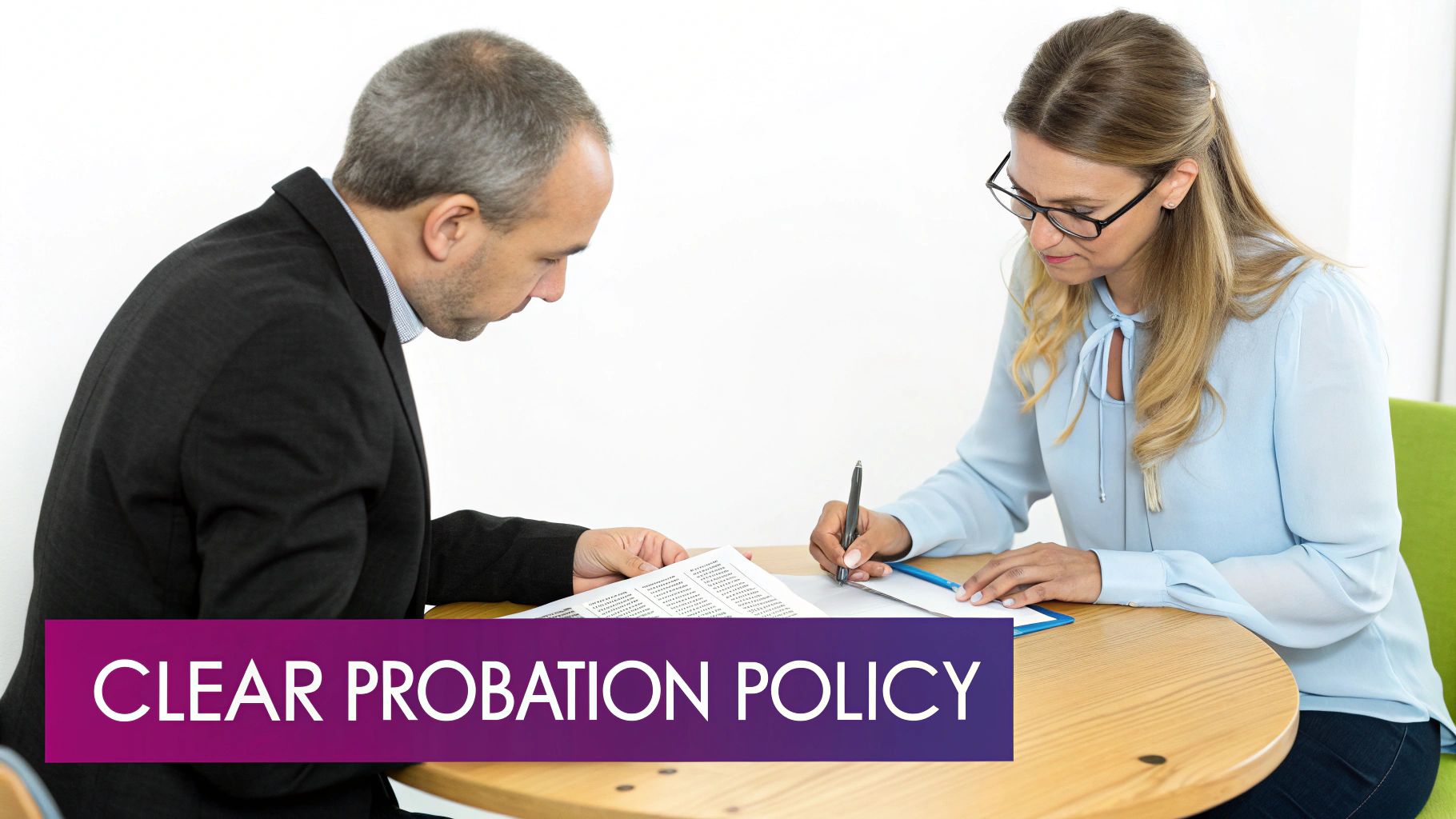
Think of this policy as your organisation’s single source of truth. It guarantees every new starter gets a consistent and fair experience, which is absolutely crucial for building trust from day one. By laying out the process clearly from the outset, you get rid of ambiguity and give managers the confidence to handle probation reviews properly.
Key Components of a Robust Probation Policy
Your policy doesn’t need to be a novel, but it must be clear and cover the essentials. It’s basically a guide that answers all the key questions a new employee is likely to have. Make sure it’s easy to find, usually as a section in the main staff handbook. For a great starting point, have a look at our guide on putting together a complete template employee handbook.
A solid policy should always include these points:
- The Purpose: A simple sentence or two explaining why you have a probation period – to check suitability for the role and offer support.
- The Duration: Be specific about how long it lasts (e.g., three or six months).
- Review Process: Lay out the frequency of review meetings, like monthly check-ins and a final review before the end date.
- Performance Standards: Define what good looks like. This means specific goals, objectives, and expected behaviours.
- Potential Outcomes: Clearly explain what can happen at the end – passing probation, extending it, or ending the employment.
- Notice Periods: State the shorter notice period that applies during probation, for both sides.
Getting this down in writing not only protects your business legally but also shows you’re committed to a fair and open process.
Setting Measurable Goals and Objectives
Vague expectations are a recipe for disaster. Simply telling a new hire to “do a good job” is next to useless. You need to set clear, measurable, and realistic goals that are tied directly to their role.
These objectives should be agreed right at the beginning of their employment, ideally within the first week. The SMART framework (Specific, Measurable, Achievable, Relevant, Time-bound) is your best friend here. For instance, instead of a woolly goal like “improve sales,” a much better objective would be “achieve £10,000 in new sales revenue within the first three months.”
A probation period without clear, documented goals is like a journey without a destination. It’s impossible to know if you’ve arrived successfully because you never defined what success looks like.
To give new starters the best chance of succeeding, you also need to build the perfect employee training plan as part of your induction process. This makes sure they have the tools and knowledge to actually hit their targets.
The Importance of Regular Check-Ins and Documentation
The probation period should never feel like a silent, six-month exam with a surprise result at the end. Regular, scheduled check-ins are vital. They’re your opportunity to give feedback, talk through any concerns, and offer support where it’s needed. These meetings turn the whole thing from a passive assessment into an active, two-way conversation.
A typical review schedule might look something like this:
- Week 1: An initial chat to set clear objectives and answer any questions they have.
- Month 1: The first formal review to see how they’re settling in and discuss any early challenges or training needs.
- Mid-Point Review: A more detailed check-in to see how they’re tracking against their goals and make any adjustments.
- Final Review: Held a week or two before the end date to formally decide on the outcome.
And here’s the crucial bit: every single one of these meetings must be documented. Keep a written note of what was discussed, the feedback given, and any actions you both agreed on. This paper trail is your best defence if things go wrong and provides a clear history of their performance. At the end of the day, a fair process is a documented one.
How to Streamline Probation Management
Let’s be honest: managing a probation period with spreadsheets and a patchwork of calendar reminders is a recipe for disaster. It’s a manual, time-consuming process that’s just begging for human error. A forgotten review meeting or a misplaced feedback form can quickly create an inconsistent experience for new starters, and in some cases, even open you up to legal risk.
This is where a modern HR system changes the game, turning what was once a chore into a real strategic advantage.

Think of it this way: instead of relying on sticky notes and memory, technology can organise and automate the entire review process. When you bring probation management into your central HR platform, you establish a single, reliable source of truth that makes compliance simple and gives managers the tools they need to succeed.
Automating Key Probation Workflows
The real magic of an HR system like DynamicsHub is automation. You no longer have to depend on a manager remembering to schedule a check-in. The system can be set up to automatically trigger the right actions at the right time, making sure no crucial step is ever skipped. This guarantees a fair, consistent process for every single new hire.
Here’s what that looks like in practice:
- Automated Review Reminders: The system pings both the manager and the employee when a review is coming up. This simple nudge ensures check-ins actually happen on schedule, providing regular, predictable moments for feedback.
- Performance Tracking: Any goals or objectives agreed upon at the start are logged directly in the system. As the employee makes progress, updates can be added, building a clear, documented timeline of their performance against what was expected.
- Centralised Documentation: All notes from reviews, feedback, and signed forms are kept securely in one digital file. No more hunting through email chains or network drives—just an instant, auditable trail for every employee on probation.
This kind of automation is a cornerstone of the best employee onboarding software, which weaves the probation period into the broader journey of a new employee joining your company.
Ensuring Fairness with Standardised Templates
One of the biggest pitfalls of handling probation manually is consistency. If every manager runs their reviews differently, you can end up with a process that feels subjective and unfair. A good HR system solves this problem by using standardised templates for every review.
By creating a consistent template for all probation reviews, you ensure that every employee is assessed against the same criteria, in the same way. This not only promotes fairness but also makes the process much easier for managers to follow correctly.
For instance, a template can prompt managers to discuss specific performance goals, evaluate how the employee aligns with company values, and note any training needs. This structured approach takes the guesswork out of the equation and helps ensure every review is comprehensive and objective.
Better still, with a platform built on Microsoft Dataverse, like DynamicsHub, all this sensitive information is stored securely within your existing Microsoft 365 environment. It means your probation data is protected by the same robust, enterprise-grade security you already trust, which simplifies GDPR compliance. By bringing structure, automation, and consistency to your process, you can transform probation from an administrative headache into a powerful tool for nurturing and keeping great people.
Ready to see how you can automate and improve your probation management? Phone 01522 508096 today or send us a message at https://www.dynamicshub.co.uk/contact/ to discuss a solution.
Dealing With Underperformance and Dismissal During Probation
Let’s be honest, tackling poor performance is one of the toughest parts of managing any job probation period in the UK. But if you have a clear and fair framework in place, you can handle it constructively. The real secret is to act early. Don’t let problems fester—identify the specific issues and give supportive, actionable feedback straight away.
When you first spot a concern, the best approach is a simple, informal chat. Talk through the specific areas where they’re not quite hitting the mark and ask if they need extra support or training. More often than not, this early conversation is all it takes to resolve things and turn a potential failure into a success story. If the issues continue, though, it’s time for a more structured approach.
Implementing a Performance Improvement Plan
If those informal chats aren’t making a difference, the next step is a formal Performance Improvement Plan (PIP). It’s important to frame this correctly: a PIP isn’t just the first step towards dismissal; it’s a genuine, structured opportunity for the employee to get back on track. For anyone struggling with this, looking into strategies for optimizing employee morale with Performance Improvement Plans can offer some valuable perspective.
A really effective PIP should include:
- Specific Areas for Improvement: Pinpoint exactly which performance standards aren’t being met.
- Measurable Objectives: Set clear, achievable, and time-bound goals for them to aim for.
- Support and Resources: Spell out the training, coaching, or tools you’ll provide to help them succeed.
- Review Schedule: Agree on regular check-in dates to discuss progress and offer more feedback.
Keeping a record of this process is absolutely essential. For a deep dive into getting this right, have a look at our comprehensive guide on creating an effective Performance Improvement Plan.
How to Manage a Dismissal During Probation
Sadly, there are times when letting someone go is the only realistic option. While employees generally have fewer rights before reaching two years of service, you still need to follow a fair and reasonable process to avoid legal headaches. This means your decision must be based on performance, never on discriminatory grounds.
The dismissal meeting itself needs to be handled with sensitivity and professionalism. State the reason for the decision clearly, connecting it back to the specific objectives and feedback you provided during their probation. Afterwards, send a formal termination letter that confirms the decision, their last day of employment, and details of their final pay. Remember, the shorter notice period outlined in their contract will apply here.
The Appeal Process and What’s on the Horizon
Offering the right to appeal is a key part of showing you’ve acted fairly. It gives the employee a chance to have their say if they feel the decision was unjust. While it’s not a strict legal requirement for staff with less than two years’ service, it is considered best practice and strengthens your defence that you acted reasonably.
On top of that, the legal landscape is shifting. Recent changes in UK employment law are set to shake up how probationary periods are managed, with the government proposing a maximum duration of nine months. This change, expected in Autumn 2026, shows a growing focus on fair processes, and businesses are already getting ready. A 2025 poll revealed that over a third (36%) of UK organisations are thinking about extending their probation periods in response.
Need a hand managing performance and making sure your processes are fair and compliant? Give us a call on 01522 508096 today or send us a message to find out how we can help.
Common Questions About UK Probation Periods
When you’re dealing with a job probation period in the UK, a lot of practical, day-to-day questions can pop up for both managers and new starters. Getting clear answers helps everyone know where they stand and makes that initial phase feel much less uncertain.
Let’s tackle some of the most common queries we hear, covering everything from resigning and handling sickness to what happens if your probation needs to be extended.
Can I Resign During My Probation Period?
Yes, absolutely. You’re free to resign at any point during your probation. The key difference is that the notice you have to give is usually much shorter than it would be after you’ve passed – often just one week.
Check your employment contract, as it will spell out the exact notice period required. It’s always best to hand in your resignation formally in writing, making sure to state your last day clearly. This just avoids any confusion for you and your employer.
What Happens If I Am Off Sick During My Probation?
Taking sick leave during your probation is generally handled the same way it would be at any other time. You’re still entitled to Statutory Sick Pay (SSP), provided you meet the criteria, and you may also get any enhanced company sick pay if your employer offers it from day one.
It is worth remembering, though, that an employer will be looking at your overall performance and suitability, and that includes your attendance. If you’re off for a long time or have frequent absences, it could be a factor in their final decision. In some situations, an employer might extend your probation if you’ve missed a significant amount of time, just to give you a fair chance to be assessed properly.
An extension due to sickness isn’t a punishment. Think of it as a practical step to make sure you have the full, agreed-upon timeframe to really show what you can do. It’s about ensuring the assessment is fair and reflects your true capabilities.
Can My Probation Be Extended Without My Agreement?
This all comes down to what’s written in your employment contract. Most contracts in the UK include a clause that gives the employer the right to extend a probationary period if they feel it’s necessary.
If that clause is in your contract, your employer can go ahead with the extension without needing your specific consent. However, they still have to act reasonably. This means they must:
- Tell you in writing before the original probation period ends.
- Clearly explain why they’re extending it.
- Set out new, achievable goals and a new end date.
If your contract doesn’t have a clause allowing for extensions, then your employer would need to get your explicit agreement before changing the length of your probation.
At DynamicsHub, we provide HR solutions that take the headache out of employee management, from smooth onboarding to clear performance reviews. We can help you make sure your probation process is fair, consistent, and properly documented.
Phone 01522 508096 today or send us a message to find out how we can help.