So, what exactly is an annualised salary?
In simple terms, it’s the total amount of money you’d earn over a full year, based on your current rate of pay. It’s your gross income—the figure before tax, National Insurance, or any other deductions are taken out—assuming you work your full contracted hours for all 52 weeks.
What an Annual Salary Really Means
Think of it as the “sticker price” for your job for a whole year. It’s like knowing the total annual cost of a subscription, rather than just the monthly payment. This bird’s-eye view is incredibly helpful for weighing up different job offers, especially if one is paid hourly and another is salaried. It gives you a consistent benchmark to understand your true earning potential.
This figure is particularly useful in the UK, where pay structures can vary wildly. You might get paid weekly, every two weeks, or monthly. Annualising your pay cuts through that noise, converting those different frequencies into one single, comparable number. This clarity is vital for everything from mapping out a personal budget to applying for a mortgage.
Why It Matters in the UK Job Market
Grasping the concept of an annualised salary is crucial when you look at the huge range of incomes across the country. The average annual salary in the UK hovers around £29,600, but this figure masks massive differences between professions. For example, a plumber might earn about £32,000 a year, while a handyman could be looking at something closer to £24,800.
This wide spectrum is precisely why a standardised annual figure is so important for comparing roles and understanding your own financial standing. If you’re curious about where different jobs sit, you can explore more UK salary insights on Jobted.
An annualized salary provides a clear, consistent measure of your earning power. It cuts through the complexity of different pay cycles—like hourly, weekly, or monthly—to give you one straightforward number that represents a full year’s work.
To make this crystal clear, it helps to see how an annual salary stacks up against other common ways people get paid.
Pay Structures at a Glance
This table breaks down the key differences between various pay structures you’re likely to come across.
| Pay Structure | How It’s Calculated | Best For |
|---|---|---|
| Annualized Salary | Based on a full year’s earnings at a set rate. | Salaried roles, long-term budgeting, and comparing different job offers. |
| Hourly Wage | Pay is calculated by multiplying the hourly rate by the hours worked. | Part-time, casual, or shift-based work where hours can change. |
| Pro-Rata Salary | A full-time salary adjusted downwards for part-time hours. | Part-time employees in roles where a full-time equivalent salary exists. |
Ultimately, understanding your annualised salary gives you the power to see the full value of what you bring to your role and what you get in return.
How to Calculate an Annualised Salary
Working out an annualised salary isn’t as complicated as it might sound. At its heart, it’s simply a way to get a single, clear yearly figure from different pay rates. Whether someone is paid by the hour, week, or month, annualising their pay puts everyone on a level playing field for comparison.
Let’s break down the formulas with a few real-world UK examples to show you how it works in practice.
From Hourly Rate to Annual Pay
For anyone paid by the hour, the calculation is a straightforward multiplication. All you need is their hourly rate, how many hours they typically work in a week, and the number of weeks in a year.
The formula is: Hourly Rate x Hours Worked Per Week x 52
This is especially handy for roles with variable hours, as it gives you a solid baseline for what someone can expect to earn over a year. If you’re unsure about what counts as full-time versus part-time, our guide on how many hours is full time can help clarify things.
Example: A Retail Assistant
Let’s say a part-time retail assistant in Manchester earns £11.50 per hour and is contracted for 20 hours per week.Here’s the calculation: £11.50 x 20 hours x 52 weeks = £11,960
Their annualized salary is £11,960. This figure gives them a much clearer picture of their total yearly earnings, which is a game-changer for budgeting and financial planning.
Converting Weekly and Monthly Pay
The same logic applies to employees who get a fixed wage each week or a set salary each month. You just multiply their regular pay by the number of times they get paid in a year.
- For Weekly Pay: Weekly Wage x 52
- For Monthly Pay: Monthly Salary x 12
This diagram shows just how simple it is to convert different pay frequencies into a single annual figure for a true ‘apples-to-apples’ comparison.
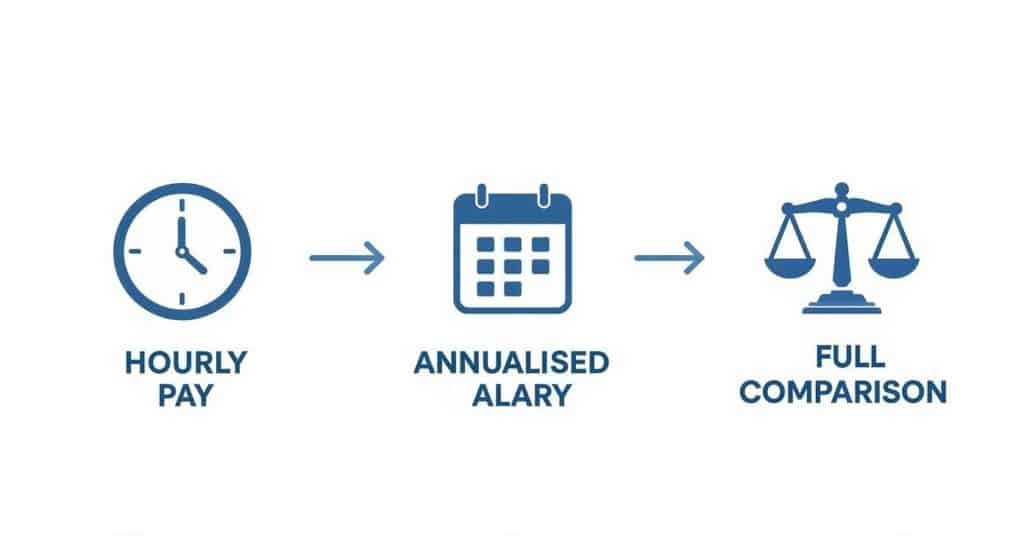
It’s this process that turns fragmented pay schedules into a unified number, allowing for fair and accurate financial analysis for everyone involved.
Example: An Office Administrator
An office administrator in Bristol takes home £500 per week.The calculation is simple: £500 x 52 weeks = £26,000
Their annualized salary is £26,000. If that same administrator were paid monthly instead—say, £2,166.67—the maths would be £2,166.67 x 12, which brings you to the exact same annual salary.
Understanding Pro-Rata Salaries
You’ll come across the term pro-rata salary all the time with part-time roles. It’s not a different type of pay, but rather a way of expressing a part-time salary as a fair fraction of the full-time equivalent (FTE).
Calculating it is key to ensuring pay parity between your full-time and part-time staff. First, you need to know the full-time salary for the role. From there, you just work out the part-timer’s salary based on the proportion of full-time hours they work.
Example: A Part-Time Graphic Designer
A company advertises a full-time graphic designer role with a salary of £35,000 for a 37.5-hour week. They hire someone who will work 22.5 hours per week.
- Find the proportion of hours: 22.5 hours / 37.5 hours = 0.6 (or 60% of the full-time hours)
- Calculate the pro-rata salary: £35,000 x 0.6 = £21,000
The part-time designer’s annualized pro-rata salary is £21,000.
This approach keeps things fair and transparent. It clearly shows both the employer and the employee how the part-time wage connects directly to its full-time counterpart.
Why Do UK Employers Use Annualised Salaries?
Ever wondered why so many UK job adverts and contracts talk in terms of an annual salary, rather than a monthly or weekly wage? It’s not just convention. It’s a strategic choice that brings some serious benefits for financial planning, operational stability, and even team morale.
For any business, people are often the single biggest cost. Presenting that cost as a fixed annual figure gives a company a crystal-clear, predictable view of its outgoings. It’s the difference between trying to budget with a fluctuating weekly wage bill and having a stable, overarching number to work with. This makes forecasting, cash flow management, and long-term financial planning much, much easier.
A Win for Employee Morale and Financial Stability
It’s not just about the company’s balance sheet, though. An annualised salary can be a huge plus for employees, especially in roles where working hours swing wildly from one month to the next. It provides a consistent, reliable wage in every pay packet, regardless of whether it’s a quiet month or a frantic, all-hands-on-deck period.
Think about sectors known for their peaks and troughs. This kind of stability is a game-changer for people working in:
- Hospitality and Tourism: Where hours often surge in the summer holidays but drop off in the winter.
- Agriculture: A world dictated by the planting and harvesting seasons.
- Retail: Where the Christmas rush means loads of overtime, followed by a much quieter January.
By smoothing out earnings over the entire year, an annualised contract means an employee’s income doesn’t lurch from high to low. This predictability takes a lot of financial stress off their shoulders, helping them manage their own budgets and household bills with confidence.
Keeping Things Fair and Compliant
There’s another crucial angle here: compliance. Using an annualised salary helps employers make sure they are consistently meeting their obligations for the National Minimum Wage (NMW) and National Living Wage (NLW).
Even if an employee works a huge number of hours one week, the annualised approach lets the employer average out their pay over the whole year. This ensures that, when you look at the big picture, their hourly rate never dips below the legal minimum.
An annualised salary simplifies complexity for everyone. For the employer, it means predictable budgeting and easier compliance. For the employee, it translates to a stable income and greater financial peace of mind, turning fluctuating work patterns into a steady, reliable wage.
Ultimately, this approach creates a transparent and fair agreement. It clearly sets out the total pay for a total number of hours worked over a full year, cutting out the guesswork and building a solid foundation of trust from day one.
Getting to Grips with Tax and National Insurance on Your Salary
So, you’ve been quoted an annual salary. It’s a big, encouraging number, but it can be a bit of a shock when you see what actually lands in your bank account each month. Why the difference? It all comes down to how HMRC handles tax and National Insurance.
The most important thing to realise is that you aren’t taxed on the big annual figure all at once. Instead, Income Tax and National Insurance Contributions (NICs) are calculated based on what you earn in each specific pay period. Whether you’re paid every week or once a month, HMRC looks at that smaller slice of income to work out your deductions.

It’s About the Pay Period, Not the Annual Total
Let’s break it down with a simple example. Imagine your annualised salary is £30,000. If your company pays you monthly, your gross pay for that month is £2,500 (£30,000 divided by 12). It’s this £2,500 figure that HMRC uses to calculate your tax and NI for the month, after factoring in your personal tax-free allowance for that period.
This is exactly why your payslip shows deductions for the current month, not for the entire year ahead. It’s a classic pay-as-you-earn system, designed to break down your tax liability into manageable, predictable chunks. For UK business owners and company directors, getting this right is crucial, and it often involves weighing up the most effective ways to pay staff—and themselves. There are some excellent resources detailing tax-efficient salary and dividend strategies that really get into the nuts and bolts of this.
At its core, the system is designed to collect tax smoothly throughout the year, right as you earn the money.
How Your Pay Frequency Shapes Your Finances
While your total annual income doesn’t change, how often you get paid can make a real difference to your personal budgeting. You and a colleague might have the exact same annualised salary, but if you’re paid weekly and they’re paid monthly, the rhythm of your financial lives will be completely different.
- Weekly Pay: This gives you a steady, frequent cash flow, which many people find easier for managing day-to-day spending and smaller bills.
- Monthly Pay: Getting a larger lump sum once a month is often a better fit for planning around big, recurring payments like rent, mortgages, or car finance.
This doesn’t alter what you earn over the year, but it absolutely changes how you manage your money. Understanding this helps you make sense of your payslip and plan your finances with a bit more confidence. It’s a timely point, too. As of April 2025, median annual earnings for full-time workers were around £39,981, a 5.6% jump from the year before, which shows wage growth is just about keeping ahead of inflation.
Think of your annualised salary as the headline figure. Your take-home pay, however, is the real story, written chapter by chapter with each pay period. Tax and NI are calculated on what you earn each month or week, not the grand total for the year.
Ultimately, your annualised salary gives you the big picture, but your payslip shows you exactly how that picture is built, piece by piece, all year long.
What to Look for in Your Employment Contract
An annualised salary can offer fantastic predictability, but the devil is always in the detail. To avoid any nasty surprises, those details must be spelled out, crystal clear, in your employment contract. This document isn’t just a formality; it’s the legally binding rulebook for your job, and getting it right protects both you and your employer.
Vague language is a recipe for disaster. A poorly worded clause can easily lead to misunderstandings about overtime or what happens if you leave. A solid contract, on the other hand, leaves no room for interpretation. As you look over your own contract, it’s helpful to understand how these documents are put together, and even modern tools for creating employment contracts using AI have to get these fundamental components right.
Your Essential Contract Checklist
When you’re reviewing a contract for an annualised hours arrangement, you need to zero in on the clauses that govern how your pay actually works. These aren’t just minor points; they are the absolute cornerstone of a fair and legally compliant agreement in the UK.
Make sure you can tick off these key elements:
- Total Annual Hours: The contract absolutely must state the total number of hours you’re contracted to work across the entire year for your salary. This number is the bedrock of the whole arrangement.
- Overtime Policy: Find the overtime clause. Does it clearly state if extra hours are already baked into your salary, or if they’ll be paid separately? If they are paid, it needs to specify the rate, such as time-and-a-half.
- Reconciliation Process: This is a big one. There should be a clause explaining how and when the company checks your actual hours worked against the hours you’ve been paid for. This review process, or reconciliation, needs to happen regularly (perhaps quarterly or annually) to keep things fair.
- Leaving the Company: What happens if you resign or are made redundant part-way through the year? The contract must lay out the process for a final reconciliation to settle up—calculating any pay owed to you, or any overpayment you might need to repay.
The Importance of Unambiguous Language
A contract that uses direct, plain English is your best friend. A wishy-washy statement like “some overtime may be required” is a red flag. A well-drafted contract will be specific, like this: “Your annualised salary of £30,000 covers a total of 1,950 hours per year. Any hours worked beyond this total will be paid at a rate of 1.5 times your standard hourly equivalent.”
Your employment contract isn’t just paperwork; it’s the rulebook for your job. For an annualised salary, it must precisely define the hours you’re paid for, how extra work is handled, and what happens if your hours don’t perfectly align at the end of the year.
This level of clarity means everyone knows exactly where they stand right from the start. It’s also good practice for employers to back this up with clear, day-to-day policies, which are often found in a staff guide or handbook. We cover what a good one looks like in our template employee handbook.
At the end of the day, a detailed, transparent contract builds trust and makes sure your annualised pay arrangement works for everyone and stays on the right side of the law.
Putting Annualised Pay into Practice with Dynamics 365
Let’s be honest: trying to manage annualised salary contracts on a spreadsheet is a recipe for disaster. It’s time-consuming, riddled with potential for human error, and frankly, just not up to the task. This is where modern HR and payroll systems come into their own.
Software like Microsoft Dynamics 365 is designed to bridge the gap between the theory of annualised hours and the reality of running payroll. It automates the heavy lifting – tracking hours worked against the contract total, applying complex overtime rules, and running the all-important reconciliation at the end of the year. It takes the guesswork out of the equation.
This level of automation isn’t just about saving your payroll team a headache. It’s about ensuring you stay compliant with UK wage laws and giving your team back the time to focus on more strategic work.
Building Trust Through Clear Reporting
One of the biggest wins of using a proper system is the transparency it creates. When both managers and employees can see clear, up-to-date information on hours worked, overtime accrued, and how it all lines up with their contract, it builds a huge amount of trust. Everyone knows exactly where they stand, and every payslip is accurate.
This clarity is especially important when you consider how much salaries can vary across the UK. Provisional data for 2024 shows just how wide the gap is – average gross annual pay starts around £22,306 for employees aged 18-21 and rises to over £50,900 for those in the 40-49 bracket. Look at it by region, and you see London’s average at £65,994 while the North East is at £38,321. With such big differences, getting the calculations right every single time is non-negotiable. You can dig deeper into average UK salary data on Starling Bank.
Investing in a robust platform like Dynamics 365 for HR is how you turn a potentially confusing pay structure into something simple, fair, and compliant. It’s about making sure your system works for your people, not the other way around.
Got Questions About Annualised Salaries? We’ve Got Answers
We get a lot of questions about how annualized salaries actually work in practice. To help clear things up, here are some of the most common queries we see from employees and employers alike.
Is an Annualised Salary What I Actually Take Home?
In short, no. Your annualized salary is your gross pay – the total amount you earn before anything is taken out.
Think of it as the top-line figure on your payslip. Your take-home pay, or net pay, is what lands in your bank account after all the deductions like Income Tax, National Insurance, and pension contributions have been subtracted.
What if I Work More (or Fewer) Hours Than Planned?
This is a great question, and your employment contract should have the answer. Most contracts with annualised hours include a ‘reconciliation’ clause.
This is just a formal process, usually done quarterly or at the end of the year, where your employer checks the hours you were paid for against the hours you actually worked. If you’ve worked extra, you might be due overtime. If you’ve worked fewer, the contract will explain how to make up the time or if any pay adjustment is needed.
For an employee, the real win with an annualized salary is stability. Your paycheque doesn’t jump up and down with your hours each week. Instead, you get a consistent, predictable income, which makes budgeting for bills and life’s other expenses a whole lot easier.
How Will This Affect My Holiday Pay?
It shouldn’t negatively affect it at all. Your right to paid holiday is protected by law.
In the UK, holiday pay is usually calculated using your average earnings over the last 52 paid weeks. Because an annualised salary smooths out your earnings into regular, equal payments, calculating your holiday pay is often much more straightforward for everyone involved. It simply reflects your consistent, regular income.
Managing complex pay structures and staying on top of HR compliance can be a real headache. Let DynamicsHub help. Give us a call on 01522 508096 today or send us a message to see how our solutions can make your processes simpler.