Hiring the right person is one of the most critical decisions a business can make, yet many organisations still rely on outdated and ineffective interview techniques. The quality of your hire is directly proportional to the quality of your questions. A generic, unstructured conversation rarely uncovers the evidence needed to make a sound judgement. Moving beyond familiar but flawed opening lines is the first step towards building a high-performing team.
Understanding the different types of interview question and knowing when to deploy each is the key to unlocking deeper insights, reducing bias, and accurately predicting a candidate's future performance. A well-structured interview process, utilising a mix of question styles, allows you to systematically gather evidence against specific competencies rather than relying on gut feeling. This strategic approach ensures every hiring decision is defensible, data-driven, and aligned with your organisational goals.
This comprehensive guide will break down the essential question types every UK hiring manager and HR professional should have in their toolkit. We'll explore the psychology behind each, provide practical examples, and show you how to structure a more strategic interview process that consistently identifies top talent. We will cover everything from behavioural and situational questions to technical and competency-based assessments, offering actionable advice for implementation. To revolutionise your interview process and understand the broader landscape, consider delving into 10 Types of Interview Consulting Questions that top firms use. By mastering these methods, you can transform your interviews from simple conversations into powerful predictive tools, ensuring you hire the right people for the right roles, every time.
1. Behavioural Interview Questions
Behavioural questions are a foundational component of modern structured interviews and are one of the most reliable types of interview question for predicting future job performance. The core principle is simple: past behaviour is the best indicator of future behaviour. Instead of asking hypothetical questions, you ask candidates to provide specific examples of how they have handled work-related situations in the past.
This method moves beyond theoretical answers and grounds the conversation in tangible experience. Companies like Amazon have built their entire interview process around this model, using their Leadership Principles as a framework for behavioural questioning. The goal is to gather evidence of specific competencies, such as problem-solving, teamwork, and conflict resolution, directly from the candidate's professional history.
When and Why to Use Them
Behavioural questions are highly versatile and should be a staple in most interviews, especially for roles requiring specific soft skills or proven experience. They are particularly effective when you need to assess qualities that are difficult to measure from a CV alone. Use them to validate claims and understand the how and why behind a candidate's achievements, not just the what.
Actionable Tips for Implementation
To get the most out of this technique, structure and consistency are key.
- Use the STAR Method: Encourage candidates to structure their answers using the STAR (Situation, Task, Action, Result) method. This framework provides a clear, concise narrative and ensures you receive all the necessary details to evaluate their example.
- Probe with Follow-up Questions: Never take an answer at face value. Ask probing follow-up questions like, "What was your specific role in that project?" or "What was the measurable outcome of your actions?" This helps you uncover the candidate’s true contribution.
- Integrate into Your ATS: Define key competencies for each role and build a library of corresponding behavioural questions within your Applicant Tracking System. For instance, using Dynamics 365 Human Resources, you can create standardised interview templates that ensure every candidate for a specific role is asked the same core questions, facilitating fairer comparisons. For more insights into structuring your recruitment process, explore our detailed guide on effective hiring and recruiting strategies.
2. Situational Interview Questions
Situational questions are forward-looking counterparts to behavioural questions and are another crucial category of types of interview question. Instead of asking about past events, they present candidates with hypothetical workplace scenarios and ask how they would respond. The core principle is to evaluate a candidate's problem-solving abilities, judgement, and alignment with company values in real-time.
This approach tests theoretical knowledge and practical application by posing questions like, "What would you do if…?". It reveals a candidate's thought process, ethical considerations, and ability to think on their feet. Prominent consulting firms like McKinsey have long used situational case interviews to assess analytical and strategic thinking, while tech companies often use them to gauge how a candidate would handle a critical system failure or a difficult stakeholder.
When and Why to Use Them
Situational questions are particularly powerful when hiring for roles with a high degree of unpredictability or for candidates with limited direct experience, such as graduates or career changers. They allow you to assess potential rather than just past performance. Use them to understand how a candidate might navigate challenges specific to your organisation and the role, providing a glimpse into their future on-the-job decision-making.
Actionable Tips for Implementation
To effectively leverage situational questions, the scenarios must be relevant and challenging.
- Create Realistic Scenarios: Design questions based on actual challenges your team has faced. This makes the exercise more practical and provides a more accurate assessment of how a candidate would perform in your specific work environment.
- Probe the 'Why': After a candidate describes their proposed action, always follow up with, "Why would you take that approach?" This deeper questioning uncovers their underlying reasoning, values, and awareness of potential consequences.
- Complement Behavioural Questions: Use situational and behavioural questions together for a comprehensive view. While behavioural questions confirm past competence, situational questions explore future potential and adaptability, creating a more rounded candidate profile.
3. Open-Ended Questions
Open-ended questions are a vital type of interview question designed to elicit detailed, narrative responses rather than simple "yes" or "no" answers. They typically begin with phrases like "Tell me about…", "Describe…", or "How would you…", prompting candidates to elaborate on their experiences, thought processes, and perspectives. This approach allows you to gauge a candidate's communication skills, depth of knowledge, and personality in a way that more restrictive questions cannot.
The primary function of these questions is to open up a dialogue and encourage the candidate to lead the conversation. By asking "Describe your ideal work environment," you invite them to share their values and what motivates them, providing insights that go far beyond their technical qualifications. This method helps create a more conversational and less interrogative interview atmosphere, allowing you to build rapport while gathering valuable information.
When and Why to Use Them
Open-ended questions are excellent conversation starters and are most effective at the beginning of an interview to build rapport or when exploring a candidate's motivations and career goals. They are particularly useful for assessing communication skills, creativity, and how a candidate organises their thoughts. Use them to understand the broader context of a candidate's experience before diving into more specific behavioural or technical questions.
Actionable Tips for Implementation
To maximise the effectiveness of open-ended questions, a thoughtful approach is necessary.
- Practise Active Listening: These questions yield rich information, but only if you are fully engaged. Avoid interrupting and allow the candidate space to complete their thoughts. Show you are listening by nodding and maintaining eye contact.
- Use Clarifying Follow-ups: Once the candidate has finished their initial response, use follow-up questions to delve deeper. Phrases like, "Could you elaborate on that point?" or "What was the reasoning behind that decision?" can uncover more specific details.
- Balance with Structured Questions: While open-ended questions are insightful, they can lack the standardisation needed for direct candidate comparison. Combine them with behavioural or situational questions to ensure you gather both broad context and specific, evidence-based examples of competencies.
- Document Key Themes in Your ATS: As candidates respond, make notes of key themes, skills, and values they mention within your HR system, such as Dynamics 365 Human Resources. You can create fields in your interview templates to capture these qualitative insights, helping to build a more holistic profile of each candidate.
4. Closed-Ended Questions
Closed-ended questions are designed to elicit a simple, factual response, often just a 'yes' or 'no'. As a distinct type of interview question, their primary function is to quickly verify specific facts, qualifications, or logistical details listed on a candidate's CV. Questions like, "Do you have a valid UK driving licence?" or "Are you proficient in Microsoft Excel?" fall into this category.
Unlike behavioural or situational questions that encourage detailed storytelling, closed-ended questions are transactional and efficient. They are not intended to reveal a candidate's personality, problem-solving skills, or cultural fit. Instead, they serve as a crucial tool for initial screening and qualification, allowing you to confirm non-negotiable job requirements without ambiguity. They provide clear, direct data points that are easy to compare across candidates.
When and Why to Use Them
Closed-ended questions are most effective at the beginning of the interview process, such as during a phone screen or the initial minutes of a face-to-face meeting. Use them to establish a baseline of eligibility and ensure that core requirements are met before investing time in a deeper, more qualitative discussion. They are perfect for confirming technical certifications, tool proficiency, or willingness to meet specific job demands like travel or shift work.
Actionable Tips for Implementation
To use this question type effectively, it must be balanced with other, more exploratory methods.
- Use as a Gateway: Start with closed-ended questions to confirm essential qualifications. If a candidate answers 'no' to a critical requirement, you can address it immediately.
- Pair with Open-Ended Follow-ups: A powerful technique is to follow a closed question with an open one. For example, after "Have you managed a team before?" (Yes), you can ask, "Can you tell me about your leadership style and the largest team you have managed?" This turns a simple fact into a starting point for a deeper conversation.
- Standardise for Screening: For consistency, build a checklist of essential closed-ended questions for each role. This can be integrated into your ATS, like Dynamics 365 Human Resources, to create a standardised screening template. This ensures every applicant is vetted against the same core criteria, supporting a fair and compliant hiring process.
5. Technical Interview Questions
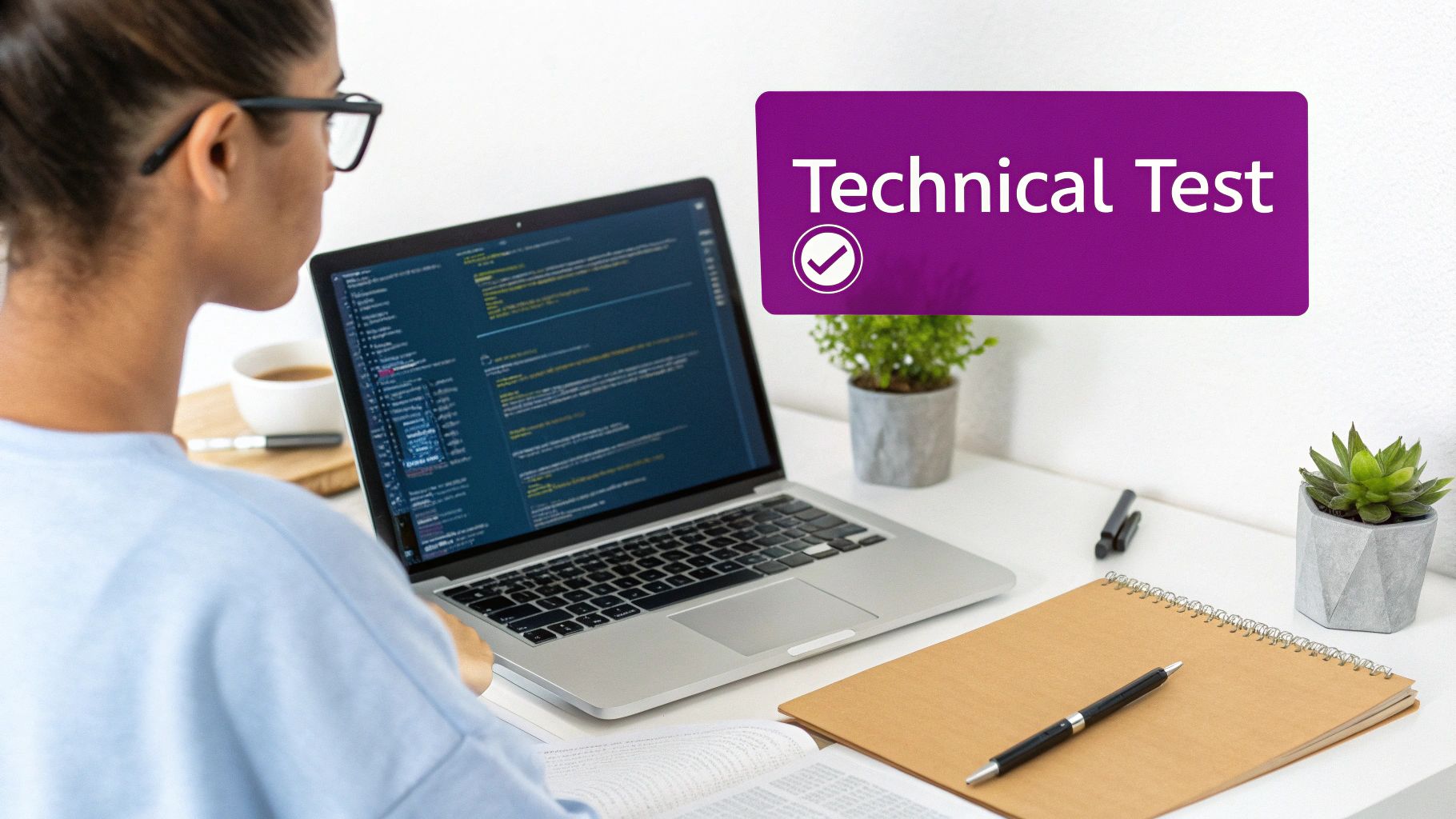
Technical questions are designed to rigorously assess a candidate's hard skills, domain knowledge, and practical problem-solving capabilities. A staple in technology, engineering, finance, and other specialised fields, this type of interview question moves beyond claimed expertise on a CV to evaluate how a candidate actually applies their knowledge. The objective is to see not just what a candidate knows, but how they think and work through a complex, relevant problem.
This practical evaluation is critical for roles where technical proficiency is non-negotiable. Leading tech companies like Google and Meta have famously built their hiring processes around these assessments, using everything from on-the-spot whiteboard coding challenges to intricate system design discussions. The goal is to get a clear, evidence-based signal of a candidate's ability to perform the core technical functions of the job from day one.
When and Why to Use Them
Technical questions are indispensable when hiring for any role that requires a specific, measurable skill set, such as software development, data science, or financial analysis. Use them to verify a candidate’s expertise and understand their approach to problem-solving under pressure. They are most effective for distinguishing between candidates who have a theoretical understanding and those who can practically apply their skills to create real-world solutions.
Actionable Tips for Implementation
A well-structured technical assessment evaluates ability fairly and effectively.
- Focus on the Process, Not Just the Answer: The best technical interviews assess a candidate's thought process. Pay attention to how they deconstruct the problem, ask clarifying questions, and explain their reasoning. A perfect answer is less valuable than a demonstrated ability to think logically and communicate complex ideas.
- Use Paired Programming or Whiteboarding: Collaborative, real-time exercises allow you to see how a candidate works. Paired programming simulates a real-world team environment, while whiteboarding is excellent for assessing high-level architectural thinking without getting bogged down in minor syntax.
- Standardise the Assessment: To ensure fairness and reduce bias, provide every candidate for a given role with the same technical challenge and evaluation criteria. Within Dynamics 365 Human Resources, you can attach standardised technical assessment guidelines and scoring rubrics to your interview templates, ensuring consistency across all interviews.
6. Competency-Based Questions
Competency-based questions are a structured interviewing technique designed to assess specific skills and behaviours that are essential for successful job performance. This approach is more targeted than general behavioural questioning. While both explore past experiences, competency questions are explicitly mapped to a pre-defined framework of core competencies, such as leadership, strategic thinking, or communication.
This method provides a systematic way to evaluate every candidate against the same set of critical criteria. It is heavily utilised by organisations that require standardised and transparent hiring processes, like the UK Civil Service for its Fast Stream programme. By focusing on specific competencies, you can ensure that your evaluation is directly relevant to the role's demands and less susceptible to interviewer bias.
When and Why to Use Them
Competency-based questions are ideal for roles where specific, well-defined skills and behaviours are crucial for success. They are particularly effective in large organisations that need to maintain consistency across hundreds of hires, or for specialised positions where qualities like clinical reasoning in healthcare or persuasive communication in sales are non-negotiable. Use this method when you need to build a holistic picture of a candidate's capabilities against a clear, job-relevant benchmark.
Actionable Tips for Implementation
A robust competency framework is the foundation for this interview style.
- Define and Map Competencies: Before the interview, identify the 4-6 core competencies crucial for the role. For each competency, develop a set of questions designed to elicit evidence. For example, for "Strategic Thinking," you might ask, "Describe a time you contributed to developing a long-term team strategy."
- Create Rating Scales: Develop a clear rating scale (e.g., 1-5) for each competency, with behavioural indicators defining what constitutes an excellent, good, or poor response. This ensures all interviewers are evaluating responses consistently.
- Document and Validate: Train interviewers to take detailed notes, capturing specific examples that demonstrate the competency. Having multiple assessors score each candidate independently and then comparing notes can help validate the final decision and reduce individual bias. This process aligns well with principles found in broader performance assessments, which you can explore in our guide to designing effective 360-degree feedback questions.
7. Case Interview Questions
Case interview questions are a specialised and intensive type of interview question designed to simulate real-world business challenges. Popularised by top-tier management consulting firms like McKinsey & Company, they require candidates to analyse a complex business problem, structure a solution, and present their recommendations in a logical, coherent manner. The focus is less on finding a single "correct" answer and more on evaluating the candidate's thought process, analytical skills, and business acumen under pressure.
Instead of asking about past experiences, you present a scenario, such as "A UK-based retail chain is seeing declining profits; how would you diagnose the problem and suggest a solution?" This method provides direct insight into a candidate's problem-solving capabilities, quantitative reasoning, and ability to communicate complex ideas clearly. It's an active, collaborative exercise that reveals how a candidate thinks on their feet.

When and Why to Use Them
Case questions are indispensable for roles demanding strong analytical, strategic, and problem-solving skills, such as management consulting, investment banking, business analysis, and product management. They are particularly effective when hiring for positions that involve ambiguous data, strategic decision-making, and client-facing advisory work. Use them to assess a candidate's ability to structure ambiguity, perform quick calculations, and articulate a defensible business strategy.
Actionable Tips for Implementation
To conduct a successful case interview, a clear structure and objective evaluation are paramount.
- Provide a Clear Framework: Explain the format to the candidate beforehand. Let them know it's a collaborative exercise and that they are encouraged to think aloud, ask clarifying questions, and structure their thoughts on paper or a whiteboard.
- Focus on the Process, Not the Answer: The value is in the 'how', not the 'what'. Evaluate the candidate based on their ability to break down the problem, identify key drivers, make reasonable assumptions, and build a logical argument. A brilliant framework is more impressive than a lucky guess.
- Create Role-Specific Cases: Develop standardised case studies relevant to your industry and the specific role. For a financial analyst, this might be a valuation case; for a product manager, a market entry strategy. Store these cases in your HR system, like Dynamics 365 Human Resources, to ensure consistency and create a library for different roles, enabling fair and comparable evaluations across candidates.
8. Stress Interview Questions
Stress interview questions are a controversial yet sometimes necessary type of interview question designed to deliberately place a candidate under pressure. The goal is to assess how they handle stressful situations, respond to criticism, and maintain composure when faced with unexpected challenges or aggressive questioning. This technique moves beyond standard Q&A to simulate the high-stakes environments common in certain professions.
This method is most famously associated with high-pressure industries like investment banking or emergency services, where the ability to think clearly under duress is a critical job requirement. The interviewer might challenge the candidate's answers, create an awkward silence, or present them with a seemingly impossible problem. The focus is less on the "correct" answer and more on observing the candidate's reaction, problem-solving process, and emotional resilience.
When and Why to Use Them
This technique should be used with extreme caution and only for roles where performing under significant, frequent pressure is a core, non-negotiable function of the job. Consider roles in emergency medicine, military leadership, or high-stakes trading. They are used to test a candidate's ability to remain calm and logical when a calm, logical response is precisely what the job demands in its most critical moments. However, for most corporate roles, their use can be counterproductive and damaging to the candidate experience.
Actionable Tips for Implementation
If you determine this approach is necessary, it must be executed professionally and ethically.
- Use Sparingly and with Purpose: Reserve these questions for final-stage interviews and only for roles where high-stress tolerance is essential. Ensure the stressor is directly relevant to the job's demands, not just a random act of pressure.
- Debrief the Candidate: Always debrief the candidate afterwards. Explain the purpose of the stress-based questioning was to simulate job-specific pressures, and allow them to ask questions. This helps to repair rapport and mitigate a negative candidate experience.
- Be Aware of Legal Risks: This method can stray into discriminatory territory if not carefully managed. Questions must remain focused on professional capabilities and not personal attributes. Ensure every candidate for the role receives the same treatment to avoid claims of bias. Modern alternatives, such as realistic job simulations, often provide better data with fewer risks.
9. Panel Interview Questions
Panel interviews involve multiple interviewers questioning a candidate simultaneously. While not a distinct category of question itself, this format is a powerful way to administer other types of interview question, such as behavioural or competency-based queries. The key benefit is gathering diverse perspectives in a single, efficient session, which helps to reduce individual interviewer bias and create a more holistic candidate profile.
This method streamlines the decision-making process by allowing key stakeholders to assess the candidate together. It is commonly used in academic hiring committees, executive-level interviews with department heads, and government civil service recruitment. The structured, multi-assessor format provides a robust framework for a thorough and balanced evaluation.

When and Why to Use Them
Panel interviews are ideal for senior or highly collaborative roles where input from multiple departments is crucial. They save considerable time by consolidating several interview stages into one, ensuring all decision-makers hear the candidate's responses firsthand. Use this format when you need to assess how a candidate interacts with various personalities and functional leaders, providing a glimpse into their potential team fit and communication style under pressure.
Actionable Tips for Implementation
A poorly organised panel can be intimidating for candidates and unproductive for interviewers. Structure is essential for success.
- Brief and Assign Roles: Before the interview, hold a pre-meeting to align the panel on the role's core competencies. Assign each interviewer a specific area to focus on, such as technical skills, cultural fit, or leadership potential, to avoid repetitive questioning.
- Appoint a Lead Interviewer: Designate one person to lead the interview, manage the time, and ensure a logical flow. This person should introduce the panel, explain the format, and guide the conversation, creating a more professional and less chaotic experience for the candidate.
- Standardise and Score Independently: Equip each panellist with the same set of standardised questions and a scoring rubric. Instruct them to take independent notes and score the candidate privately before coming together for a calibration discussion. This prevents groupthink and ensures each perspective is considered objectively. You can manage this process effectively by understanding what an Applicant Tracking System is and using it to store standardised interview kits and collate feedback.
10. Unstructured Interview Questions
Unstructured interview questions are the hallmark of a free-flowing, conversational interview with no predetermined set of questions. This approach relies heavily on the interviewer's intuition and allows the discussion to evolve organically, covering topics as they arise. Rather than following a script, the interviewer guides the conversation based on the candidate's responses, creating a more natural and relaxed atmosphere.
While this format can build rapport and uncover unexpected insights, it is also the least reliable of all types of interview question for predicting job performance. The lack of standardisation makes it highly susceptible to unconscious bias, as different candidates are asked different questions, making direct comparisons almost impossible. This subjectivity can lead to hiring decisions based on "gut feeling" or how much the interviewer personally likes a candidate, rather than on objective capabilities.
When and Why to Use Them
This approach is best used sparingly, perhaps as a small, informal component of a larger, more structured process. For example, an initial coffee chat or the final "culture fit" conversation with a senior leader might adopt an unstructured feel. Its primary purpose should be to assess interpersonal skills, gauge a candidate’s personality, and see how they think on their feet in a less formal setting. It should never be the sole method for evaluating a candidate.
Actionable Tips for Implementation
To mitigate the significant risks of unstructured interviews, it's crucial to add elements of control and awareness.
- Combine with Structure: Never rely solely on an unstructured format. Use it as a supplementary part of a semi-structured or fully structured interview process. This ensures you still gather the core, comparable data needed to make a fair decision.
- Train Interviewers on Bias: Before allowing managers to conduct unstructured interviews, provide comprehensive training on unconscious bias. Awareness is the first step in preventing biases related to affinity, halo/horn effects, and other common pitfalls from influencing the outcome.
- Document and Standardise Notes: Even if the questions are spontaneous, the note-taking shouldn't be. Insist that interviewers document their observations against predefined competencies. Within your Dynamics 365 HR system, you can create a standardised feedback form that prompts interviewers to record evidence related to key job requirements, even if the conversation was unstructured. This brings a layer of objectivity back into a subjective process.
10 Interview Question Types Compared
| Question Type | Implementation complexity | Resource requirements | Expected outcomes | Ideal use cases | Key advantages |
|---|---|---|---|---|---|
| Behavioural Interview Questions | Moderate — requires structured questions and skilled interviewers | Time-intensive per interview; interviewer training for STAR use | High predictive validity; concrete examples of past performance | Mid-to-senior roles; competency and leadership assessment | Strongly predictive; reveals real problem‑solving and role in outcomes |
| Situational Interview Questions | Low–Moderate — needs realistic scenario design | Time to design scenarios; easier to standardise scoring | Shows decision‑making and reasoning; less predictive than behavioural | Entry-level roles; candidates with limited experience; values alignment | Fair to inexperienced candidates; standardised; assesses future behaviour |
| Open-Ended Questions | Low — minimal setup but needs probing skill | Requires interviewer listening skill and time for long answers | Rich qualitative insight into communication and thought process | Early-stage interviews; cultural fit and exploratory conversations | Elicits detail and storytelling; reveals communication style and passion |
| Closed-Ended Questions | Low — simple to implement and standardise | Minimal time; useful in structured screening | Quick factual verification; limited insight into reasoning | Screening interviews; qualification and eligibility checks | Efficient, objective, and easy to compare across candidates |
| Technical Interview Questions | High — requires domain expertise and appropriate format | Expert interviewers, testing platforms or assignments, prep time | Direct measurement of technical competencies; objective metrics | Technical, engineering, and specialist roles | Directly assesses job‑critical skills and problem‑solving approach |
| Competency-Based Questions | Moderate–High — needs defined competency framework | Upfront competency analysis, rating scales, interviewer training | Standardised assessment against job criteria; easier comparison | Roles with clear competency requirements; structured hiring programmes | Focused on job success; reduces bias; consistent evaluations |
| Case Interview Questions | High — complex case development and interviewer calibration | Time for case prep, skilled assessors, candidate practice | Evaluates analytical structure, business acumen, and ambiguity handling | Consulting, strategy, product management, finance roles | Assesses real-world problem solving and structured thinking |
| Stress Interview Questions | Moderate — deliberate pressure techniques require controls | Trained interviewers, consistent protocols, legal/ethical oversight | Measures composure under pressure but can be unreliable and risky | Very selective high‑pressure roles (used sparingly) | Reveals stress tolerance and conflict handling (controversial) |
| Panel Interview Questions | High — coordination of multiple interviewers and roles | Multiple participants’ time, panel training, logistical planning | Multi-perspective evaluation; reduced single‑interviewer bias | Senior hires, academic panels, cross-functional roles | Diverse viewpoints; faster consensus; more objective when structured |
| Unstructured Interview Questions | Low — minimal preparation but high subjectivity | Little prep time but requires bias mitigation if used | Natural rapport and exploratory insight; poor predictive validity | Supplemental rapport-building or informal screening (not sole method) | Flexible and conversational; can surface unexpected strengths (but unreliable) |
Structuring Success: Integrating Question Types into Your HR Workflow
The journey through the diverse landscape of interview questions, from behavioural and situational to technical and case-based, reveals a powerful truth: a one-size-fits-all approach to interviewing is fundamentally flawed. Relying solely on unstructured, "gut-feel" conversations is no longer a viable strategy for building a high-performing, diverse, and resilient workforce. The real art and science of modern recruitment lie in the strategic deployment of different types of interview question at the right stages of the hiring process.
Moving beyond theory to practical application is the critical next step. This involves weaving this newfound knowledge into the very fabric of your HR operations. An initial phone screen might benefit from a mix of open-ended and closed-ended questions to quickly qualify a candidate. A second-stage interview could then pivot to competency-based and behavioural questions to validate claims made on a CV. For a senior technical role, a final panel interview might incorporate a challenging case study to assess problem-solving skills under pressure. Each question type serves a distinct purpose, and a well-orchestrated process ensures you gather a holistic, multi-faceted view of every applicant.
From Ad-Hoc to Architected: Operationalising Your Strategy
Mastering these question formats is one part of the equation; the other is building a repeatable, scalable, and compliant system to manage them. Without a centralised framework, even the best-laid plans can devolve into inconsistency, introducing bias and undermining the integrity of your hiring decisions.
Here are the key pillars for operationalising your interview strategy:
- Develop a Centralised Question Bank: Create a repository of approved, vetted questions categorised by type (behavioural, competency, technical) and linked to specific roles or core company values. This ensures consistency and quality across all interviews.
- Standardise Interview Templates: For each role, build structured interview templates that specify which types of questions to ask at each stage. This guides hiring managers, reduces variability, and ensures every candidate is assessed against the same core criteria.
- Embed Evaluation Frameworks: Don't just standardise the questions; standardise the evaluation. Use scoring rubrics (e.g., a 1-5 scale) with clear definitions for what constitutes a poor, average, or excellent answer. This moves feedback from subjective opinion to objective data.
- Leverage Technology for Governance: Manually managing this process is prone to error. A modern HR system is essential for housing question banks, distributing templates, and collating feedback in a structured, reportable format.
This structured approach is also vital when collaborating with external partners. For instance, when working effectively with recruitment agencies, providing them with your standardised question templates and evaluation criteria ensures they are screening candidates against your precise needs, saving valuable time and improving the quality of submissions.
The DynamicsHub Advantage: Unifying Process and Platform
Ultimately, the goal is to transform your interview process from an inconsistent art form into a data-driven science. By understanding and implementing the various types of interview question through a structured, technology-enabled workflow, you move beyond simply filling vacancies. You begin to strategically build the teams that will drive your organisation's future success. This disciplined approach not only leads to better hires but also enhances the candidate experience, strengthens your employer brand, and ensures full compliance with UK regulations. It's about making every conversation count, every decision defensible, and every new hire a strategic asset.
Ready to architect a world-class, compliant, and efficient hiring engine? DynamicsHub provides the HR Management solution for Microsoft Dynamics 365, enabling you to build structured interview guides, embed competency frameworks, and manage candidate feedback centrally. Transform your interview process by visiting DynamicsHub or phone 01522 508096 today. You can also send us a message at https://www.dynamicshub.co.uk/contact/.