Figuring out how to work out your holiday entitlement in the UK can feel like a bit of a minefield, but the core rule is actually quite simple. Nearly every worker is legally entitled to 5.6 weeks of paid holiday each year.
If you work a typical five-day week, that translates to 28 days. This is the absolute minimum your employer can give you.
Your Basic UK Holiday Entitlement Explained
Getting your head around your basic holiday rights is the first step. UK employment law provides a clear floor for everyone, which is then adjusted depending on how you work. For most people, this all starts with that statutory minimum.
This legal baseline is there to make sure everyone gets a fair amount of rest. It also includes any public or bank holidays, which is a common source of confusion. Your employer gets to decide whether those bank holidays are part of your 28-day allowance or are given on top of it. You have to check your contract to be sure.
The Statutory Minimum for Full-Time Workers
For anyone on a standard five-day week, the maths is pretty straightforward. The law gives you 5.6 weeks of paid leave. Multiply that by your five working days, and you land on the standard 28-day entitlement. This figure is the bedrock for all other holiday calculations.
The crucial thing to remember is that your employment contract can’t offer you less than this. Many companies offer more generous leave as a perk, but they can never legally dip below 28 days (or its equivalent) for a full-time employee.
How Bank Holidays Fit In
In England and Wales, we usually have eight bank holidays a year (the number can differ in Scotland and Northern Ireland). Your employer can count these eight days as part of your statutory 28 days.
For instance, if your contract says you get 28 days of holiday including bank holidays, you’ll have 20 days left to book yourself. On the other hand, a contract offering 25 days plus bank holidays is much better, giving you 33 days off in total. The wording in your contract is everything.
To give you a quick overview, here’s how the statutory minimum breaks down based on your working week.
UK Statutory Holiday Entitlement at a Glance
This table provides a quick summary of the minimum legal holiday entitlement based on the number of days worked per week.
| Days Worked per Week | Statutory Weeks of Leave | Minimum Holiday Days per Year |
|---|---|---|
| 5 days | 5.6 weeks | 28 days |
| 4 days | 5.6 weeks | 22.4 days |
| 3 days | 5.6 weeks | 16.8 days |
| 2 days | 5.6 weeks | 11.2 days |
| 1 day | 5.6 weeks | 5.6 days |
As you can see, the 5.6-week entitlement is constant; it’s the final number of days that changes based on your working pattern.
Adapting for Part-Time Workers
Fairness is the whole point of UK leave law. Part-time workers get the exact same 5.6 weeks of holiday, but it’s calculated on a pro-rata basis—meaning it’s proportional to the days or hours they actually work.
So, while someone working a five-day week gets 28 days, a colleague working a three-day week is entitled to 16.8 days (3 days × 5.6 weeks). It’s the same amount of time off relative to the time they put in. We have a lot more detail on how to work out holiday entitlement for different working patterns if you need to dive deeper into more complex scenarios.
Calculating Holiday for Different Work Patterns
Abstract rules and legal jargon are one thing, but figuring out your actual holiday entitlement really comes down to doing the maths. How you work out your leave depends entirely on your contract and work pattern, so let’s move past the theory and look at some real-world calculations for different types of employment.
Whether you’re part-time, on a zero-hours contract, or work irregular shifts, the principles of fairness and proportionality always apply. The goal is to make sure you receive the same 5.6 weeks of paid leave as a full-time colleague, just adjusted for the actual time you work.
This flowchart gives you a simple decision-making path to follow based on your work pattern.
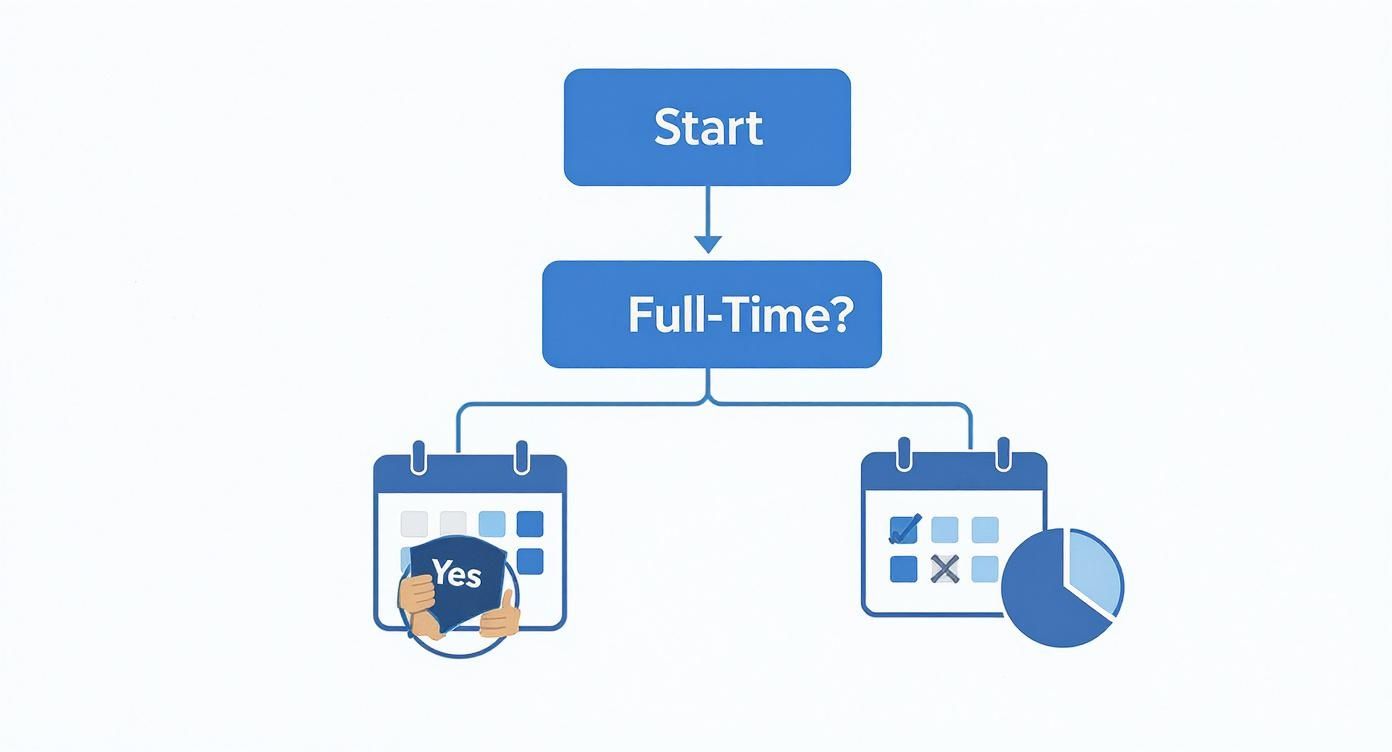
As you can see, the first question is always about your employment status. Answering that sets you on the right path for calculating your time off and holiday pay correctly.
Calculating for Part-Time Staff
For part-time employees who work a set number of days each week, the calculation is refreshingly simple. All you need to do is multiply the number of days you work per week by the statutory entitlement of 5.6 weeks.
A Quick Part-Time Example
- Scenario: Alex works three days a week as a marketing assistant.
- Formula: Days worked per week × 5.6 weeks
- Calculation: 3 days × 5.6 = 16.8 days of paid holiday per year.
It’s common practice for employers to round this figure up to the nearest half or full day, so Alex would likely get 17 days of leave. This approach ensures part-time staff receive a fair, proportional holiday allowance. This concept is central to many HR calculations, and you can learn more about it in our detailed guide on how to calculate pro-rata salary.
Dealing with Irregular Hours and Zero-Hours Contracts
Things get a bit more complex when you don’t have fixed hours. For workers with variable schedules, holiday entitlement is usually calculated based on the hours they’ve actually worked.
For years, the standard approach was to use the 12.07% method. This percentage comes from the fact that the 5.6 weeks of statutory holiday make up 12.07% of the remaining working year of 46.4 weeks (because 5.6 ÷ 46.4 = 0.1207).
The 12.07% Method in Action
- Scenario: Sam is on a zero-hours contract in a warehouse and worked 80 hours last month.
- Formula: Hours worked × 12.07%
- Calculation: 80 hours × 0.1207 = 9.66 hours of holiday accrued.
So, for those 80 hours of work, Sam has earned just over nine and a half hours of paid leave.
A word of warning: It’s crucial to note that recent government guidance has shifted away from the 12.07% figure for many workers. The current preference is for a 52-week average pay period to calculate holiday pay, especially for those with irregular hours or part-year workers. Always check which method your employer is using and make sure it complies with the latest regulations.
How Holiday Pay is Calculated in Pounds
Knowing your entitlement in days or hours is only half the battle. You also need to know what you’ll actually be paid for that time off. For salaried staff, it’s easy – your pay stays the same. But for anyone on an hourly or variable rate, it’s a different story.
Your holiday pay should reflect what you would have normally earned if you’d been at work. This means it must include regular payments you receive, such as:
- Commission payments
- Performance-related bonuses
- Regular overtime hours
The law requires employers to look back over the previous 52 paid weeks (ignoring any weeks you didn’t work) to find an average weekly pay. This average then becomes your pay for one week of holiday.
Calculating Average Weekly Pay
- Scenario: Chloe works in retail, and her pay varies due to commission and overtime. Over the last 52 weeks she actually worked, she earned a total of £20,800.
- Formula: Total pay over 52 weeks ÷ 52
- Calculation: £20,800 ÷ 52 = £400 per week.
This means when Chloe takes a week’s holiday, she should be paid £400. This system ensures she isn’t financially penalised for taking the leave she is legally entitled to.
Understanding Holiday Accrual and Carryover Rules
Knowing your total holiday allowance is a great start, but it’s only half the story. You also need to understand when you can actually take it. Holiday entitlement isn’t usually dumped in your lap in one go on your first day. Instead, you earn it bit by bit throughout the year in a process known as holiday accrual.
This is particularly important if you join a company part-way through its holiday year. You won’t get the full annual allowance straight away; you build it up as you go. It’s a fair system that keeps your entitlement proportional to the time you’ve actually worked.

How Holiday Accrual Works in Practice
The simplest and most common way to handle accrual is on a monthly basis. Your employer just divides your total annual leave by 12, giving you the amount you earn each month.
Let’s walk through a real-world example to see how this works for a new starter.
- Scenario: Maria starts a new full-time job on 1st July. Her company’s holiday year is the standard January to December, and she gets the statutory 28 days.
- Monthly Accrual: We calculate this as 28 days ÷ 12 months = 2.33 days per month.
- Total Accrued Leave: Maria will be working for the last six months of the year (July to December). So, her holiday entitlement for that period is 6 months × 2.33 days = 13.98 days.
In nearly all cases, an employer would round this up to 14 days. This means Maria has 14 days of paid leave she can book between July and the end of December.
The Rules on Carrying Over Unused Leave
So, what happens if you get to the end of the leave year with days left over? This is where carryover rules come in. UK law sets out the basic guidelines, but your own employment contract might be more generous.
The law splits the statutory 5.6 weeks (28 days) of leave into two distinct pots:
- The first 4 weeks: This part comes from the EU’s Working Time Directive. The law is strict here – you generally can’t carry this leave over. You have to use it in the year it’s given.
- The additional 1.6 weeks: This is the extra bit granted under UK law. You can carry this over into the next year, but only if your employer has agreed to it in your contract or policy.
For a full-time employee, this means you could potentially carry over up to 8 days (1.6 weeks x 5 days) of your statutory leave. The key phrase here is “with your employer’s permission.” Always check your contract or company handbook, as that’s where their specific policy will be laid out.
Special Exceptions for Carrying Over Holiday
There are a few important situations where the standard carryover rules are relaxed. These exceptions are designed to protect you from losing leave when you’re genuinely unable to take it.
You’re legally allowed to carry over untaken statutory holiday if you’ve been on:
- Long-term sick leave
- Maternity leave
- Paternity, adoption, or shared parental leave
If you couldn’t take your holiday because of these circumstances, the law says you can carry it into the next leave year.
It’s also interesting to see how work culture is changing. Recent data shows a clear trend of UK workers taking more of their allocated time off. The average number of unused holiday days per employee has plummeted from 18.5 in 2019 to just 5.3 in 2024—a 71% reduction. This shift points towards better leave management and a healthier work-life balance. You can dig into more of the state of annual leave statistics on Timetastic.co.uk. As people use more of their allowance, understanding the rules for those few leftover days becomes even more critical.
Navigating Complex Scenarios and Common Pitfalls
Figuring out holiday for a standard full-time employee is usually straightforward. But what happens when things aren’t so simple? Real life rarely fits into neat boxes, and situations like long-term sick leave or someone leaving the company can throw a spanner in the works.
This is where many businesses—and employees—get tripped up. Let’s walk through some of the most common tricky areas, from how leave builds up when someone’s off long-term to calculating that all-important final holiday payment when a job ends.
Holiday Entitlement During Long-Term Absence
It’s a surprisingly common myth that holiday entitlement just stops when an employee isn’t actively working. In reality, UK law is clear: statutory holiday entitlement continues to build up as normal during any period of extended leave. You can’t penalise someone for being away.
This protection is crucial in a few key situations:
- Family Leave: Whether it’s maternity, paternity, adoption, or shared parental leave, an employee’s full holiday entitlement accrues throughout their time off.
- Long-Term Sickness: Leave also builds up while an employee is on sick leave, no matter how long they’re away. If they’re too ill to use their holiday, they are legally allowed to carry it over into the next leave year.
This means if an employee takes a full year of maternity leave, they’ll come back to a full year’s holiday allowance ready and waiting. Many new parents use this accrued leave to create a phased, more gradual return to work.
Calculating Final Holiday Pay When Leaving a Job
When an employee moves on, one of the last bits of admin is settling their final holiday pay. Getting this right is absolutely critical for a clean break and, more importantly, for staying on the right side of the law.
The process is all about working out how much holiday they’ve earned up to their very last day of employment. Any of that accrued leave they haven’t used must be paid out in their final salary.
Let’s look at a quick example.
- Scenario: Ben works full-time and gets 28 days of holiday a year. He hands in his notice and his last day is 30th September. His company’s holiday year runs from January to December.
- How far into the year is he?: Ben has worked for 9 of the 12 months (9 ÷ 12 = 0.75).
- What has he earned?: He’s accrued 75% of his total leave: 28 days × 0.75 = 21 days.
- What has he taken?: Looking at the records, Ben has already used 15 days of holiday this year.
- What is he owed?: 21 days accrued minus 15 days taken leaves 6 days. Ben must be paid for these 6 days in his final payslip.
What if it went the other way? If Ben had taken 22 days of holiday, he would have used one more day than he’d actually earned. In this situation, most employers can deduct one day’s pay from his final salary, but only if this is clearly spelled out in his employment contract.
Pro Tip: Make sure your employment contracts include a clear clause allowing for deductions if an employee takes more holiday than they’ve accrued upon leaving. Without it, you’ll find it very difficult to legally claw that money back.
Common Mistakes to Avoid
Even with the best intentions, errors in holiday calculations happen all the time. Knowing what to watch out for can save you a world of headaches down the line.
One of the biggest tripwires is miscalculating holiday pay for people with irregular hours. It’s not enough to just pay their standard hourly rate. You have to factor in regular overtime and commission by calculating their average pay over the previous 52 weeks. Failing to do this is a direct breach of employment law.
Another classic mistake is rounding down pro-rata entitlements. If a part-timer’s calculation comes out to 16.8 days, rounding down to 16 is illegal. You must always round up to the nearest half or full day, making 17 days the correct, compliant figure.
Sometimes, extra work means you owe employees time off in another way. Our guide on how days off in lieu work digs into the specifics of managing this. These small details aren’t just nit-picking; they’re essential for getting it right.
Taking the Headache Out of Holiday Management with Dynamics 365
Let’s be honest, manually tracking pro-rata leave, accruals, and carryover on a spreadsheet is a pain. For many growing businesses, what starts as a simple task soon spirals into a complex mess of potential errors, wasted admin hours, and serious compliance risks. This is exactly where a modern HR system proves its worth.
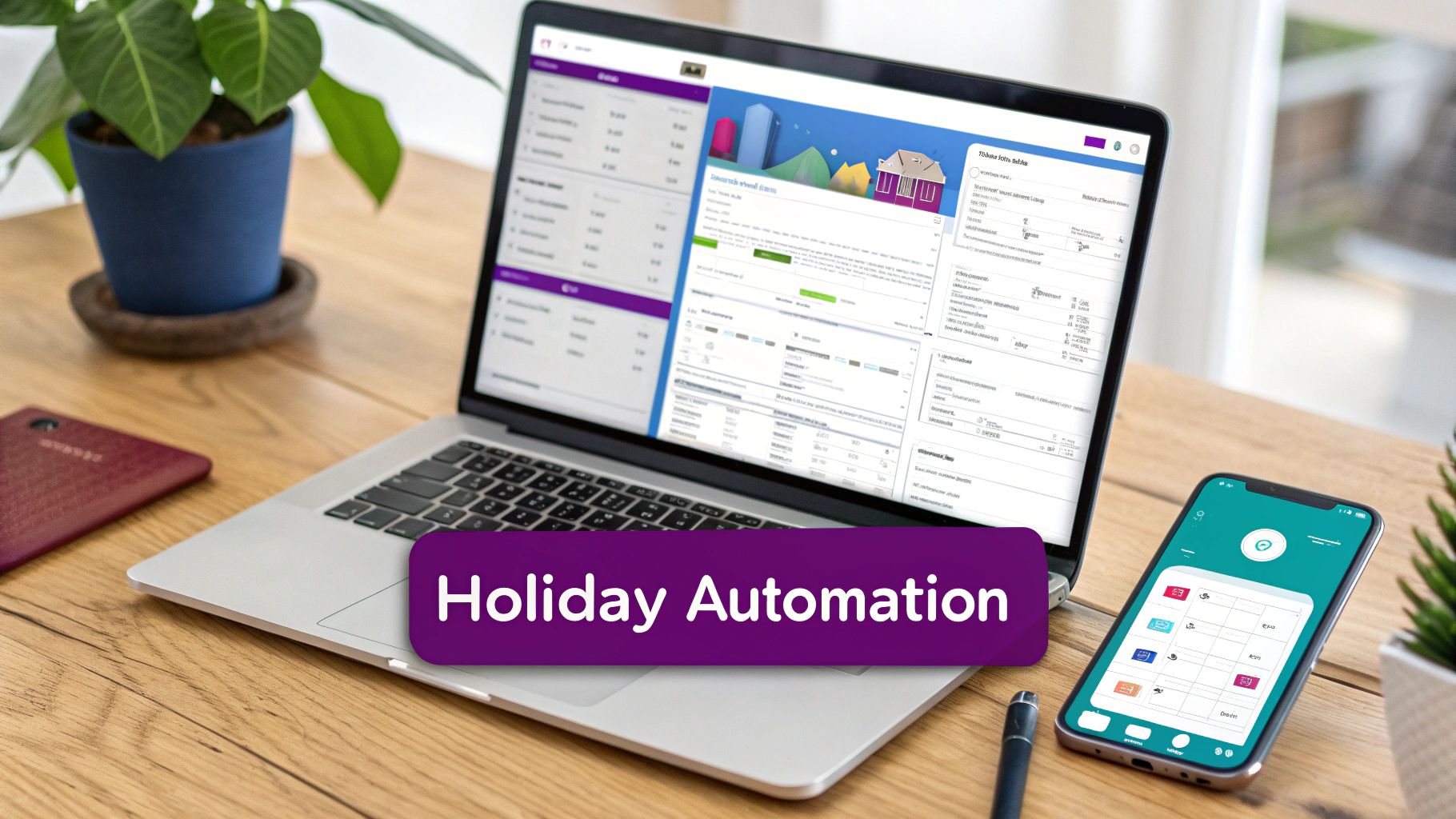
Ditching the spreadsheet isn’t just about making life easier; it’s a strategic move to boost accuracy and efficiency across the board. An integrated system like Dynamics 365 Human Resources is built to eliminate the guesswork. It brings all your holiday data into one place, handles the complex maths for you, and creates a single, reliable source of information for everyone.
A Simpler Way to Handle Holiday Requests and Approvals
One of the first things you’ll notice is the end of endless email chains and paper forms. With Dynamics 365, your team gets a self-service portal where they can check their remaining holiday balance and pop in a request whenever they need to.
The whole process is completely transparent. Staff know exactly how much leave they have left, which helps them plan their time off properly. At the same time, managers get an instant ping for new requests and can see a live team calendar, making it easy to spot clashes before they become a problem. This kind of visibility is brilliant for preventing staff shortages and keeping operations running smoothly. We cover more on managing different leave types in our guide on what PTO leave is and how it works.
Automatic Accruals for Every Type of Contract
Figuring out holiday entitlement gets really fiddly when you have part-time staff, people on variable hours, or new starters. A system like Dynamics 365 takes care of these headaches automatically.
You just set up the rules for each employment contract once, and the platform handles the rest:
- Pro-rata Calculations: The system instantly works out the correct entitlement for part-timers based on their specific hours or days.
- Monthly Accrual: For new starters, leave is added to their balance automatically each month, so it’s always accurate right from their first day.
- Variable Hours: You can configure it to manage leave for workers with irregular patterns, applying the right accrual rules based on the hours they’ve actually worked.
This isn’t just a time-saver; it’s a compliance lifeline. It ensures every single employee, no matter their working pattern, gets their correct statutory and contractual holiday, drastically reducing the risk of a payroll blunder or a legal challenge.
Staying Compliant and Gaining Better Insight
Beyond the daily admin, automation gives you powerful tools for compliance and bigger-picture planning. The system keeps a perfect audit trail of every leave request and approval, which is invaluable if you ever need to show that you’re applying your policies fairly and consistently.
It’s worth remembering that many UK employers offer more than the legal minimum to attract and keep good people. While the statutory floor is 28 days, many firms offer a more generous package, often around 34 days including bank holidays. As these enhanced benefits become the norm, managing them accurately is non-negotiable.
Having all your data in one place means you can pull insightful reports in seconds. You can spot absence trends, keep an eye on team capacity, and even identify potential burnout risks before they become serious issues. This data-driven approach helps you make smarter decisions about your workforce. For more on how these platforms fit into your overall strategy, you can find great information on business automation SaaS integration.
So, What’s Next for Your Holiday Entitlement?
We’ve covered a lot of ground. You should now feel much more comfortable figuring out holiday entitlement for your full-time staff, part-timers, and even those on zero-hours or irregular patterns. You know what the law says, and just as importantly, you know that the employment contract is king when it comes to the finer details like carryover rules and bank holiday policies.
But knowledge is only half the battle. Now it’s time to apply it.
From Theory to Practice
If you’re an employee, you’re now in a great position to double-check your holiday allowance. You have the tools to see if you’re getting the right amount of paid leave, which is a fundamental right. Don’t be afraid to run the numbers yourself – it’s your time off, after all.
And for the employers and HR managers out there… are you still wrestling with spreadsheets? If you’re bogged down with manual tracking and constantly worried about compliance, it’s a clear sign that you’ve outgrown your current process. Manual calculations are not only time-consuming but are also a breeding ground for costly mistakes.
Moving to a proper HR system isn’t just a ‘nice to have’ or a simple time-saver. It’s about creating a fair and transparent culture. It shows your team you value their wellbeing while ensuring your business is built on a solid, legally compliant foundation.
Ready to stop managing leave and start leading your people? For a no-nonsense chat about how a solution like Dynamics 365 can get you there, give us a call on 01522 508096 or send us a message to see how we can help.
Answering Your Holiday Entitlement Questions
Even when you’ve got the basics down, real-life situations can throw up some tricky questions about holiday entitlement. Let’s tackle some of the most common ones we come across from both managers and their teams.
What Happens to Bank Holidays If I’m Part-Time?
This is a classic. The simple answer is that you’re entitled to a pro-rata share of bank holidays, just like your main annual leave. It’s all about fairness.
If a bank holiday falls on a day you normally work, great – you get the day off, and it’s just taken from your total holiday allowance. But what if it lands on a non-working day? In that case, you don’t lose out. That day remains in your entitlement pot for you to take at another time, agreed with your employer.
Can My Employer Dictate When I Take My Holiday?
In short, yes. An employer can legally set specific times when you must take your leave. You’ll often see this in sectors that have clear peak seasons or in companies that have a mandatory Christmas shutdown.
However, they can’t just drop it on you last minute. The rules are clear: they must give you notice that is at least double the length of the holiday they’re requiring you to take. So, if they want you to take one week off, they need to let you know at least two weeks beforehand. It’s always a good idea to check your employment contract for any specific company policies on this.
It’s a two-way street. An employer can also refuse a holiday request, but they have to give you proper notice. The notice must be at least as long as the leave you asked for. If you request a two-week holiday, they must say no at least two weeks before it was meant to begin.
Is Holiday Pay the Same as My Normal Pay?
Your holiday pay should reflect what you would have typically earned if you’d been at work. This is a vital protection to ensure you aren’t financially worse off for taking the time off you’re entitled to.
For salaried employees with fixed hours and pay, it’s straightforward. But for people whose pay fluctuates—perhaps due to regular overtime, commission, or performance-based bonuses—the calculation is different. For them, holiday pay must be based on their average earnings over the previous 52 working weeks. This ensures the pay they receive is a fair reflection of their actual income.
Tired of wrestling with spreadsheets and worrying about compliance? Phone 01522 508096 today or send us a message to see how we can make your HR processes a whole lot simpler.