

A staff satisfaction survey is much more than a simple HR exercise; it's a vital piece of business intelligence. When done right, it gives you a clear window into the health of your organisation, flagging up real opportunities to boost productivity, improve retention, and spark innovation. Think of it as a regular check-up for your most valuable asset: your people.
Why Your Staff Satisfaction Survey Is a Strategic Business Tool
Let's get past the idea of a staff satisfaction survey as just an annual box-ticking chore. In today's competitive UK market, truly understanding employee sentiment is fundamental to sustainable growth. It’s a direct line to the heart of your organisation, giving you the hard data you need to make informed, strategic decisions instead of relying on guesswork.

A well-designed survey acts as an early warning system. It can help you get ahead of major issues like widespread burnout, spot hidden leadership gaps before they hurt performance, and pinpoint what you're already doing well so you can build on those strengths.
Connecting Sentiment to Performance
It's a simple truth: happy, fulfilled employees are more productive. Study after study has shown that organisations with high employee satisfaction see tangible benefits that go straight to the bottom line.
These aren't just fuzzy feelings; they translate into real-world results:
- Improved Retention: When you understand why people stay—and what might push them to leave—you can address issues proactively. This significantly cuts down on the high cost of staff turnover.
- Enhanced Productivity: Employees who feel heard and valued are naturally more motivated and committed. This leads directly to better quality work and higher output.
- Stronger Company Culture: Asking for regular feedback helps build a culture of open communication and continuous improvement, making your company a much more attractive place to work.
The CIPD Good Work Index paints a complex picture of staff satisfaction across UK workplaces. While job satisfaction is generally high, financial pressures are mounting. The percentage of employees keeping up with bills without difficulty dropped from 55% in 2022 to just 48% in 2023. This kind of data underscores how crucial it is for HR systems to help track and support employee wellbeing. You can dig deeper into UK workplace trends on the official government website.
A staff satisfaction survey isn’t about measuring happiness for its own sake. It’s about collecting the intelligence needed to build a more resilient, efficient, and successful organisation from the inside out.
From Static Data to Actionable Insights
The real value of a modern staff satisfaction survey is unlocked through integration. Standalone survey tools often leave you with isolated data points that are difficult to do anything with. But when your survey data is plugged directly into a central HR system like HR Management for Microsoft Dynamics 365, it comes to life.
This approach transforms static numbers into real-time, actionable insights, all within the Microsoft environment your team already uses every day. It allows you to spot trends over time, connect satisfaction levels with performance metrics, and create targeted action plans. This is how you turn employee feedback into meaningful, measurable change across the business.
We are DynamicsHub.co.uk. We provide Transformative HR solutions customised to the unique way you work. Human Resource HR Management for Microsoft Dynamics 365 by Hubdrive is the leading hire-to-retire solution for the Microsoft Platform.
To discover how we can help transform your HR processes, phone 01522 508096 today or send us a message.
Designing a Survey That Delivers Honest Feedback
Let's be blunt: the quality of your staff satisfaction survey hinges entirely on asking the right questions, in the right way. A poorly designed survey can do more harm than good. At best, it causes confusion; at worst, it signals to your team that you aren't genuinely interested in what they have to say. To get the honest, actionable feedback you're after, you need to move beyond generic templates and create a survey that’s thoughtful, relevant, and respects your employees' time.
This starts with choosing the right tools for the job. For example, Likert scales (think "Strongly Agree" to "Strongly Disagree") are fantastic for gauging sentiment and tracking how things change over time. On the other hand, you can’t beat open-ended questions for getting that rich, human context that raw numbers just can't provide.
A brilliant addition to any survey is the Employee Net Promoter Score (eNPS). It’s a single, powerful question: "On a scale of 0-10, how likely are you to recommend our company as a place to work?" This gives you a crystal-clear, high-level snapshot of overall employee loyalty. A really solid survey will blend all three of these approaches to paint a complete picture.
Choosing the Right Question Types
The way you frame a question has a massive impact on the answers you get. If your questions are ambiguous or leading, you’ll end up with skewed results that mask the real issues.
Think about the difference here:
- Poor Question: "Is management doing a good job?" It's far too broad and subjective. What does "good" even mean?
- Better Question: "I receive regular, constructive feedback from my line manager that helps me improve my performance." This is specific, measurable, and zeros in on a tangible action.
Another classic mistake is the "double-barrelled" question, like, "Are you satisfied with your pay and benefits?" Someone might be perfectly happy with their salary but feel the benefits package is letting them down. Splitting these into two separate questions is the only way to get accurate data.
The real aim is to make every question so clear that each employee interprets it in exactly the same way. That consistency is what gives you reliable data and makes sure you're actually measuring what you think you're measuring.
Crafting a UK-Centric Question Bank
To gather genuinely useful insights, your questions need to resonate with the key drivers of satisfaction for a UK-based workforce. While every organisation has its own culture, certain themes pop up time and time again as being critical.
Here’s a sample question bank to get you started, focusing on these core areas.
Sample Staff Satisfaction Survey Question Bank
This table offers a selection of effective, UK-centric questions across key satisfaction drivers. You can use this as a solid starting point for designing your own survey.
| Category | Question Type | Sample Question |
|---|---|---|
| Leadership & Management | Likert Scale | My line manager provides me with the support I need to do my job well. |
| Career Development | Likert Scale | I can see a clear path for career progression within this organisation. |
| Work-Life Balance | Likert Scale | I am able to maintain a healthy balance between my work and personal life. |
| Communication | Open-Ended | What is one thing we could do to improve communication within the company? |
| Recognition | Likert Scale | I feel that my contributions are recognised and valued by the organisation. |
| Wellbeing | Likert Scale | The company genuinely cares about my mental and physical wellbeing. |
This is just a foundation, of course. For more detailed inspiration, it's worth looking at the frameworks used in 360-degree feedback, which often contain well-tested and validated questions. Digging into these 360 survey examples can spark some great ideas for your own design.
Ensuring Anonymity and Building Trust
Ultimately, none of this matters if your team doesn't trust the process. Anonymity isn't just a nice-to-have feature; it is the absolute bedrock of a successful staff satisfaction survey. You have to be crystal clear about how you are protecting everyone's confidentiality.
Here’s how to do it:
- Be Upfront and Honest: Start the survey by explicitly stating that all responses are anonymous and will only ever be reviewed in an aggregated format.
- Set Group Size Thresholds: Reassure people by explaining that results for specific teams will only be reported if the group is large enough (say, five or more people) to prevent any individual from being singled out.
- Use Secure Technology: When you use a trusted platform, like one built on Microsoft Dataverse, you're showing a commitment to security. Keeping the data within your own system goes a long way towards building confidence.
When your people feel genuinely safe to share their honest opinions without any fear of comeback, that's when you unlock the kind of feedback that can drive real, meaningful change in your organisation.
Bring Your Survey to Life with Microsoft 365 and Dynamics HR
A brilliantly designed survey is only half the battle. The real test is in the execution. Relying on manual processes to run your staff satisfaction survey is not just slow; it's a recipe for errors that can quickly undermine trust and invalidate your results. The good news is, you likely already have the tools to automate the entire process securely and efficiently within the Microsoft ecosystem your organisation uses every day.
This isn't about just finding a fancier survey tool. It's about building a connected, intelligent system. For quick, straightforward pulse checks, Microsoft Forms is a fantastic place to start. It’s intuitive, easy to use, and plays nicely with other Microsoft 365 apps, letting you gather feedback without needing a complex setup.
Get Your Distribution and Reminders on Autopilot
One of the biggest headaches with any survey is chasing responses. Manually sending invites, tracking who has and hasn't replied, and sending follow-ups is a huge drain on your HR team's time. This is where a tool like Power Automate really shines, acting as the smart glue that holds your process together.
You can set up automated workflows to handle all the heavy lifting:
- Send Personalised Invitations: Automatically send survey links via Microsoft Teams or Outlook, greeting each employee by name for a more personal touch.
- Schedule Smart Reminders: Set up gentle nudges that only go to colleagues who haven't completed the survey yet. No more spamming the entire company.
- Notify Key Stakeholders: Automatically alert managers when their team’s response rate hits a specific target, empowering them to encourage participation.
Automation isn't just about saving time. It’s about creating a more professional and respectful experience for your employees. A smooth, well-managed process sends a clear message: we value your time and your feedback.
This flowchart maps out the key stages of survey design, from framing the right questions to ensuring anonymity is protected.
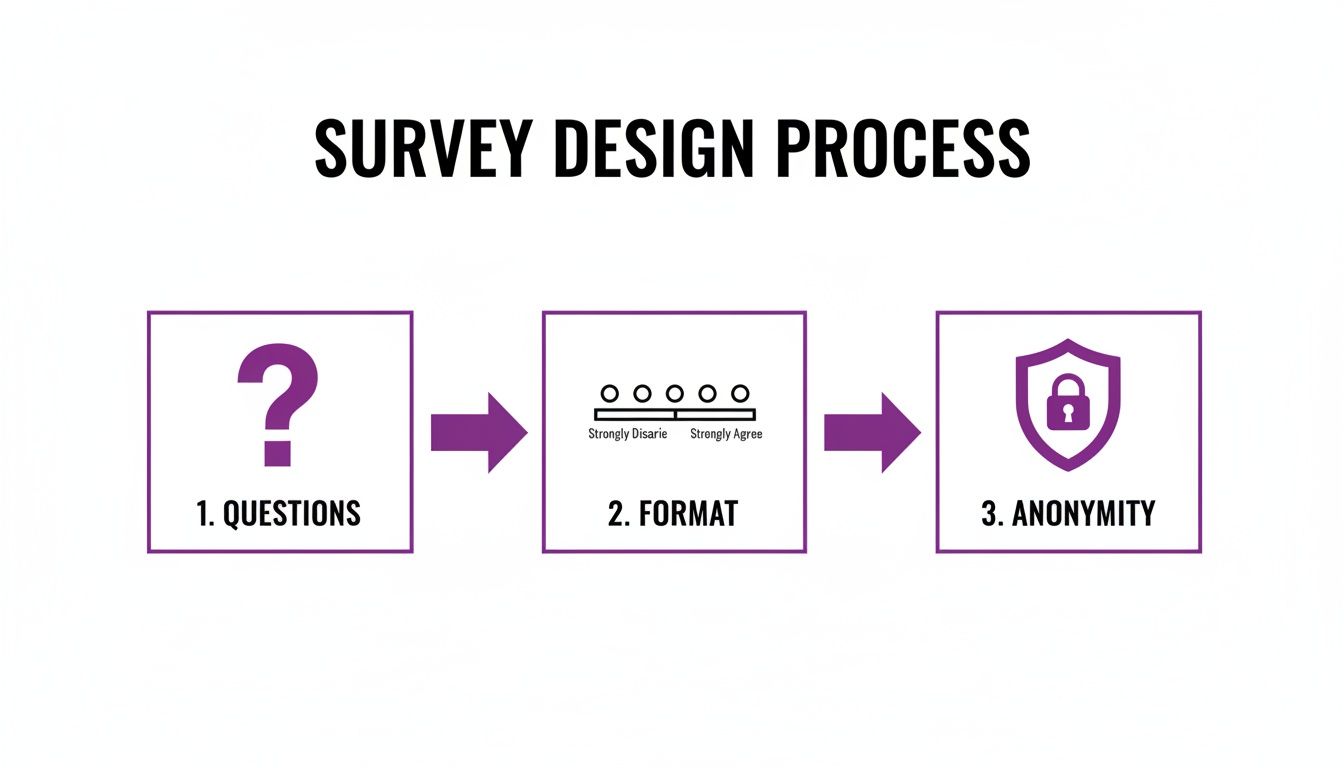
As you can see, the technical automation is built upon a solid strategic foundation. Get the design right, and the automation will make it fly.
Keep Your Data Secure and GDPR Compliant
When you're dealing with sensitive employee opinions, security and data privacy are paramount. This is non-negotiable, especially with strict UK GDPR regulations. One of the biggest wins of using an integrated Microsoft solution is that all your sensitive data stays right where it belongs: inside your own secure IT environment.
By using a platform like HR Management for Microsoft Dynamics 365, which is built on Microsoft Dataverse, all survey responses are stored securely within your own Microsoft 365 tenant. This completely removes the risks of exporting confidential employee data to third-party tools, which can be a compliance nightmare. Your IT team retains full control over the data, applying the same tough security policies you use across the rest of the business. If you're new to this, you can learn more about what the Power Platform is and how it provides this secure backbone.
Think about the scale of a major survey, like the one at the University of Oxford which gathered 8,980 responses. Their results found that only 41% of staff felt confident that action would be taken based on the feedback. This highlights a crucial point: trust is earned not just by asking, but by managing the process securely and being transparent about the follow-up. You can read the University of Oxford's staff survey findings here.
Using the power of Dynamics 365 and the wider Microsoft stack lets you create a seamless and secure process from start to finish. It frees up your HR team to focus on what matters—the insights—and shows your employees that you're handling their valuable feedback with the professionalism it deserves.
We are DynamicsHub.co.uk. We provide Transformative HR solutions customised to the unique way you work. Human Resource HR Management for Microsoft Dynamics 365 by Hubdrive is the leading hire-to-retire solution for the Microsoft Platform.
To see how we can help you modernise your HR processes, give us a call today on 01522 508096 or send us a message.
Uncovering the Story in Your Data with Power BI
So, you’ve collected all the responses from your staff satisfaction survey. What now? A spreadsheet full of raw numbers is just noise. The real magic happens when you start to interpret that data, turning it into a compelling story that actually drives change. This is where we go beyond basic charts and step into the dynamic world of Microsoft Power BI, a tool designed to make your survey results come alive.

If you're using HR Management for Microsoft Dynamics 365, your survey data can be piped directly into Power BI. This connection is a game-changer. It allows you to build interactive dashboards that translate complex datasets into clear, easy-to-digest visual stories. Instead of a flat, static report, you get a living tool that your leadership team can explore for themselves.
Slicing and Dicing to Find the Real Issues
The true power of Power BI lies in its ability to slice and filter data on the fly. It's easy to be lulled into a false sense of security by a high overall satisfaction score, but this can mask serious underlying problems. By creating dynamic filters, you can start asking much more specific and insightful questions.
For example, a quick exploration might reveal:
- By Department: The engineering team reports high satisfaction, but new starters in sales are really struggling after their first six months.
- By Location: Your London office has a much lower score on work-life balance compared to your regional branches.
- By Tenure: Staff who have been with you for over five years feel less optimistic about career progression than those with just one to two years of service.
These are the kind of crucial, actionable insights that get completely lost in an aggregated summary. Granular analysis lets you pinpoint exactly where your interventions are needed most.
The goal isn't just to see what your employees are thinking, but to understand why different groups feel the way they do. Dynamic dashboards let you peel back the layers and get to the root cause of both satisfaction and dissatisfaction.
Choosing the Right Visuals to Tell Your Story
To build a strong business case for change, your dashboard needs to tell a crystal-clear story. Resist the temptation to cram it with every possible metric. Instead, focus on a few key visuals that hammer home the most important takeaways from your survey.
I'd recommend incorporating these elements:
- Sentiment Analysis: Use Power Platform AI tools to make sense of open-text comments. A word cloud is a brilliant way to instantly show the most frequently mentioned terms, while a sentiment gauge (positive, neutral, negative) offers a quick emotional snapshot.
- Trend Analysis: If you run regular pulse surveys, a line chart showing how key metrics like eNPS or wellbeing scores change over time is non-negotiable. It's the only way to track whether your initiatives are actually working.
- Heat Maps: A colour-coded matrix is fantastic for showing satisfaction scores across different departments and survey topics (e.g., leadership, pay, culture). It immediately draws the eye to problem areas.
The NHS National Staff Survey is a perfect real-world example of why this detail matters. While some headline metrics improved in their latest survey, it also revealed that a shocking 42% of staff felt unwell due to work-related stress. Granular analysis showed that while new joiners often had better experiences initially, this satisfaction frequently nosedived after their first year—flagging a major retention risk. Breaking down results by organisation and staff group is essential for targeted action, a capability that well-designed Power BI dashboards deliver perfectly. You can find more insights from the 2023 NHS Staff Survey on The King's Fund website.
For a deeper dive into the metrics that matter, our guide on human resources analytics provides more context. And if you're exploring options beyond Power BI for visualising your survey data, this Business Intelligence Tools Comparison Guide is an excellent resource.
By transforming your survey data into a clear, compelling, and interactive story, you give your leadership team the evidence they need to make confident, data-driven decisions that will genuinely improve the employee experience.
Turning Insight into a Meaningful Action Plan
Let’s be honest: the survey itself is the easy part. The real work, the part that actually makes a difference, begins the moment it closes.
Once you’ve collected all that valuable feedback, the clock is ticking. Failing to act on what your people have told you is one of the fastest ways to destroy trust and make sure nobody bothers to respond next time. A visible, well-thought-out action plan isn't a nice-to-have; it's the only way to prove you were actually listening.
Think of the post-survey period as a critical window. Your employees have spoken up and are now waiting, watching to see what happens next. This is your chance to build some serious momentum and show them their time was well spent.
Start with Open and Honest Communication
Before you even think about building an action plan, you need to talk to your people. In the absence of information, silence will always be interpreted as inaction. Your first job is to get a clear and simple communication plan in place.
Here’s what that should look like:
- A Quick Thank You: As soon as the survey closes, send a company-wide message. Thank everyone for participating and give them a rough timeline of what to expect next. Keep it simple and realistic.
- Share the Big Picture: Within a couple of weeks, share the high-level results. Don’t just focus on the negatives. Celebrate what you’re doing well, but be just as transparent about the areas that clearly need work.
- Brief Your Managers First: Make sure you equip your managers with their team-specific results before sharing them more widely. This gives them a chance to process the feedback and get ready for some really constructive team conversations.
The point of post-survey communication isn't just to dump data on people. It's about starting a conversation and building a shared understanding of where you are as a company and where you need to go—together.
Empower Managers to Drive Change on the Ground
While the senior leadership team will own the big, company-wide initiatives, the most powerful changes often happen at the team level. Your managers are on the front line; they’re perfectly placed to turn feedback into real, tangible improvements.
But you can’t just hand them a report and expect magic to happen. That’s a recipe for disaster.
Instead, you need to give them a framework. A brilliant way to do this is to guide them in creating action plans with their teams, built around SMART goals:
- Specific: What, exactly, are we trying to achieve?
- Measurable: How will we know we’ve done it?
- Achievable: Can we realistically do this as a team?
- Relevant: Does this goal tackle a key problem from our survey?
- Time-bound: What’s the deadline?
For example, if a team’s feedback flagged poor communication as a major issue, a weak goal would be "improve communication." A SMART goal would sound more like this: "To improve how we communicate, we will start a 15-minute daily huddle each morning. The team lead will also have a one-to-one check-in with every team member every two weeks. We’ll measure progress in our next quarterly pulse survey."
Understanding and tackling common issues like workplace stress is a crucial part of this process, helping you create a healthier environment by exploring practical strategies to reduce workplace stress.
Create a Continuous Feedback Loop
An action plan shouldn't be a document that gets created, filed, and forgotten. It’s a living commitment that needs constant attention.
This is where having an integrated system like HR Management for Microsoft Dynamics 365 becomes a game-changer. It takes your action plan off a static spreadsheet and turns it into a dynamic, trackable part of your everyday HR operations.
You can assign tasks, set deadlines, and monitor progress right inside the system. This builds in accountability and makes sure the promises you made after the survey are actually kept. It closes the loop perfectly, showing employees that their voice led directly to measurable change. That’s how you build the trust and psychological safety needed for a genuinely brilliant company culture.
We are DynamicsHub.co.uk. We provide Transformative HR solutions customised to the unique way you work. Human Resource HR Management for Microsoft Dynamics 365 by Hubdrive is the leading hire-to-retire solution for the Microsoft Platform.
To see how we can help you build a more responsive and engaged workforce, phone 01522 508096 today or send us a message.
Right, you've got the data from your staff survey. Now what? Leaving those insights to gather dust in a spreadsheet is a massive missed opportunity. The real value comes from turning that feedback into genuine, tangible improvements across the business.
This is exactly where an integrated HR system changes the game. We are big believers in the Human Resource HR Management for Microsoft Dynamics 365 solution from Hubdrive, because it’s the leading hire-to-retire platform built entirely within the Microsoft ecosystem you already know and trust.
Imagine connecting your survey feedback directly into your core HR processes. You could manage everything from performance reviews and wellbeing initiatives to compliance and overall engagement, all in one place. It’s about building a direct line from what your people are saying to the actions you take to create a more satisfied, productive, and engaged workforce.
Let's chat about how you can turn those survey results into meaningful action.
To see how we can help you get more from your HR processes, phone 01522 508096 today, or send us a message.
Got a Question? We’ve Got Answers
When you start digging into staff satisfaction surveys, a few questions always pop up. It’s natural. We’ve answered some of the most common ones we hear from UK business leaders and HR managers to help you move forward with confidence.
How Often Should We Be Surveying Our Staff?
Finding the right survey frequency is all about balance. A big, comprehensive annual survey is brilliant for getting that deep, strategic view and benchmarking progress year on year. But let's be honest, a lot can happen in twelve months, and you risk missing the day-to-day reality on the ground.
That’s why so many organisations are now blending their approach.
Think about supplementing that big yearly survey with quarterly or even biannual 'pulse' surveys. These are much shorter, more focused check-ins that can give you immediate feedback on specific things, like a new wellbeing policy or a recent change to hybrid working. You get the best of both worlds: the strategic depth of an annual review and the agility to spot and fix small issues before they snowball.
Are These Surveys Genuinely Anonymous?
This is a big one, and the short answer is: they absolutely must be. Anonymity is the bedrock of honest feedback. If your team doesn't trust that their responses are private, you simply won't get the candid insights you need to make meaningful changes.
Modern survey platforms are built to protect this. True anonymity works by aggregating data, which means individual responses get bundled together. For instance, you could set a rule that demographic or team-specific results will only be displayed if there are more than five respondents in that group. This makes it impossible to single anyone out.
From a UK GDPR standpoint, you have to be transparent. You'll need a clear privacy notice that explains what data you're collecting and why. Using a secure, integrated system like HR Management for Microsoft Dynamics 365 gives you a solid foundation here, as all the employee data stays within your own secure Microsoft 365 environment.
What's a Good Survey Response Rate to Aim For in the UK?
In our experience, if you’re hitting a response rate between 50% and 60% in the UK, you’re doing well. If you can push that above 70%, that’s genuinely excellent and points to a really high level of trust and engagement in your organisation.
Of course, that number depends on a few things. How well did you communicate why the survey is important? Do people trust that leadership will actually listen and act on the feedback? How easy is it for them to fill it out?
While a higher rate is always better for statistical confidence, don't discount the value you can get from a 30-40% response. The real gold is often in the open-ended comments. Your goal should be to improve the rate over time, not just fixate on hitting one specific number.
What’s the Real Difference Between Satisfaction and Engagement?
It’s easy to use these terms interchangeably, but they measure two very different, though related, things. Getting the distinction right is crucial to understanding what’s really going on with your workforce.
-
Satisfaction is all about contentment. It’s the answer to: "Am I happy with the basics of my job?" Think of it as transactional – things like pay, benefits, and working hours fall into this category. It's about feeling fairly treated.
-
Engagement goes much deeper. It's an emotional commitment to the company and its purpose. It answers: "Am I motivated to go the extra mile for this organisation?" An engaged employee feels connected to the mission and is genuinely invested in seeing the company succeed.
An employee can easily be satisfied without being engaged. They might be happy with their salary and get on well with colleagues, but they lack that fire to innovate or push beyond their job description. A truly great survey will measure both, giving you a complete picture of your organisation’s health.
At DynamicsHub.co.uk, we provide Transformative HR solutions customised to the unique way you work. Human Resource HR Management for Microsoft Dynamics 365 by Hubdrive is the leading hire-to-retire solution for the Microsoft Platform.
We can help you create a more satisfied, productive, and engaged workforce. Phone 01522 508096 today, or send us a message.