In the complex landscape of UK employment law, selecting the appropriate contract is more than a formality; it's a strategic decision that defines the relationship between your organisation and its people. From the stability of a permanent position to the flexibility of a freelance agreement, each of the UK's employment contract types carries distinct legal, financial, and operational implications. Getting this choice right ensures compliance with regulations like the Employment Rights Act 1996, manages risks associated with IR35, and aligns your workforce strategy with your business goals. Conversely, getting it wrong can lead to costly employment tribunals, significant tax liabilities, and lasting reputational damage.
This comprehensive guide serves as a practical roundup of the 10 key employment contract types every UK HR professional and business leader needs to understand. We will move beyond basic definitions to explore specific use cases, legal frameworks, and critical compliance considerations for each agreement. For every contract, understanding what constitutes a total compensation package is vital, as benefits, bonuses, and pension contributions often differ significantly between them.
Crucially, we will also demonstrate how a modern, integrated HR solution like Hubdrive's HR Management for Microsoft Dynamics 35 can streamline the administration of these diverse agreements. As implemented by DynamicsHub, this system empowers you to manage everything from Right to Work checks to GDPR compliance within a single platform, ensuring you remain efficient and strategically agile in your talent management. This article provides the actionable insights you need to navigate these choices with confidence.
1. Permanent Full-Time Employment Contract
The permanent full-time contract is the cornerstone of the UK employment landscape. It establishes an ongoing employer-employee relationship with no predetermined end date, providing stability for both parties. Employees typically work a standard week, such as 35-40 hours, and are entitled to the full spectrum of statutory employment rights, including paid holiday, sick pay, and pension contributions. This contract type is the default for core business functions and signifies a long-term commitment from the organisation.

This model is prevalent across stable, established roles. Consider the core consultants in a Microsoft partner firm, NHS clinical staff, or the finance team in a large technology company like Accenture. These roles require deep institutional knowledge and continuity, making the permanent contract the ideal choice. It fosters loyalty and allows for significant investment in employee training and development.
When and Why to Use This Contract
Use a permanent full-time contract for roles central to your organisation's mission and daily operations. It is best suited for positions where long-term stability, employee retention, and deep expertise are critical for success. This approach provides maximum security for the employee, which in turn helps attract high-calibre talent and reduces the significant costs associated with frequent recruitment and onboarding. Accurately defining these roles is key; understanding how to calculate Full-Time Equivalent (FTE) status is a fundamental first step.
HR Implementation with Dynamics 365
For organisations leveraging the Microsoft ecosystem, managing these contracts becomes a streamlined, compliant process.
- Centralised Records: Use the HR solution from Hubdrive to create and maintain a single source of truth for all contract documentation, from the initial offer letter to any subsequent amendments.
- Compliance Automation: Implement DynamicsHub’s integrated UK compliance module to automate Right to Work checks directly within the employee record, ensuring you meet Home Office requirements from day one.
- Onboarding Workflows: Build a standardised onboarding journey in Power Apps. This ensures every new permanent employee receives their contract, signs it electronically, and has it automatically filed in their Dynamics 365 profile, creating a complete audit trail.
- Data-Driven Insights: Leverage Power BI to build dashboards that track key metrics for your permanent workforce, such as headcount, average tenure, and salary costs, enabling strategic workforce planning.
2. Fixed-Term Contract
A fixed-term contract establishes an employment relationship for a specific, predetermined period. This type of agreement has a clear start and end date, making it ideal for roles that are not permanent by nature. Employees on fixed-term contracts are generally entitled to the same pay, benefits, and conditions as permanent colleagues, and after four years of continuous service on successive contracts, their employment may automatically become permanent.
This model is common for covering temporary absences or delivering time-bound projects. Examples include providing maternity cover within an HR team, bringing in a specialist for a six-month Dynamics 365 implementation project, or hiring seasonal retail staff for the Christmas period. Academic institutions also frequently use fixed-term contracts for research positions tied to specific funding grants. The key is that the need for the role is temporary.
When and Why to Use This Contract
Use a fixed-term contract when you have a genuine, objectively justifiable reason for the role being temporary. It is perfect for covering employee leave (such as sabbaticals or parental leave), managing seasonal peaks in demand, or executing specific projects with defined timelines. This approach offers workforce flexibility, allowing you to scale your team up or down in line with business needs without the complexities of redundancy. However, it's crucial to ensure the reason for the fixed term is legitimate to avoid potential claims of unfair dismissal if the contract is not renewed.
HR Implementation with Dynamics 365
Managing the lifecycle of these employment contract types requires precision, which is where a unified Microsoft ecosystem excels.
- Automated End-Date Alerts: Configure Power Automate flows based on the contract end date stored in Hubdrive’s HR solution. These flows can trigger automated email reminders to line managers and HR 90, 60, and 30 days before expiry.
- Renewal Justification Workflows: Use Power Apps to create a mandatory workflow for contract renewals. This ensures managers provide and document an objective justification for extending the term, which is then stored against the employee record in DynamicsHub for compliance.
- Standardised Offboarding: When a contract is not renewed, trigger an automated offboarding process in Dynamics 365. This can manage the return of company property, final payroll calculations, and exit interviews, ensuring a consistent and compliant exit.
- Proactive Workforce Planning: Utilise Power BI dashboards to visualise all upcoming contract end dates across the organisation. This allows HR to forecast potential recruitment needs, analyse the reliance on temporary staff, and make strategic decisions about converting roles to permanent positions.
3. Part-Time Employment Contract
A part-time employment contract formalises a relationship where an employee works fewer hours than a full-time colleague, typically less than 35 hours per week. Critically, part-time workers are protected by UK law and are entitled to the same statutory rights as full-time employees on a pro-rata basis. This includes paid holiday, sick pay, pension contributions, and redundancy rights. This contract type is essential for organisations seeking to build a flexible, diverse, and inclusive workforce.

This model is increasingly common across various sectors. Consider parents returning to work on a three-day week, experienced professionals reducing hours pre-retirement, or students balancing work with their studies in retail. Shared HR business partner roles or administrative support positions in professional services also frequently use part-time contracts to ensure coverage without the cost of a full-time headcount, making it a versatile tool in modern workforce planning.
When and Why to Use This Contract
Use a part-time contract to attract talent pools that require flexibility, such as working parents, carers, or students. It is ideal for roles where the workload doesn't justify a full-time position or where job-sharing can provide wider skills coverage. Offering part-time arrangements enhances your employer brand, improves employee morale, and can increase retention by accommodating changing life circumstances. Correctly managing pay and benefits is crucial; understanding how to calculate pro-rata salary and leave is fundamental for compliance and fairness.
HR Implementation with Dynamics 365
Managing part-time staff requires precision, which the Microsoft ecosystem is perfectly equipped to handle.
- Accurate Hour Tracking: Utilise Hubdrive’s Time and Attendance capabilities, potentially enhanced with AI-powered clocking systems, to record part-time hours with complete accuracy for payroll processing.
- Automated Pro-Rata Benefits: Configure your payroll integration to automatically calculate pro-rata holiday entitlement and pension contributions based on contracted hours stored in the HR solution, eliminating manual errors.
- Flexible Working Request Management: Build a Power App to standardise the statutory flexible working request process. This ensures all requests are logged, reviewed, and responded to within legal timeframes, with the outcomes documented in the employee's central record.
- FTE Budget Planning: Leverage Power BI dashboards to track your part-time workforce as a Full-Time Equivalent (FTE). This provides clear visibility for resource planning, departmental budgeting, and strategic headcount analysis.
4. Zero-Hours Contract
A zero-hours contract is an arrangement where an employer does not guarantee the individual any minimum working hours. The individual is called upon to work as and when they are needed, offering maximum flexibility for the business. While historically controversial, these employment contract types are now heavily regulated in the UK to protect worker rights. Key features include the prohibition of exclusivity clauses and the entitlement to statutory employment rights, such as paid holiday, after a qualifying period.
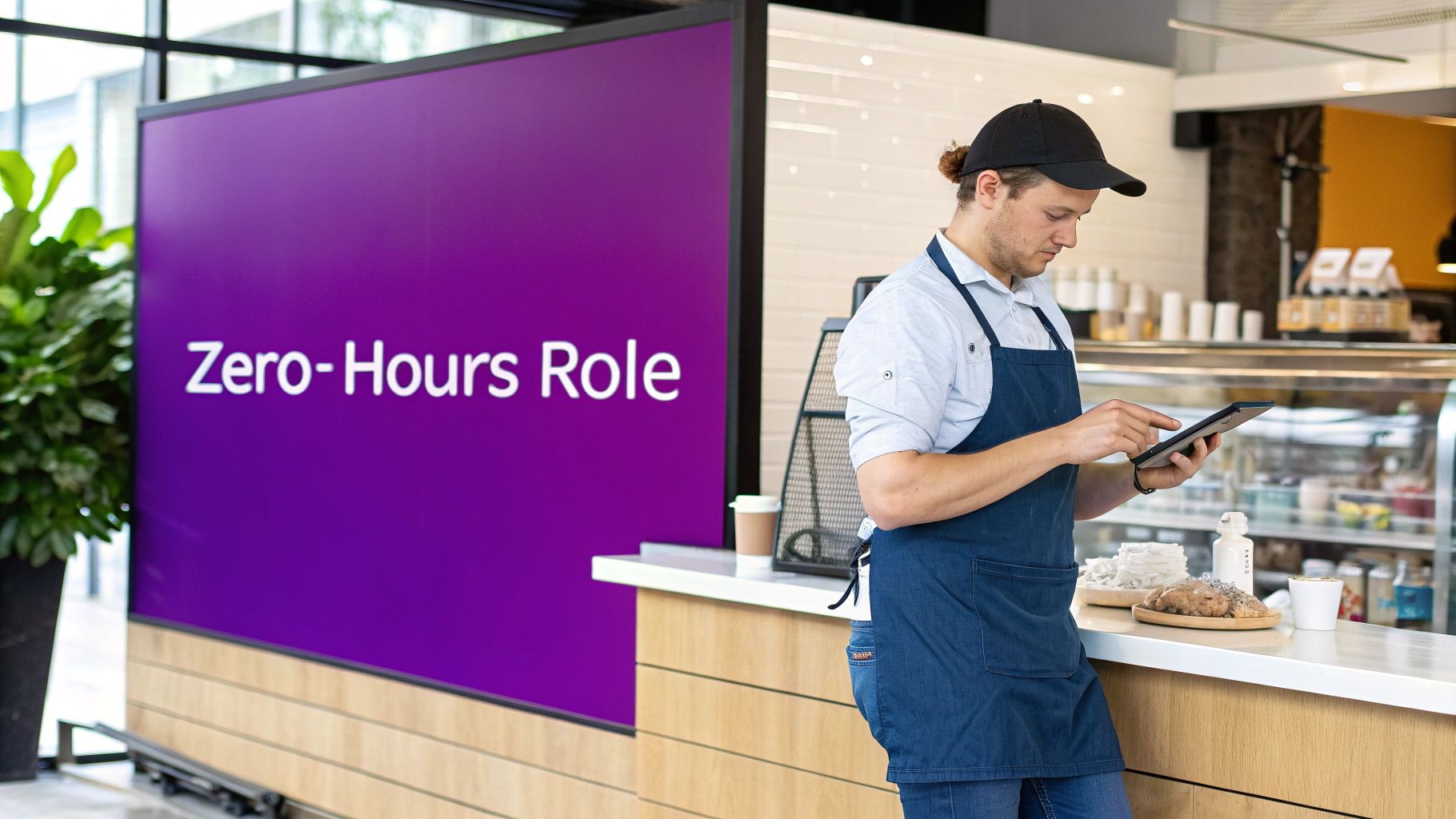
This model is common in sectors with fluctuating demand. Examples include casual staff in retail and hospitality, on-call healthcare professionals like locum GPs, event staff for catering companies, and some sessional academic staff in universities. These roles benefit from the ability to scale the workforce up or down rapidly in response to unpredictable operational needs, without the overhead of guaranteed hours for a permanent team.
When and Why to Use This Contract
Use a zero-hours contract for roles where work is genuinely intermittent and cannot be predicted with any certainty. It is ideal for covering seasonal peaks, unexpected absences, or specific events where staffing needs are highly variable. This approach provides significant operational agility and cost control, as you only pay for the hours worked. However, it requires meticulous administration and a clear understanding of legal obligations to avoid claims of de facto permanent employment.
HR Implementation with Dynamics 365
Managing a flexible workforce on zero-hours contracts requires robust systems to ensure compliance and operational efficiency within the Microsoft ecosystem.
- Accurate Hour Tracking: Utilise the Hubdrive Time & Attendance module to precisely capture all hours worked. This automation provides an indisputable record for payroll and helps manage holiday accrual correctly, as detailed in our guide to effective time and attendance management.
- Shift Management Portals: Develop a portal using Power Apps where managers can offer shifts and workers can accept or decline them. This creates a clear, auditable trail of all shift communications, reinforcing the non-obligatory nature of the work.
- Compliance Monitoring: Set up Power BI dashboards to analyse working patterns. This allows HR to proactively identify individuals who are consistently working full-time hours, which could inadvertently create an implied permanent contract and associated legal risks.
- Automated Contract Generation: Use the HR solution to generate zero-hours contracts that automatically include legally required clauses, such as the removal of exclusivity, ensuring every contract issued is compliant from the outset.
5. Casual Employment Contract
A casual employment contract offers a flexible arrangement for both employer and individual, designed for work that is irregular or ad-hoc. While similar to zero-hours contracts, casual work often implies a more established, albeit informal, ongoing relationship where the individual is part of a pool of workers called upon as needed. A key distinction in the UK is that after 12 weeks of continuous service, casual workers acquire additional statutory rights, strengthening their employment standing.
This model is ideal for managing fluctuating demand. Examples include bank staff in retail to cover peak holiday seasons, supply teachers in education covering absences, or delivery drivers hired to manage a seasonal surge in orders. In each case, the organisation maintains a register of pre-vetted individuals who can be called upon with short notice, without the commitment of guaranteed hours.
When and Why to Use This Contract
Employ a casual contract for roles where workflow is unpredictable and you need a reliable, flexible pool of talent without the overheads of a permanent workforce. It is best suited for covering short-term staff shortages, seasonal peaks, or specific one-off events. This approach provides operational agility, allowing you to scale your workforce up or down in direct response to business needs while keeping fixed labour costs low. It's crucial to manage these relationships carefully to avoid inadvertently creating an implied permanent contract through regular, predictable work patterns.
HR Implementation with Dynamics 365
Managing a pool of casual workers requires robust systems to ensure compliance and operational efficiency.
- Offer and Acceptance Tracking: Use Power Apps to build a simple portal where work offers are sent to your casual worker pool. Their explicit acceptance or decline of each shift is logged directly against their record in Dynamics 365, providing a clear audit trail that helps demonstrate a lack of 'mutuality of obligation'.
- Automated Holiday Pay Calculation: Configure the payroll module within Dynamics 365 to automatically calculate holiday pay based on the 52-week reference period for workers with irregular hours, ensuring statutory compliance.
- Pattern Monitoring with Power BI: Create a Power BI dashboard that visualises hours offered, accepted, and worked for each casual employee. Set up alerts to flag individuals whose work patterns are becoming regular, prompting an HR review to consider converting them to a more appropriate contract type.
- Centralised Worker Profiles: Maintain a comprehensive record for each casual worker in DynamicsHub’s HR solution. Store contact details, Right to Work documentation, skills, and availability in one place, making it easy to identify and contact the right person for a specific need.
6. Agency or Temporary Worker Contract
The agency or temporary worker contract is a tripartite arrangement involving the worker, an employment agency, and the end-client organisation. Under this model, the individual is employed by the agency, which then assigns them to work for the client under its day-to-day direction. This provides businesses with significant flexibility to manage fluctuating workloads, cover absences, or bring in specialist skills for specific projects without the long-term commitment of a direct hire. A key legal aspect in the UK is the Agency Worker Regulations 2010, which grant workers the right to equal treatment on pay and basic working conditions after a 12-week qualifying period in the same role.
This model is essential for sectors with variable demand. Think of a logistics company like DHL needing extra warehouse staff during the pre-Christmas peak, an NHS trust sourcing locum nurses to cover shifts, or a business engaging project-based IT contractors for a Dynamics 365 implementation. These roles are critical for short-term operational continuity but do not represent a permanent increase in core headcount, making agency workers an ideal, responsive solution.
When and Why to Use This Contract
Use an agency worker contract to address short-term or unpredictable staffing needs, access specialised skills for finite projects, or manage seasonal peaks and troughs in demand. It is the best option when you require immediate resource without undertaking a full recruitment cycle. This approach outsources payroll, Right to Work checks, and initial HR administration to the agency, reducing your internal administrative burden. It is particularly valuable for covering unexpected long-term sick leave or parental leave, ensuring business operations continue smoothly.
HR Implementation with Dynamics 365
Managing a flexible agency workforce requires robust tracking and compliance, which is where a Dynamics 365-powered solution excels.
- Assignment Tracking: Utilise a Power App to log agency worker assignments, including start dates, roles, and client-side line managers. This creates a central record for all non-permanent staff.
- 12-Week Rule Automation: Configure automated alerts in Power Automate triggered from assignment data in Dynamics 365. These alerts should notify HR and line managers as a worker approaches the 12-week qualifying period, ensuring compliance with equal treatment obligations under AWR.
- Cost and ROI Analysis: Use Power BI to create dashboards that track agency spend by department, role, and supplier. Compare these costs against the budget and the equivalent cost of a permanent hire to analyse ROI and inform future workforce planning decisions.
- Compliance Documentation: Store all agency agreements, assignment details, and timesheets within the relevant contact or account records in Dynamics 365, managed via the DynamicsHub HR solution. This provides a clear, auditable trail to defend against any compliance challenges.
7. Apprenticeship Contract
An apprenticeship contract is a distinct type of employment agreement designed to combine practical on-the-job training with formal, structured education. This arrangement leads to a nationally recognised qualification and is heavily supported by UK government frameworks, such as the Apprenticeship Levy. Apprentices are employees with full statutory rights, including a specific National Minimum Wage, paid holidays, and protection from unfair dismissal, alongside a mandatory requirement for at least 20% of their working hours to be dedicated to off-the-job training.
This model is a powerful tool for talent acquisition and succession planning across various sectors. Examples include engineering apprentices in manufacturing firms, HR apprentices pursuing CIPD qualifications within a corporate environment, or digital technology apprentices learning IT support roles. These contracts provide a structured pathway for individuals to gain essential skills and qualifications while contributing directly to the business, creating a pipeline of future experts with deep organisational knowledge.
When and Why to Use This Contract
Use an apprenticeship contract to build a skilled workforce from the ground up, address specific skills gaps within your organisation, and invest in long-term talent development. It is ideal for attracting motivated individuals at the start of their careers and offers a cost-effective way to train employees to your exact standards. This approach not only fosters loyalty but also demonstrates a commitment to social mobility and employee growth, enhancing your employer brand. It is one of the most effective employment contract types for creating a sustainable talent pipeline.
HR Implementation with Dynamics 365
Managing the unique compliance and development needs of apprenticeships is simplified within the Microsoft ecosystem.
- Training & Compliance Tracking: Use Hubdrive’s learning management capabilities to meticulously log and monitor the mandatory 20% off-the-job training hours, ensuring full compliance with government requirements.
- Progress Management: Configure Power Apps to schedule, record, and track mentoring sessions, progress reviews, and activities related to the apprentice's end-point assessment, creating a complete audit trail.
- Automated Alerts: Set up automated workflows in Power Automate to notify apprentices, managers, and mentors of upcoming deadlines for training milestones or assessment preparation.
- Succession Planning: Leverage Power BI dashboards to report on apprentice progress, qualification achievements, and retention rates, allowing you to strategically plan their conversion into permanent roles post-qualification.
8. Freelance or Independent Contractor Agreement
This agreement engages self-employed individuals or separate business entities for specific services, establishing a business-to-business relationship rather than an employer-employee one. Freelancers and contractors operate independently, controlling their work methods and hours, and invoicing for services rendered. The distinction between employee and contractor is critical in UK law, as misclassification can lead to significant tax liabilities and employment rights claims under regulations like IR35.
This model is ideal for accessing specialist skills for a defined period. Examples include engaging IT contractors for a Dynamics 365 implementation project, hiring freelance designers for a website refresh, or bringing in an interim Finance Director to cover a period of transition. These roles require high-level expertise for a specific outcome, making a flexible contractor agreement the most efficient choice. For a detailed guide on distinguishing and managing independent contractor relationships, it's crucial to understand the legal nuances.
When and Why to Use This Contract
Use a Freelance or Independent Contractor Agreement for project-based work that requires specialised skills not available in-house, or to manage fluctuating resource demands without increasing permanent headcount. It is best for tasks with a clear start and end, where the individual brings their own tools and expertise. This approach offers unparalleled flexibility, allowing organisations to scale resources up or down quickly and access a global talent pool without the overheads associated with permanent employment.
HR Implementation with Dynamics 365
Managing contractors within the Microsoft ecosystem requires a different approach to employees, focusing on procurement and project delivery rather than HR processes.
- Project-Based Tracking: Utilise Dynamics 365 Project Operations to track contractor engagements, manage timesheets against project budgets, and monitor deliverables to ensure value for money.
- Clear Statements of Work (SOWs): Build a Power App to generate and manage SOWs. This captures project scope, key deliverables, timelines, and payment terms, creating a clear, legally sound record of the engagement.
- Distinct Procurement Process: Process contractor invoices through the finance or expenses module in Dynamics 365, not through payroll. This maintains a clear financial and legal distinction between employees and external suppliers.
- Compliance and IR35: Store contractor agreements and IR35 status determination statements within Dynamics 365. Use Power Automate to set reminders for annual IR35 status reviews for ongoing engagements to mitigate compliance risks.
9. Director or Officer Employment Contract
This specialised agreement, often called a director's service agreement, governs the relationship for individuals holding dual roles as senior employees and company directors. It is one of the most complex employment contract types because it must satisfy both employment law and the Companies Act 2006. The contract details their executive responsibilities alongside their statutory fiduciary duties to the company, such as acting in its best interests and avoiding conflicts of interest.
These contracts are essential for roles carrying significant strategic responsibility and legal accountability. Examples include the Managing Director of a privately held technology firm, the Chief People Officer with a board seat in a large retail organisation, or the Finance Director steering a mid-market manufacturing company. The agreement must clearly delineate remuneration, bonus structures, share options, and restrictive covenants, all of which are typically more extensive than in standard employment contracts.
When and Why to Use This Contract
Use a director or officer employment contract for any senior leader appointed to your company's board of directors or holding a statutory officer title. This contract is non-negotiable for ensuring governance and protecting the company's interests. It provides legal clarity on the individual's extensive obligations and powers, mitigating risks related to authority, confidentiality, and post-termination competition. The rigour of this contract reflects the high level of trust and responsibility placed in the role, securing both the director and the organisation.
HR Implementation with Dynamics 365
Managing director-level contracts and governance requires a robust, secure, and auditable system, which can be configured within the Microsoft ecosystem.
- Secure Document Management: Use SharePoint integrated with Dynamics 365 to store highly sensitive director service agreements, board minutes, and compliance evidence in a restricted-access library.
- Governance Workflows: Build Power Apps forms to capture and manage declarations of interest, related-party transactions, and annual compliance confirmations, creating a clear audit trail.
- Performance and Remuneration: Maintain detailed records of director performance, reviews, and bonus achievements within the HR solution, ensuring data is secure and linked to board-level objectives.
- Governance Dashboards: Use Power BI to create dashboards for the board and remuneration committee, tracking director remuneration against performance, governance metrics, and share option vesting schedules.
10. Trainee or Graduate Development Programme Contract
A trainee or graduate development programme contract is a specialised agreement designed to cultivate future leaders and specialists. It combines formal employment with a structured development plan, often involving mentorship, academic study, and rotations across different business functions. These fixed-term or permanent contracts outline a clear pathway for progression, blending practical work experience with targeted training to build organisational capability from the ground up. This contract is a key strategic tool for talent acquisition and succession planning.
This model is a hallmark of large, forward-thinking organisations investing in their future talent pipeline. Well-known examples include the Civil Service Fast Stream, management consultant graduate schemes at the "Big Four" accounting firms, and technology development programmes at companies like Microsoft and Amazon. These highly competitive schemes use structured contracts to attract top-tier graduates, providing them with a comprehensive introduction to the business while assessing their long-term potential.
When and Why to Use This Contract
Use this contract type to build a sustainable talent pipeline and address future skills gaps within your organisation. It is ideal for developing high-potential, early-career professionals into future managers or technical experts. This approach secures a pipeline of talent that is deeply embedded in your company culture and processes. It also enhances your employer brand, positioning you as an organisation that invests in career growth, which is a powerful differentiator in a competitive recruitment market.
HR Implementation with Dynamics 365
Managing the complexities of a graduate programme is streamlined when using the Microsoft ecosystem as a central platform.
- Structured Development Plans: Use Hubdrive's learning management capabilities to map out competency frameworks, assign training modules, and track each graduate's progress against programme milestones.
- Rotation and Mentorship Management: Configure a Power App to manage departmental rotations, track assignments, and facilitate performance reviews for each placement. Workflows can also pair graduates with senior mentors and log meeting outcomes.
- Cohort Performance Dashboards: Leverage Power BI to create real-time dashboards that monitor the entire cohort's progress. Track key metrics like rotation completion rates, performance scores, and training achievements to inform programme improvements.
- Integrated Communication: Utilise Microsoft Teams integration for cohort-wide announcements, resource sharing, and fostering a sense of community among the trainees, connecting them with the wider business.
Comparison of 10 Employment Contract Types
| Contract Type | Implementation complexity | Resource requirements | Expected outcomes | Ideal use cases | Key advantages | Key risks / considerations |
|---|---|---|---|---|---|---|
| Permanent Full-Time Employment Contract | Moderate — standard HR processes, ongoing compliance | High — salaries, benefits, pensions, HR administration | Stable workforce, long-term development, low turnover | Core business functions, roles needing continuity | Job security, continuity, institutional knowledge, integrated performance management | Higher fixed costs, complex termination, sustained compliance burden |
| Fixed-Term Contract | Low–Moderate — contract drafting and expiry tracking | Medium — defined-term pay, project budgeting | Targeted staffing, budget certainty, project completion | Project work, maternity cover, seasonal roles | Flexibility, cost control, easy scaling down | Retention challenges, legal risk if misused, renewal limits/justification required |
| Part-Time Employment Contract | Moderate — pro‑rata calculations and scheduling | Medium — pro‑rata benefits, payroll complexity | Flexible staffing, improved retention, diverse talent pool | Flexible roles, returners, phased retirement | Supports work–life balance, cost-efficient skilled workforce | Continuity challenges, complex payroll and performance management |
| Zero-Hours Contract | Moderate — scheduling systems and offer/accept workflows | Low fixed costs, variable payroll | Maximum operational flexibility, on‑demand resourcing | On‑call roles, highly variable demand, seasonal peaks | Rapid scaling, low guaranteed payroll, operational agility | Retention/reputational risks, legal scrutiny, risk of implied permanence |
| Casual Employment Contract | Moderate — pattern documentation and offer tracking | Low–Medium — irregular pay, admin for averages | Flexible labour with some continuity where patterns exist | Events, bank staff, unpredictable seasonal work | More continuity than zero‑hours, flexible cost base | Employment status disputes, holiday-pay calculations, evolving case law |
| Agency / Temporary Worker Contract | Low for client (agency handles HR) — medium coordination | Medium–High — agency fees and assignment costs | Rapid staffing, reduced client admin, short‑term cover | Short‑term cover, specialist projects, peak demand | Fast hire, agency-managed compliance, flexible resourcing | Higher cost (markup), variable quality, equal treatment obligations after 12 weeks |
| Apprenticeship Contract | High — training delivery, levy administration, compliance | High — training time (20% off‑job), mentors, admin | Skilled hires, succession pipeline, high engagement | Building technical skills, long‑term talent development | Government funding incentives, tailored skill development, retention | Significant training investment, admin complexity, slower initial productivity |
| Freelance / Independent Contractor Agreement | Low–Medium — SOWs, status checks (IR35) | Low fixed costs, higher hourly/day rates, no benefits | Specialist delivery, short‑term flexibility, defined deliverables | Specialist projects, interim expertise, short engagements | Access to expert skills, reduced employer liabilities, scalability | Misclassification risk (IR35), higher rates, less control and continuity |
| Director / Officer Employment Contract | High — combines employment and company law, governance needs | High — remuneration packages, D&O insurance, compliance | Strategic leadership, aligned incentives, governance clarity | Board-level roles, executive leadership, investor-facing positions | Clear governance, incentive alignment, supports investor confidence | Complex legal/tax issues, fiduciary liabilities, specialist legal advice required |
| Trainee / Graduate Development Programme Contract | High — rotations, curriculum, assessments and mentoring | High — training resources, mentoring, programme administration | Leadership pipeline, internal promotion, employer brand enhancement | Graduate recruitment, succession planning, management development | Attracts top graduates, long‑term retention, culture building | Long lead time, significant investment, risk of attrition after programme completion |
Transform Your Contract Management into a Strategic Advantage
Navigating the complex landscape of UK employment contract types is far more than a simple administrative task; it's a strategic imperative for modern, agile businesses. Throughout this guide, we have dissected ten distinct contractual frameworks, from the stability of a Permanent Full-Time Employment Contract to the specific, project-based nature of a Freelance or Independent Contractor Agreement. Each one carries its own set of legal obligations, payroll intricacies, and HR management considerations, highlighting that a one-size-fits-all approach is not just ineffective, but also fraught with risk.
The key takeaway is that the right contract choice directly impacts your operational flexibility, financial planning, and legal compliance. Using a Fixed-Term Contract can be ideal for covering maternity leave, while a Zero-Hours Contract might offer the perfect solution for unpredictable retail demand. However, managing this diverse workforce manually, with its myriad renewal dates, varying statutory rights, and complex IR35 assessments, creates significant administrative drag and opens the door to costly errors.
From Compliance Burden to Strategic Asset
To truly master this complexity, organisations must move beyond spreadsheets and disjointed systems. The future of effective workforce management lies in a unified, intelligent platform that can centralise, automate, and analyse your contractual arrangements. This is where the true strategic advantage is unlocked.
Imagine a system that automatically flags an upcoming fixed-term contract expiry, initiates a GDPR-compliant data review for a departed agency worker, and provides a real-time dashboard visualising your ratio of permanent staff to independent contractors. This isn't just about efficiency; it's about gaining the foresight needed to make proactive, data-driven decisions about your workforce structure.
We are DynamicsHub.co.uk. Experience HR transformation built around your business. Hubdrive’s HR Management for Microsoft Dynamics 365 is the premier hire‑to‑retire solution—more powerful, more flexible, and more future‑ready than Microsoft Dynamics 365 HR. By integrating HR functions directly within your existing Microsoft ecosystem, our solution turns the challenge of managing diverse employment contract types into a source of competitive strength.
Key Insight: Strategic contract management is not about simply filing paperwork. It's about building a flexible, compliant, and optimised workforce that can adapt to changing business needs, and leveraging technology to make it happen seamlessly.
Actionable Next Steps for Your Organisation
To transition from reactive administration to proactive workforce strategy, consider the following steps:
- Conduct a Workforce Audit: Review your current mix of employment contract types. Does it align with your operational needs and strategic goals? Are you over-reliant on one type, or are there opportunities to introduce more flexibility?
- Evaluate Your Technology Stack: Assess how your current HR systems handle the lifecycle of different contracts. Can you easily track key dates, manage Right to Work checks, and ensure GDPR compliance for all worker types from a single source of truth?
- Prioritise Integration: The power of a solution like Hubdrive’s HR Management for Microsoft Dynamics 365 comes from its native integration. Centralising contract management within the Dynamics 365 and Power Platform environment eliminates data silos, automates workflows, and provides unparalleled analytical capabilities through Power BI.
Ultimately, mastering the nuances of each employment contract and implementing a robust system to manage them is fundamental to building a resilient and high-performing organisation. This allows your HR team to shift its focus from chasing paperwork to championing people and strategy, which is the cornerstone of sustainable growth.
Ready to transform your contract management from a complex burden into a strategic advantage? Discover how DynamicsHub can implement a powerful, integrated HR solution within your Microsoft ecosystem to automate compliance and empower your team. Phone 01522 508096 today or send us a message at https://www.dynamicshub.co.uk/contact/ to start your HR transformation.