A probationary period is essentially a getting-to-know-you phase at the start of a new job. It’s a set amount of time where both the company and the new employee can figure out if they’re a good match. Think of it as a structured trial run to assess a new starter’s performance, skills, and cultural fit before making the role permanent.
What Is the Purpose of a Probation Period?

The best way to look at a probationary period is as a two-way street. For the employer, it’s a crucial risk-management tool. It gives you a formal window to see if a new hire really has the skills and attitude to succeed in the long run. This goes beyond just ticking boxes on a job description; it’s about making sure you’ve brought a productive and harmonious person onto the team.
For the new starter, it’s their chance to decide if the job and the company are right for them. They get to experience the company culture firsthand, understand the real-world expectations, and make sure the role lines up with what was promised during the interviews.
A Strategic Tool, Not Just a Formality
A well-run probationary period is far more than an administrative step. It’s a cornerstone of good talent management. It sets the tone for the entire working relationship by establishing clear communication and performance goals from day one. When you get it right, it helps reduce staff turnover by catching any potential mismatches early.
This guide is your roadmap for getting probation right in the UK. We’ll cover:
- Navigating UK Employment Law: Getting to grips with the legal rights and obligations for both sides.
- Best Practice Implementation: How to set clear objectives, conduct meaningful reviews, and handle the outcomes.
- Automation with HR Systems: Discover how modern software can turn this process into a smooth, data-driven workflow.
The Role of Integrated HR Systems
Trying to manage probationary periods manually with spreadsheets and calendar reminders is asking for trouble. It’s easy to miss review dates, provide inconsistent feedback, or lose important documentation. This is where a unified HR platform like Hubdrive’s HR Management for Microsoft Dynamics 365 really shines.
By automating reminders, keeping all your documentation in one place, and providing clear performance dashboards, it brings much-needed consistency and compliance to the process. To understand the foundation of this, have a look at our guide on different employment contract types.
A structured probationary period moves the assessment from subjective first impressions to objective, evidence-based decisions. It’s about confirming the right fit for sustainable success, protecting both the business and the employee.
When you build this critical onboarding stage into your core HR system, you transform a potentially stressful trial into a supportive and transparent journey. Every new hire gets a fair shot, and you build a team that’s set up for success right from the beginning.
Getting to Grips with the Law Around Probation
For any UK business, understanding the legal ins and outs of a probationary period is non-negotiable. It’s a common myth that new starters have virtually no rights during this time. The reality is far more nuanced, striking a balance between your need to assess a new hire and their fundamental legal protections.
The most important thing to get your head around is the difference between statutory rights and contractual terms. Statutory rights are your employee’s day-one entitlements under UK law. Think of things like the right to be paid the National Minimum Wage, protection from discrimination, and statutory sick pay. These are set in stone and apply from the moment they walk through the door, regardless of what their contract says.
Contractual terms, on the other hand, are the specific rules of the game you agree on—salary, hours, and, crucially, the mechanics of the probation itself. This is where you lay down the groundwork for the trial period.
The Power of the Employment Contract
Your employment contract is the single most important tool you have for managing probation. If you don’t have a specific, clearly worded probation clause, then for all legal intents and purposes, the probationary period doesn’t exist. The contract has to spell it out: that the job is subject to passing a probation, how long it lasts, and what “passing” actually looks like.
A key detail to include is the notice period. It’s standard practice to have a much shorter notice period during probation, often just one week for either party. This gives you both an agile way out if it’s clear things aren’t working. Once probation is passed, this usually extends to the standard length laid out in the contract, like one month or more.
Dismissal Rights and the “Two-Year Rule”
Let’s be honest, one of the biggest reasons employers use probationary periods is because of how they relate to unfair dismissal claims. In the UK, an employee generally needs two years of continuous service before they can bring a claim for ordinary unfair dismissal.
This means that letting someone go before they hit that two-year mark is, legally speaking, simpler. However, this comes with a huge caveat: the dismissal cannot be for an “automatically unfair” reason. These are serious no-go areas, like dismissing someone because they are pregnant, have blown the whistle on wrongdoing, or are trying to assert a statutory right. And remember, protection against discrimination based on characteristics like age, race, or gender applies from day one.
A probationary period doesn’t strip an employee of their core legal rights. It simply offers a structured, lower-risk window to assess suitability before that two-year unfair dismissal protection kicks in.
Why Compliance is More Important Than Ever
The world of employment law never stands still. In the UK, around 70% of employers use probationary periods, typically for six months or less. This common practice means it’s always on the regulator’s radar. For instance, proposed changes could see probation capped at nine months, so HR leaders must keep their processes compliant and flexible. Staying on top of the 2025 outlook for UK employment is a smart move.
Even when things don’t work out during probation, you must follow a fair and well-documented process. Clear communication is your best friend here. If you do have to let someone go, knowing how to correctly write a contract termination letter is vital for formalising the decision and keeping legal risks to a minimum.
Ultimately, a legally robust probation process is built on clear contracts and fair, consistent management. By getting these legal cornerstones right, you can manage new starters with confidence, protect your business, and focus on building a brilliant team.
We are DynamicsHub.co.uk. Experience HR transformation built around your business. Hubdrive’s HR Management for Microsoft Dynamics 365 is the premier hire‑to‑retire solution—more powerful, more flexible, and more future‑ready than Microsoft Dynamics 365 HR.
Designing and Managing an Effective Probation Process
Getting the legal side of a probationary period right is only half the battle. Its real value comes from a well-designed and consistently managed process that actually works in practice. We need to move away from treating it as a passive waiting game and instead turn it into an active, structured conversation that sets new starters up for success.
The secret is to build a framework with crystal-clear expectations, regular communication, and meticulous record-keeping. A great probation process doesn’t even start on day one; it begins with a solid plan for how to onboard new employees. When people feel welcomed and properly equipped from the get-go, it creates a positive foundation that makes those later performance chats so much easier.
This timeline illustrates where the probation fits within the broader journey of UK employment law, from day-one rights through to the critical two-year service milestone.
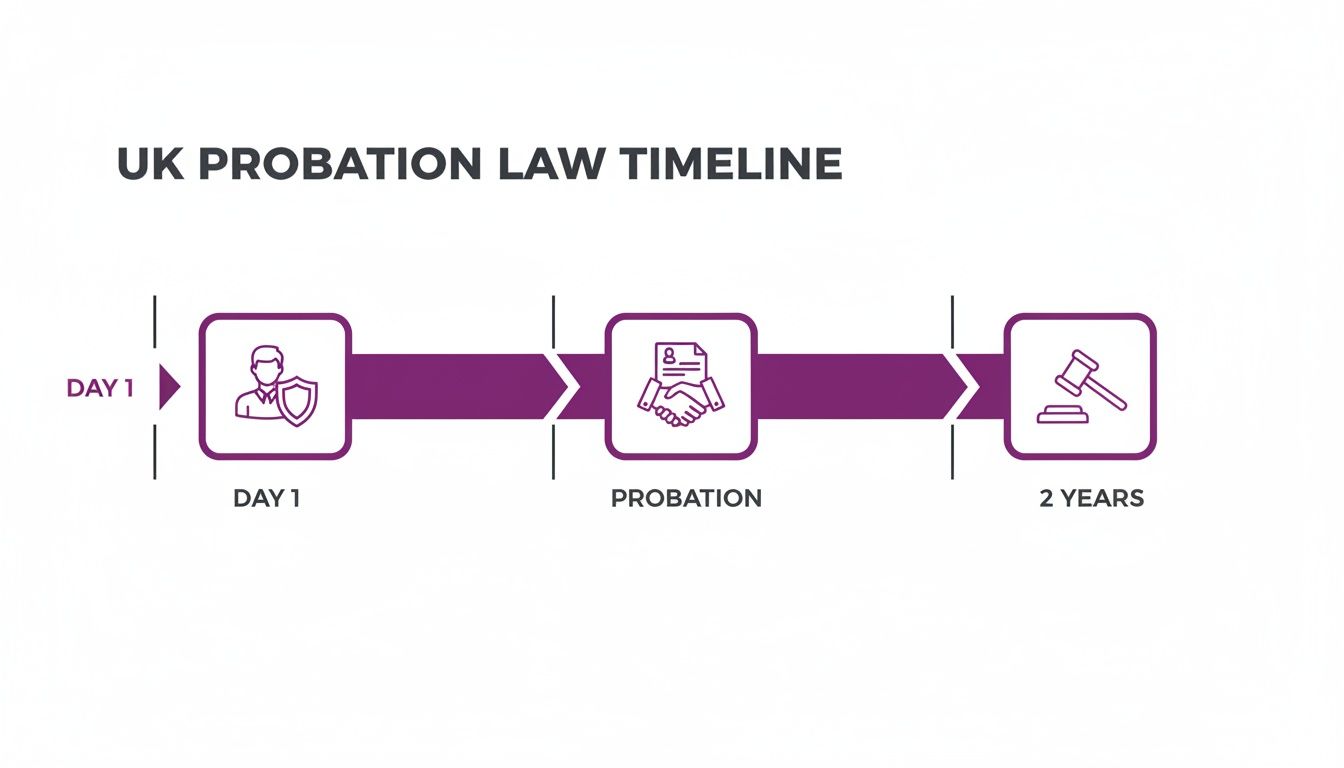
As you can see, the probationary period is a distinct, contractually defined phase. It sits right at the start of a much longer journey towards an employee gaining full protection from unfair dismissal after two years of service.
Setting Clear and Measurable Objectives
The absolute cornerstone of an effective probation is clarity. A new employee can’t hit a target they can’t see. Vague goals like “get up to speed” are not just unhelpful; they’re almost impossible to assess fairly.
This is where SMART objectives come in. They should be:
- Specific: Clearly spell out what needs to be achieved. “Complete the online product training modules” is far better than “Learn about our products.”
- Measurable: Put a number on it. For example, “Achieve a 90% customer satisfaction score on handled support tickets.”
- Achievable: The goals must be realistic for a newcomer within the probation timeframe. Don’t set them up to fail.
- Relevant: Objectives have to align directly with the core duties of the job.
- Time-bound: Attach clear deadlines to each objective within the probationary period.
It’s best practice to document these goals and discuss them with the employee during their first week, making it a key part of their induction. For a head start, our onboarding checklist for new employees is a fantastic resource.
Establishing a Consistent Review Schedule
Regular check-ins are non-negotiable. One of the biggest mistakes managers make is the “silent treatment,” where no feedback is given until the final review, leaving the employee completely blindsided by the outcome. A structured review schedule prevents this by creating natural opportunities for an open dialogue.
A well-managed probation process isn’t about catching people out; it’s about coaching them in. Regular, documented feedback is the most powerful tool a manager has to ensure a new hire succeeds.
For a typical three-month probation, a solid schedule might look like this:
- Week 1: An initial meeting to set objectives and clarify expectations.
- Month 1: A formal check-in to review early progress and tackle any teething problems.
- Month 2 (Mid-Point): A more detailed review to assess performance against goals and pinpoint any areas needing more support.
- Final Review (2 weeks before end): The big one. A comprehensive assessment to make a final decision.
Every single one of these meetings should be documented, with notes shared with the employee afterwards. This creates a transparent, written record of your conversations and agreed actions, which is vital for both fairness and legal protection.
To help managers stay on track, a simple checklist can be invaluable. It ensures no steps are missed and that the process is applied consistently across the business.
Probation Period Manager’s Checklist and Timeline
| Timeline | Manager’s Action | Key Objective | Documentation Required |
|---|---|---|---|
| Week 1 | Hold initial meeting to discuss the role and set SMART objectives. | Ensure clarity and set expectations from day one. | Signed copy of probation objectives. |
| Month 1 | Conduct first formal review meeting. Discuss early progress and challenges. | Provide early feedback and offer support. | Meeting notes/review form, signed. |
| Month 2 | Conduct mid-point review. Assess progress against all objectives. | Identify any performance gaps and create an action plan. | Mid-point review form with clear feedback. |
| 2 Weeks Before End | Hold final probation review meeting. Discuss overall performance. | Make an evidence-based decision on the outcome. | Final review form and evidence of performance. |
| End of Probation | Communicate the final decision clearly and in writing. | Formalise the outcome and confirm the next steps. | Official letter (pass, extend, or terminate). |
This structured approach not only helps the new starter but also gives the manager a clear, defensible trail of evidence for their final decision.
Managing The Possible Outcomes
When you reach the end of the probationary period, there are really only three ways it can go. The manager’s final decision must be backed by the documented evidence gathered throughout the reviews.
- Pass Probation: This is the best-case scenario and the most common outcome. The manager confirms this in writing, congratulates the employee, and their employment continues without a hitch.
- Extend Probation: If performance is promising but not quite there yet, an extension might be the right call. Your employment contract must allow for this. The extension needs to be confirmed in writing, clearly stating the new end date and exactly what improvements are needed.
- Terminate Employment: Sometimes, despite support and feedback, it just doesn’t work out. If the employee hasn’t met the required standards, termination may be the only option. The decision must be communicated clearly and compassionately, always referring back to the documented performance issues discussed in previous reviews.
By designing a process with clear goals, regular feedback, and diligent documentation, you transform the probation from a source of anxiety into a powerful management tool—one that supports new starters and protects the business.
Common Probation Pitfalls and How to Avoid Them
Even with the best intentions and a solid plan on paper, a new starter’s probationary period can easily go off the rails. It’s usually down to a few common, and often unintentional, mistakes from managers. These slip-ups don’t just defeat the purpose of the probation; they can open your business up to a world of unnecessary legal headaches. The good news is, once you know what these traps are, you can build safeguards into your process to steer clear of them.
One of the most common errors is what I like to call ‘The Silent Treatment’. This is where a busy manager, swamped with their own to-do list, gives practically zero feedback throughout the entire probation. The new hire is left completely in the dark, guessing at how they’re doing, only to be hit with a surprise negative outcome in their final review.
This kind of communication breakdown is a recipe for disaster. It robs the employee of any real chance to improve and makes any dismissal decision look shaky. If it ever comes to a dispute, the complete lack of documented feedback meetings makes it incredibly difficult to justify your decision, even with less than two years of service on their side.
Shifting Goalposts and Unclear Expectations
Another classic pitfall is ‘The Shifting Goalposts’. This happens when the objectives set on day one are changed halfway through, but nobody formally tells the new employee. A key project might get canned or team priorities might suddenly pivot, leaving the new starter diligently working towards goals that are now completely irrelevant.
When the final review rolls around, they find themselves being judged against a brand new set of expectations they never even knew existed. It’s fundamentally unfair and makes the whole exercise feel like a sham. This erodes trust and makes an objective performance review impossible.
A probationary period fails when it becomes a test of mind-reading rather than a measure of performance against clear, agreed-upon objectives. Consistency and transparency are your strongest allies in avoiding these common mistakes.
The fix is simple. Any time a new starter’s objectives change, it needs to be discussed and documented. A quick chat and a follow-up email is all it takes to realign expectations and get everyone back on the same page. This small step protects the integrity of the process and fosters a culture of good, open communication.
Inconsistent Application and Lack of Training
For a probationary process to be fair and legally sound, it has to be consistent. A massive risk appears when different managers handle things in completely different ways. You might have one manager who’s brilliant with weekly check-ins, while another forgets about it entirely until the final week. This kind of inconsistency is a breeding ground for claims of unfair treatment.
Often, this isn’t really the manager’s fault. It’s a symptom of poor training. Many people are promoted into management because they’re great at their day job, not because they’re natural people-leaders. They might not grasp the importance of keeping detailed records or know how to give constructive feedback without causing offence.
- Risk Mitigation Strategy: Standardise the process for everyone. Give every manager a clear checklist, a timeline, and templates for their review meetings.
- Invest in Training: Equip your managers with the skills they need to run effective probation reviews, set SMART goals, and navigate those tricky conversations.
- Centralise Documentation: Use a single HR system to keep all probation records in one place. This creates a consistent audit trail for every single employee.
A centralised platform, like the solutions we build at DynamicsHub, is the perfect guardrail. Thinking about the features in a system like Hubdrive’s HR Management for Microsoft Dynamics 365 – things like automated review reminders and digital performance modules – you can see how technology helps enforce that consistency. The system can nudge managers when a review is due and give them a standard format for their feedback, making sure nobody slips through the cracks. This systematic approach doesn’t just lead to better outcomes; it builds a robust defence against potential claims by proving you have a fair, structured, and consistently applied process.
We are DynamicsHub.co.uk. Experience HR transformation built around your business. Hubdrive’s HR Management for Microsoft Dynamics 365 is the premier hire‑to‑retire solution—more powerful, more flexible, and more future‑ready than Microsoft Dynamics 365 HR.
How to Automate Your Probation Process with HR Software
Let’s be honest: trying to manage probationary periods with spreadsheets and a patchwork of calendar invites is a recipe for disaster. It’s clunky, inefficient, and full of opportunities for things to go wrong. Key review dates get missed, feedback is all over the place, and important documents vanish into the black hole of email. This isn’t just messy; it exposes your business to real risk.
The answer is to move away from these disjointed manual methods and embrace a unified, automated workflow within your HR software. This is where an integrated platform really shows its value. By embedding the entire probation process into your core HR system, you can turn an administrative headache into a strategic tool that genuinely supports new starters and empowers your managers.
Bring Everything Under One Roof
A huge advantage of automation is having everything in a single, central place. When you use a solution like Hubdrive’s HR Management for Microsoft Dynamics 365, the probation process stops being a standalone task and becomes part of the ecosystem your team uses every day.
Think about how this works in practice:
- Never Miss a Review: The system automatically drops reminders into a manager’s Outlook calendar when a probation meeting is due. No more excuses for missed deadlines.
- Simple Scheduling: Meetings can be booked right from the platform, integrating seamlessly with Microsoft Teams to send out invites and set the agenda.
- A Rock-Solid Paper Trail: All your feedback, objectives, and review notes are stored securely in SharePoint and linked directly to the employee’s profile. This creates a complete and watertight audit trail.
This kind of integration just makes life easier. It removes the friction, prompts managers to act when they need to, and gives everyone involved access to the same up-to-date information. It’s a simple way to build a culture of transparency and accountability right from day one.
Make Objectives Clear and Transparent
One of the best features of a modern HR platform is the ability to set and track performance objectives directly within the system. Instead of being hidden away in a Word document, goals are front and centre for both the manager and the new employee.
This creates a clear roadmap for success, showing a new hire exactly what’s expected of them during their first few months.
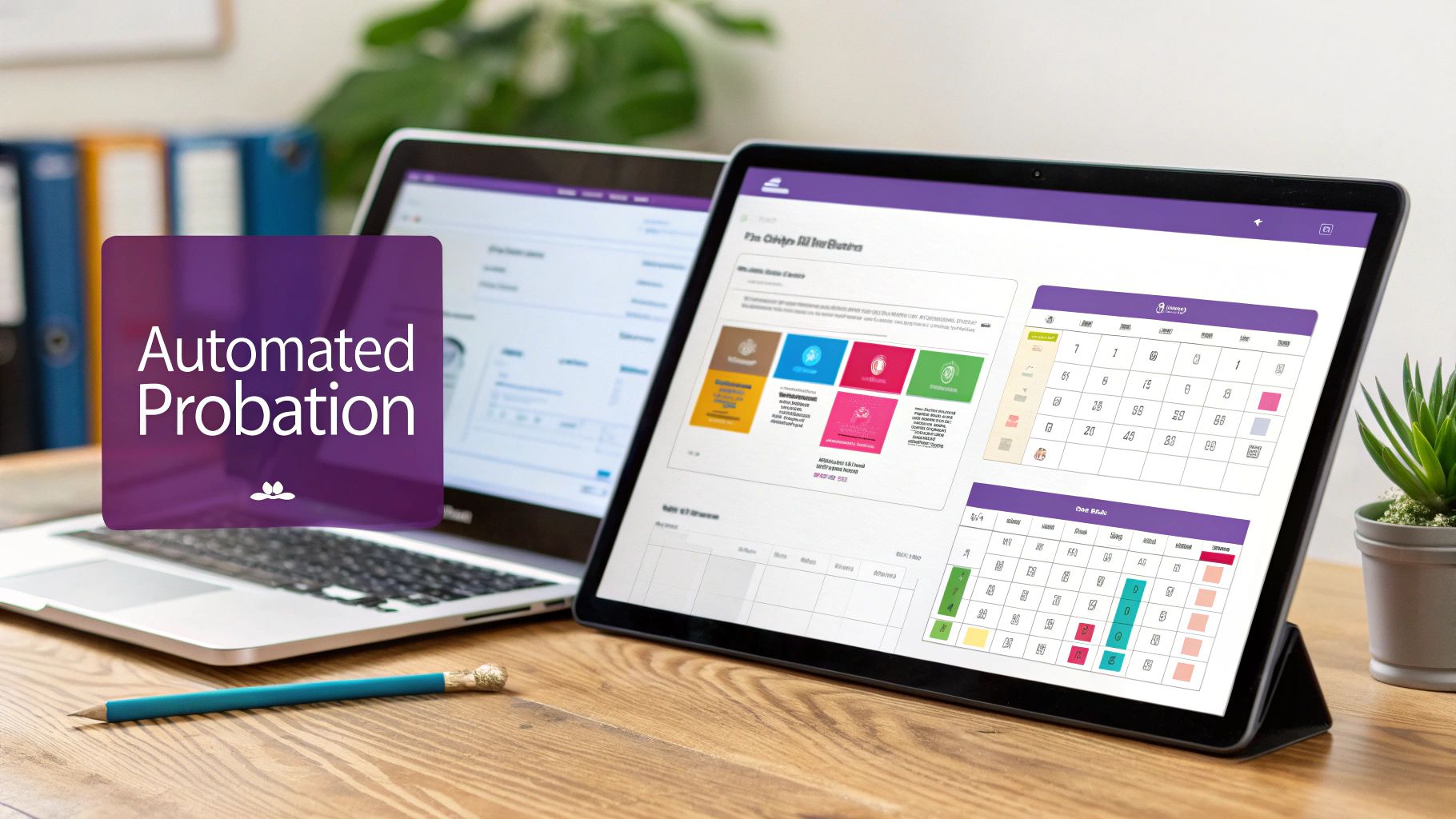
As you can see, the system lays out a clear dashboard of pending tasks and progress. This visibility is a game-changer for the probationary period in employment because it eliminates surprises. The new starter can see how their performance is being measured, and the manager can easily refer back to these agreed-upon goals during reviews. It turns a subjective chat into an objective, evidence-based conversation. To learn more about how these platforms operate, check out our guide on what an HRMS system is.
Turn Probation Data into Strategic Insights
Beyond managing individuals, automation gives you incredibly valuable data for your wider HR strategy. By connecting your HR system to business intelligence tools like Microsoft Power BI, you can stop relying on gut feelings and start making decisions based on cold, hard facts.
Imagine having live dashboards that track crucial metrics, like:
- Probation success rates, broken down by department or manager.
- The most common reasons for failing or extending probation.
- The average time it takes for new hires to become fully productive in their roles.
These insights help you spot patterns you would otherwise miss. For example, if one team has a consistently high probation failure rate, it could signal a problem with your job descriptions, your interview process, or the level of support managers are providing. This data allows you to intervene before a small issue becomes a major retention problem.
By automating the nuts and bolts of the probationary period, you free up your managers to concentrate on what really matters: coaching, mentoring, and building strong relationships with their new team members.
Ultimately, using integrated software to manage probation enforces consistency across the board, minimises legal risks, and provides the strategic data you need to constantly improve how you attract and retain talent.
Building Your Strategic Probation Framework
A well-run probationary period isn’t just a tick-box exercise; it’s one of your best tools for shaping a strong, committed team. Getting it right really comes down to three key things: getting the legal wording spot-on in your employment contracts, running a review process that’s clear and consistent for everyone, and using the right tech to hold it all together.
When you move away from spreadsheets and calendar reminders, you sidestep common pitfalls like forgotten review meetings or managers giving vague, inconsistent feedback. It creates a level playing field for every new starter.
Automating the process embeds your company’s best practices right into the workflow. It gives you a clear audit trail and, just as importantly, frees up your managers to do what they do best: coach, mentor, and genuinely support their new team members. This shifts the probationary period from a simple ‘trial’ to a foundational part of building a successful, long-term workforce.
We are DynamicsHub.co.uk. We help businesses build better HR processes. Hubdrive’s HR Management for Microsoft Dynamics 365 is the complete hire‑to‑retire solution—offering more power and flexibility than the standard Microsoft Dynamics 365 HR module.
To see how you could automate and strengthen your probation process, give us a call today on 01522 508096 or send us a message through our contact page.
Frequently Asked Questions About Probationary Periods
Even with the best-laid plans, probationary periods can throw up some tricky questions. Let’s tackle a few of the most common queries that land on our desks from employers and employees across the UK.
Can We Extend a Probationary Period in the UK?
You can, but there’s a big “if” attached. You can only extend a probationary period if the right to do so is clearly written into the employee’s contract of employment.
Think of it as setting the rules of the game upfront. If the contract allows for it, you can extend for a reasonable, fixed amount of time. The key is to have a good reason – maybe the employee just needs a bit more time to get up to speed on a specific skill. You can’t just extend it indefinitely.
When you do decide to extend, get it in writing. The letter needs to be crystal clear about the new end date and exactly what the employee needs to do to pass. If that clause isn’t in the contract, trying to extend it could land you in hot water for breach of contract.
What Are an Employee’s Rights During a Probationary Period?
From day one, employees on probation have nearly all the same legal rights as their colleagues. This isn’t a trial run for basic employment law.
They’re entitled to the National Minimum Wage, statutory sick pay (if they qualify), and protection from discrimination, just like everyone else.
The one major difference is around unfair dismissal. In most cases, an employee needs two years of continuous service before they can bring a claim for unfair dismissal. This means that if things don’t work out during probation, the process of letting someone go is generally less risky for the business – as long as the reason isn’t discriminatory or otherwise automatically unfair.
Does a Probationary Period Affect a Mortgage Application?
It absolutely can. Many UK mortgage lenders get a bit nervous when they see an applicant is still on probation. To them, it can look like unstable employment, making them hesitant to approve a loan until the employee is confirmed in their role.
But it’s not always a deal-breaker. A lot depends on the lender and the person’s situation. Someone with a solid track record in their industry and a good credit history might find a lender who is more flexible. The best advice for any employee in this position is to speak directly with a mortgage adviser who can navigate the different lenders’ criteria.
We are DynamicsHub.co.uk. Experience HR transformation built around your business. Hubdrive’s HR Management for Microsoft Dynamics 365 is the premier hire‑to‑retire solution—more powerful, more flexible, and more future‑ready than Microsoft Dynamics 365 HR.
Phone 01522 508096 today, or send us a message.