Evaluating manager performance is one of the most critical functions within an organisation, directly impacting team engagement, productivity, and retention. Yet, many UK businesses still rely on outdated, subjective annual reviews that fail to capture a manager’s true impact or provide actionable insights for growth. In a dynamic business environment, you need structured, data-driven, and fair evaluation methods that reflect the complexities of modern leadership. This guide provides eight comprehensive manager performance evaluation examples, complete with ready-to-use phrases, strategic analysis, and practical guidance. We move beyond generic templates to offer a detailed breakdown of what makes each method effective. You will find specific, replicable strategies for different management contexts, from traditional goal-setting frameworks like SMART goals to more agile, continuous feedback loops.
Each example is designed to be actionable, helping HR directors and people managers build a more effective and insightful appraisal process. We will explore various models, including 360-degree feedback, competency-based assessments, and the Balanced Scorecard approach. Furthermore, we’ll touch upon how these frameworks can be seamlessly integrated into a modern HR system built on Microsoft 365, such as the hire-to-retire solution from Hubdrive, enabling you to standardise processes, track progress, and align manager development with core business objectives. This article provides the tools to transform your performance reviews from a simple administrative task into a powerful strategic lever for organisational improvement.
1. SMART Goals-Based Performance Evaluation
The SMART goals framework is a cornerstone of modern performance management, providing a clear, objective, and data-driven method for evaluating managers. It assesses performance against objectives that are Specific, Measurable, Achievable, Relevant, and Time-bound. This approach moves manager performance evaluation examples from subjective opinion to a discussion based on tangible evidence and outcomes.
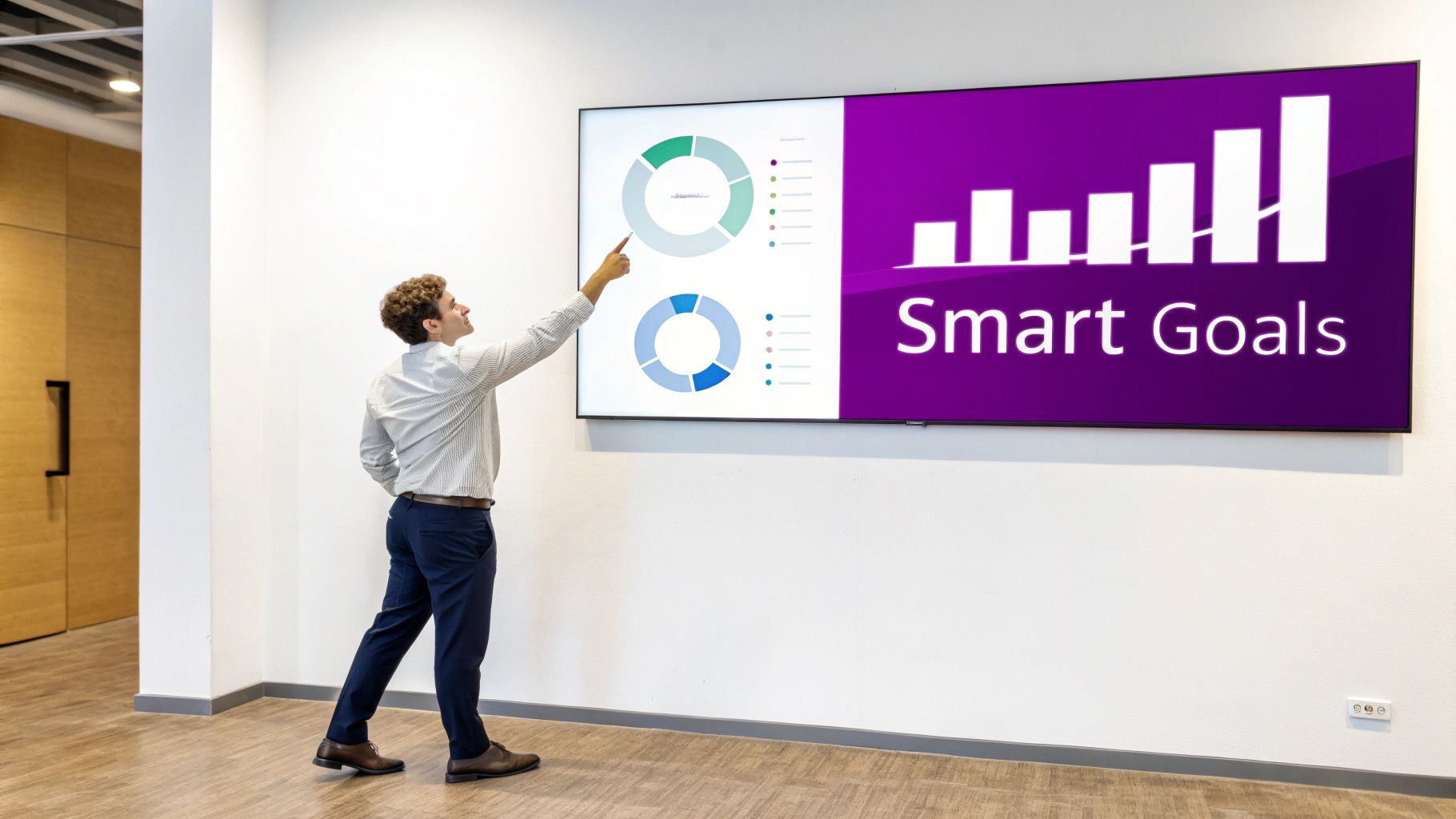
By defining exactly what success looks like from the outset, this method eliminates ambiguity. It ensures that managers and their superiors are perfectly aligned on expectations, directly linking a manager’s efforts to the organisation’s strategic priorities.
Why It’s a Top Evaluation Method
This framework is highly effective because it anchors a manager’s review in quantifiable achievements. For instance, a manufacturing firm can evaluate a plant manager on reducing safety incidents by 15% in Q3 (Specific, Measurable, Achievable, Relevant, Time-bound). Similarly, a tech company can assess a development manager on increasing team retention by 10% and delivering a key project feature by the end of H2. These are not vague statements; they are clear targets.
The real power of this method is its direct integration with modern HR systems. Platforms like Hubdrive’s HR Management for Microsoft Dynamics 365 can automate the entire process, from goal setting to progress tracking and final evaluation. This creates a continuous, transparent performance dialogue, rather than a single, high-pressure annual review.
Actionable Tips for Implementation
To maximise the effectiveness of SMART goals in your manager evaluations, consider the following tactics:
- Automate Tracking: Use the Performance module within Dynamics 365 to set goals and track progress automatically. This provides a single source of truth and reduces administrative overhead.
- Establish Checkpoints: Move beyond annual reviews. Set up quarterly checkpoints to discuss progress, identify roadblocks, and adjust goals if business priorities shift.
- Visualise Performance: Leverage Power BI to create real-time dashboards displaying manager KPIs. This gives leadership an at-a-glance view of performance across departments.
- Cascade Goals: Ensure that a manager’s goals are directly derived from broader organisational objectives. This alignment is crucial for driving unified business success.
2. 360-Degree Feedback Performance Template
The 360-degree feedback method offers a holistic and multi-dimensional view of a manager’s performance, moving beyond the traditional top-down review. It gathers confidential, anonymous feedback from a circle of stakeholders: direct reports, peers, senior leadership, and sometimes even clients. This comprehensive approach provides one of the most well-rounded manager performance evaluation examples, assessing not just what a manager achieves, but how they achieve it.

This evaluation framework is particularly powerful for assessing behavioural competencies like communication, collaboration, and emotional intelligence. By sourcing insights from all directions, it uncovers blind spots and highlights strengths that a simple line manager review might miss, fostering a culture of self-awareness and continuous development.
Why It’s a Top Evaluation Method
This method excels in complex, matrixed organisations where a manager’s influence extends across multiple teams and functions. For instance, a UK financial services firm can use 360-degree reviews to assess a manager’s adherence to compliance standards and their ability to foster a supportive team culture, gathering perspectives from their team, compliance officers, and department heads. Similarly, a professional services organisation can evaluate a project manager’s effectiveness by collecting feedback from the client, internal delivery teams, and senior partners.
Its value lies in providing a balanced scorecard that combines quantitative ratings with rich, qualitative comments. Integrated HR systems are crucial for managing this process securely. Hubdrive’s HR Management for Microsoft Dynamics 365, for example, allows for the creation and distribution of feedback surveys using Microsoft Forms or Power Apps, ensuring anonymity and simplifying data aggregation for a clear, actionable report. This turns a potentially complex process into a streamlined, data-driven developmental tool.
Actionable Tips for Implementation
To implement a 360-degree feedback process effectively within your Microsoft 365 environment, consider these tactics:
- Secure Feedback Collection: Use Microsoft Forms or a custom Power App to create and distribute anonymous feedback surveys. This ensures confidentiality and encourages honest responses.
- Ensure Diverse Raters: Select a minimum of 8–10 raters per manager, including direct reports, peers, and senior stakeholders, to provide a balanced and statistically relevant perspective.
- Combine Data with Coaching: Present results in a confidential, one-on-one session led by a trained HR partner or executive coach. Focus on developmental language rather than criticism.
- Visualise Trends: Utilise Power BI to create dashboards that track a manager’s 360-degree scores over time. This helps to measure the impact of coaching and development plans across evaluation cycles.
- Balance Scores and Comments: Emphasise the importance of qualitative comments alongside numerical scores to provide context and specific, actionable examples for improvement. For guidance on structuring your review, explore these detailed 360 feedback questions.
3. Behavioural Competency-Based Evaluation
This evaluation framework assesses managers against a defined set of behavioural competencies, such as strategic thinking, team development, and change management. It shifts the focus from purely what a manager achieves (the outcomes) to how they achieve it (the behaviours). This provides a more holistic and insightful view of a manager’s performance and future potential.
By standardising the “how,” organisations can create a consistent leadership culture and a clear development pathway for aspiring leaders. It ensures that managers are not only hitting targets but are also fostering a positive, productive, and strategically aligned team environment.
Why It’s a Top Evaluation Method
This method is exceptional for building a strong leadership pipeline. For instance, a UK-based engineering firm can evaluate its managers on competencies like innovation, risk management, and fostering psychological safety. Similarly, a healthcare provider can assess clinical managers on compassionate leadership, regulatory compliance, and staff wellbeing. These manager performance evaluation examples focus on behaviours critical to long-term success.
The real strength of this approach lies in its ability to identify specific development needs. A manager may excel at operational delivery but struggle with strategic communication. Competency models make these gaps visible and actionable. For managers aiming to enhance their leadership presence, targeted programmes like executive communication skills training can be invaluable for bridging these identified competency gaps.
Actionable Tips for Implementation
To effectively implement a competency-based evaluation model, consider these practical steps:
- Define Core Competencies: Identify and define 5–7 core leadership competencies that are directly aligned with your organisation’s strategic goals and values.
- Create Behavioural Indicators: For each competency, create specific, observable behavioural examples for different proficiency levels (e.g., ‘developing’, ‘proficient’, ‘excels’).
- Automate Assessments: Use the HR Management for Microsoft Dynamics 365 solution to auto-populate competency assessment forms based on a manager’s specific role, ensuring relevance and consistency.
- Train Evaluators: Conduct mandatory training for all evaluators to ensure they apply the competency ratings consistently and can provide constructive, evidence-based feedback.
- Link to Development: Connect identified competency gaps directly to learning and development opportunities. This can be streamlined using Power Apps to recommend specific training modules or coaching sessions.
4. Continuous Performance Management (Ongoing Feedback Model)
Continuous Performance Management represents a significant shift from traditional, rigid annual reviews towards a more agile and dynamic approach. This model prioritises real-time feedback, frequent check-ins, and ongoing development conversations, creating a constant dialogue between managers and their teams. Instead of a single, high-stakes yearly event, performance is managed through a series of smaller, more frequent interactions.
This modern method is particularly well-suited for fast-paced organisations, such as those leveraging the Microsoft 365 ecosystem, where adaptability and rapid alignment are critical. It transforms performance evaluation from a retrospective exercise into a forward-looking, developmental tool that drives engagement and addresses issues proactively.
Why It’s a Top Evaluation Method
This model excels because it embeds performance discussions into the daily operational rhythm, making feedback timely, relevant, and actionable. For example, a professional services firm can implement quarterly manager touchpoints aligned with project cycles, ensuring feedback is delivered when it’s most impactful. Likewise, UK technology start-ups are increasingly using Microsoft Teams for continuous feedback with distributed manager teams, keeping everyone aligned despite geographical distance.
The true strength of this approach lies in fostering a culture of open communication and continuous improvement. Beyond formal reviews, continuous performance management relies heavily on effective guidance, emphasising essential coaching skills for leaders to provide ongoing support and development. Integrating this model with HR systems like Dynamics 365 allows organisations to capture these frequent interactions, building a comprehensive and legally robust performance record over time. For more detail on structuring these interactions, see our complete guide to the modern performance management process.
Actionable Tips for Implementation
To successfully adopt a continuous performance management model, consider these practical steps:
- Structure Your Check-ins: Implement structured one-on-one templates within Microsoft Teams or Outlook to ensure consistency across all manager evaluations. Set a clear cadence, such as 15-minute check-ins every two weeks and more formal reviews quarterly.
- Capture Feedback Instantly: Use Power Apps to create a simple tool for managers to capture lightweight feedback notes immediately after each check-in. This prevents valuable insights from being lost.
- Ensure Compliance: Archive all feedback notes and performance data securely within Dataverse. This creates a GDPR-aligned audit trail for legal compliance and historical analysis.
- Analyse Trends: Leverage Power BI dashboards to track feedback frequency, sentiment trends, and goal progress across the organisation. This provides leadership with a real-time view of management effectiveness.
5. Management by Objectives (MBO) Performance Review
Management by Objectives (MBO) is a strategic performance management model where managers and their superiors collaboratively set and agree upon specific objectives for a defined period. Performance is then evaluated based on the achievement of these mutually agreed-upon goals, which are directly aligned with broader organisational strategy. This method fosters a sense of shared responsibility and clarifies how a manager’s role contributes to the company’s success.
The MBO approach transforms performance reviews from a top-down assessment into a partnership. By involving managers in the goal-setting process, it increases their commitment and motivation, ensuring they have a clear understanding of what is expected and why it matters to the business.
Why It’s a Top Evaluation Method
This framework excels because it creates a direct link between individual managerial performance and organisational outcomes. For example, a retail chain can set a manager’s objective to increase their store’s sales by 8% while improving staff retention by 15% within six months. In a financial services firm, a manager’s goals might focus on achieving 100% team compliance with new regulations and improving customer satisfaction scores by one point. These are clear, negotiated targets.
The MBO model is especially powerful for UK mid-market companies using an integrated HR system. Hubdrive’s HR Management for Microsoft Dynamics 365 streamlines the MBO process, allowing organisational goals to be cascaded down to individual managers. This ensures every objective set is relevant, visible, and trackable within a single platform, making it one of the most effective manager performance evaluation examples for strategic alignment.
Actionable Tips for Implementation
To effectively implement the MBO framework in your manager evaluations, consider these tactics:
- Cascade Objectives Systematically: Use the Goal Management module within Dynamics 365 to link manager objectives directly to departmental and company-wide strategic goals.
- Set 3–5 Key Objectives: Focus on a balanced mix of quantitative and qualitative goals. A good weighting might be 60% business outcomes, 30% team development, and 10% personal growth.
- Schedule Regular Check-ins: Institute monthly or quarterly progress reviews. This creates opportunities to discuss roadblocks, provide coaching, and adjust objectives if business priorities shift.
- Visualise Progress: Leverage Power BI dashboards to track organisational goal achievement and highlight each manager’s contribution in real-time. This provides clear visibility for senior leadership.
- Document Achievements: Require managers to support their goal completion with evidence such as performance reports, key metrics, and stakeholder feedback directly within the HR system.
6. Competency and Skill Matrix Evaluation
The Competency and Skill Matrix is a grid-based assessment that maps a manager’s proficiency against the core competencies required for their role. This structured approach evaluates technical skills, business knowledge, and functional expertise, creating a clear visual representation of capabilities and identifying specific areas for development. It provides a data-centric foundation for manager performance evaluation examples, focusing on tangible skills rather than abstract traits.

This method is particularly valuable for organisations that rely on specialised knowledge. It helps ensure that managers not only lead their teams effectively but also possess the necessary technical and business acumen to guide strategic decisions, mentor staff, and drive innovation within their departments.
Why It’s a Top Evaluation Method
This framework excels in its ability to pinpoint precise capability gaps and inform targeted training initiatives. For instance, an IT-heavy organisation can assess a manager’s proficiency in Dynamics 365, Power Platform, and cloud technologies. Similarly, a manufacturing firm can evaluate a manager’s expertise in lean management principles, ERP system utilisation, and health and safety protocols.
The matrix transforms performance reviews into constructive development planning sessions. By integrating with HR systems, it links a manager’s current skill levels directly to organisational needs and future role requirements. This systematic approach is essential for strategic workforce planning, succession management, and building a resilient leadership pipeline. A thorough understanding of how to conduct a skills gap analysis is fundamental to this process, providing the groundwork for an effective matrix.
Actionable Tips for Implementation
To implement a competency and skill matrix effectively in your manager evaluations, consider these tactics:
- Create Role-Specific Matrices: Align each matrix with the specific job descriptions and responsibilities stored in Dynamics 365. This ensures the evaluation is directly relevant to the manager’s role.
- Define Proficiency Levels: Establish 3–4 clear proficiency levels (e.g., Novice, Competent, Proficient, Expert) with concise behavioural or technical descriptors for each skill.
- Automate Data Collection: Use Power Apps to create simple forms for managers and their superiors to conduct annual skill audits, feeding the data directly into your HR system.
- Visualise Organisational Gaps: Employ Power BI to generate heatmaps from the matrix data. This offers an at-a-glance view of skill concentrations and organisation-wide training needs.
- Inform Succession Planning: Use the skill matrix data to identify high-potential managers with the right skill sets for future leadership positions, making internal mobility decisions more strategic.
7. Critical Incident and Event-Based Evaluation
The critical incident method provides a structured, evidence-based approach to manager performance evaluation examples. Instead of relying on general impressions, this technique involves documenting and assessing a manager’s performance based on specific, noteworthy events or behaviours (critical incidents) observed throughout the review period. This method shifts the conversation from subjective feelings to concrete, factual examples of both effective and ineffective management actions.
By focusing on tangible occurrences, this evaluation style greatly reduces recency bias and ensures assessments are fair and accurate. It is particularly valuable for organisations in regulated industries or those aiming to meet stringent UK compliance frameworks, as it creates a clear, auditable trail of performance data.
Why It’s a Top Evaluation Method
This framework is highly effective because it grounds the performance review in reality. For example, a healthcare organisation can document a nursing manager’s exemplary handling of a patient safety incident, noting the specific actions taken and the positive outcome. Conversely, a financial services firm can record a manager’s decision-making process during a critical compliance event, providing a factual basis for discussion and development.
The real power of this method is its ability to integrate seamlessly with modern HR platforms. By logging incidents directly within an HR solution built on Microsoft Dynamics 365, organisations can compile a comprehensive performance log over time. This transforms the annual review into a balanced discussion supported by a year’s worth of specific, relevant examples, rather than a single meeting based on memory alone.
Actionable Tips for Implementation
To maximise the effectiveness of critical incident evaluations, consider the following tactics:
- Enable Real-Time Logging: Create a simple Power Apps form connected to your HR system for managers and their supervisors to log critical incidents as they happen.
- Store Securely: Ensure all incident logs are stored securely in Dataverse, with role-based access controls to maintain confidentiality and GDPR compliance.
- Balance Documentation: Actively train evaluators to record both positive incidents (demonstrating strengths) and developmental opportunities to provide a fair and balanced view.
- Use as Conversation Starters: During the review, pull all logged incidents to use as evidence-based starting points for a constructive conversation, not as a list of accusations.
8. Balanced Scorecard Manager Evaluation
The Balanced Scorecard (BSC) is a strategic performance management framework that provides a more holistic view of a manager’s effectiveness. It moves beyond purely financial metrics to evaluate performance across four critical dimensions: Financial/Business Results, Customer/Stakeholder Impact, Internal Processes, and Learning/Growth. This approach ensures manager performance evaluation examples focus on sustainable, long-term value creation rather than just short-term gains.
By linking these four perspectives, the BSC helps organisations ensure that managers are not only hitting financial targets but also satisfying customers, optimising internal operations, and developing their teams for future challenges. It provides a balanced picture of performance, aligning a manager’s daily activities directly with overarching business strategy.
Why It’s a Top Evaluation Method
This framework is highly effective because it prevents the common pitfall of focusing on one area of performance to the detriment of others. For instance, a logistics manager might be evaluated on cost efficiency (Financial), on-time delivery performance (Customer), warehouse process reliability (Internal Processes), and staff upskilling on new inventory systems (Learning/Growth). This provides a complete and balanced assessment of their contribution.
The true strength of the BSC lies in its ability to translate high-level strategy into tangible, measurable objectives for individual managers. When integrated with an HR system built on the Microsoft Power Platform, these varied metrics can be tracked and visualised seamlessly. This turns the evaluation from a subjective review into a data-driven conversation about strategic impact.
Actionable Tips for Implementation
To successfully use the Balanced Scorecard for your manager evaluations, consider these tactics:
- Define Quadrant KPIs: Work with senior leadership to define 3-4 key performance indicators (KPIs) for each of the four quadrants that are directly controllable by the manager.
- Create Visual Dashboards: Use Power BI to build manager-level scorecards that pull data from Dynamics 365 and other systems, providing a real-time, at-a-glance view of performance.
- Assign Strategic Weighting: Weight the quadrants according to organisational priorities. A common split is 30% Financial, 25% Customer, 25% Internal Process, and 20% Learning & Growth.
- Link to Manager Objectives: Ensure every KPI on the scorecard is tied to a specific objective within the manager’s performance plan in your HR solution. This creates clear accountability.
Manager Performance Evaluation: 8-Point Comparison
| Approach | Implementation complexity | Resource requirements | Expected outcomes | Ideal use cases | Key advantages |
|---|---|---|---|---|---|
| SMART Goals-Based Performance Evaluation | Medium — structured goal setup and integrations | Moderate — Dynamics 365 + Power BI, admin time, training | Measurable, data-driven manager performance aligned to strategy | Mid‑market orgs using Dynamics 365; outcome-driven teams | Reduces subjectivity; aligns goals to strategy; analytics-ready |
| 360-Degree Feedback Performance Template | High — multi-rater flows, anonymity and confidentiality controls | High — survey tools (Forms/Power Apps), Dataverse, training, analysis time | Holistic behavioural insight; blind-spot identification; development cues | Leadership development, multi-site or client-facing organisations | Balanced perspectives; reveals blind spots; supports coaching |
| Behavioural Competency-Based Evaluation | High — define competencies, behavioural anchors and calibration | Moderate–High — L&D design, evaluator training, competency frameworks | Standardised leadership expectations; clearer development paths | Building leadership pipelines; succession planning across sites | Standardises expectations; enables targeted training; reduces bias with anchors |
| Continuous Performance Management (Ongoing Feedback Model) | Medium — tooling + cultural change for frequent check-ins | Moderate — Teams/Outlook templates, Power Apps for notes, manager time | Faster course correction, higher engagement, adaptive performance | Fast-moving orgs, startups/scale-ups, project-based teams | Real-time feedback; frequent dialogue; reduces annual-review pressure |
| Management by Objectives (MBO) Performance Review | Medium — collaborative goal definition and checkpoint cadence | Moderate — Dynamics 365 Goal module, reporting, manager time | Clear accountability and objective performance differentiation | Strategy-aligned mid‑market organisations with measurable outcomes | Aligns objectives with strategy; clear accountability; supports compensation decisions |
| Competency and Skill Matrix Evaluation | Medium–High — build and maintain role-specific skill matrices | Moderate–High — assessments, Power Apps, annual audits, training | Visual skill-gap mapping; targeted L&D and internal mobility planning | IT-heavy, technical leadership, organisations planning workforce development | Identifies skill gaps; prioritises training; supports mobility and succession |
| Critical Incident and Event-Based Evaluation | Medium — incident logging workflow and reviewer discipline | Moderate — Power Apps logging, Dataverse storage, training on criteria | Evidence-based reviews; reduced recency bias; defensible audit trail | Regulated/ safety-critical sectors, compliance-focused organisations | Concrete evidence for discussions; audit trail; reduces bias |
| Balanced Scorecard Manager Evaluation | High — define KPIs across four quadrants and causal links | High — cross-domain data sources, Power BI dashboards, executive alignment | Holistic strategic alignment; balance of short- and long-term measures | Organisations executing strategic initiatives (manufacturing, finance) | Balances financial and non-financial metrics; encourages systemic thinking |
Transform Your Manager Evaluations with DynamicsHub
Navigating the landscape of manager performance evaluation examples can feel overwhelming. From the clear, quantifiable nature of SMART goals and Management by Objectives (MBO) to the comprehensive, qualitative insights of 360-degree feedback and behavioural competency models, the ideal approach often lies in a strategic blend. This article has provided a detailed toolkit of phrases, goals, and evaluation frameworks designed to move your organisation beyond generic, tick-box exercises. The goal is not just to assess past performance but to actively shape future leadership success.
The most crucial takeaway is that effective evaluation is an ongoing dialogue, not an annual event. Models like continuous performance management and the critical incident technique underscore the importance of real-time feedback and coaching. Similarly, frameworks such as the balanced scorecard encourage a holistic view, ensuring that managerial success is measured not just by team output, but by its alignment with broader organisational strategy, employee development, and operational efficiency. By thoughtfully selecting and customising these manager performance evaluation examples, you can create a system that is fair, transparent, and genuinely developmental.
From Examples to Action: The Power of an Integrated System
The true potential of these evaluation methods is unlocked when they are removed from static Word documents and spreadsheets and embedded within a dynamic, integrated HR ecosystem. Manually tracking goals, collating 360-degree feedback, and aligning individual performance with company-wide objectives is inefficient and prone to error. This administrative burden often distracts from the core purpose of the evaluation: meaningful conversation and growth.
This is where a dedicated HR solution becomes a strategic imperative. Hubdrive’s HR Management for Microsoft Dynamics 365, built on the familiar Microsoft 365 platform, transforms performance management from a burdensome task into a seamless, data-driven process.
Strategic Insight: Integrating performance management into your core business systems allows for a single source of truth. Data from projects, financials, and operations can be linked directly to a manager’s performance record, providing a rich, contextualised view that is impossible to achieve with disconnected tools.
Imagine a system where a manager’s objectives, set within the MBO framework, are directly linked to live project data in Dynamics 365. Feedback from a 360-degree review can be securely collected and anonymised within the same platform. Competency ratings are not just subjective scores; they are supported by records of completed training courses and certifications, all managed within one solution. This level of integration provides the robust data needed for fair assessments and powerful analytics through Power BI, turning performance reviews into a powerful tool for strategic workforce planning.
Your Next Step Towards Leadership Excellence
Ultimately, the purpose of mastering manager performance evaluation examples is to build a stronger, more capable leadership team that can navigate challenges and drive your organisation forward. By adopting a structured approach and leveraging the right technology, you can ensure consistency, reduce bias, and provide your managers with the specific, actionable feedback they need to excel. This investment in your leaders is a direct investment in the engagement of their teams and the overall success of your business.
At DynamicsHub.co.uk, we help you experience HR transformation built around your business. Hubdrive’s HR Management for Microsoft Dynamics 365 is the premier hire‑to‑retire solution—more powerful, more flexible, and more future‑ready than Microsoft Dynamics 365 HR.
Ready to elevate your performance management process from a manual chore to a strategic driver of growth? Phone 01522 508096 today, or send us a message at https://www.dynamicshub.co.uk/contact/ to discover how we can help you build a world-class manager evaluation system.