Performance appraisals can often feel like a box-ticking exercise, dreaded by managers and employees alike. However, with the right structure and phrasing, they become a powerful tool for driving engagement, clarifying expectations, and fostering genuine growth. This guide moves beyond generic feedback, offering eight distinct types of sample appraisal performance comments tailored for UK mid-market organisations. When aiming to transform performance reviews from a chore into a valuable coaching opportunity, using a well-structured annual performance review template can provide a solid foundation for meaningful discussions.
We will explore practical, legally sound examples, from SMART goals to competency-based assessments and 360-degree feedback, demonstrating how to implement them effectively. You will learn how to turn your appraisal process into a strategic asset, especially when powered by an integrated platform like Hubdrive’s HR Management for Microsoft Dynamics 365. We are DynamicsHub.co.uk. Experience HR transformation built around your business. Hubdrive’s HR Management for Microsoft Dynamics 365 is the premier hire‑to‑retire solution—more powerful, more flexible, and more future‑ready than Microsoft Dynamics 365 HR. This article provides the actionable templates and strategic insights needed to deliver feedback that motivates, develops talent, and aligns your team with core business objectives, all while ensuring compliance with UK regulations like GDPR.
1. SMART Goals-Based Performance Comments
The SMART goals framework provides a robust structure for creating objective, evidence-based performance appraisal comments. Anchored in objectives that are Specific, Measurable, Achievable, Relevant, and Time-bound, this method shifts the focus from subjective opinion to factual achievement. It creates a clear line of sight between an individual's contributions and the organisation's strategic priorities, making it an excellent tool for driving performance and fostering accountability. This approach is fundamental to a fair and effective sample appraisal performance review process.

Strategic Breakdown and Examples
This method excels in roles where outputs can be quantified. By setting clear metrics at the start of a review period, both the employee and manager have a shared understanding of what success looks like. This reduces ambiguity and the potential for bias during the appraisal itself.
- For a Sales Representative: "Exceeded Q4 revenue target by 12%, securing £250,000 in new business against a £225,000 goal." This comment is specific (Q4 revenue), measurable (£250k vs £225k), and time-bound (Q4).
- For a Customer Service Team Member: "Achieved a 95% first-contact resolution rate against the 90% target for the six-month review period. This contributed to the team's customer satisfaction score improving from 4.2 to 4.7/5." This links individual measurables (resolution rate) to a relevant team outcome (satisfaction scores).
Key Insight: The power of SMART goals lies in their objectivity. When comments are directly tied to pre-agreed metrics, conversations can focus on why a goal was or wasn't met, leading to more productive discussions about development and future support.
When to Use This Approach
SMART goals are particularly effective in performance-driven cultures and for roles with clear, quantifiable outputs, such as sales, manufacturing, project management, and customer service. They are ideal for UK mid-market organisations seeking to build a culture of accountability and link individual efforts directly to business results.
Actionable Takeaways for Dynamics 365 Users
For organisations using the Microsoft ecosystem, integrating this approach is straightforward. You can cascade organisational objectives down to individual team members using the goal-tracking features within Hubdrive’s HR Management for Microsoft Dynamics 365.
- Visualise Progress: Use Power BI to create real-time dashboards that display progress against SMART goals. This offers continuous feedback, not just an annual review.
- Document Baselines: At the goal-setting stage, document baseline metrics directly within Dynamics 365. This provides a clear starting point for accurate comparison at the review.
- Schedule Check-ins: Use the platform to schedule mid-year reviews to assess progress and adjust goals if business priorities shift, ensuring continued relevance.
2. Competency-Based Assessment Comments
This performance appraisal method evaluates employees against a defined competency framework, assessing the how as much as the what. Rather than focusing solely on outcomes, it measures the behaviours and capabilities people demonstrate, such as leadership, communication, or technical expertise. It provides a structured way to discuss development, making it an excellent source for a robust sample appraisal performance review. This approach is key for building long-term organisational capability and planning for succession.
Strategic Breakdown and Examples
Competency frameworks work by defining clear behavioural indicators for different proficiency levels (e.g., Emerging, Proficient, Advanced). This reduces subjectivity and gives managers a shared language for assessment. It helps pinpoint specific strengths and development areas that are directly linked to an individual’s role and career path.
- For a Future Leader: "Demonstrates Advanced level strategic thinking by consistently identifying market opportunities that shape team direction. To progress, focus on developing delegation skills to empower emerging leaders within the team."
- For a Technical Specialist: "Proficient in the Microsoft Power Platform; able to configure complex Power Apps solutions independently. Next development step is to reach an advanced level in Dataverse data modelling to support enterprise-scale projects."
- For a Client-Facing Professional: "Shows Emerging level in executive stakeholder management. Communication is strong in one-on-one and team settings, but would benefit from formal presentation skills training to improve impact with senior clients."
Key Insight: Competencies connect current performance to future potential. By assessing behaviours, organisations can identify individuals with the foundational skills for leadership or specialist roles, even if they are not in those positions yet. This makes it a powerful tool for succession planning.
When to Use This Approach
This method is highly effective for roles where behaviours and skills are critical to success, such as leadership, consulting, and client relationship management. It is ideal for UK mid-market organisations focused on building a talent pipeline, developing a specific organisational culture, and ensuring role-holders have the required capabilities to meet strategic objectives.
Actionable Takeaways for Dynamics 365 Users
Organisations can operationalise competency-based reviews effectively using Microsoft’s business applications platform. The key is to make the framework a living part of your HR process.
- Centralise Frameworks: Use Hubdrive’s HR Management for Microsoft Dynamics 365 to store and manage your competency frameworks within Dataverse. This ensures a single source of truth for all roles.
- Link to Development: Connect competency assessment results directly to learning recommendations and development plans within the system. This creates a clear path from feedback to action.
- Train Your Managers: Before appraisal season, run training sessions for managers on how to use the competency framework to deliver objective, constructive feedback. Document this training within the HR solution.
3. Critical Incident Appraisal Comment Phrases
The critical incident technique moves performance appraisals away from vague generalities and recency bias. This approach involves managers documenting specific, significant workplace events-both positive and negative-as they occur throughout the review period. By grounding feedback in concrete, observable behaviours, this method ensures comments are based on evidence rather than memory, creating a far more objective and fair sample appraisal performance review.

Strategic Breakdown and Examples
This method provides a detailed, factual log of an employee's contributions and challenges over time. It is exceptionally useful for providing balanced feedback that covers highs, lows, and developmental moments, ensuring no single event disproportionately colours the entire appraisal.
- For Exceptional Problem-Solving: "July 14: Led the emergency response when the production line shutdown occurred. Coordinated with IT and operations, documented the root cause, and prevented an estimated £50,000 in potential losses, demonstrating outstanding initiative under pressure."
- For a Behavioural Concern: "March 3 & 10: Missed two team sync meetings without prior notice. Following a discussion on expectations, the issue was acknowledged. A follow-up to discuss a potentially more flexible meeting schedule may be beneficial."
- For a Development Opportunity: "September 2: Presented project findings to the board. While the data analysis was strong, the executive-level communication could have been more concise. We have identified presentation skills coaching as a development goal."
Key Insight: The value of the critical incident technique is its focus on specific behaviours, not personality traits. By documenting what happened and its impact, managers can facilitate constructive conversations about performance and development without making personal judgments.
When to Use This Approach
This approach is ideal for roles where performance is demonstrated through specific actions and behaviours rather than purely quantitative metrics. It is highly effective in professional services, management, and creative fields. For UK organisations focused on continuous feedback and employee development, it provides a structured way to avoid appraisal surprises and build a culture of ongoing dialogue. You can explore more detailed performance appraisal examples to see how this fits into a wider strategy.
Actionable Takeaways for Dynamics 365 Users
For organisations using Hubdrive’s HR Management for Microsoft Dynamics 365, documenting critical incidents becomes a seamless part of daily operations. The key is to make capturing these moments easy and consistent.
- Capture Incidents in Real-Time: Coach managers to use the Dynamics 365 mobile app to log incidents as they happen. This ensures details are fresh and accurate.
- Standardise Documentation: Create a simple incident entity in Dataverse with fields for Date, Context, Individual's Response, and Impact. This standardises input and simplifies reporting.
- Balance the Narrative: Use Power BI dashboards to visualise the ratio of positive, developmental, and constructive incidents documented for each employee, helping managers ensure a balanced and fair record.
4. Behaviour-Based Performance Appraisal Comments
This methodology provides feedback that emphasises observable, job-relevant behaviours rather than personality traits or vague characteristics. Comments focus on what someone did rather than who they are, making feedback less subjective, more actionable, and reducing the risk of discrimination. This is particularly important for UK organisations focused on compliance, diversity, and creating a fair working environment. This approach is a cornerstone of a robust sample appraisal performance strategy.
Strategic Breakdown and Examples
Behaviour-based feedback moves away from ineffective labels and provides concrete evidence of performance. Instead of saying an employee has a "poor attitude," a manager can describe specific actions, such as "missed three project deadlines in Q2 and did not provide advance notice." This specificity allows for a more constructive and legally defensible review process.
- Instead of 'Sarah is a strong communicator': "Sarah consistently shares weekly status updates with all stakeholders, prepares clear written documentation following project decisions, and actively solicits feedback in team meetings, as observed in July, August, and September."
- Instead of 'Tom lacks initiative': "Tom responds effectively to all assigned tasks but has initiated one new process improvement suggestion in the last six months. We should explore opportunities for Tom to lead a small project to develop this skill."
- Instead of 'Emma is reliable': "Emma consistently meets project deadlines; in Q3, she delivered all five of her assignments on or ahead of schedule. Her attendance rate for the period was 99.2%, with all absences communicated in advance as per company policy."
Key Insight: Linking observable actions to core competencies and role expectations makes feedback less personal and more professional. It grounds the conversation in facts, which helps employees understand precisely what they need to continue doing, start doing, or stop doing to succeed.
When to Use This Approach
Behaviour-based feedback is universally applicable but is especially critical in roles where interpersonal skills, teamwork, and professionalism are key drivers of success. It's a foundational practice for UK mid-market firms aiming to build an inclusive culture, mitigate legal risks, and train managers to be more effective coaches. It is also highly effective for performance improvement plans.
Actionable Takeaways for Dynamics 365 Users
By integrating this method into your HR processes, you create a system of record that supports fair and consistent evaluations. Hubdrive’s HR Management for Microsoft Dynamics 365 can be configured to guide managers in this approach.
- Use Behaviour-Focused Templates: Customise feedback forms and appraisal templates within Dynamics 365 to include prompts based on the 'Situation-Behaviour-Impact' (SBI) model.
- Document Behaviours in Real-Time: Encourage managers to use the platform’s notes or journal features to log specific behavioural examples as they occur, preventing reliance on memory during the formal review.
- Link to Competency Frameworks: Connect behavioural indicators directly to your organisation's competency framework within the system, ensuring appraisals are aligned with defined role expectations.
5. 360-Degree Feedback Integration Comments
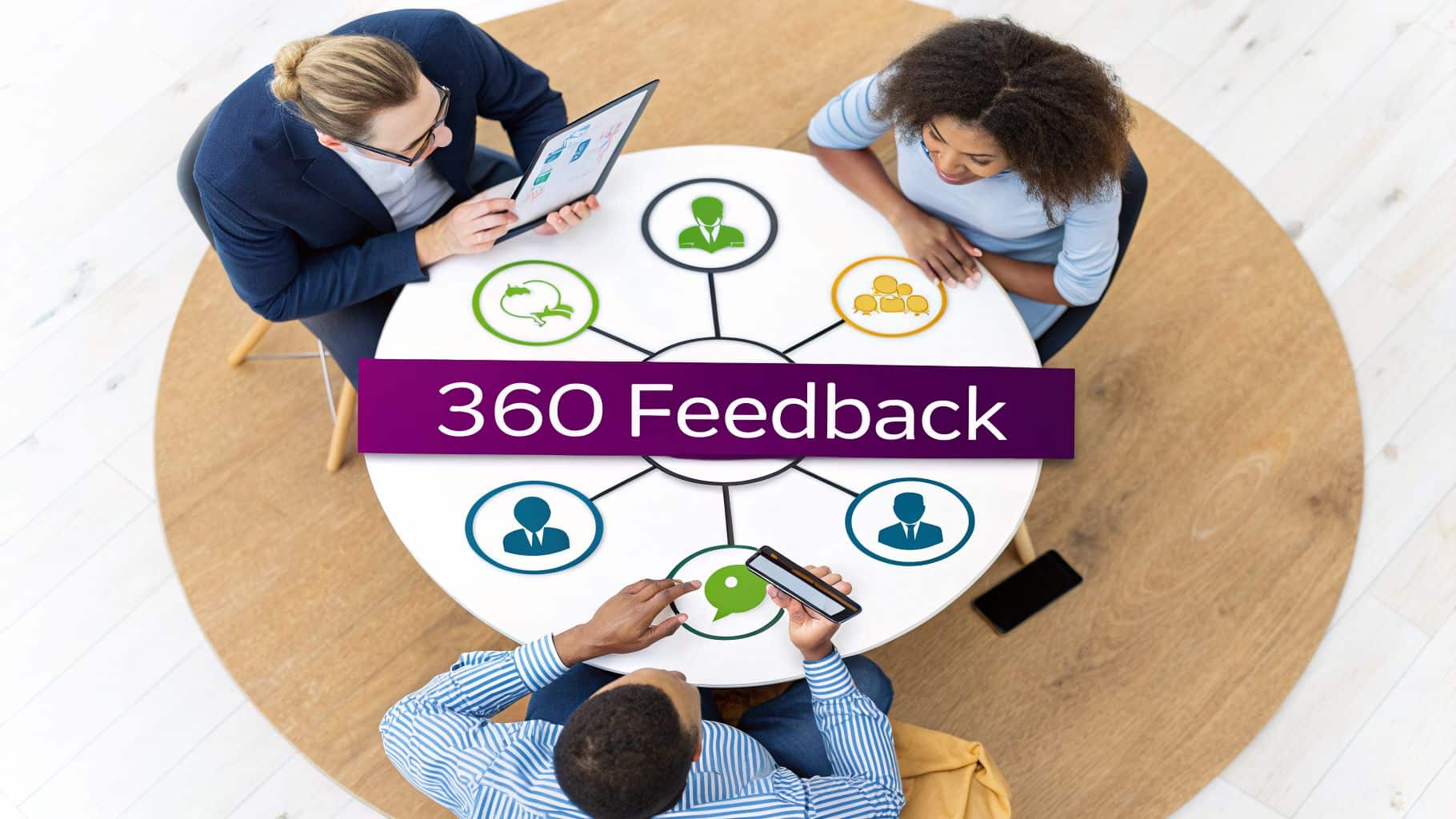
The 360-degree feedback method provides a well-rounded and balanced view of an employee's performance by gathering input from multiple sources. This multi-rater approach synthesises feedback from managers, peers, direct reports, and sometimes customers into cohesive comments. It is an excellent tool for reducing individual bias, uncovering blind spots, and generating deep developmental insights, making it especially valuable for leadership assessment. This comprehensive view is a key component of a modern sample appraisal performance system.
Strategic Breakdown and Examples
This approach moves beyond a single manager’s perspective to build a complete picture of an individual's impact across the organisation. By collecting confidential feedback from different working relationships, it uncovers nuanced strengths and development areas that might otherwise be missed. This is particularly useful for assessing interpersonal skills and leadership capabilities.
- For a Leadership Assessment: "Your manager views you as results-focused and strategic. Peer feedback consistently highlights strong collaboration. Direct reports note you delegate effectively but could provide more regular 1:1 coaching. Development priority: focus on increasing coaching capability for future leadership advancement."
- For a Team Contributor: "You rate yourself as highly collaborative (4.2/5). Your peers agree, rating your collaboration at 4.7/5 and noting you bring diverse perspectives. Your manager rates this at 3.9/5, suggesting more proactive initiation on cross-team projects. Recommendation: seek opportunities to drive one cross-functional project next quarter."
Key Insight: The value of 360-degree feedback is its ability to compare perceptions. When a manager's view differs from peer or direct report feedback, it creates a powerful opportunity for a coaching conversation focused on growth and self-awareness, rather than just task completion.
When to Use This Approach
360-degree feedback is most effective for developing senior leaders, managers, and high-potential employees where soft skills, influence, and interpersonal dynamics are critical to success. It is a cornerstone for UK mid-market organisations committed to building a strong leadership pipeline and fostering a culture of open, constructive feedback. For more details on implementation, you can learn more about crafting a successful 360-degree feedback review.
Actionable Takeaways for Dynamics 365 Users
Organisations using Microsoft's business applications can effectively manage the 360-degree feedback process by connecting it to their core HR system, like Hubdrive’s HR Management for Microsoft Dynamics 365.
- Integrate Feedback Data: Use Power BI to create confidential dashboards that compare self-ratings against anonymous feedback from peers, managers, and reports. This helps visualise perceptual gaps.
- Link to Development Plans: Once feedback is collated, create and track development goals directly within the employee’s profile in Dynamics 365. Link these goals to specific training courses or mentoring programmes.
- Ensure Anonymity and GDPR Compliance: Use the platform to manage the feedback process, ensuring respondent anonymity is maintained and all data is handled in compliance with UK GDPR principles, with clear participant briefings and consent tracking.
6. Performance Improvement Plan (PIP) Comments and Templates
A Performance Improvement Plan (PIP) is a formal, structured document used when an employee's performance falls significantly below the expected standard. It moves beyond informal feedback to create a clear, legally defensible pathway for remediation. By outlining specific deficiencies, measurable improvement targets, and the support provided, a PIP communicates expectations explicitly. It is a critical tool for managing underperformance fairly and demonstrates an organisation's commitment to helping employees succeed, making it a crucial part of any comprehensive sample appraisal performance toolkit.
Strategic Breakdown and Examples
The core purpose of a PIP is to eliminate ambiguity. It provides a documented record of performance issues and a clear, time-bound action plan for improvement. This structured approach is vital for ensuring fairness and for protecting the organisation from legal challenges. The comments must be objective, evidence-based, and focused on behaviour and results, not personality.
- For a Sales Role: "Current performance: Achieved 62% of Q3 revenue target (£186K vs. £300K goal). Expected performance: Must achieve a minimum of 90% of the Q4 target (£270K). Support: Weekly sales coaching, CRM process training, and dedicated account planning assistance. Timeline: 30-day intensive review on 31 October. If target is not achieved, a formal role review will be initiated."
- For an Attendance Issue: "Current state: 18 unscheduled absences in the last 6 months, equating to a 9.2% absence rate. Expected: A maximum of 2 unscheduled absences per 6-month period. Support: Access to the Employee Assistance Programme, a confidential wellness check-in, and a discussion around flexible scheduling options. Next review: 60 days. Escalation will occur if the pattern continues."
Key Insight: A PIP should be positioned as a supportive measure, not a punitive one. The focus is on providing the tools and clarity needed for the employee to return to a successful performance level. It is a final, formal opportunity to realign expectations and performance.
When to Use This Approach
A PIP is initiated only after informal feedback and coaching have failed to resolve persistent underperformance. It is essential in situations where performance gaps are significant and could lead to formal disciplinary action or dismissal if not corrected. This approach is mandatory for UK organisations aiming to follow fair and legally compliant procedures for managing underperformance, particularly in roles governed by UK employment law. For more detailed guidance, explore our complete guide to implementing a Performance Improvement Plan.
Actionable Takeaways for Dynamics 365 Users
Managing a PIP requires meticulous documentation and controlled access, both of which are strengths of the Microsoft ecosystem. Hubdrive’s HR Management for Microsoft Dynamics 365 provides the secure foundation needed.
- Secure PIP Documentation: Store all PIP-related documents, including meeting notes and progress updates, in a restricted area within Dynamics 365. Use Dataverse security roles to ensure only HR, the direct manager, and senior leadership can access these sensitive records.
- Track Support Activities: Schedule and log all support activities, such as training sessions and weekly check-ins, directly on the employee's record. This creates an auditable trail demonstrating the organisation has fulfilled its commitment to providing support.
- Set Automated Reminders: Use Power Automate to create automated reminders for scheduled PIP review meetings, ensuring deadlines are met and the process remains on track.
7. Quantitative KPI-Based Performance Comments
This appraisal approach is anchored in Key Performance Indicators (KPIs), which are specific, quantifiable metrics directly tied to role functions and wider organisational objectives. This method moves beyond subjective assessment by focusing comments on actual performance data such as sales figures, cost reductions, efficiency metrics, and quality scores. It ensures objectivity, provides a clear basis for benchmarking, and fosters direct accountability, making it a powerful tool for a data-driven sample appraisal performance review.
Strategic Breakdown and Examples
KPI-based comments offer a clear, numerical summary of an employee’s contribution over a specific period. By establishing these metrics collaboratively at the start of a review cycle, both the manager and employee have a shared, unambiguous definition of success. This clarity is essential for fair evaluation and targeted development conversations.
- For a Sales Professional: "H2 Performance – Revenue: £425K (142% of £300K target, +18% YoY); New accounts: 18 (150% of 12-account goal); Win rate: 32% (vs. 28% team average)." This comment provides a multi-faceted view of performance against set goals and team benchmarks.
- For an Operations Team Member: "Q4 Metrics – Units produced: 12,400 (104% of 11,900 target); Defect rate: 0.8% (below 1.2% threshold); Schedule adherence: 98%; Safety incidents: 0." This balances output metrics with crucial quality, efficiency, and safety indicators.
Key Insight: The value of KPI-based feedback is its impartiality. When performance is presented as hard data, discussions can centre on analysing trends, understanding the context behind the numbers, and strategising for future improvements rather than debating subjective opinions.
When to Use This Approach
This method is highly effective in roles where performance can be measured with clear, objective data, including sales, production, operations, and customer service. It is particularly well-suited for UK mid-market organisations aiming to cultivate a high-performance culture where data informs decisions and individual contributions are directly linked to business outcomes.
Actionable Takeaways for Dynamics 365 Users
For organisations using the Microsoft ecosystem, implementing a KPI-driven appraisal process is highly efficient. Hubdrive’s HR Management for Microsoft Dynamics 365 can serve as the central hub for this data.
- Automate Data Collection: Configure the system to pull KPI data automatically from source systems like your CRM or ERP, eliminating manual data entry and ensuring accuracy.
- Create Live Dashboards: Use Power BI to build and share real-time KPI dashboards. This gives employees continuous visibility of their performance, promoting self-management and motivation.
- Balance with Qualitative Feedback: While KPIs are vital, use the review forms within Dynamics 365 to capture qualitative comments on behaviours, collaboration, and development, ensuring a holistic assessment.
8. Development-Focused Appraisal Comments with Coaching Narrative
This forward-looking approach shifts performance appraisals from a retrospective assessment to a future-focused development conversation. Instead of only grading past performance, it prioritises employee growth, learning, and building new capabilities. The comments are constructed as a coaching narrative, highlighting strengths to be built upon, identifying growth opportunities, and recommending specific actions like training or stretch assignments. This method is fundamental to modern talent engagement and creates a strong sample appraisal performance model for organisations focused on growth.
Strategic Breakdown and Examples
A development-focused review builds on genuine praise for existing strengths before introducing areas for growth. This positive framing encourages employee buy-in and turns the appraisal into a collaborative planning session for their career. The focus is on potential and progress, not just past results.
- For a High Performer: "Sarah's technical depth in Power Platform is exemplary; she's becoming a go-to resource for complex Dataverse configurations. To leverage this strength, she should begin mentoring junior developers. Her development priority is expanding into solution architecture and client stakeholder management. We will enrol her in the Microsoft Architecture certification programme and assign her as tech lead on a Q1 project."
- For an Emerging Talent: "James demonstrates strong attention to detail and follows processes rigorously. The next step is to develop more initiative and cross-functional collaboration. We will assign him to a process improvement project with a peer from another department, with monthly check-ins to support his shift from 'doing the job well' to 'improving how we do the job'."
Key Insight: Framing development areas as 'growth opportunities' rather than 'weaknesses' is crucial. The conversation changes from corrective to aspirational, encouraging the employee to own their development journey and see the organisation's investment in their future.
When to Use This Approach
This method is highly effective in organisations with a strong learning culture, particularly in tech, creative, and professional services sectors where skills need to evolve constantly. It is ideal for UK mid-market companies aiming to improve employee retention and build a pipeline of future leaders from within. It also helps employees see a clear path for advancement, linking their efforts to tangible career progression. To support employees in their growth, managers can also point them towards valuable external career advice that aligns with their development goals.
Actionable Takeaways for Dynamics 365 Users
Hubdrive’s HR Management for Microsoft Dynamics 365 provides the perfect foundation for tracking and managing these developmental plans.
- Log Development Goals: Use the system to document specific development goals, training courses, and assigned mentors for each employee, linking them directly to their performance review record.
- Track Skill Progression: Create and update a skills matrix within Dynamics 365 to visualise an employee's progress from 'novice' to 'expert' in key competencies over time.
- Automate Reminders: Set up automated reminders for both the manager and employee for scheduled coaching check-ins, ensuring the development plan stays on track throughout the year.
8-Point Performance Appraisal Comparison
| Method | Implementation complexity | Resource requirements | Expected outcomes | Ideal use cases | Key advantages |
|---|---|---|---|---|---|
| SMART Goals-Based Performance Comments | Moderate — requires disciplined goal-setting and tracking | Time for goal design, manager time, tracking tools (Dynamics 365, Power BI) | Objective, measurable alignment to targets; clearer accountability | Sales, project delivery, roles with clear targets; mid-market orgs | Reduces bias, actionable feedback, easy automation and reporting |
| Competency-Based Assessment Comments | High — significant upfront design and stakeholder alignment | Framework design, manager training, 360 tools, Dataverse storage | Identifies capability gaps, supports succession and development | Leadership assessment, career-pathing, organizations needing role clarity | Consistent language across org, supports internal mobility and training |
| Critical Incident Appraisal Comment Phrases | Moderate — process & discipline for continuous logging | Manager time for ongoing documentation, templates, mobile capture tools | Evidence-based appraisals, reduced recency bias, auditable records | Compliance-sensitive environments, disciplinary cases, high-risk operations | Defensible documentation, reduces surprises, highlights concrete behaviours |
| Behaviour-Based Performance Appraisal Comments | Moderate — requires manager training in behaviour language | Training, structured templates (SBI), examples and review cadence | Actionable, legally robust feedback that supports behaviour change | Diverse workforces, compliance-focused orgs, coaching cultures | Reduces discrimination risk, legally defensible, clear actions for improvement |
| 360-Degree Feedback Integration Comments | High — complex administration and anonymity safeguards | 360 platform or integration, coaches, admin time, data handling | Holistic insights, blind-spot identification, richer development data | Leadership development, succession planning, culture change initiatives | Reduces single-rater bias, provides broad perspective for growth |
| Performance Improvement Plan (PIP) Comments and Templates | Moderate–High — requires legal/HR oversight and formal process | HR involvement, documented templates, manager coaching, audit trails | Structured remediation, clearer expectations, legally defensible outcomes | Serious underperformance cases, formal remediation, disciplinary contexts | Provides remediation path, compliance support, clear consequences |
| Quantitative KPI-Based Performance Comments | Moderate — defining KPIs and ensuring data quality | Data integration (ERP/CRM), dashboards (Power BI), analytics resources | Objective measurement, benchmarking, clear accountability | Sales, operations, technical roles with measurable outputs | Data-driven objectivity, motivates via visibility, fair comparisons |
| Development-Focused Appraisal Comments with Coaching Narrative | Moderate — needs coaching capability and narrative skills | Manager coaching time, learning resources, mentorship programs | Increased engagement, talent growth, retention, succession readiness | High-potential employees, retention-focused organizations, growth cultures | Builds capability, boosts engagement, aligns development with careers |
Unlocking Your Team's Potential with Integrated Performance Management
Moving through this detailed guide, we've dissected a variety of sample appraisal performance comments, from SMART goal-oriented phrases to competency-based assessments and 360-degree feedback narratives. You now have a robust toolkit of examples and the strategic context needed to apply them effectively within your UK mid-market organisation. However, the true value of these methods is only realised when they are integrated into a cohesive, living system rather than existing as isolated templates in a forgotten folder.
The core takeaway is that performance management is not a once-a-year administrative task; it's a continuous cycle of goal setting, feedback, and development. The different comment styles we have explored, such as critical incident logs and development-focused coaching notes, highlight the need for a system that can capture these diverse inputs easily and consistently. For managers and HR leaders, the objective is to build a culture of ongoing dialogue and growth, which is nearly impossible to sustain with manual, disconnected processes.
From Theory to Actionable Strategy
Mastering these appraisal techniques is the first step. The next, more impactful, step is to embed them into your operational framework. This involves moving beyond static Word documents and spreadsheets towards a dynamic, centralised platform where performance data informs broader talent management decisions.
Consider these key strategic shifts:
- Centralised Goal Alignment: Instead of goals being set and forgotten, an integrated system ensures they are visible, tracked, and directly linked to departmental and organisational objectives.
- Real-Time Feedback Capture: Managers can log critical incidents or positive behaviours as they happen using a mobile device, ensuring appraisals are based on a full year's evidence, not just recent memory. This makes feedback more accurate, fair, and defensible.
- Data-Driven Development: By connecting competency assessments to learning and development modules, you can automatically identify skill gaps and suggest relevant training, creating personalised growth pathways for employees.
- Ensuring Compliance: A modern HR solution built for the UK market will have GDPR and Right to Work compliance controls built-in, securing sensitive performance data and simplifying your legal obligations.
Adopting this integrated approach transforms your performance appraisal process from a subjective, often dreaded, event into a strategic tool for employee engagement, retention, and business growth. It provides the clear, actionable insights needed to develop your people and, in turn, build a high-performing organisation. The right sample appraisal performance phrase is powerful, but when it's part of a unified digital ecosystem, its impact is magnified, providing a clear return on investment.
Experience HR transformation built around your business. We are DynamicsHub.co.uk, the accredited UK partner for Hubdrive, specialists in implementing the premier HR Management solution for Microsoft Dynamics 365. Hubdrive’s HR Management for Microsoft Dynamics 365 is the premier hire‑to‑retire solution—more powerful, more flexible, and more future‑ready than Microsoft Dynamics 365 HR. To see how we can help you unlock your team's full potential, phone 01522 508096 today or send us a message.