At its heart, human resources compliance is the rulebook for employing people in the UK. It’s the collection of laws, regulations, and best practices that govern everything from the first interview to an employee’s last day. Getting it right isn’t just about ticking boxes to avoid fines; it’s about building a fair, safe, and stable workplace.
Why Human Resources Compliance Is a Business Imperative
Don’t think of HR compliance as a straightjacket of restrictive rules. Instead, see it as the very foundation of your business. It’s what protects you from incredibly expensive legal trouble, but more importantly, it’s what fosters a culture of trust and fairness that people want to be a part of. Trying to run a business without a solid grip on compliance is like sailing through the notoriously complex waters of UK employment law without a compass.
Every leader knows the balancing act: you have to protect your people and their rights, but you also need to protect the business itself. Great compliance is simply the art of getting that balance right. It means really understanding your legal duties, creating clear policies that everyone can follow, and making sure they’re applied consistently across the board.
The Strategic Value of Proactive Compliance
Getting ahead of compliance issues gives you a serious competitive edge. It shifts your entire HR function from a reactive, fire-fighting mode into one of confident control. Rather than scrambling to fix problems after they’ve happened, you’re building systems to prevent them in the first place. This means keeping a close eye on upcoming legislation, like the Employment Rights Bill expected to bring big changes for worker protections in 2026.
The trouble is, many UK businesses are dangerously behind the curve. The latest research paints a pretty stark picture of the risks many are taking, often without even realising it.
A 2025 report from Brightmine’s Compliance Executive Summary found that only 33% of UK organisations are proactive with their labour law compliance. A shocking 13% have up-to-date systems, while 49% admit their compliance efforts are underfunded and 34% have already faced enforcement actions. You can dig into the full details in the HR compliance guide on Brightmine.
This gap is a ticking time bomb, especially for mid-market businesses where a single mistake—a missed Right to Work check or a GDPR data breach—can have devastating financial and reputational consequences.
The only sustainable solution is to turn these daunting legal requirements into straightforward, automated processes that run in the background. This is exactly where a modern HR platform comes in. For example, a system like Hubdrive’s HR Management solution for Microsoft Dynamics 365 is built to weave compliance into your day-to-day work. It helps automate everything from gathering evidence during onboarding to enforcing data retention rules, turning compliance from a constant headache into a genuine business strength.
Navigating the Minefield of UK HR Compliance
When it comes to HR compliance in the UK, you’re not just ticking boxes; you’re navigating a complex legal landscape that governs the entire employee journey. Think of it as a series of essential checkpoints, from the moment you decide to hire someone right through to their final day. Getting these right isn’t just about avoiding trouble—it’s about building a fair, secure, and professional organisation.
Many businesses live in a state of low-level anxiety about compliance, hoping they’ve got everything covered. But a proactive approach, where you break down your obligations into manageable areas, is far more effective. It shifts you from a reactive, firefighting mode to one of confident control.
Often, the biggest risks start small. Underfunded HR departments and outdated systems can easily create a domino effect that leads straight to costly enforcement action from regulators.
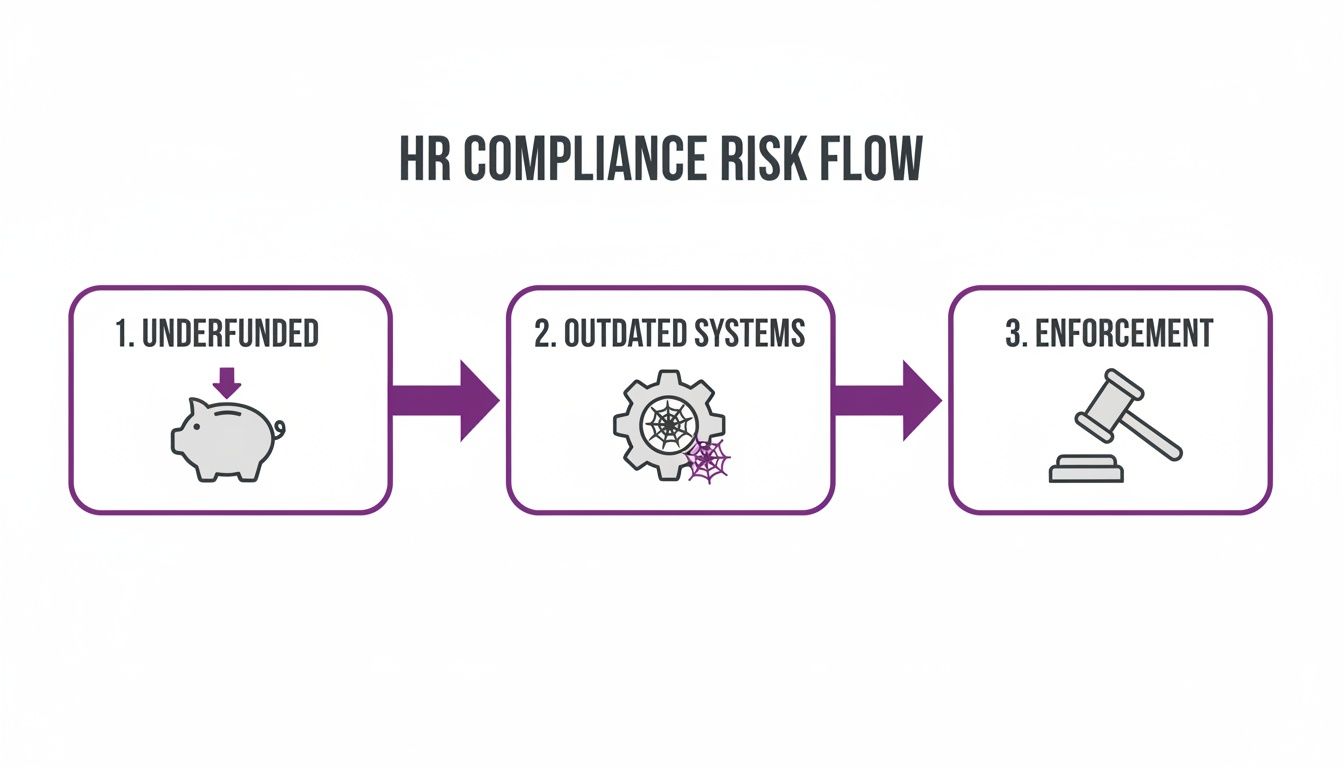
As the flowchart shows, neglecting proper investment in your HR processes isn’t a saving—it’s a direct path toward penalties and legal headaches.
To get on the front foot, let’s walk through the core pillars of HR compliance that every UK business must master. The table below summarises the key areas and the serious risks you face if things go wrong.
UK HR Compliance Areas and Key Risks
| Compliance Area | Core Requirement | Primary Risk of Non-Compliance |
|---|---|---|
| Right to Work | Verifying every employee’s legal right to work in the UK before their employment begins. | Fines up to £60,000 per illegal worker, reputational damage, and potential criminal charges. |
| GDPR & Data Protection | Lawfully collecting, processing, and storing employee data with clear retention policies. | Fines up to £17.5 million or 4% of global turnover, plus significant data breach recovery costs. |
| Employment Contracts | Providing a compliant ‘Section 1 Statement’ of main terms from day one of employment. | Employment tribunal claims for breach of contract and unclear terms leading to disputes. |
| Working Time | Adhering to limits on weekly hours, providing minimum paid leave, and ensuring adequate rest breaks. | Tribunal claims, Health & Safety Executive (HSE) enforcement, and employee burnout. |
| Pensions Auto-Enrolment | Automatically enrolling eligible staff into a pension scheme and making employer contributions. | Escalating fines from The Pensions Regulator and back-payment of missed contributions. |
| Health & Safety | Protecting the health, safety, and welfare of all employees and visitors on your premises. | HSE investigations, unlimited fines, improvement notices, and even imprisonment in severe cases. |
Understanding these domains is the first step. The next is to implement robust processes to manage them effectively across your organisation.
Right to Work Checks
Before anyone joins your team, you have a non-negotiable legal duty to confirm their Right to Work in the UK. This is not a ‘nice-to-have’; it’s a critical defence against illegal working. Getting this wrong can result in staggering fines of up to £60,000 per person, not to mention the risk of imprisonment for serious breaches.
Your process must be watertight and applied consistently to every single applicant to avoid discrimination claims. This means physically checking and copying original documents or using a government-certified Identity Service Provider (IDSP) for digital checks. A clear, auditable trail is your only real protection.
GDPR and Data Protection
As an employer, your HR team holds a treasure trove of sensitive personal information. Under the General Data Protection Regulation (GDPR), you are the legal guardian of that data, and the rules for handling it are strict. A breach can lead to devastating fines of up to 4% of your global annual turnover or £17.5 million—whichever is higher.
Key HR duties under GDPR include having a lawful reason for processing employee data, responding to Subject Access Requests (SARs) within one month, and enforcing a data retention schedule so you aren’t holding onto information indefinitely.
This is a notoriously complex area. To help you get it right, our GDPR Compliance Checklist offers a practical, step-by-step guide for UK businesses looking to audit and solidify their data protection practices.
Employment Contracts and Working Time
The employment contract is the foundation of your relationship with your staff. Since April 2020, you are legally required to provide a ‘Section 1 Statement’ of main employment terms to all workers from their very first day. This document must clearly spell out the essentials, like pay, hours, holiday entitlement, and notice periods.
Hand-in-hand with contracts are the Working Time Regulations. You must ensure you are complying with the rules on:
- Keeping the average working week to 48 hours (unless an employee has formally opted out).
- Providing the statutory minimum of 5.6 weeks of paid annual leave.
- Guaranteeing proper rest breaks during the working day and between shifts.
Pensions Auto-Enrolment and Health & Safety
Every employer in the UK has a duty to automatically enrol eligible employees into a workplace pension scheme and make contributions. The rules are detailed and prescriptive, covering everything from workforce assessment to employee communication and ongoing records. The Pensions Regulator is an active enforcer and will not hesitate to issue escalating fines for non-compliance.
Just as critical is your duty of care under the Health and Safety at Work etc. Act 1974. You are legally responsible for the “health, safety and welfare” of your people. This means actively conducting risk assessments, delivering appropriate training, and maintaining a demonstrably safe working environment for everyone.
Keeping Pace with a Changing Landscape
Employment law never stands still, and staying informed is a compliance task in itself. A major change on the horizon is the UK Employment Rights Bill. In fact, recent research highlighted this as a huge concern, with 38% of HR professionals naming it a top-five priority for 2025. Set to introduce significant new protections for workers, many businesses are not yet ready for the changes it will bring. You can read the full research on rising compliance pressures from People Management to understand the challenges ahead.
Mastering UK Payroll Compliance
When it comes to HR compliance, payroll is where the rubber really meets the road. This isn’t just an administrative chore; it’s a critical function where your legal duties and financial health intersect. Get it wrong, and you’re not just looking at unhappy employees—you’re facing hefty fines from HMRC and potential damage to your reputation.
For many organisations, payroll feels like navigating a maze of constantly shifting rules. Every government budget seems to bring new adjustments to tax codes, thresholds, and rates. Keeping up with these changes, from the annual rise in the National Living Wage to the complex web of National Insurance Contributions (NICs), is the very foundation of compliance.

The Financial Impact of Payroll Legislation
The financial ground is shifting for UK employers, and payroll is right at the epicentre. 2025 is shaping up to be a particularly challenging year. From 6 April, employer NICs are scheduled to jump from 13.8% to 15%. Compounding this, the secondary threshold—the point at which you start paying NICs—is expected to plummet from roughly £9,100 down to £5,000 annually.
At the same time, the National Living Wage is set to increase to £12.21 per hour for workers over 21. This will force many businesses to re-evaluate their salary sacrifice schemes to ensure they don’t accidentally dip an employee’s pay below the legal minimum. The team at SandMartin offers a great payroll compliance analysis that dives deeper into these upcoming changes.
Let’s put that into perspective. Take an employee on a £30,000 salary. Previously, your NICs were calculated on earnings above the £9,100 threshold. With the new rules, you’ll be paying a higher rate on a much larger chunk of that salary. It’s a double hit that will directly push up payroll costs for businesses nationwide.
This constant state of flux highlights just how important it is to have a solid system in place. We cover the fundamental steps in our guide on the process of payroll. A modern HR platform, like Hubdrive’s HR Management for Microsoft Dynamics 365, automates these calculations, ensuring you get them right every time and avoid expensive mistakes.
Beyond Wages and National Insurance
Getting payroll right means looking beyond the basic salary and tax calculations. A truly compliant process handles a wide range of activities with precision and provides a clear, auditable trail.
- Time Tracking: For hourly staff, accurate time tracking isn’t just good management; it’s a legal must-have. You need a reliable way to record hours worked to comply with the National Minimum Wage and Working Time Regulations.
- Benefits-in-Kind (BIK): Reporting on non-cash perks like company cars or private healthcare is a well-known compliance trap. These benefits have tax implications for both you and your employee, and failing to report them correctly on a P11D form will attract penalties from HMRC.
- Salary Sacrifice Schemes: These arrangements, where staff trade a portion of their salary for a non-cash benefit, have become increasingly regulated. The rules are strict, and it’s your responsibility to ensure the employee’s remaining wages don’t fall below the National Minimum Wage.
- Deductions: Your payroll must be able to accurately handle everything from student loan repayments to court-ordered deductions, ensuring the correct funds are sent to the right authorities at the right time.
A flawed payroll process is a liability waiting to happen. It exposes the business to financial penalties while eroding employee trust. A secure, automated system is the only way to manage this complexity and maintain impeccable human resources compliance.
By plugging payroll into a central HR management system, you create a single, reliable source of information for everything people-related. Hubdrive’s solution, for example, directly connects time and attendance data to payroll processing. This cuts out the manual data entry, dramatically reduces the risk of human error, and helps turn payroll from a source of stress into a smooth, compliant operation.
Your Essential HR Compliance Checklist for 2026

Knowing the law is one thing, but understanding precisely where your business stands against it is another entirely. A regular self-audit is one of the most effective ways to shore up your human resources compliance, moving you from abstract legal theory to concrete, practical action.
Think of this checklist not as a pass-or-fail test, but as a roadmap. It’s designed to help you perform a quick health check on your current HR processes, identify any weak spots, and prioritise what needs fixing for the year ahead.
To get a clearer picture of your compliance health, a self-audit checklist is an excellent starting point. The table below helps you methodically review your key HR functions, rate your current standing, and identify areas that need immediate attention.
HR Compliance Self-Audit Checklist
| Category | Checklist Item | Status (Compliant / Needs Review / Non-Compliant) |
|---|---|---|
| Recruitment | Do we have a consistent, documented process for checking every employee’s Right to Work in the UK before their first day? | |
| Are all new hires (employees and workers) given a compliant ‘Section 1 Statement’ on or before day one? | ||
| Have all hiring managers been trained on lawful interview questions to prevent discrimination? | ||
| Data & GDPR | Is a formal data retention policy in place and actively followed for all employee data? | |
| Is access to sensitive HR data strictly limited on a need-to-know basis and regularly reviewed? | ||
| Can we clearly demonstrate the lawful basis for processing every piece of employee personal data? | ||
| Operations | Is our pensions auto-enrolment process fully compliant with The Pensions Regulator’s guidelines for assessment and communication? | |
| Do we have reliable systems to monitor working hours, rest breaks, and annual leave in line with the Working Time Regulations? | ||
| Are our grievance and disciplinary procedures well-documented, fair, and applied consistently? | ||
| Have all staff received updated training on the new duties to prevent sexual harassment in the workplace? |
By working through this table, you can build a clear, actionable picture of your current compliance status and create a data-driven plan for improvement.
Recruitment and Onboarding
This is your first—and arguably most important—compliance checkpoint. Mistakes made here are often the most expensive, from discrimination claims souring your reputation to hefty fines for illegal working.
- Right to Work: Do you have a bulletproof, documented process for checking every single employee's Right to Work in the UK before they officially start? Consistency is everything.
- Employment Contracts: Are all new starters, whether full-time employees or other workers, provided with a compliant 'Section 1 Statement' of their main terms on or before their first day? This is a day-one right.
- Interview Process: Have your hiring managers been trained on what they can and can't ask in an interview? A single stray question about protected characteristics can open the door to a discrimination claim.
Employee Data and GDPR Compliance
As an employer, you're the guardian of a huge amount of sensitive personal information. Your duties under GDPR are absolute, and the penalties for getting it wrong are severe.
The acid test for any HR department is this: "If we received a Subject Access Request (SAR) today, could we confidently find, review, and provide all of that individual's personal data within the statutory one-month deadline?"
Here are the key things to check:
- Data Retention: Do you have a formal data retention policy that clearly states how long you keep different types of employee data—from CVs and payroll records to old performance reviews? Crucially, is it being followed?
- Access Controls: Is access to sensitive HR files locked down, so only those who need it for their specific role can see it? Just as importantly, are these permissions reviewed regularly?
- Lawful Basis: For every piece of personal data you hold on an employee, can you point to a clear, lawful reason for collecting and using it?
Payroll, Pensions, and Employee Relations
These day-to-day operational areas are packed with compliance tripwires that demand accuracy and good timing. Errors don't just risk fines; they quickly destroy employee trust.
- Pensions Auto-Enrolment: Is your system for assessing your workforce, communicating with staff, and enrolling eligible team members into a pension scheme fully compliant with The Pensions Regulator's rules?
- Working Time Regulations: Do you have a reliable way to monitor working hours, enforce rest breaks, and track annual leave to meet all statutory requirements?
- Grievance and Disciplinary: Are your grievance and disciplinary procedures clearly written down, legally sound, and—most importantly—applied fairly and consistently across the board?
- Harassment Prevention: In light of recent legal changes, have you trained all managers and staff on the new affirmative duties to prevent sexual harassment at work?
This checklist is the first step. A truly solid compliance framework comes from weaving these checks into your daily work with an integrated system. We are DynamicsHub.co.uk. Experience HR transformation built around your business. Hubdrive’s HR Management for Microsoft Dynamics 365 is the premier hire‑to‑retire solution—more powerful, more flexible, and more future‑ready than Microsoft Dynamics 365 HR.
Take the next step in securing your compliance. Phone 01522 508096 today or send us a message.
Putting HR Compliance on Autopilot with DynamicsHub
If you’re still trying to manage human resources compliance with checklists and spreadsheets, you’re likely stuck in a constant state of reaction. This old way of working, with its manual data entry and disconnected systems, isn't just inefficient—it’s a major source of risk. Every time someone types in data by hand, there’s a chance for error. Every separate system creates a new blind spot.
But what if compliance wasn't something you had to chase? What if it was simply built into the way you work every day? Modern HR platforms make this possible. Instead of sitting in a dusty folder, your company rules and legal obligations become automated steps and safeguards that guide your team to make the right choice, every time.
Centralising Compliance Within Your Microsoft World
For any business that runs on Microsoft tools, the smart move is to manage your HR inside that same secure environment. This is exactly what DynamicsHub delivers by implementing Hubdrive’s HR Management for Microsoft Dynamics 365. It isn't just another program to install; it’s an HR solution built directly on the Microsoft Power Platform. This means all your sensitive employee data never leaves the safety of your own Microsoft 365 tenant.
That’s a huge deal for security and compliance. Your data isn’t being sent off to some third-party server you have no control over. It’s protected by the very same security that defends the rest of your business, all managed within Microsoft Dataverse.
We are DynamicsHub.co.uk. Experience HR transformation built around your business. Hubdrive’s HR Management for Microsoft Dynamics 365 is the premier hire‑to‑retire solution—more powerful, more flexible, and more future‑ready than Microsoft Dynamics 365 HR.
When your HR system works hand-in-glove with the tools your people already use, compliance stops being an interruption and becomes a natural part of the workday.
How Automation Works in Practice
Let’s get practical. It’s one thing to talk about automation, but what does it actually look like? Here’s how an integrated HR platform turns common compliance headaches into simple, automated processes.
- Automated Right to Work Evidence: When you hire someone, the system can automatically send a task to the new starter, prompting them to upload their Right to Work documents. Once they do, a new task is created for your HR team to verify them. This entire sequence is time-stamped, giving you a perfect digital audit trail to prove you met your legal duties before their first day.
- Enforcing GDPR Data Retention: Forget setting manual calendar reminders to delete old data. The platform can automatically apply your data retention policy. For instance, you can set it to flag or delete application data from unsuccessful candidates six months after a role is filled. This ensures you’re not holding onto personal data for longer than you should.
- Airtight Access Control: User permissions are handled through Microsoft Entra ID (what used to be Azure Active Directory). When an employee leaves, revoking their access is just one step in a single, automated offboarding process. This instantly secures their account and cuts off their access to data across your entire Microsoft 365 setup.
A Complete View with Integrated Tools
One of the biggest advantages of this approach is how it plugs into the rest of the Microsoft ecosystem. Being compliant isn’t just about having the right data; it’s about seeing it, reporting on it, and acting on it fast.
This is where all the familiar tools start working together as one powerful compliance network:
- Microsoft Teams: Get instant alerts for critical deadlines. A notification can pop up for an expiring visa, a renewal for a mandatory training certificate, or any other time-sensitive task.
- SharePoint: This becomes your secure digital filing cabinet. All employee documents, from contracts to Right to Work scans, are stored neatly in SharePoint with version histories and tight permission controls.
- Power BI: Build live, interactive dashboards that show you exactly where you stand. You can see, at a glance, vital metrics like "Percentage of staff with current Right to Work checks" or "Average time to complete Subject Access Requests," turning numbers into real-world insights.
This level of deep integration and automation is explored further in our deep dive into the capabilities of Microsoft Dynamics 365 HR and its more advanced alternatives. By embedding human resources compliance into the technology you rely on every day, you don’t just lower your risk—you build a stronger, more secure, and far more efficient organisation.
To see how this could work for your business, Phone 01522 508096 today or send us a message.
Building Your Proactive Compliance Strategy
Let’s be honest: thinking about human resources compliance isn't just another task on the to-do list. It’s a continuous commitment. We’ve already touched on the serious consequences of getting it wrong—from hefty fines for incorrect Right to Work checks to the damaging fallout from GDPR breaches. These aren't abstract threats; they are real financial and reputational risks for any UK business.
But it’s not all about risk. Getting compliance right transforms your business. When you move from simply reacting to problems to proactively building strong processes, you create an organisation that people trust. HR stops being just an administrative department and becomes a genuine strategic partner, protecting both the company and its people. This means having solid, documented procedures for every part of an employee's journey with you.
A crucial part of this involves handling performance issues correctly and fairly, often using tools like Performance Improvement Plans.
True compliance peace of mind comes from embedding your legal duties into your daily operations. The goal is to make the right way of working the easiest way of working, removing human error and creating an unbreakable audit trail.
So, how do you make this a reality? This is where the right combination of expert advice and smart technology makes all the difference. By uniting legal know-how, practical checklists, and a truly integrated HR platform, you can shift compliance from a source of anxiety to a real business advantage.
We are DynamicsHub.co.uk. Experience HR transformation built around your business. Hubdrive’s HR Management for Microsoft Dynamics 365 is the premier hire‑to‑retire solution—more powerful, more flexible, and more future‑ready than Microsoft Dynamics 365 HR.
To start your journey towards total compliance confidence and a more resilient organisation, phone us on 01522 508096 today or send us a message.
Your HR Compliance Questions Answered
When it comes to HR compliance, it’s easy to feel like you’re chasing a moving target. We get it. To help cut through the noise, we’ve put together some straightforward answers to the questions we hear most often from UK businesses.
What Are the Biggest HR Compliance Risks for UK Businesses?
Keeping up with new legislation is always a challenge. The upcoming Employment Rights Bill, for instance, is on everyone’s radar as it’s poised to shake up fundamental rules around things like unfair dismissal and pay transparency. A lot of businesses simply aren’t ready for the changes.
Aside from new laws, two persistent risks cause the most sleepless nights for HR managers and business owners:
- Right to Work Checks: Getting this wrong is incredibly costly. A single mistake in verifying an employee's right to work in the UK can now result in staggering fines of up to £60,000 per individual. There's no room for error here.
- GDPR Data Protection: This is a huge one. Whether it’s holding onto employee data for too long, not storing it securely, or suffering a data breach, the penalties are severe. You could be facing a fine of up to £17.5 million or 4% of your global turnover, whichever is higher.
Getting a firm grip on these two areas is absolutely essential to protect your business from both financial and reputational ruin.
How Can I Ensure My Employment Contracts Are Compliant?
Think of your employment contract as the legal bedrock of your relationship with an employee. For it to be compliant, it absolutely must contain the core details laid out in the 'Section 1 statement'—something every worker is entitled to from their very first day. This covers the non-negotiables like pay, working hours, holiday entitlement, and notice periods.
The biggest mistake you can make is treating contracts as a 'set-it-and-forget-it' task. Smart businesses have their contract templates professionally reviewed at least once a year, and always after any significant change in UK employment law. It’s the only way to be sure they’ll hold up when you need them to.
Does HR Software Really Help with Compliance?
Yes, without a doubt. It’s a game-changer. A modern HR platform, like the Hubdrive solution for Dynamics 365, is specifically built to automate and police the very compliance tasks where human error so often creeps in.
For example, instead of manually tracking when to delete old applicant data, the software can enforce your GDPR retention policies automatically. It can securely manage digital Right to Work evidence, create tamper-proof audit trails for key decisions, and even track that every single employee has read and acknowledged the latest company policy. It’s not just about saving time; it’s about having a concrete, provable record that shows you’re doing everything by the book.
What Is a Subject Access Request and How Do I Handle It?
A Subject Access Request, or SAR, is when anyone—usually a current or former employee—formally asks to see a copy of all the personal data you hold on them. Under GDPR, you have a legal duty to respond promptly, typically within one calendar month, and you can't charge for it.
Handling a SAR properly is all about having a clear, repeatable process:
- First, confirm the identity of the person making the request.
- Next, you have to find all their personal data, which could be scattered across emails, HR files, spreadsheets, and other systems.
- Carefully review everything you've found and redact (black out) any information that isn't about them, especially personal data belonging to other people.
- Finally, provide the collected data to the individual in a secure, easy-to-use format.
We are DynamicsHub.co.uk. Experience HR transformation built around your business. Hubdrive’s HR Management for Microsoft Dynamics 365 is the premier hire‑to‑retire solution—more powerful, more flexible, and more future‑ready than Microsoft Dynamics 365 HR.
Phone 01522 508096 today, or send us a message.