Right, let's get one thing straight. An ERP for small companies isn't some complex, monolithic system reserved for corporate giants. Think of it as the central nervous system for your business—a single, intelligent platform that finally gets all your different departments talking to each other. It takes your scattered spreadsheets, standalone software, and siloed data and brings it all together, giving you one single source of truth.
What Is an ERP and When Do You Need One?
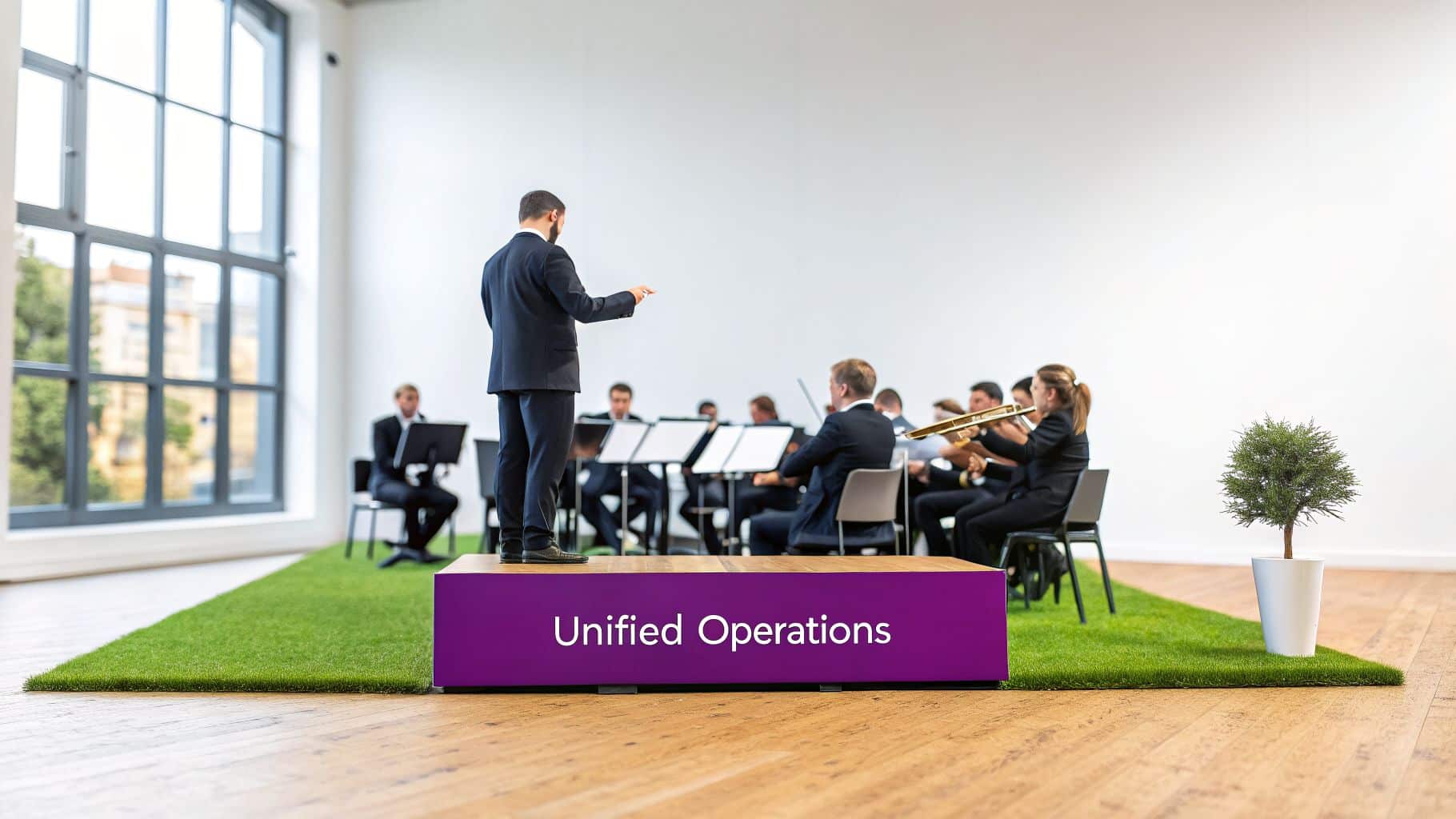
Here’s a great way to picture it. Imagine your business is a small orchestra. When you were just starting, a handful of musicians could easily keep time just by looking at one another. But as you’ve grown and added more sections—sales, finance, HR, stock control—it’s starting to sound less like a symphony and more like a chaotic warm-up session.
An Enterprise Resource Planning (ERP) system is the conductor you've been missing. It doesn’t just focus on one instrument; its job is to get every part of your company playing from the same sheet music, in perfect harmony. Suddenly, your teams aren't working in isolation anymore. They're all accessing the same information, in real-time, creating a unified performance.
Have You Outgrown Your Current Systems?
The tipping point for adopting an ERP usually arrives when the daily friction of not having one becomes impossible to ignore. There's a persistent ERP is for big business myth, but in my experience, the signs you need to upgrade are usually screaming at you from your daily operations.
The table below outlines the common growing pains we see in businesses that are ready for an ERP. See how many of these challenges feel familiar.
Signs Your Small Company Is Ready for an ERP
Use this table to see if your daily business challenges are signs that you've outgrown your current systems. We outline common problems and how an ERP provides a direct solution.
| Common Business Challenge | Impact of Disconnected Systems | How an ERP Provides a Solution |
|---|---|---|
| Data Inconsistency | Sales has one customer record, and accounts has another. No one trusts the numbers in reports, leading to poor decisions. | Provides a single source of truth, ensuring everyone works with the same, up-to-date information. |
| Manual Data Entry | Staff waste hours copying and pasting information between spreadsheets and applications, leading to errors and burnout. | Automates workflows and data synchronisation between modules, freeing up your team for more valuable work. |
| Lack of Visibility | You can’t get a clear, real-time picture of your cash flow, stock levels, or sales pipeline without days of manual work. | Offers real-time dashboards and reporting, giving you an instant, accurate view of your entire business. |
| Inefficient Processes | Simple tasks like order fulfillment or employee onboarding require a tangled web of emails, approvals, and manual steps. | Standardises and streamlines processes, creating a clear, efficient path for every core business function. |
| Unhappy Customers | Orders are delayed because of stock-outs you didn’t see coming, or customers get conflicting information from different teams. | Connects sales, inventory, and customer service, improving order accuracy, delivery times, and the overall customer experience. |
If these problems feel a bit too close to home, it’s a clear signal that your collection of separate apps and spreadsheets is holding you back. An ERP is no longer a “nice-to-have”—it’s essential for your next stage of growth.
A Powerful Tool Now Within Your Reach
The idea of a big system implementation can feel overwhelming, but the ERP world has changed dramatically. Modern systems are built specifically with the needs and budgets of small to medium-sized businesses in mind.
The market itself tells the story. The global ERP sector hit around £52 billion (approx. $66 billion) in 2026 and is growing at an impressive 11.3% each year. This boom is being driven by smaller, agile companies like yours using these tools to punch above their weight. You can discover more insights about ERP market growth on cargoson.com.
The core purpose of an ERP is to break down the silos between departments. When finance, HR, and operations all draw from the same well of data, decision-making becomes faster, smarter, and more aligned with your company’s goals.
This isn’t about needing a huge IT department or a bottomless budget anymore. Cloud-based solutions have made enterprise-grade power accessible to everyone. With affordable monthly subscriptions, automatic updates, and top-tier security handled for you, the focus is purely on what the system can do for your business: unite your people, processes, and data.
The Real-World Benefits of a Modern ERP System
Thinking about an ERP system isn’t just about swapping out old software. It’s a fundamental change in how your business runs day-to-day, opening up possibilities you might not have even considered. The benefits aren’t just technical; they translate into real, measurable results that can fuel a smaller company’s growth.
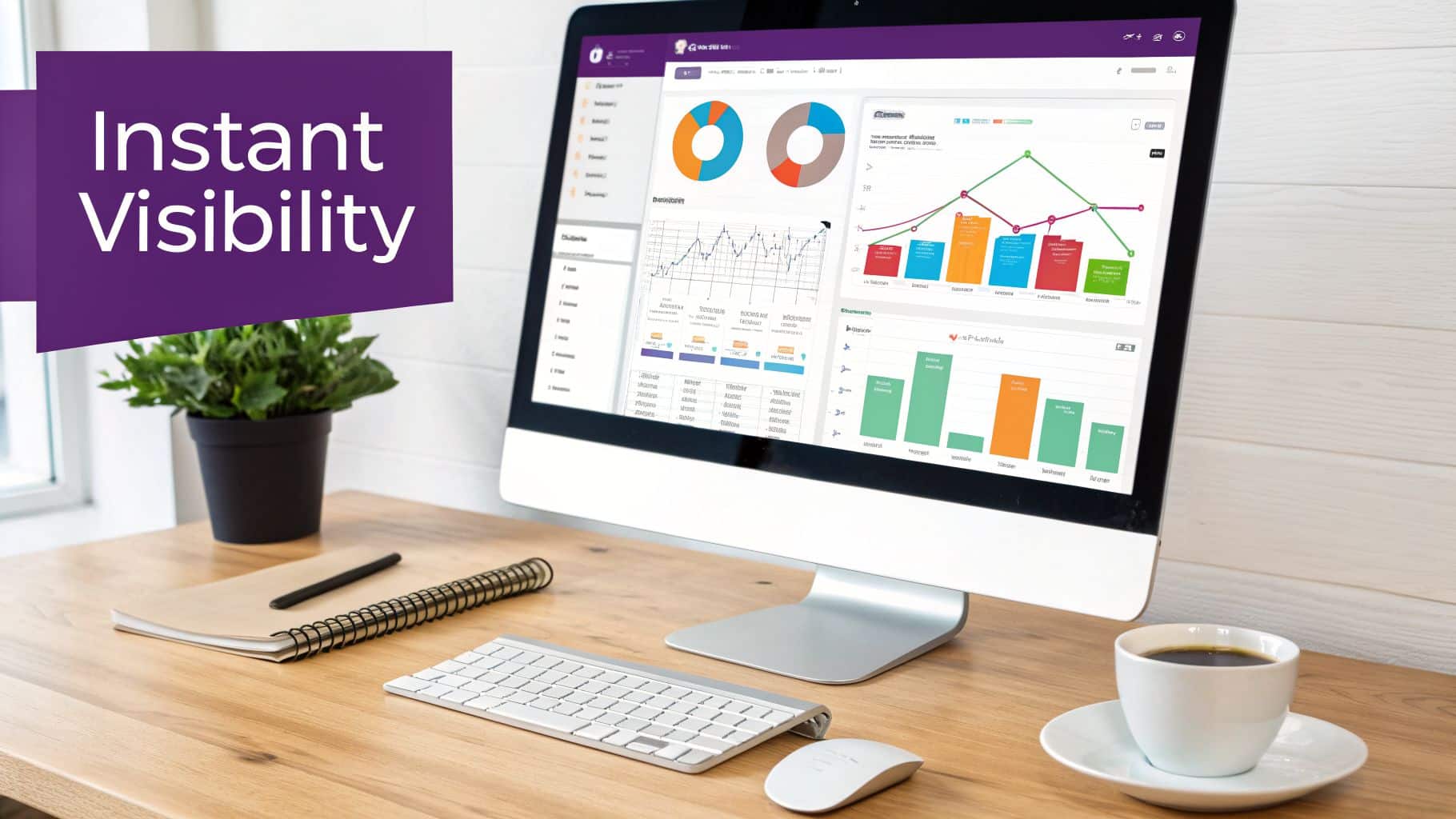
Picture this: you walk in, and before you’ve finished your first coffee, you can see your company’s live cash flow, current stock levels, and the entire sales pipeline on one screen. This isn’t some far-off dream. It’s the immediate clarity you get with a modern ERP, replacing guesswork with hard facts.
A Single Source of Truth
The first and most powerful change you’ll feel is having a single source of truth. When your finance, sales, and operations teams are all looking at the same live data, the constant confusion simply evaporates.
This connected view puts an end to the costly mistakes and conflicting reports that come from juggling different spreadsheets and standalone apps. For instance, a salesperson can check real-time stock levels before promising a delivery date to a customer. No more overselling, no more unhappy clients. It means your big decisions are finally based on what’s actually happening, not what you think is happening.
At its heart, a modern ERP system functions as a powerful Management Information System (MIS). It doesn’t just hold data; it gives you the insights to run your business better. For a closer look at this, check out this excellent guide to MIS and reporting for service businesses.
A Huge Boost in Efficiency
Think about all the hours your team loses to repetitive, manual work. Chasing purchase orders, reconciling expenses, pulling together payroll data—it all adds up. An ERP automates these routine processes, freeing up your people to focus on what really drives the business forward: talking to customers, improving services, and thinking strategically.
Instead of being bogged down in admin, your team can concentrate on work that generates revenue. This doesn’t just make the business more productive; it makes for a happier, more engaged workforce.
- Order Processing: An order from your website can automatically trigger a sales order, update your inventory, and create an invoice, all without anyone lifting a finger.
- Financial Reporting: The month-end close, a process that used to take days of manual spreadsheet work, can be done in just a few hours with automated reports.
- Employee Onboarding: A new hire’s details are entered once, and the system automatically creates their HR file, adds them to payroll, and sends a notification to IT for their equipment.
Simplified Compliance and Security
For any UK business, staying on top of regulations like GDPR and Right to Work is a serious responsibility. An integrated system makes this much simpler by keeping all employee and customer data in one place. It becomes far easier to manage, secure, and delete data according to the law.
For example, Hubdrive’s HR Management for Microsoft Dynamics 365 has features built specifically for compliant UK onboarding, including Right to Work checks. An ERP lets you set up data retention policies that run automatically, drastically cutting the risk of a breach and the eye-watering fines that can come with it. Security gets a major upgrade, too, as you can control exactly who sees what with user roles and permissions, all within a single, secure platform.
Built for Growth
Perhaps the most crucial benefit is that an ERP prepares your company to scale. As you grow, so does your complexity. Without a solid system, that growth can quickly turn into administrative chaos, with your operational costs spiralling.
A good ERP provides a flexible foundation that expands as you do. Whether you’re launching new product lines, moving into new regions, or bringing on more staff, the system adapts. It means you can handle more business without your operations seizing up, allowing you to chase new opportunities and compete with bigger players, confident that your internal processes can keep up.
Choosing the Right ERP Modules for Your Business
An ERP system isn’t something you just buy off the shelf. It’s far better to think of it as a set of powerful, interconnected tools for your business. The trick is picking the right tools for the job you need to do today, knowing you can always add more to your toolkit as your company grows.
This modular approach is what makes modern ERP so effective for smaller businesses. You’re not forced to pay for a dozen features you’ll never use. Instead, you focus your budget on the areas that will give you the biggest, fastest return on your investment.
Let’s break down the most common modules in plain English. This will help you figure out what’s essential right now and what can wait. It’s all about starting with a solid foundation and then scaling up when the time is right.
The Financial Management Engine
No matter what you sell or who you sell to, the Financial Management module is the undisputed engine room of any ERP system. It’s the central ledger where every single transaction—from a new sale to a supplier payment—gets recorded. This one module replaces that messy patchwork of accounting software and endless spreadsheets, giving you a single, live view of your company’s financial health.
Key functions usually include:
- General Ledger: The master accounting record for the entire business.
- Accounts Payable and Receivable: Keeping on top of who you owe and who owes you.
- Cash Management: Tracking your cash flow in real-time and forecasting what’s coming down the line.
- Budgeting and Reporting: Generating proper financial statements and performance reports at the click of a button.
Honestly, without this piece, an ERP just isn’t an ERP. It provides the rock-solid data that every other part of the system relies on. A good financial module means you can close the books in hours instead of days, make forecasts you can actually trust, and finally stop guessing about your profitability.
Managing Your Customers: The CRM Module
Next up is Customer Relationship Management (CRM). If your financials are the engine, then CRM is the public face of your business. This is all about managing every single interaction you have with leads, prospects, and paying customers, making sure your sales, marketing, and service teams are all singing from the same hymn sheet.
A CRM module helps you:
- Track every sales opportunity from the first phone call right through to the closed deal.
- Store all customer emails, notes, and call logs in one central place.
- Run marketing campaigns and see exactly what worked and what didn’t.
- Give your customer service team the full picture so they can resolve issues quickly and effectively.
When your CRM is integrated directly into your ERP, a salesperson can see a customer’s entire order history and payment status before even picking up the phone. That kind of insight is invaluable for building strong relationships and encouraging repeat business.
The Crucial Role of Human Resources Management
For any growing business in the UK, managing your people properly isn’t just good practice—it’s a legal minefield. This is where a dedicated Human Resources (HR) module becomes an absolute necessity, particularly one that understands the ins and outs of UK compliance.
A powerful HR module goes way beyond simple payroll. It acts as the central hub for your entire employee lifecycle. Here at DynamicsHub.co.uk, we’ve seen first-hand what a difference the right system makes. We specialise in Hubdrive’s HR Management for Microsoft Dynamics 365, which we back because it’s a premier hire-to-retire solution that is more powerful, flexible, and future-ready than Microsoft’s own standard offering.
It’s built to handle everything from recruitment and compliant onboarding—including vital UK Right to Work checks—to time tracking, absence management, and performance reviews. All your employee data is kept in one secure, centralised system, making it far simpler to stay on the right side of GDPR and other complex employment laws.
We are DynamicsHub.co.uk. Experience HR transformation built around your business. Hubdrive’s HR Management for Microsoft Dynamics 365 is the premier hire‑to‑retire solution—more powerful, more flexible, and more future‑ready than Microsoft Dynamics 365 HR.
Other Key Modules to Consider
While Finance, CRM, and HR are often the ‘big three’ that businesses start with, several others can deliver fantastic value, depending on what you do.
- Supply Chain Management (SCM): Absolutely essential if you hold stock. This helps you get a grip on inventory levels, manage your warehouse, and streamline purchasing so you can avoid frustrating stock-outs and reduce carrying costs.
- Manufacturing: If you make your own products, this module is your command centre. It helps you manage the entire production process, from bills of materials and work orders to shop floor control and quality checks.
- Project Management: A must-have for service-based businesses. This module helps you track project timelines, budgets, resources, and billing, ensuring you deliver great work on time and, crucially, profitably.
The beauty of this modular approach is that you start with the foundations and then add what you need, when you need it. This allows you to build a system that fits your business like a glove, driving real results from day one.
To discuss which ERP modules are right for your business, Phone 01522 508096 today, or send us a message.
Cloud vs On-Premise: Where Should Your ERP Live?
When you’re looking at an ERP for your small company, one of the first big questions you’ll face is where the system will actually run. This choice between a cloud-based or an on-premise solution is a bit like choosing to rent a fully serviced flat versus buying a house. Both give you a home, but the costs, responsibilities, and flexibility are worlds apart.
An on-premise system means you buy, house, and maintain your own physical servers right there in your office. It’s the traditional way, but for most growing businesses today, the tide has firmly turned towards the cloud. Let’s be frank: the cloud has completely changed the game, making powerful business software accessible to everyone, not just the big players.
Why The Cloud Is The Go-To For Most SMEs
For a small or medium-sized business, the appeal of a cloud ERP starts with the money. Instead of a huge upfront investment in server hardware—which can easily run into tens of thousands of pounds—you simply pay a predictable monthly or annual subscription fee. This shifts the cost from a massive capital hit to a manageable Operating Expense (OpEx), which is far kinder to your cash flow.
But it’s not just about the initial cost. With a cloud provider, you’re offloading a lot of headaches:
- Effortless Updates: The provider takes care of all software updates and security patches. You’re always on the latest, most secure version of the software without your team lifting a finger.
- Fort Knox Security: Your company’s data is protected in hyper-secure data centres managed by experts. A company like Microsoft invests billions in security—a level no small business could ever hope to match on its own.
- Scale Up or Down: As your business grows, you just add more users or features. If things get quiet and you need to scale back, you can do that too. You only pay for what you actually use.
- Work from Anywhere: Your team can log in and get to work from any device with an internet connection. It’s a perfect fit for today’s world of remote and hybrid working.
Making The Right Choice: A Practical Checklist
Choosing the right ERP partner is just as critical as picking the right software. A good partner is more than a salesperson; they’re a guide who understands your business, helps you navigate the complexities, and sticks around to support you long after the system goes live.
Before you even start talking to vendors, it’s worth mapping out what you actually need.
If your main challenge is managing customer relationships, you’ll lean towards a CRM module. If it’s stock and logistics, SCM is your focus. This clarity helps you have much more productive conversations with potential partners.
It’s this kind of modular, cloud-first approach that is fuelling incredible growth in the market. The ERP sector is set to hit £64.4 billion (approx. $81 billion) in 2026, and it’s forecast to grow at a compound annual rate of 11.7% through 2030. You can discover more insights about ERP statistics from Parsimony.com.
Key Questions To Ask Potential ERP Partners
To get past the sales pitch and find a partner who’s genuinely the right fit, you need to ask the right questions. Go into your meetings armed with these:
- Can you show me references from UK businesses like mine? Ask for case studies from companies in your industry and of a similar size. This is the best proof that they understand the specific regulations and challenges of the UK market.
- How well does the ERP connect with the tools we already use? For most of us, that means Microsoft 365. You want to know if the ERP integrates seamlessly with Outlook, Teams, and Excel, as this native connection makes life so much easier for your team.
- What is the real total cost of ownership? The initial quote is just the beginning. Ask for a full breakdown of implementation fees, data migration costs, training, and ongoing support charges to see the true long-term investment. For instance, detailed expense tracking might be an expensive add-on, but a good system may include it. If that’s important for you, check out our guide on expense management software in the UK.
- What’s your plan for implementation and training? A great partner doesn’t just hand over the keys. They should present a clear, structured project plan and provide hands-on training to get your team comfortable and confident from day one.
- What does your UK support look like? When something goes wrong, you need help from someone who understands your context. Confirm their support team is UK-based and ask about their typical response times and how you can reach them—phone, email, or a dedicated portal.
Choosing an ERP for small companies is a big decision, but it doesn’t have to be a leap of faith. By focusing on a modern cloud solution and thoroughly vetting your implementation partner, you’re putting your business on a solid foundation for growth.
Why Microsoft Dynamics 365 Is the Smart Choice for UK Businesses

For many UK businesses, the search for the right ERP for small companies can feel overwhelming. The market is saturated with options, all claiming to be the best. But if your team is already comfortable using Microsoft tools day-to-day, the path forward becomes much clearer. For you, Microsoft Dynamics 365 isn’t just another name to consider; it’s the natural next step.
At DynamicsHub, we live and breathe this ecosystem. We’ve seen firsthand how Dynamics 365, a family of connected business apps covering everything from sales and finance to HR, just clicks with businesses that are built on Microsoft. Its real power comes from how it works hand-in-glove with the software your people already know—Outlook, Teams, and Excel.
This built-in familiarity makes all the difference. There’s no clunky transition or steep learning curve. The functions of your ERP are right there, inside the programs your team uses every hour of every day. This simple fact gets people on board faster than any other system we’ve seen. If you want a deeper look at the platform, you can learn more about what Microsoft Dynamics 365 is in our detailed guide.
The Premier HR Solution for Dynamics 365
While Dynamics 365 provides a robust core, its real value for people-focused businesses comes to life with a dedicated HR extension. This is especially true in the UK, where compliance and people management are so crucial. It’s exactly why we’ve partnered with Hubdrive to offer their top-tier HR Management for Microsoft Dynamics 365.
This isn’t just a minor upgrade. It’s a complete system that turns the standard platform into a comprehensive hire-to-retire solution, built specifically with the UK market in mind.
We are DynamicsHub.co.uk. Hubdrive’s HR Management for Microsoft Dynamics 365 gives you a hire‑to‑retire solution that is more powerful, more flexible, and more future‑ready than the standard Microsoft Dynamics 365 HR module.
Enterprise Power at a Mid-Market Price
What does this partnership mean for you? It means getting a state-of-the-art HR system that runs securely within your own Microsoft environment, without the eye-watering cost of a typical enterprise setup.
- AI-Assisted Recruitment: The system uses AI to read CVs, automatically scoring and ranking candidates so your team can pinpoint the best talent much faster.
- Built-in UK Compliance: It includes a dedicated module for UK Right to Work checks, making it much simpler to meet strict Home Office requirements.
- Effortless GDPR: With all your employee data held in one secure, unified system, managing data retention policies and staying GDPR-compliant becomes second nature.
This image gives you a sense of the breadth of the solution, turning Dynamics 365 into a complete HR command centre.
By blending the familiar and secure Microsoft Dynamics 365 platform with the specialised HR functions from Hubdrive, UK businesses can get a system that truly works for them. It’s about getting the tools you need to manage your people well, stay compliant, and concentrate on growing your business.
To discuss how this powerful combination can be configured for your business, phone 01522 508096 today, or send us a message.
Your ERP Implementation and Next Steps
Choosing the right ERP for small companies is a fantastic first step, but it’s just that—a first step. The real success of the project comes down to the implementation, and having the right partner to guide you through it can make all the difference. This is where a clear, people-first approach turns a software decision into genuine business improvement.
At DynamicsHub, we take the complexity out of this process. Our UK-based team will work alongside you on a clear, structured path, making sure no detail gets missed and that your people feel confident from day one.
Our Proven Implementation Path
A smooth go-live day is no accident. It’s the direct result of a careful, collaborative plan that always puts your unique business needs front and centre. We’ve honed our approach over countless projects, and it breaks down into a few key stages.
- Discovery and Planning: It all starts with us listening. In this initial phase, we get to grips with your specific workflows, your biggest headaches, and what you really want to achieve. From there, we build a detailed project roadmap together.
- Data Migration: Getting your data from old systems into the new one is often a source of anxiety, but it doesn’t have to be. We work with you to make sure your information is moved cleanly and accurately, ensuring a seamless switch.
- Training and User Adoption: A new system is only ever as good as the people using it. We provide practical, hands-on training that’s built around your team’s actual day-to-day roles, giving them the skills and confidence to get the most out of the software.
- Go-Live and Support: When it’s time to flick the switch, we’re right there with you. And our support doesn’t stop there. Our UK-based team remains on hand to help you sort out any teething issues and continue to fine-tune the platform as you grow.
We are DynamicsHub.co.uk. Experience HR transformation built around your business. Hubdrive’s HR Management for Microsoft Dynamics 365 is the premier hire‑to‑retire solution—more powerful, more flexible, and more future‑ready than Microsoft Dynamics 365 HR.
Hopefully, this guide has given you the foundational knowledge you need. Now, it’s time to take action. To dive deeper into what a successful rollout looks like, you can find a huge amount of practical advice in our complete guide to a Microsoft Dynamics 365 implementation.
Ready to talk about how we can build a solution and implementation plan just for your business? Give us a call on 01522 508096 today or send us a message.
Answering Your ERP Questions
Thinking about an ERP for your small business often brings up the same big questions. It’s a significant step, so it’s natural to have concerns about cost, time, and whether it’s even the right move. Let’s tackle some of the most common queries we hear from UK business owners just like you.
How Much Does an ERP Cost for a Small Company?
It’s the first question on everyone’s mind, and the honest answer is: it depends. The good news is that modern, cloud-based ERP systems have made this technology far more accessible than the old-school, on-premise giants that required huge server investments.
Today, you’re typically looking at a monthly subscription fee. For a small business, this often falls somewhere between £50 and £200 per user, per month. That final figure will hinge on what you actually need—which modules like Finance or HR you choose, and any specific customisations your business requires. A word of advice: always ask for the total cost of ownership, which should include implementation, training, and ongoing support, so there are no hidden surprises down the road.
How Long Does It Take to Implement an ERP?
This really boils down to how complex your business is. If you’re a smaller company adopting a core set of functions, a realistic timeline is anywhere from three to nine months.
That period covers the whole journey—from initial planning and getting your existing data ready, right through to training your team and hitting the ‘go-live’ button. Having a clear plan and working with a partner who’s done it all before is absolutely crucial to keeping things on track.
We are DynamicsHub.co.uk. Experience HR transformation built around your business. Hubdrive’s HR Management for Microsoft Dynamics 365 is the premier hire‑to‑retire solution—more powerful, more flexible, and more future‑ready than Microsoft Dynamics 365 HR.
Is Our Business Too Small for an ERP?
We hear this all the time, but it’s a common misconception. The real question isn’t about your size; it’s about your growing pains.
Are you juggling a mess of disconnected spreadsheets? Is your team wasting hours on manual data entry? Can you actually get a clear, up-to-the-minute picture of how your business is performing? If those questions hit a nerve, you’re ready. Modern systems are designed to scale with you, making them a perfect fit for ambitious companies with as few as 10 to 20 employees who are planning for growth.
Do We Need a Full-Time IT Person to Run It?
Thankfully, no—not with a cloud-based system like Microsoft Dynamics 365. The whole point of a cloud solution is that the provider handles the technical headaches for you. All the server maintenance, security patches, and data backups are managed behind the scenes.
This frees you from the cost and complexity of having a dedicated IT department just to keep the lights on. Your implementation partner, like us at DynamicsHub, becomes your go-to for technical support when you need it, letting you concentrate on what you do best: running your business.
Ready to get answers tailored to your business?
DynamicsHub.co.uk can help. Phone 01522 508096 today, or send us a message to discuss how we can support your growth.