

This guide provides a definitive roundup of the top ten best practices for performance management, designed specifically for UK organisations already leveraging the Microsoft ecosystem
In a competitive business environment, the traditional annual review is quickly becoming obsolete. It’s an outdated model that fails to drive meaningful growth, engage modern workforces, or retain top talent. UK mid-market organisations are now pivoting towards a more dynamic, continuous, and data-informed approach to managing employee performance. The challenge extends beyond simply tracking metrics; it involves cultivating a culture of transparent communication, consistent development, and strategic alignment.
We move beyond theory to offer actionable strategies that your managers can implement immediately. You will discover how to integrate frameworks like OKRs and continuous feedback directly into your daily operations using familiar tools like Dynamics 365 and the Power Platform.
We’ll break down each practice, providing concrete steps to empower your managers, engage your employees, and clearly connect individual contributions to your core business objectives. This is not just another list of ideas; it is a practical blueprint for building a resilient, high-performing team. By adopting these strategies, you can transform performance management from a dreaded annual task into a powerful engine for organisational success and employee satisfaction. Let’s explore the essential components for creating that high-performance culture.
1. Clear Goal Setting and Alignment (OKRs/SMART Goals)
Effective performance management begins with a clear destination. Without well-defined goals, employees lack direction, and managers struggle to measure progress meaningfully. Frameworks like SMART (Specific, Measurable, Achievable, Relevant, Time-bound) goals and OKRs (Objectives and Key Results) provide the structure needed to connect individual efforts directly to organisational strategy. This alignment is a cornerstone of modern best practices for performance management, transforming performance reviews from backward-looking critiques into forward-focused strategic conversations.
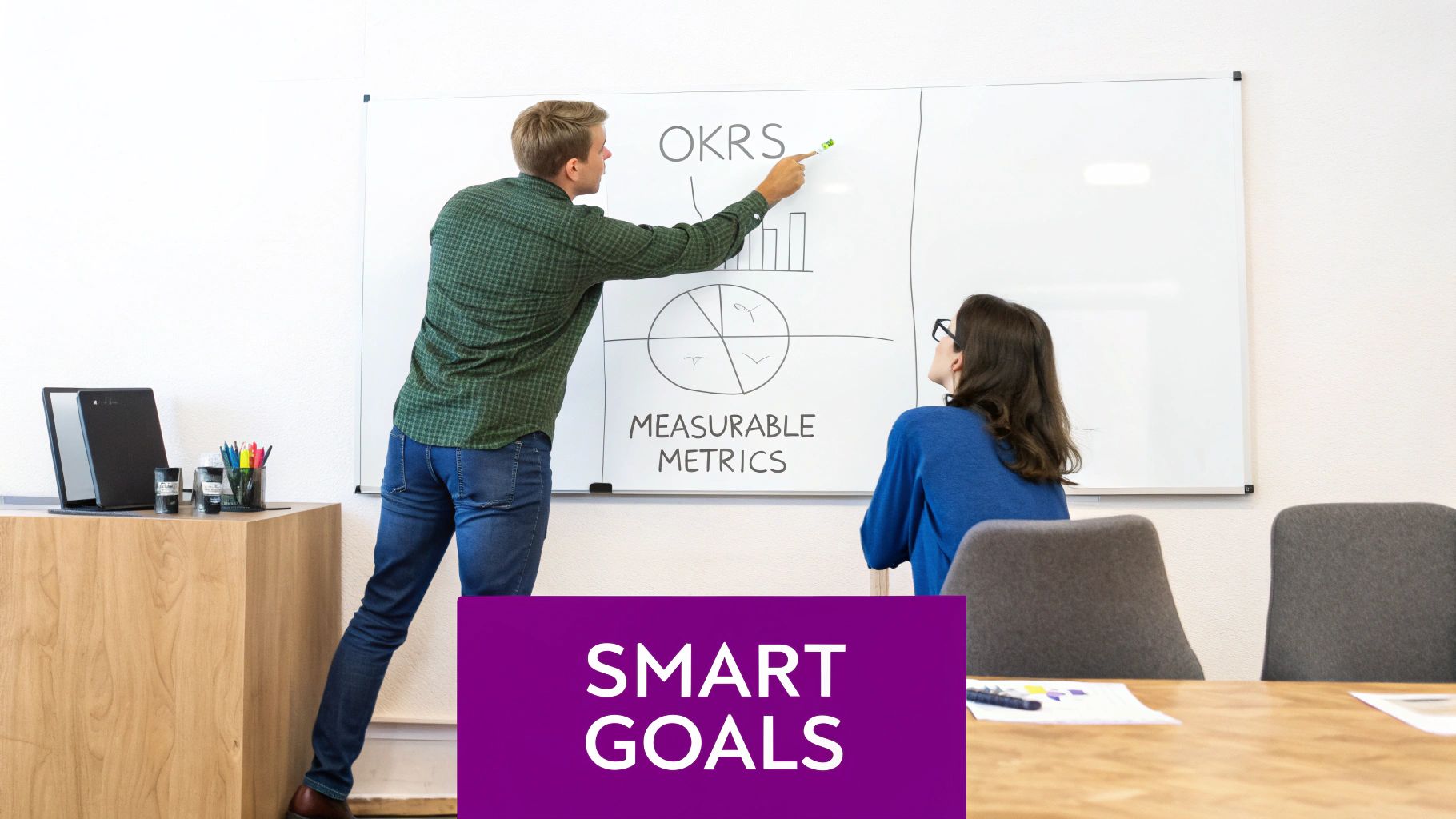
Pioneered by figures like Peter Drucker and popularised by tech giants such as Intel and Google, these methodologies create transparency and accountability. An “Objective” is a qualitative, ambitious goal (e.g., “Enhance our customer onboarding experience”), while “Key Results” are the specific, quantitative metrics that prove the objective has been met (e.g., “Reduce average customer setup time by 20%” or “Achieve a 95% satisfaction score on post-onboarding surveys”). This structure removes ambiguity, ensuring everyone understands what success looks like and how their work contributes to it.
Practical Implementation Tips
To embed this practice within your UK mid-market organisation, consider the following actionable steps:
- Quarterly Cadence: Shift from annual goal setting to a quarterly review cycle. This agility allows teams to adapt to changing market conditions and maintain momentum.
- Collaborative Creation: Involve employees in the goal-setting process. When team members help define their objectives, their sense of ownership and commitment increases significantly.
- Visibility is Key: Use shared platforms to keep goals visible. A central dashboard prevents objectives from being forgotten after the initial planning session.
- Balance Ambition: Mix realistic, achievable targets with aspirational “stretch” goals. This encourages innovation and continuous improvement without fostering a culture of failure.
Key Insight: The true power of goal-setting frameworks lies not just in defining targets, but in creating a shared language for performance and progress that cascades seamlessly from the boardroom to every individual contributor.
How to Operationalise with Dynamics 365 and Power Platform
For organisations utilising the Microsoft ecosystem, DynamicsHub can integrate goal management directly into your daily workflows. Using Dynamics 365 Human Resources, you can create and track individual and team goals, linking them to performance reviews. Furthermore, by leveraging Power BI, you can build real-time dashboards that visualise progress against OKRs, pulling data from various sources across your business. This creates a single source of truth for performance, making goal alignment a dynamic, data-driven process rather than a static, annual exercise.
2. Continuous Feedback and Coaching
The era of the once-a-year, high-stakes performance review is fading. Modern performance management prioritises agility and development, shifting the focus from backward-looking assessment to forward-focused coaching. Continuous feedback is a dynamic process where managers and employees engage in frequent, informal conversations about performance, development, and wellbeing. This approach, championed by thought leaders like Marcus Buckingham, transforms performance management from an annual administrative task into an ongoing, value-adding dialogue.
Companies like Adobe and Deloitte have famously abandoned traditional annual reviews in favour of regular check-ins and real-time feedback. The core idea is simple: addressing challenges and recognising achievements as they happen is far more effective than saving them for a formal review months later. This model fosters psychological safety, strengthens manager-employee relationships, and embeds a culture of continuous learning and improvement. It’s a cornerstone of effective best practices for performance management because it directly impacts engagement and accelerates professional growth.
Practical Implementation Tips
To introduce a continuous feedback culture in your UK mid-market organisation, consider these steps:
- Establish a Rhythm: Schedule regular, predictable one-to-one meetings (weekly or bi-weekly). Consistency is crucial for building trust and making feedback a normal part of the work routine.
- Train Your Managers: Equip managers with the skills for effective coaching and feedback delivery. Training on models like SBI (Situation-Behaviour-Impact) can help structure conversations constructively.
- Balance the Conversation: Ensure a healthy mix of positive recognition and developmental feedback. Acknowledging what’s going well is just as important as identifying areas for improvement.
- Encourage Peer Feedback: Foster a 360-degree feedback culture where employees feel comfortable giving and receiving constructive input from their colleagues, not just their line managers.
Key Insight: Continuous feedback separates the coaching conversation (developmental) from the compensation conversation (evaluative), allowing for more honest, open, and impactful dialogue focused purely on growth.
How to Operationalise with Dynamics 365 and Power Platform
The Microsoft ecosystem is perfectly suited to support a continuous feedback model. Within Dynamics 365 Human Resources, managers can use the performance journal feature to log key discussion points, achievements, and development goals from their regular check-ins. This creates a running record that informs more structured performance discussions. Furthermore, a Power App can be developed to facilitate real-time feedback, allowing employees and managers to send “kudos” or constructive notes on the go, which can then be logged against an employee’s profile in Dataverse, creating a rich picture of performance over time.
3. Multi-Source Feedback (360-Degree Feedback)
Traditional performance reviews rely on a single perspective: the manager’s. This narrow viewpoint can miss crucial aspects of an employee’s contribution and impact. Multi-source, or 360-degree, feedback broadens this lens by systematically collecting confidential, anonymous feedback from an employee’s colleagues, including their manager, peers, and direct reports. This holistic approach provides a well-rounded view of performance, uncovering blind spots and highlighting strengths that a top-down review might overlook. It is a vital component of modern best practices for performance management, shifting the focus from a singular judgement to a collective, developmental perspective.
Pioneered by organisations like the Center for Creative Leadership and used extensively by companies such as Google and McKinsey, this method is especially powerful for leadership development. It helps individuals understand how their behaviours and actions are perceived by others across the organisation. For instance, a manager might believe they are an effective communicator, but feedback from direct reports could reveal a need for greater clarity or approachability. This rich, multi-faceted data provides a more accurate foundation for meaningful professional growth and targeted development plans.
Practical Implementation Tips
To successfully introduce 360-degree feedback in your UK mid-market company, follow these key steps:
- Communicate Purpose Clearly: Frame the process as a developmental tool, not an evaluative one. Reassure participants that the goal is growth, not criticism, to foster psychological safety.
- Ensure Anonymity: Use a trusted system to guarantee that all feedback, except for the manager’s, is anonymous. This is critical for encouraging honest and constructive responses.
- Keep it Concise: Limit the number of raters to a manageable group (typically 5-8 people) and keep the survey focused on specific, observable behaviours to avoid survey fatigue.
- Facilitate the Debrief: Have a trained manager, HR business partner, or external coach help the employee interpret their feedback report, identify key themes, and create a tangible action plan.
Key Insight: The value of 360-degree feedback isn’t in the raw data itself, but in the structured, facilitated conversation that follows. It transforms subjective opinions into actionable insights for personal and professional development.
How to Operationalise with Dynamics 365 and Power Platform
The Microsoft ecosystem provides robust tools for managing this process. Within Dynamics 365 Human Resources, you can configure and manage performance journals and feedback requests that align with 365-degree principles. For a more structured approach, DynamicsHub can help you leverage Microsoft Forms or a Power Apps canvas app to create and distribute customised, anonymous feedback surveys. The aggregated results can then be visualised in a confidential Power BI dashboard for each employee, providing clear insights into strengths and development areas, ensuring the process is both efficient and impactful.
4. Transparent Performance Metrics and Data
Effective performance management thrives on clarity, not secrecy. Making performance data accessible, visible, and understandable across the organisation demystifies evaluation and builds a culture of accountability. When employees can see the metrics that define success in real-time, they are empowered to self-correct, innovate, and align their efforts with business priorities. This shift from opaque, annual judgements to transparent, ongoing measurement is a critical component of the best practices for performance management, turning data into a tool for empowerment rather than a weapon for appraisal.
This data-driven approach, championed by figures like W. Edwards Deming and more recently by leaders like Microsoft’s Satya Nadella, treats performance as an objective, measurable process. For example, a sales team with a transparent pipeline dashboard can instantly see individual and team progress towards targets, fostering healthy competition and proactive problem-solving. Similarly, an operations team using a shared dashboard to track production efficiency can identify bottlenecks and collaborate on solutions without waiting for a manager’s intervention. This transparency ensures everyone is speaking the same language and working towards the same measurable outcomes.
Practical Implementation Tips
To embed data transparency within your UK mid-market organisation, consider these actionable steps:
- Create Visual Dashboards: Use tools to build simple, easy-to-understand visualisations of key performance indicators (KPIs). A well-designed dashboard is more impactful than a complex spreadsheet.
- Balance Indicator Types: Include a mix of leading indicators (predictive metrics like sales pipeline growth) and lagging indicators (historical results like quarterly revenue) for a holistic view.
- Provide Context: Never present data without context. Train managers to explain what each metric means, why it matters, and how it connects to the broader company strategy.
- Ensure Accessibility: House dashboards and reports in a central, easily accessible location, such as a Microsoft Teams channel or SharePoint site, to encourage regular engagement.
Key Insight: Transparency in performance metrics shifts the focus from “who is to blame?” to “what does the data tell us and how can we improve?”. It fosters a collective sense of ownership over results.
How to Operationalise with Dynamics 365 and Power Platform
The Microsoft ecosystem is perfectly designed to bring performance data to life. With Power BI, you can create and embed real-time, interactive dashboards directly within Dynamics 365 Human Resources or even Microsoft Teams. These dashboards can pull data from various sources-from sales figures in Dynamics 365 Sales to project completion rates in a project management tool. By automating data aggregation and visualisation, you provide every employee and manager with a live, accurate view of performance, making data-driven conversations the norm. For those evaluating their current systems, you can learn more about the best HR software in the UK and how it supports such integrations.
5. Competency-Based Performance Assessment
While goal achievement measures the “what,” competency-based assessment evaluates the “how.” This approach shifts the focus from purely results-driven metrics to the underlying behaviours, skills, and capabilities that drive success. By defining what excellence looks like in action, organisations can provide a clear and consistent framework for employee development, feedback, and career progression. This is one of the most crucial best practices for performance management as it builds a sustainable, skilled workforce capable of adapting to future challenges.
Pioneered by researchers like Spencer & Spencer and popularised by consultancies such as the Hay Group, competency models create a shared understanding of critical skills. For instance, companies like Microsoft and Deloitte use comprehensive competency frameworks to define levels of proficiency in areas from technical expertise to leadership and strategic thinking. This method provides employees with a transparent roadmap for growth, showing them exactly which behaviours they need to demonstrate to advance in their careers, thereby fostering a culture of continuous learning and mastery.
Practical Implementation Tips
To effectively integrate competency-based assessments into your UK mid-market organisation, consider these steps:
- Define Core and Role-Specific Competencies: Identify universal competencies (e.g., communication, teamwork) that apply to all employees, as well as technical skills specific to certain roles.
- Use Behavioural Anchors: For each competency, define clear, observable behaviours for different proficiency levels (e.g., from “Novice” to “Expert”). This removes subjectivity from assessments.
- Involve Subject Matter Experts: Collaborate with senior employees and team leaders to ensure your competency models are relevant, accurate, and reflect the real-world demands of their functions.
- Link to Development: Use competency gaps identified during reviews to create targeted personal development plans, connecting employees with relevant training, mentoring, or project opportunities.
Key Insight: Competency-based assessment transforms performance conversations from a simple review of past results into a constructive dialogue about developing the capabilities needed for future success.
How to Operationalise with Dynamics 365 and Power Platform
The Microsoft ecosystem is ideally suited for managing competency frameworks. Within Dynamics 365 Human Resources, you can build and maintain a comprehensive skills and competency library, assigning specific competencies to job roles and tracking employee proficiency levels. You can then integrate these into performance journals and review templates. By using a Power App, you can create a user-friendly interface for employees and managers to conduct 360-degree feedback based on these defined competencies, with the data feeding directly back into an employee’s profile in Dynamics 365.
6. Regular 1-on-1 Meetings
If continuous feedback is the lifeblood of modern performance management, then regular one-on-one meetings are the heartbeat. These scheduled, private conversations between a manager and their direct report are fundamental for building trust, addressing challenges, and fostering development. Moving beyond simple status updates, these meetings create a dedicated space for meaningful dialogue on career aspirations, well-being, and feedback, making them one of the most impactful best practices for performance management.
Popularised by influential leaders like Intel’s Andy Grove and championed in the tech world by companies like Google and GitLab, the 1-on-1 is designed to be the employee’s meeting, not the manager’s. It’s a critical tool for pre-empting issues, understanding individual motivations, and providing tailored coaching. By creating psychological safety, managers can uncover the real obstacles and opportunities that might not surface in a group setting or annual review, transforming their role from a taskmaster to a true coach.
Practical Implementation Tips
To successfully integrate this practice into your UK mid-market organisation, focus on consistency and quality:
- Protect the Time: Schedule weekly or bi-weekly 1-on-1s and treat them as non-negotiable. Cancelling them sends a message that the employee’s development is not a priority.
- Use a Shared Agenda: Create a collaborative document where both manager and employee can add topics. A simple structure covering wins, challenges, goals, and feedback ensures conversations are productive.
- Listen More Than You Talk: The manager’s primary role is to listen, ask powerful questions, and guide, not to dictate. Aim for an 80/20 split of employee talking to manager talking.
- Document and Follow Up: Note down key discussion points and action items. Following through on commitments builds credibility and shows you are invested in their progress.
Key Insight: The 1-on-1 is the single best mechanism for a manager to build rapport and trust. It’s not an operational review; it’s a human-centric conversation focused on growth, engagement, and support.
How to Operationalise with Dynamics 365 and Power Platform
The Microsoft ecosystem provides excellent tools to structure and track these crucial interactions. Within Dynamics 365 Human Resources, managers can schedule recurring 1-on-1s that link directly to an employee’s performance journal. Notes, action items, and development goals discussed can be logged against the employee’s record, creating a coherent history of conversations. You can also build a simple Power App as a “1-on-1 Hub” that provides a template for shared agendas and integrates with Microsoft To Do or Planner to assign and track follow-up tasks, ensuring nothing falls through the cracks.
7. Performance Improvement Plans (PIPs) with Support
When an employee consistently falls short of performance expectations, a structured, supportive intervention is crucial. A Performance Improvement Plan (PIP) is a formal tool designed to give an employee the opportunity to succeed, providing clear, documented targets, resources, and a defined timeline for improvement. A key element of best practices for performance management is shifting the perception of PIPs from a pre-termination formality to a genuine, supportive development tool aimed at recovery and success.
This modern approach emphasises a partnership between the manager, employee, and HR. Instead of simply listing failures, a constructive PIP clearly defines the performance gap, outlines specific, measurable goals for improvement, and details the support the organisation will provide, such as additional training, coaching, or mentoring. This transforms the process into a collaborative effort to get performance back on track, reinforcing the company’s commitment to its people while maintaining clear standards and accountability.
Practical Implementation Tips
To implement supportive PIPs effectively within your UK mid-market organisation, consider these actionable steps:
- Be Specific and Objective: Clearly define the performance gaps using specific, data-driven examples. Avoid vague statements and focus on observable behaviours and outcomes.
- Set Realistic Targets: The goals within the PIP must be achievable within the specified timeframe, typically 30, 60, or 90 days. The aim is to build confidence and momentum.
- Frequent Check-ins: Schedule mandatory weekly or bi-weekly meetings to review progress, discuss challenges, and provide ongoing feedback and coaching. This prevents the PIP from being a “set and forget” document.
- Document Everything: Maintain meticulous records of all conversations, progress against goals, and support provided. This is vital for fairness, transparency, and legal compliance.
Key Insight: A well-executed PIP should feel less like a disciplinary action and more like a focused, high-support coaching plan. Its primary goal is successful rehabilitation, not just procedural documentation for dismissal.
How to Operationalise with Dynamics 365 and Power Platform
DynamicsHub can help you manage these sensitive processes with structure and confidentiality. Within Dynamics 365 Human Resources, you can create a specific PIP case type, tracking all documentation, goals, and meeting notes securely against the employee’s record. You can use Power Automate to create workflows that schedule mandatory check-in reminders for both the manager and employee, ensuring the process stays on track. This centralisation and automation ensures consistency, fairness, and robust documentation, protecting both the employee and the organisation.
8. Recognition and Reward Systems
Performance management isn’t solely about addressing underperformance; it’s equally about amplifying what works. A robust recognition and reward system is a critical component of modern best practices for performance management, creating a positive feedback loop that reinforces desired behaviours and outcomes. When employees feel seen and valued for their contributions, their motivation, engagement, and alignment with company values increase significantly, moving performance conversations from purely developmental to celebratory.
Pioneered by engagement experts like Marcus Buckingham and exemplified by the culture at Zappos under Tony Hsieh, effective recognition extends beyond annual bonuses. It encompasses both formal awards (e.g., “Employee of the Quarter”) and informal, timely acknowledgements (e.g., a public thank-you in a team chat). The goal is to build a culture where appreciation is frequent, specific, and authentic. This approach validates employees’ efforts and clearly signals to the entire organisation what success and valuable contributions look like in practice.
Practical Implementation Tips
To embed this practice within your UK mid-market organisation, consider the following actionable steps:
- Make it Timely and Specific: A generic “good job” is less impactful than “Thank you, Sarah, for staying late to fix that critical bug; it saved the client presentation.” The closer recognition is to the action, the more it reinforces the behaviour.
- Embrace Peer-to-Peer Recognition: Empower employees to recognise each other. This builds camaraderie and ensures that great work, which managers might miss, is still celebrated.
- Balance Monetary and Non-Monetary Rewards: While financial rewards are important, non-monetary recognition like extra holiday days, professional development opportunities, or a simple, heartfelt thank-you can be just as powerful.
- Connect to Company Values: Explicitly link recognition to your organisation’s core values. For instance, “This award for ‘Customer Champion’ reflects our commitment to customer-centricity.” Discover how these systems can improve employee engagement and reinforce your culture.
Key Insight: Recognition is a powerful form of communication. It tells a story about what your organisation values, and when done consistently, it becomes a key driver of your desired culture and performance standards.
How to Operationalise with Dynamics 365 and Power Platform
For organisations in the Microsoft ecosystem, DynamicsHub can help you systematise recognition. Using Microsoft Viva Engage (formerly Yammer), you can create dedicated channels for “praise” and peer recognition, making it a visible and integrated part of daily communication. Furthermore, by leveraging Power Automate, you can create workflows that trigger notifications to managers when team members receive praise, ensuring positive contributions are logged and considered during formal performance reviews in Dynamics 365 Human Resources. This integration turns ad-hoc appreciation into valuable performance data.
9. Development Planning and Skill Building
Performance management should be a catalyst for growth, not just an evaluation of past actions. Integrating development planning and skill-building transforms the process from a retrospective judgement into a forward-looking investment in your people. This practice involves creating individualised development plans that identify skill gaps, chart learning opportunities, and align with career progression pathways. This is one of the most crucial best practices for performance management because it directly connects individual improvement to organisational capability building.
Pioneered by corporate training experts and championed by organisations like LinkedIn and Deloitte, this approach fosters a culture of continuous learning. Instead of waiting for annual reviews to highlight weaknesses, managers and employees proactively collaborate on a plan for growth. This could involve formal training, stretch assignments, mentorship, or pursuing external certifications, all designed to close current skill gaps and prepare employees for future roles within the company, strengthening both engagement and retention.
Practical Implementation Tips
To embed this practice within your UK mid-market organisation, consider the following actionable steps:
- Create Individual Development Plans (IDPs): Work with each employee annually to build a formal IDP that outlines specific goals, learning activities, and desired outcomes.
- Balance Skill Types: Ensure plans address both technical competencies (e.g., software proficiency) and crucial soft skills (e.g., communication, leadership).
- Mix Learning Methods: Combine formal training courses with on-the-job learning, mentorship programmes, and challenging “stretch” projects to provide a rounded development experience.
- Regular Progress Reviews: Check in on development progress quarterly, not just annually. This allows for timely support and adjustments to the plan.
Key Insight: Linking performance discussions directly to development opportunities shows employees that the organisation is invested in their career journey, turning feedback into a tangible pathway for advancement.
How to Operationalise with Dynamics 365 and Power Platform
The Microsoft ecosystem is perfectly suited to manage and track employee development. Within Dynamics 365 Human Resources, you can create and manage detailed development plans, set learning goals, and track course completions for each employee profile. By integrating with Microsoft Viva Learning, you can pull in content from LinkedIn Learning and other providers directly into the Microsoft Teams environment. Furthermore, a Power App can be built to facilitate mentorship matching or to allow employees to request specific training, creating a seamless, integrated system for skill enhancement. To explore how to get started, you can learn more about human resources for small business.
10. Accountability and Consequences Framework
A robust performance management system is incomplete without clear, consistently applied consequences for both high and low performance. An accountability framework ensures that performance conversations have real weight, fostering a culture where excellence is rewarded and underperformance is addressed constructively. This moves beyond subjective annual appraisals, establishing a transparent system where outcomes are directly linked to effort and results, a critical component of modern best practices for performance management.
Historically, this concept was seen in models like GE’s ‘rank and yank’ system, but contemporary approaches are far more nuanced. They focus on creating a fair and predictable environment. For example, a high-performer might be fast-tracked for development opportunities or given a bonus, while an employee struggling to meet standards is placed on a supportive Performance Improvement Plan (PIP). The key is that these actions are predefined and understood by everyone, eliminating surprise and perceptions of favouritism.
Practical Implementation Tips
To build a fair and effective accountability framework in your UK mid-market organisation, consider these steps:
- Define Clear Standards: Before evaluating performance, ensure that the standards for ‘exceeds’, ‘meets’, and ‘needs improvement’ are explicitly defined and communicated for every role.
- Consistency is Crucial: Apply the framework consistently across all departments and levels. Use calibration sessions to ensure managers are applying standards and consequences uniformly.
- Document Everything: Maintain meticulous records of performance conversations, agreed actions, and outcomes. This protects both the employee and the organisation.
- Balance with Support: Accountability should not be purely punitive. Pair corrective actions with coaching, training, and resources to give employees a genuine opportunity to improve.
Key Insight: True accountability isn’t about punishment; it’s about clarity. When everyone understands the ‘rules of the game’ and sees them applied fairly, it builds trust and motivates the entire workforce to strive for excellence.
How to Operationalise with Dynamics 365 and Power Platform
The Microsoft ecosystem provides the tools to manage this process with transparency and compliance. Within Dynamics 365 Human Resources, managers can log performance discussions and initiate formal processes like Performance Improvement Plans. Custom workflows can be built using Power Automate to ensure HR is automatically notified and required steps are followed, creating an auditable trail. A custom Power App can provide managers with a guided checklist for conducting difficult performance conversations, ensuring they cover key points and adhere to UK employment law, turning a challenging process into a structured, compliant one.
Performance Management: 10 Best Practices Comparison
| Approach | Implementation complexity | Resource requirements | Expected outcomes | Ideal use cases | Key advantages |
|---|---|---|---|---|---|
| Clear Goal Setting and Alignment (OKRs/SMART Goals) | Medium–High — needs design and cascading | Time for planning, goal-tracking tools, leadership buy-in | Improved alignment, measurable progress, clearer priorities | Organization-wide strategy alignment, cross-functional initiatives | Clear direction, quantifiable targets, cross-team alignment |
| Continuous Feedback and Coaching | Medium — requires manager skill development | Manager time, training, feedback platforms | Faster improvement, stronger manager relationships, reduced surprises | Rapid-change environments, development-focused teams | Timely corrections, increased engagement, growth focus |
| Multi-Source Feedback (360° Feedback) | High — design, anonymity and analysis required | Survey tools, facilitator/HR time, participant effort | Comprehensive perspective, blind-spot identification, leadership insights | Leadership development, promotion decisions, self-awareness programs | Multiple perspectives, reduced individual bias, richer development data |
| Transparent Performance Metrics and Data | Medium — KPI definition and dashboarding | Data systems, analytics capability, governance | Data-driven decisions, faster issue detection, increased transparency | Sales/ops teams, metrics-driven cultures, performance monitoring | Clarity on performance, accountability, rapid insight |
| Competency-Based Performance Assessment | High — build competency models and anchors | SME involvement, training, HR systems | Clear skill expectations, targeted development, succession readiness | Role-based progression, technical career ladders, talent mobility | Consistent criteria, career pathways, skills-gap visibility |
| Regular 1-on-1 Meetings | Low–Medium — scheduling and agenda discipline | Manager time, simple templates or tools | Stronger relationships, early issue detection, personalized support | Day-to-day management, remote teams, coaching-driven cultures | High engagement, continuous dialogue, tailored development |
| Performance Improvement Plans (PIPs) with Support | Medium — requires documentation and monitoring | Manager + HR time, coaching/training resources | Clarified expectations, opportunity for improvement, documented outcomes | Persistent underperformance, formal corrective processes | Structured support, clear milestones, legal/HR protection |
| Recognition and Reward Systems | Low–Medium — policy and platform setup | Reward budget, recognition tools, manager participation | Increased motivation, improved retention, reinforced behaviors | Culture building, high-performance incentives, peer recognition | Boosts morale, reinforces values, cost-effective non-monetary options |
| Development Planning and Skill Building | Medium–High — individualized plans and programs | Training budget, learning platforms, mentors | Improved capabilities, succession planning, higher retention | Talent pipelines, upskilling initiatives, career development programs | Systematic skill growth, career clarity, reduces future performance gaps |
| Accountability and Consequences Framework | Medium–High — policy design and consistent application | HR oversight, manager training, documentation systems | Performance-oriented culture, fairness, protected employment decisions | High-accountability orgs, regulated sectors, scaling companies | Clear consequences, consistent standards, motivates performance |
Ready to Build Your High-Performance Culture?
Transitioning from a traditional, often dreaded, annual review process to a dynamic performance management system is a significant undertaking. It’s a cultural shift, not just a procedural one. As we’ve explored, implementing these best practices for performance management is about creating an environment where employees are engaged, aligned with organisational goals, and empowered to grow. This isn’t merely about tracking metrics; it’s about fostering a culture of continuous improvement, open communication, and mutual accountability.
By weaving together clear goal setting using frameworks like OKRs, consistent coaching through regular 1-on-1s, and a fair recognition system, you build a powerful engine for growth. The journey involves moving beyond isolated practices and creating an integrated ecosystem where each element reinforces the others. Transparent performance data empowers managers, multi-source feedback provides holistic insights, and dedicated development plans show your team you are invested in their future.
From Strategy to Execution: The Critical Next Steps
The difference between a high-performing organisation and its competitors often lies in execution. Reading about best practices is the first step; operationalising them is where the real transformation happens. For UK mid-market businesses, this means moving from theory to practice in a way that is both efficient and scalable.
Your immediate focus should be on these key takeaways:
- Start with Alignment: Ensure every employee understands how their work directly contributes to the company’s strategic objectives. This is the foundation upon which all other practices are built.
- Empower Your Managers: Your people managers are the linchpins of this entire system. Provide them with the training, tools, and autonomy to be effective coaches, not just administrators.
- Leverage Technology Wisely: Manual tracking on spreadsheets is unsustainable. To truly embed these practices, you need a central system that integrates seamlessly with your existing workflows. For organisations invested in the Microsoft stack, this means leveraging tools like Dynamics 365 and the Power Platform to automate processes, capture data, and provide actionable insights.
Key Insight: A modern performance management framework is not a set of disconnected activities. It’s a cohesive system where goals, feedback, development, and recognition are intertwined, creating a continuous cycle of improvement that benefits both the individual and the organisation.
Ultimately, mastering these approaches is not just an HR initiative; it’s a strategic business imperative. It directly impacts employee retention, productivity, and innovation. When your people feel valued, see a clear path for growth, and understand their impact, they become your greatest asset in navigating the competitive UK market. The commitment to building this culture is a direct investment in your organisation’s long-term resilience and success.
Don’t let outdated, disconnected processes hold your team back from achieving their full potential. The tools and strategies are available to build a truly high-performance culture. Take the decisive step to modernise your approach and empower your workforce.
Ready to put these best practices into action? DynamicsHub provides a comprehensive HR Management solution built on Dynamics 365 and the Power Platform, designed specifically for UK organisations like yours. We help you operationalise goal setting, continuous feedback, and performance analytics within the Microsoft ecosystem you already use.
Phone us on 01522 508096 today to discuss your challenges, or send us a message to schedule a personalised demonstration.


