

Let’s get straight to it: what are contingent workers?
Forget the dry, corporate definitions. Think of them as your on-demand specialists—the freelancers, contractors, and consultants you bring in for a specific project, a set period, or to fill a crucial skills gap. They’re not on your permanent payroll, and that’s the key difference. For any modern UK business trying to stay nimble in a fast-moving market, understanding this workforce is no longer optional; it’s essential.
Why Your Workforce Is More Flexible Than You Think

The old model of a business built entirely on permanent, nine-to-five staff is showing its age. Today’s reality demands agility. You need to scale up for a big launch or bring in highly specialised expertise without the long-term overheads of another full-time hire. This is precisely where your contingent workforce comes into its own, offering a powerful strategic advantage.
It’s like assembling a film crew. You don’t hire a cinematographer, a sound engineer, and a special effects artist on a permanent basis just in case you decide to make a movie. Instead, you bring in the best people for the specific job, and when the project is done, they move on to the next. A contingent worker is no different—they could be a freelance marketer for a three-month campaign, an IT contractor for a system overhaul, or a strategic consultant to guide you through a major change.
The Real-World Impact on Your Business
This shift towards a more fluid workforce isn’t just a passing trend. It’s a direct answer to the challenges facing the UK economy. Skills shortages, for example, are a major roadblock to growth for many companies. It’s a stark reality when you consider that nearly a quarter (23%) of UK workplaces are struggling with at least one vacancy, often because they can’t find the right specialist skills. Adopting flexible staffing solutions has become a practical and effective way to bridge these gaps and keep moving forward.
Bringing external talent on board offers some clear, immediate benefits:
- Access to Niche Expertise: You can instantly tap into a global talent pool for very specific skills, avoiding the time and cost of training someone in-house.
- Unmatched Agility: Your business can react swiftly to market opportunities, fluctuating project demands, or unexpected staff shortages by scaling your team up or down.
- Smarter Cost Control: For short-term projects, using contingent workers is often more cost-effective. You avoid the long-term financial commitments of permanent salaries, benefits, and National Insurance contributions.
A Strategic Asset, Not Just a Stopgap
It’s time to change the way we think about non-permanent staff. They aren’t just temporary cover for someone on leave; they are a vital, strategic part of a modern, resilient business. These professionals are here to fill critical skill gaps, drive innovation, and get important projects over the line.
By properly integrating contingent workers into your workforce strategy, you’re not just plugging a hole—you’re building a competitive edge. This approach gives you incredible operational flexibility and access to top-tier talent you might not be able to hire permanently.
To make the distinction crystal clear, here’s a quick breakdown of how these roles differ from your permanent employees.
Contingent Workers vs Permanent Employees at a Glance
This table highlights the fundamental differences between contingent and permanent roles in the UK.
| Characteristic | Contingent Worker | Permanent Employee |
|---|---|---|
| Contract Type | Fixed-term contract, project-based, or contract for services | Open-ended contract of employment |
| Employment Status | Self-employed or worker status (e.g., via an umbrella company) | Employee |
| Payment | Invoiced for services rendered (e.g., day rate, project fee) | Receives a regular salary (PAYE) |
| Benefits | None (no sick pay, holiday pay, or pension contributions) | Statutory benefits (holiday, sick pay, pension) plus company perks |
| Job Security | Low; engagement ends when the project or contract finishes | High; protected by UK employment law against unfair dismissal |
| Control & Autonomy | High; typically controls how and when the work is done | Low; works under the direct supervision and control of the employer |
Ultimately, understanding the nuances between these worker types is the first step. Knowing how to find, manage, and integrate this valuable talent pool is what will truly set your business apart.
Understanding the Different Types of Contingent Workers
Let’s be clear: not all temporary staff are the same, and knowing the difference is vital for getting your project right. ‘Contingent worker’ is a catch-all term, but underneath it sits a few very distinct categories of worker. Getting to grips with these differences is the first step in moving from simply filling gaps to building a smart, flexible workforce plan.
Think of it like hiring tradespeople for a home renovation. You wouldn’t call a plumber to rewire your kitchen. In the same way, understanding whether you need a freelancer, a contractor, or an agency temp ensures you get the right skills for the job, with the right contract and payment model from the get-go.
Freelancers and Independent Contractors
These terms are often used interchangeably, and for good reason. Both describe self-employed individuals who bring specialist skills to the table, usually for multiple clients. They are masters of their trade, hired for a specific project or a defined period. Crucially, they operate under a contract for services, not a contract of employment.
A classic example? Hiring a freelance UX designer to redesign your company website. You agree on a specific outcome – the new site design – for a fixed fee, maybe £5,000. They bring their own tools, set their own schedule, and are accountable for that final product. You’re buying a result, not their time.
Or perhaps you need an independent IT contractor for a six-month system migration. You might agree on a day rate of £450 for them to manage the technical side of things. While they’ll work closely with your in-house team, they aren’t managed like an employee; their professional independence is a given.
The key word here is autonomy. Freelancers and contractors are brought in for their expert skills to deliver a specific outcome. They retain control over how they do the work.
Temporary Agency Staff
This is a completely different arrangement. When you hire an agency temp, your contract is with the recruitment agency, not the individual doing the work. The agency is their legal employer, handling all the admin that comes with it – payroll, National Insurance, and any statutory pay.
This model is perfect for covering short-term operational needs. Say your receptionist goes on long-term sick leave. You can ring an agency and have a temporary replacement in place for three weeks. They send you a qualified person, you get the work done, and you simply pay the agency’s invoice. It’s a fast, straightforward way to keep things running smoothly.
The main differences from a contractor are:
- Employment Relationship: The worker is on the agency’s payroll, not yours.
- Management: You’ll direct their day-to-day tasks, but the agency manages their overall employment.
- Payroll: The agency handles all PAYE (Pay As You Earn) tax and National Insurance deductions.
Consultants and Zero-Hours Workers
Consultants are at the top end of the expertise scale. These are specialists hired to provide strategic advice and untangle complex business problems. You might engage a management consultant to help you streamline your supply chain, paying a premium for their strategic brainpower rather than for them to do the day-to-day work.
Finally, we have zero-hours contract workers. This is a more controversial setup. An individual agrees to be available for work, but the employer isn’t obliged to offer them any set number of hours. This gives businesses huge flexibility to cope with fluctuating demand, but it’s a model that demands careful handling to ensure workers are treated fairly and all legal lines are respected.
Navigating UK Compliance and Legal Requirements
Engaging contingent workers in the UK gives you incredible flexibility, but it also brings a whole host of legal duties and compliance risks. Getting this wrong isn’t just a bit of admin trouble; it can lead to serious financial penalties and legal headaches. The single most important part of building a successful flexible workforce is getting a firm grip on your obligations right from the start.
Think of it like building a house. You can have the most brilliant architectural plans (your project), but if the foundations (your compliance) are shaky, the whole thing is at risk of collapse. For any UK business, these foundations are built on a few key pillars of legislation you simply can’t afford to ignore.
This decision tree can help you start to visualise how you might categorise different types of workers based on what your project actually needs.
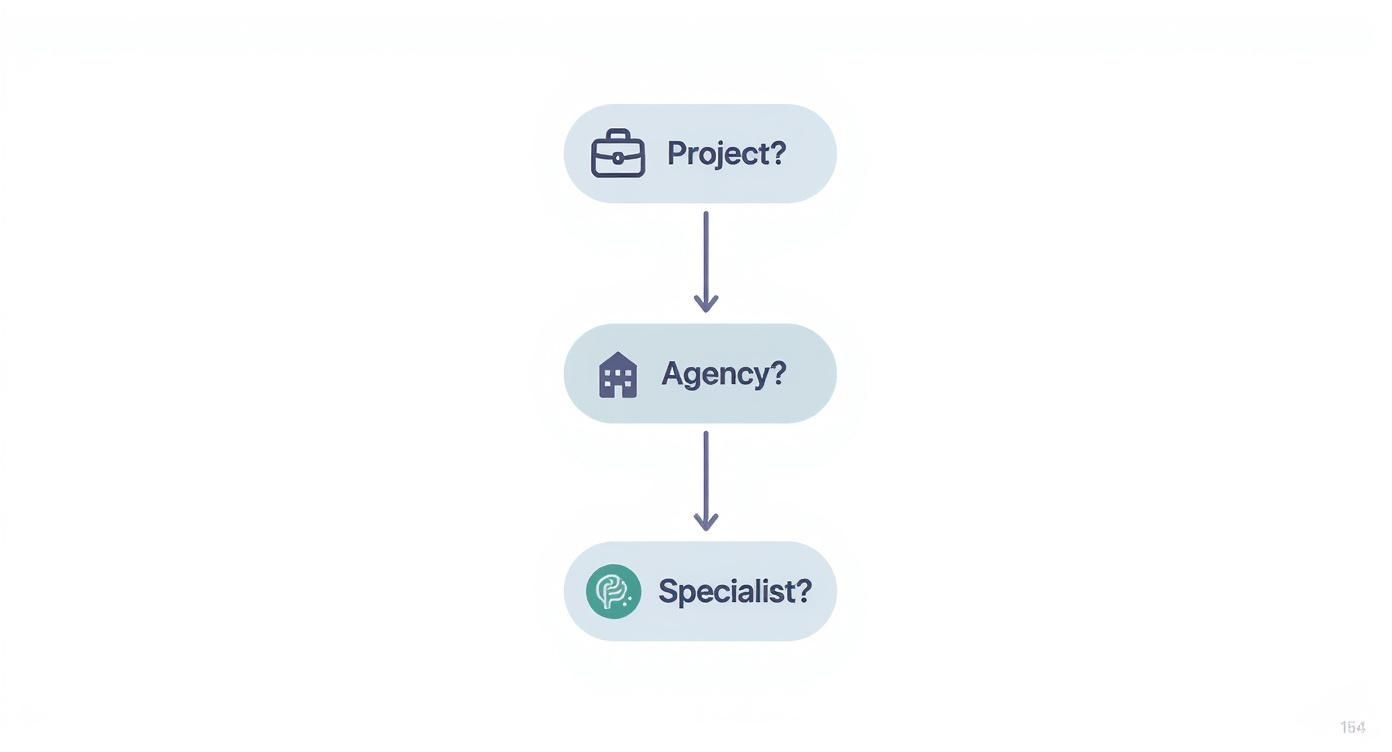
As the flowchart shows, the nature of the work—whether it’s a defined project, sourced through an agency, or needs a niche specialist—points you toward the right kind of contingent worker for the job.
The Cornerstone of Compliance: Right to Work Checks
Before anyone starts any work for you, you have an absolute legal duty to check they are eligible to work in the UK. This isn’t optional, and pleading ignorance is no defence. A slip-up here can result in fines of up to £60,000 for each illegal worker.
The process involves checking and copying specific documents to give your business a “statutory excuse” against a civil penalty. It’s a non-negotiable first step in your onboarding process and one that demands a careful and consistent approach every single time. To make sure your processes are watertight, you can explore our detailed guide on how to correctly perform Right to Work checks in the UK.
Demystifying IR35: The Off-Payroll Working Rules
IR35, also known as the ‘off-payroll working rules’, is probably the trickiest area of UK compliance when it comes to contingent workers. The rules exist to stop tax avoidance by contractors who are essentially acting as ‘disguised employees’. For most businesses, the responsibility for deciding a worker’s status now falls squarely on you, the end-client.
Misclassifying a worker isn’t just a tax issue; it has a knock-on effect on employment rights, benefits, and potential liabilities. HMRC can demand back-dated tax and National Insurance contributions, plus interest and penalties, if they find you’ve got the determination wrong.
The UK government’s latest updates to IR35, coming into effect from April 2025, have further defined how businesses must engage with contractors. Under these rules, companies with a turnover above £15 million, a balance sheet over £7.5 million, or more than 50 employees must assess the employment status of their contingent workers. This is to ensure full compliance with both tax and employment law.
Data Protection and Your GDPR Responsibilities
When you bring a contingent worker on board, you’ll inevitably be processing their personal data—everything from their name and contact details to bank information for payroll. This means the General Data Protection Regulation (GDPR) absolutely applies.
You have to treat their data with the same high level of care you would for a permanent employee. This means ensuring it is:
- Processed lawfully, fairly, and transparently. You must have a clear legal reason for holding their data.
- Collected for specific and legitimate purposes. You can’t just gather data without a clear, stated purpose.
- Kept secure and confidential. You need robust measures in place to prevent any data breaches.
- Stored for no longer than necessary. Once the contract ends and all final payments are sorted, their data must be securely deleted in line with your data retention policy.
A breach of GDPR can lead to eye-watering fines, making data protection a critical checkpoint throughout your entire process for managing contingent workers. To use a flexible workforce effectively, you have to master these legal responsibilities to protect both the worker and your business from risk.
A Playbook for Managing Your Contingent Workforce
Excellent management is what turns a temporary hire into a lasting asset. To truly get the most out of your contingent workers, you need a clear, structured approach that covers their entire journey with you—from the moment you realise you need help, right through to their final day on the project.
Without a solid game plan, you’re opening the door to scope creep, disjointed teams, and a poor return on your investment. This guide offers a practical playbook for managing your flexible talent well. By putting these best practices in place at each stage, you’ll create a positive, productive environment that makes top-tier talent want to work with you again and again.
Stage 1: Sourcing and Scoping the Work
Getting the first step right is often the most critical part of the whole process. Before you even think about looking for someone, you have to pin down exactly what you need them to do. A vague brief almost always leads to a mismatched hire and a messy project.
Your most powerful tool here is a detailed Statement of Work (SOW). This document is far more than just a job description; it’s a formal agreement that clearly maps out:
- Specific Deliverables: What are the tangible outcomes you expect? Be crystal clear.
- Project Timeline: What are the key milestones and the final deadline?
- Payment Terms: How and when will the worker be paid (e.g., day rate, fixed project fee)?
- Acceptance Criteria: How will you define ‘done’ and officially sign off on the work?
A well-crafted SOW acts as the project’s North Star, preventing misunderstandings and keeping everyone aligned from the get-go. It protects both you and the worker by setting clear boundaries from day one. To get a better handle on finding the right people, it’s worth exploring some modern candidate sourcing strategies.
Stage 2: Nailing the Onboarding and Integration
Once you’ve found the right person, the immediate goal is to get them up to speed and productive as quickly as possible. A slow or confusing onboarding process wastes precious time and can leave a new worker feeling disconnected and isolated.
Your onboarding for a contingent worker should be lean and focused. They don’t need the full company induction, but they absolutely need the essential tools and context to start adding value right away.
Concentrate on a seamless experience that covers the absolute essentials:
- System Access: Make sure they have all the necessary logins and software access on day one. No waiting around.
- Key Introductions: Introduce them to the core team members they’ll be working closely with.
- Process Briefing: Quickly walk them through the key workflows, communication channels (like Teams or Slack), and any reporting procedures they need to know.
Proper integration is about making them feel like part of the team, even if their time with you is short. Include them in relevant project meetings and show that you respect their expertise. This collaborative approach always fosters a much more effective and enjoyable working relationship.
Stage 3: Managing Performance and Time
Managing contingent workers requires a different touch compared to permanent employees. You’re managing the outcome, not their day-to-day activity. That’s why regular, structured check-ins are so important for keeping things on track.
Schedule brief weekly or bi-weekly catch-ups to review progress against the SOW milestones. These meetings are the perfect opportunity to offer constructive feedback, clear any roadblocks, and make sure the project is still heading in the right direction. Accurately tracking their time is also essential for both project costing and payroll. Many businesses are now using a modern staff clocking in system to ensure timekeeping is precise and fair for everyone.
Stage 4: Offboarding and Handing Over Knowledge
A smooth exit is just as important as a strong start. When the contract comes to an end, you need a structured offboarding process to ensure a clean handover and, crucially, to retain the valuable knowledge they’ve brought to the business.
Your offboarding checklist should cover the basics like revoking system access, collecting any company equipment, and processing that final invoice. But most importantly, schedule a proper knowledge transfer session. This ensures all project documentation, insights, and outstanding tasks are passed back to your permanent team, leaving no loose ends.
By managing the entire journey with care and professionalism, you not only get fantastic work from your contingent talent but also build a reputation as a great company to partner with.
Ready to gain complete control over your workforce management? Phone 01522 508096 today or send us a message to discover how we can help.
Using Technology to Simplify Workforce Management
Let’s be honest. Juggling spreadsheets, chasing emails, and relying on manual checklists to manage your contingent workers isn’t just inefficient—it’s a massive compliance risk. For every single contractor you bring on board, you create a trail of sensitive data that needs to be tracked, managed, and secured. As your flexible workforce grows, this manual approach quickly becomes unsustainable, leading to costly errors, security gaps, and a huge administrative headache for your HR team.
The good news? The right technology completely changes the game. Forget chaotic, manual tracking. You can move to a secure, centralised system that gives you complete visibility and control over your entire non-permanent workforce. This isn’t about adding another complicated tool to the pile; it’s about embedding smart workforce management directly into the systems you already use every day.
A modern system gives you a clear, at-a-glance view of your entire workforce, turning scattered data into actionable intelligence.

With a centralised platform, critical information is organised and instantly accessible, finally replacing those fragmented spreadsheets with a single source of truth.
Centralising Data with Dynamics 365
Imagine one secure place for every piece of information related to your contingent workers. That’s precisely what a platform like Microsoft Dynamics 365 delivers. It acts as a central command centre, storing everything from contracts and Right to Work documents to project details and payment schedules.
This is about more than just storage; it’s about creating a single, reliable source of truth. When all your data lives in one place, you kill the risk of duplicate records and outdated information. Your HR and finance teams can access the same, up-to-the-minute data, which means everyone is finally on the same page.
For a deeper dive into what to look for, check out our guide on the best workforce management software on the market today.
Automating Key Processes with the Power Platform
So many of the most time-consuming tasks in managing contingent workers are repetitive and rule-based. This makes them perfect candidates for automation. This is where the Microsoft Power Platform steps in, giving you the ability to build automated workflows that handle all the heavy lifting.
Think about the typical lifecycle of a contingent worker:
- Onboarding: An automated flow can kick off the moment a new contract is signed. It can create the necessary user accounts, assign initial training modules, and send out welcome information—all without anyone lifting a finger.
- Time and Expense Approvals: Instead of managers chasing email approvals, contractors can submit timesheets or expenses through a simple app. The system automatically routes it to the right person for approval, speeding up the whole process and ensuring people get paid on time.
- Offboarding: When a contract ends, a workflow can automatically revoke system access, schedule the return of company equipment, and ensure the final payment is processed correctly. This simple step drastically reduces the security risk that comes from forgotten access credentials.
By automating these critical touchpoints, you not only save countless administrative hours but also create a consistent, professional experience for every single contingent worker you engage.
Ensuring Security and Compliance
A unified technology platform gives you a powerful framework for managing security and compliance from the ground up. With a system like Dynamics 365, built on Microsoft’s secure cloud, all your worker data is protected by enterprise-grade security.
You can finely control access permissions, making sure people only see the information they absolutely need to do their job. Better yet, you can build compliance checks directly into your workflows. For instance, the system can be set up to prevent a worker from starting until their Right to Work documentation is uploaded and verified. This transforms compliance from a manual, error-prone checklist into an integrated, automated part of your process.
The Strategic Advantage of a Flexible Workforce
So far, we’ve walked through the what, why, and how of bringing contingent workers into your business. We’ve covered everything from the different types of flexible talent to the nitty-gritty of UK compliance and the best ways to manage them. Now, let’s pull back from the operational details and look at the bigger picture: pure strategy.
Thinking of your flexible workforce as more than just a temporary fix is the secret to unlocking a real, lasting competitive edge. It’s about building a resilient, future-proof business.
A well-managed contingent workforce shifts you away from a rigid, fixed-cost structure. Instead, you get a dynamic model that can bend and adapt in real-time to market swings, new project demands, and whatever unexpected challenges come your way. This isn’t just about plugging gaps; it’s about strategically adding on-demand expertise to your core team.
Driving Business Agility and Scale
Imagine your company lands a huge, unexpected project. Fantastic news! But the traditional hiring process could drag on for months, and you might miss the window of opportunity. A strategic approach to contingent staffing changes the game completely, letting you scale your team almost overnight.
You can bring in a seasoned project manager, a crack team of developers, or a marketing specialist for the exact time you need them. They deliver the results you need without the long-term overheads of a permanent hire. This kind of agility means you can say “yes” to more opportunities, confident you have access to the right talent, right when you need it.
Accessing Specialised Skills On-Demand
Let’s be honest, some skills are so specific it just doesn’t make financial sense to keep them on the permanent payroll. You might only need a cybersecurity expert for a one-off audit, a data scientist for a three-month analytics project, or a commercial law consultant for a single, complex contract negotiation.
The contingent workforce is your gateway to a global pool of elite talent. It opens the door to highly specialised skills that would otherwise be out of reach or would sit idle as a full-time position. Tapping into this on-demand expertise can spark innovation and solve complex problems far more efficiently than trying to build every single skill in-house.
Think of your flexible workforce not as a secondary team, but as a strategic extension of your core capabilities. It provides the variable capacity and niche expertise needed to thrive in a constantly changing business environment.
And this isn’t a niche concept. The scale is huge. As of December last year, there were approximately 1.48 million temporary workers in the UK alone, proving just how integral they are to modern business. You can learn more about these emerging workforce trends and see how other companies are adapting.
Achieving Greater Cost-Efficiency
At the end of the day, every business decision circles back to the bottom line. Engaging contingent workers gives you a much more efficient cost model, particularly for project-based work. You’re paying for specific outcomes, not just time, and you sidestep the associated costs of permanent employment like National Insurance contributions, pension schemes, and other benefits.
This isn’t to say it’s simply “cheaper”—it’s about being smarter with your resources. Instead of carrying fixed salary costs all year round, you convert them into variable expenses that directly map to your revenue-generating activities. That financial flexibility frees up capital you can then reinvest into growth, innovation, and your core team.
When you master the art of flexible staffing, you’re not just managing temps. You’re building a more agile, highly skilled, and financially robust organisation.
Ready to build your strategic advantage with a flexible workforce? Phone 01522 508096 today or send us a message to find out how DynamicsHub can provide the tools and support you need.
Your Top Questions About Contingent Workers, Answered
Hiring flexible talent can be a game-changer, but it often comes with a whole host of questions. Let’s tackle some of the most common queries UK businesses have when they start bringing contingent workers into the fold.
Do We Have to Provide Holiday and Sick Pay?
This is probably one of the most frequent questions we hear, and the short answer is: it depends entirely on their employment status. It’s a common misconception that all non-permanent staff have the same rights.
A truly self-employed contractor running their own business, for example, won’t be entitled to statutory holiday or sick pay from you. However, a worker deemed ‘inside’ IR35 is treated as an employee for tax purposes, which can muddy the waters and potentially grant them access to certain benefits. Getting that initial classification right is absolutely critical to staying on the right side of the law.
How Does IR35 Actually Affect Our Hiring?
If you’re a medium or large UK business, the IR35 rules have put the ball squarely in your court. The responsibility for figuring out a contractor’s employment status for tax now rests entirely with you, the client.
This means you must conduct a thorough assessment of each engagement to determine if it’s a case of ‘disguised employment’. A wrong call here can be costly, potentially leading to a hefty bill for back-dated taxes and penalties from HMRC. This isn’t something you can do casually; the assessment needs to happen before any work starts, and you must give the worker a formal Status Determination Statement (SDS).
Getting IR35 status right isn’t just about paperwork. It’s a fundamental compliance step that shields your business from significant financial risk. A robust, fair assessment is simply non-negotiable.
What’s the Best Way to Bring Them into the Team?
So, you’ve hired a contractor – now what? Integrating them effectively without blurring the lines between them and your permanent staff is key. Success starts with a slick, organised onboarding process from their very first day.
Make sure they have all the tools, system access, and information needed to hit the ground running. Introduce them to the team they’ll be working with, and be crystal clear about their role, the project goals, and how you expect to communicate.
It’s great to include them in project meetings and foster collaboration, but you do need to be careful. Maintaining a clear distinction is important. This often means avoiding things that are typical of employment, like inviting them to company-wide social events that have nothing to do with their specific contract.
Ready to get your contingent workforce management sorted and ensure you’re fully compliant? The experts at DynamicsHub are here to help.
Give us a call on 01522 508096 today or send us a message to see how we can give you total control and peace of mind.


