

Let’s cut through the noise. What exactly is a Human Resource Management System ( HRMS System )? Think of it as the central hub for your entire workforce. It takes all the scattered spreadsheets, endless paperwork, and disconnected systems and pulls them all together into one intelligent platform.
A Modern Guide to Managing Your People
Picture your HR department without the constant drag of admin. No more manually tracking holiday requests, chasing down signatures for new starter forms, or piecing together payroll data from three different places. An HRMS automates and centralises these tedious tasks.
This isn’t just about saving time; it’s about fundamentally changing how your HR team operates. It frees them from being bogged down in tactical admin and empowers them to focus on what really matters: strategic, people-focused work like developing talent and improving company culture.
When you have a single source of truth for all your employee data, you start making smarter, more informed decisions. The knock-on effects are huge:
- Better Data Accuracy: Getting rid of manual data entry means fewer costly mistakes in payroll and compliance reports.
- Greater Productivity: When routine tasks are automated, your HR professionals can concentrate on high-value activities that actually move the business forward.
- A Superior Employee Experience: Empower your staff with self-service portals where they can book holidays, view payslips, and update their own details. It creates a more modern and trusting workplace.
Why UK Businesses are Investing in HR Systems
The shift towards these integrated solutions is undeniable. In the UK, the Human Resources Provision industry has ballooned, with the number of businesses in the sector expected to hit 3,393 by 2025.
That’s a growth rate of 6.9% per year between 2020 and 2025, which tells you just how hungry the market is for better HR tools. As UK businesses look to strengthen their people operations, systems that deliver a clear, measurable return on investment are no longer a ‘nice-to-have’—they’re essential. You can dig deeper into the UK’s HR industry growth on Ibisworld.com.
Ultimately, a well-chosen HRMS becomes the backbone of your business, giving you the structure and insight needed to effectively manage your most valuable asset: your people.
HRMS vs HRIS vs HCM: Navigating the Acronyms
If you’ve spent any time looking at HR software, you’ve no doubt been hit with a wall of acronyms: HRMS, HRIS, HCM. They all sound similar, and many vendors use them interchangeably, which only adds to the confusion. But they aren’t just buzzwords; they represent a genuine evolution in how we manage people.
Let’s think of it like building a house.
At the very beginning, you have the Human Resource Information System (HRIS). This is your foundation. An HRIS is the original system of record, designed to handle the absolute essentials—storing employee names, job titles, NI numbers, and basic payroll data. It’s effectively a modern, digital filing cabinet. It’s organised and crucial, but its job is purely administrative.
Next, you build the walls and rooms with a Human Resource Management System (HRMS). An HRMS takes all that core data from the HRIS and puts it to work. It introduces tools to manage daily HR functions like tracking time and attendance, running a full recruitment process, onboarding new starters, and administering benefits. This is the operational engine of your HR department.
Finally, you put the roof on and furnish the house with Human Capital Management (HCM). HCM software encompasses everything an HRIS and HRMS can do, but it adds a strategic layer focused on talent and growth. We’re talking about performance management, succession planning, learning and development, and sophisticated analytics. An HCM system treats employees as valuable assets—human capital—to be nurtured and developed for the long term.
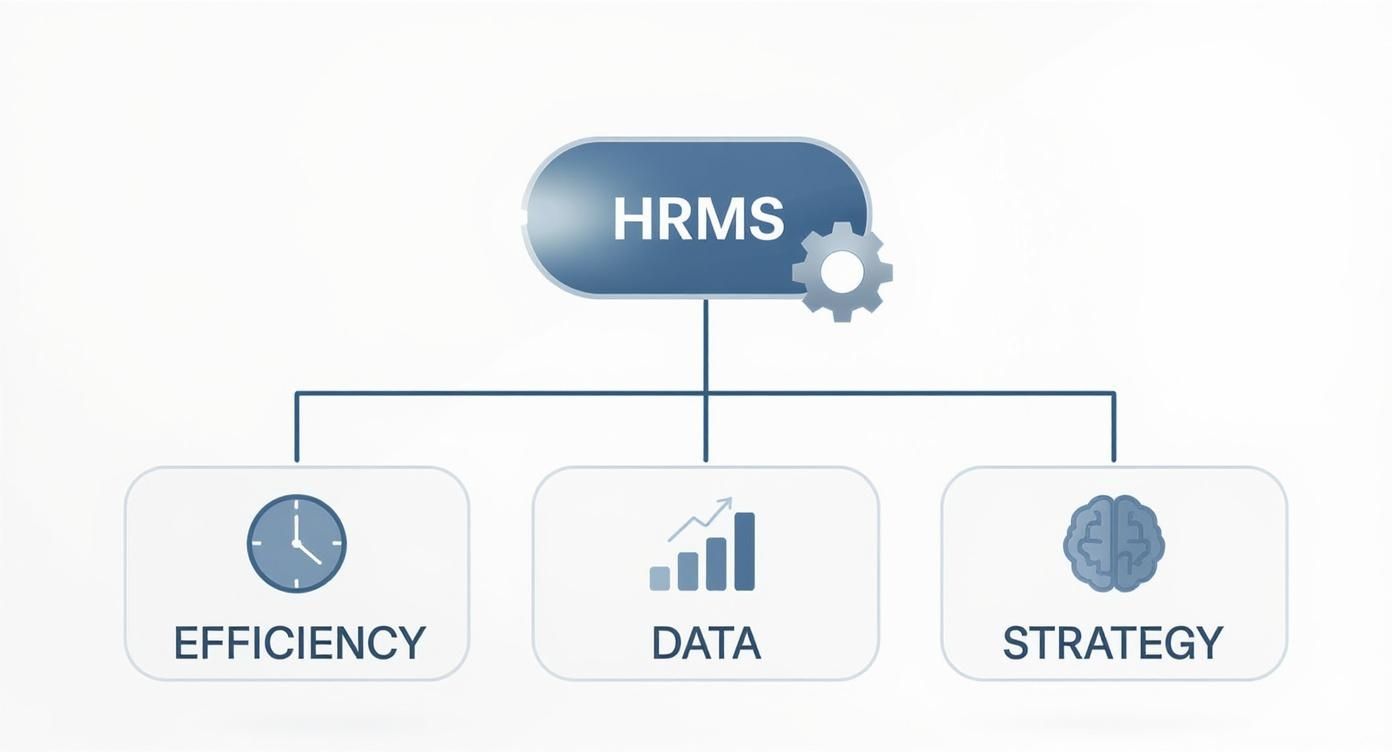
As you can see, a true HRMS is the central hub that transforms HR from a purely administrative function into a strategic partner for the business, driving efficiency and better decision-making.
HRMS vs HRIS vs HCM Feature Comparison
To make the distinctions even clearer, it helps to see where each system typically concentrates its features. While the lines can blur between modern platforms, their core philosophy and scope are quite different.
This progression from HRIS to HCM really mirrors a wider shift in business thinking: we’ve moved from simply administering employee records to strategically managing and developing our people as a core driver of success.
The table below breaks down the typical functions you’d find in each system.
| Feature Area | HRIS (Human Resource Information System) | HRMS (Human Resource Management System) | HCM (Human Capital Management) |
|---|---|---|---|
| Core Functions | Employee Database, Payroll | HRIS functions + Time & Attendance, Benefits | All HRMS + Performance, Compensation |
| Recruitment | Basic Applicant Data Storage | Full Applicant Tracking System (ATS) | Strategic Workforce Planning |
| Employee Self-Service | Limited (e.g., view payslips) | Comprehensive (e.g., book leave, update details) | Integrated with Personal Development Plans |
| Analytics & Reporting | Basic Headcount Reports | Operational Dashboards | Predictive Analytics, Talent & Trend Analysis |
Getting a handle on this hierarchy is the first step in making a smart investment. It helps you pinpoint exactly what your organisation needs today while keeping an eye on where you want to go tomorrow, ensuring you choose a platform that can grow with you.
Exploring the Core Modules of a Modern HRMS
A Human Resource Management System isn’t just a digital filing cabinet. It’s a suite of powerful, connected tools built to handle every stage of the employee journey. Think of it as a central hub where each function—or module—has a distinct job, but they all share information to keep the entire organisation running smoothly. Let’s break down the essential components that make up a modern HRMS.
Recruitment and Applicant Tracking
The employee lifecycle always starts with finding the right talent. A recruitment module, often known as an Applicant Tracking System (ATS), brings order to the hiring process, from the moment a job is posted to the final offer. It gives you a single place to manage applications, schedule interviews, and let hiring managers collaborate on feedback.
It’s the end of chaotic inboxes overflowing with CVs. The best systems also integrate with a variety of specialized tools for recruiters, making the whole workflow even more effective.
Onboarding and New Starter Management
Once you’ve found your perfect candidate, the onboarding module kicks in. This is about so much more than digital paperwork; it’s your chance to create a structured, welcoming experience for new starters. It can automate everything from sending contracts and collecting Right to Work documents to making sure IT has their equipment ready.
A great onboarding experience is your first, best chance to boost retention. When new employees feel supported and organised from day one, they are far more likely to integrate successfully and become productive members of the team quickly.
By mapping out a clear path, this module makes sure nothing gets missed and transforms a potentially stressful first few days into a brilliant introduction to your company.
Payroll and Time Management
Let’s be honest: making sure everyone gets paid correctly and on time is probably the most critical HR task. The payroll module is the engine that drives this, managing complex calculations for tax, National Insurance, pensions, and statutory pay, all while keeping you compliant with HMRC rules.
This function is nearly always tied to a time and attendance component. Staff can clock in, request holidays, and log extra hours through an easy-to-use portal. That data then flows straight into payroll, which gets rid of manual data entry and massively reduces the risk of human error. If you’d like to dig deeper, have a look at our guide to the best time and attendance software available for UK businesses.
Performance and Development
A truly modern HRMS goes beyond admin and actively nurtures employee growth. The performance management module gives you the framework for regular check-ins, goal setting, and annual appraisals. It encourages constructive, ongoing feedback between managers and their direct reports.
This creates a clear, transparent record of an individual’s achievements and development areas. As a result, performance conversations become more meaningful and are driven by data, not just gut feelings. It’s also how you directly connect individual effort to the company’s bigger strategic goals.
Ready to unify these modules and transform your HR processes? Phone 01522 508096 today or send us a message to discuss how a Microsoft-native HRMS can work for your business.
Unlocking Your HRMS Within the Microsoft Ecosystem
For any business already running on the Microsoft suite, the real magic happens when your HRMS stops being a forgotten island of data. The aim is to weave your people information directly into the tools your teams live in every day, like Outlook and Teams. This is where a native Microsoft solution truly shines.
Instead of asking employees to juggle yet another login and password, imagine HR tasks just… happening. A holiday request could be a simple one-click approval inside a Teams notification. This isn’t just about convenience; it’s a fundamental change that drives user adoption and makes crucial HR processes feel like part of the natural workflow, not a chore.
A Single Source of Truth with Dataverse
At the very heart of a Microsoft-native HRMS sits Microsoft Dataverse. The best way to think of Dataverse is as the secure, central brain that powers your Dynamics 365 and Power Platform apps. When your HR system is built on this foundation, all your employee data—from interview notes to performance reviews—lives in the same shared space as your sales leads, customer service cases, and operational data.
This creates a powerful, unified view of the entire organisation. You can finally knock down the walls between departments and start asking much bigger, more strategic questions. For instance, how does employee performance in a particular region correlate with customer satisfaction scores? With one common data model, finding that answer is no longer a guessing game.
Integrating HR into Your Daily Workflow
But true integration is about more than just data; it’s about reshaping how work gets done. A system that’s plugged into the Microsoft ecosystem lets you build slick, automated workflows that slash admin time and wipe out manual errors.
Here are a few real-world examples of what this looks like in practice:
- Collaborative HR in Teams: You could manage onboarding checklists as tasks within a dedicated Teams channel, letting HR, IT, and the new starter’s line manager coordinate everything without sending a single email.
- Automated Power Platform Workflows: When a candidate accepts their offer in the HRMS, a Power Automate flow can kick off a whole chain of events—from creating their new user account to automatically ordering their laptop.
- Data Visualisation in Power BI: Key metrics like employee turnover, salary benchmarks, and diversity figures can be pulled into live Power BI dashboards, giving leadership an instant, clear view of workforce trends.
This shift towards integrated, intelligent HR is a huge driver for UK businesses. The UK HR analytics market was valued at £165 million in 2022 and is expected to grow at 15.0% every year until 2030, which shows just how hungry companies are for data-driven insights. It’s not surprising when research shows this approach can improve recruitment efficiency by up to 80%. You can read more about the growth of the HR analytics market on Grandviewresearch.com.
By embedding your HRMS within the Microsoft stack, you elevate it from a simple admin tool to a genuine strategic asset. You can see exactly how this works by learning more about a Microsoft-native Dynamics 365 for HR solution.
Getting to Grips with UK HR and Payroll Compliance
Here in the UK, handling HR and payroll isn’t just about paying people on time. It’s about navigating a dense, ever-changing thicket of legislation. A solid HRMS isn’t a luxury; it’s your guide and safety net, helping turn what can feel like a high-stakes administrative headache into a structured, manageable process. It’s built to handle the very specific compliance hurdles UK businesses have to clear every day.
Take Right to Work checks, for instance. This is a non-negotiable first step for any UK employer. An HRMS takes this crucial task out of a chaotic paper-based system by prompting new hires for the right documents during onboarding. It then stores them securely and can even flag when a visa is nearing its expiry date. What was once a manual, slip-up-prone process becomes a methodical, easily auditable workflow.
From GDPR to Statutory Pay
Once someone is on board, the way you manage their data is under constant scrutiny. The General Data Protection Regulation (GDPR) has sharp teeth, and the fines for getting it wrong can be crippling.
A good HRMS helps you stay compliant by its very nature. Think of features like:
- Role-Based Access: This simply means people only see the data they absolutely need to see. A line manager doesn’t need access to an employee’s bank details.
- Data Retention Policies: The system can be configured to automatically flag or delete data once you no longer have a legal reason to keep it.
- Secure Employee Portals: Staff get a safe, password-protected space to view their payslips or update their details, which is far more secure than emailing sensitive documents back and forth.
This secure foundation is vital. Of course, a system is only part of the solution; you also need a well-trained team, which is where implementing effective regulatory compliance training comes in. An HRMS can even help here by tracking who has completed which training modules.
An HRMS shifts your business from being reactive to proactive on compliance. Instead of frantically digging through filing cabinets for an audit, you have a clear, compliant digital trail for every single employee action, ready at a moment’s notice.
Then there’s the maze of statutory leave and pay. Calculating maternity, paternity, or sick pay involves a dizzying number of rules on eligibility and rates. An HRMS automates all of this, ensuring your people are paid correctly and your records are flawless, all without someone having to get a calculator out. It removes the guesswork, which in turn protects your business from expensive payroll mistakes and the employee disputes that often follow.
By building these UK-specific rules directly into its logic, the system becomes an essential tool for managing risk.
Ready to simplify your UK compliance challenges? Phone 01522 508096 today or send us a message to find out how.
Choosing the Right HRMS for Your Business Growth
Picking a Human Resource Management System isn’t just about buying new software. It’s a major investment in your company’s future. You need to think carefully about not just where your business stands today, but where you see it heading in the next five years.
For UK companies, the push to modernise HR is real and pressing. A recent global Human Resource Management market report from startus-insights.com found that a massive 74% of UK businesses plan to increase their HR tech spending. That’s well above the global average and shows a clear understanding that the right systems are fundamental to staying competitive.
With that kind of investment on the line, getting the choice right is more critical than ever. It’s easy to get distracted by a long list of shiny features, but the real value comes from a system with a solid, reliable core that can truly support your business as it evolves.
Key Factors for Your Selection Process
When you start looking at different HRMS providers, it’s vital to think beyond your immediate needs. The platform that works perfectly for 50 employees can quickly become a frustrating bottleneck when you hit 500 if it wasn’t built to scale.
Here’s what you should be focusing on:
- Scalability: Can the system handle your projected growth over the next three to five years? You don’t want to be forced into a costly migration just as your business is taking off.
- Integration Capabilities: How easily does it talk to your other essential software? Think about your finance package or, if you’re a Microsoft-centric organisation, how it connects with the Power Platform and Dynamics 365.
- User Experience (UX): Is it genuinely easy to use for everyone? Your HR team, line managers, and every employee using the self-service portal should find it intuitive. A clunky, confusing system simply won’t get used.
- Ongoing Support: What kind of help will you get after you go live? A UK-based support team that understands local compliance and operational headaches is a huge advantage.
Planning for a Successful Implementation
Selecting the right system is only half the job. A smooth, well-planned rollout is what actually turns that software purchase into a valuable business asset. A structured implementation plan is non-negotiable, covering everything from initial setup and data migration to proper user training.
Return on Investment (ROI) becomes tangible when you can put numbers to it. If a new HRMS costs £30,000 a year but saves the business £50,000 through less admin work and better staff retention, the business case practically makes itself.
The secret to a successful launch often comes down to good old-fashioned change management. You need to communicate the “why” behind the new system to your team early and often. Involve key people from different departments in the process, and make sure everyone has the training and support they need to feel confident with the new tools. This is how you turn reluctance into genuine enthusiasm.
To help you get started, we’ve put together a detailed breakdown of the best HR software in the UK to help you compare your options.
Got Questions About HRMS? We’ve Got Answers
If you’re exploring the idea of an HRMS for your business, you probably have a few questions swirling around. It’s a big decision. We’ve pulled together the most common queries we hear from UK businesses to give you some clear, no-nonsense answers.
What’s the Typical Investment for an HRMS in the UK?
Pricing for an HRMS nearly always works on a per-employee, per-month basis. For a mid-sized business, you can generally expect to budget somewhere between £5 to £15 per employee each month.
The final figure really depends on which modules you need and how complex your setup is. Don’t forget to factor in a one-off implementation fee for getting everything configured and running smoothly. The only way to know for sure is to get a detailed quote that maps directly to your company’s requirements, including any specific integrations or customisations.
How Long Does It Take to Get an HRMS Up and Running?
The timeline for implementation really hinges on the size of your organisation and the scope of the project. For a company with around 100-500 employees, a typical rollout takes between 8 and 16 weeks from start to finish.
This window covers all the crucial steps: initial discovery and planning, system configuration, migrating your existing data, thorough testing, and getting your team trained up. Many businesses opt for a phased approach, launching core modules like payroll and time tracking first. This is a great way to start seeing a return on your investment much sooner.
Just How Secure Is Our Employee Data in a Cloud HRMS?
This is a big one, and rightly so. Reputable cloud-based HRMS providers—especially those built on robust platforms like Microsoft Azure—offer security that’s frankly far beyond what most individual businesses could manage themselves. We’re talking about enterprise-grade protection.
This includes encrypting your data both when it’s moving and when it’s stored, along with regular security audits and multi-factor authentication to control access.
Critically, these systems are built from the ground up to be fully compliant with UK GDPR. This ensures your employee data is protected by the highest standards, with strong disaster recovery plans in place to keep your information safe, no matter what happens.
Time for a Change?
If you’re ready to see what a modern HRMS can really do for your business – from cutting down on admin to genuinely helping your people thrive – then it’s time to talk. We can help you navigate the options and figure out what makes sense for your specific needs.
Phone 01522 508096 today or send us a message to book a no-obligation chat with one of our specialists.


