

Think of an employee’s salary as the foundation of a house. It’s absolutely essential, but it doesn’t make it a home. Employee benefits packages are everything else—the non-wage compensation that adds the walls, the roof, and all the comforts that make it a place someone wants to stay. In the UK’s competitive job market, these packages are no longer a nice-to-have; they’re a vital strategic tool for attracting, keeping, and motivating your best people.
Why Modern Employee Benefits Packages Matter

Today, a great benefits package is much more than just a list of extras. It’s a powerful statement about your company’s culture and values. It shows you see your staff as people, not just job titles, by actively supporting their health, financial future, and the balance between work and life.
This investment pays back in spades. When your team feels genuinely valued and supported, their engagement and loyalty skyrocket. That positive feeling spreads, lifting morale, boosting productivity, and creating a far more collaborative environment. Put simply, a strong benefits offering is one of the most effective ways to build a resilient, motivated workforce.
The Strategic Advantage in Talent Acquisition
The fight for top talent is fierce. In many cases, a competitive salary just gets you a seat at the table. The best candidates now look closely at the entire offer before they even consider signing on. Your employee benefits package is what makes you stand out from the crowd.
Think about it. If a candidate has two similar salary offers, but one includes flexible hours, private medical insurance, or an enhanced pension scheme, which one do you think they’ll choose? These benefits send a clear signal that you offer a supportive environment and are invested in your employees’ long-term wellbeing—a massive draw for high-calibre professionals.
Driving Retention and Reducing Costs
Losing good people is expensive. High staff turnover hits your budget with recruitment costs, drains team productivity, and can seriously damage morale. A well-designed benefits package is a proven way to convince your best people to stick around. We explore this further in our guide on how to reduce employee turnover.
By meeting the diverse needs of your team, you give them a powerful reason to stay. Things like generous parental leave, real opportunities for professional growth, and accessible mental health support help create a place where people can build a career, not just do a job.
We are DynamicsHub.co.uk we provide Transformative HR solutions customised to your unique workflows, Human Resource ( HR ) Management for Dynamics 365 is the leading hire to retire solution for the Microsoft Platform.
Ready to build a benefits package that gives you a competitive edge? Phone 01522 508096 today or send us a message to discover how our technology can help.
The Core Components of a UK Benefits Package
Putting together a truly compelling benefits package is about more than just ticking the legal boxes. Of course, things like auto-enrolment pensions and paid holidays are the non-negotiable foundations. But it’s the voluntary benefits—the thoughtful extras—that really show what you stand for and make you an employer people want to work for.
A modern, effective benefits package in the UK really stands on four key pillars. Each one speaks to a different part of an employee’s life, showing that you’re offering genuine, well-rounded support. Nail these, and you’re on your way to building a programme that your team will actually value.
Pillar 1: Health and Wellbeing
This has become a massive deal for UK employees, and for good reason. It’s no longer enough to just cover sick days. Today, it’s all about proactively supporting the physical and mental health of your people. A solid health and wellbeing offering shows you genuinely care.
Common benefits you’ll find here include:
- Private Medical Insurance (PMI): This gives your team faster access to specialists and treatments, cutting down on worry and time away from work.
- Mental Health Support: This could be anything from confidential counselling via an Employee Assistance Programme (EAP) to subscriptions for mindfulness apps like Calm or Headspace.
- Dental and Optical Care: Plans that help with the routine costs of check-ups, treatments, and new glasses are always a welcome addition.
- Gym Memberships or Wellbeing Allowances: Encourage a healthy lifestyle by subsidising gym fees or giving people a flexible pot of money to spend on whatever keeps them well.
The data backs this up. An Aon survey recently highlighted that work-life balance (90%) and flexible working (87%) are top of the list for employee expectations, proving just how much people want this kind of holistic support.
Pillar 2: Financial Security
Money worries are a huge source of stress, and that stress doesn’t just disappear when an employee logs on for the day. Benefits that help your team manage their finances, plan for the future, and weather life’s storms provide a sense of security that a salary alone can’t buy.
These benefits act as both a safety net for today and a building block for tomorrow.
Key financial benefits often include:
- Enhanced Pension Schemes: Going above the statutory minimum contribution is a powerful statement that you’re invested in your employees’ long-term future.
- Life Assurance (Death in Service): A simple but vital benefit that provides a lump-sum payment to an employee’s family, offering financial protection at the worst possible time.
- Income Protection: This insurance is a lifeline, paying a percentage of an employee’s salary if they’re unable to work for a long time due to illness or injury.
When putting these in place, it’s crucial to understand the general tax considerations for employee benefits to make sure everything is compliant and structured effectively for both you and your staff.
Pillar 3: Work-Life Balance
Let’s be honest, the old 9-to-5 office culture is on its way out. People now expect, and need, the flexibility to juggle their work with the rest of their lives. Offering benefits that support this balance is one of the most effective ways to prevent burnout and attract top talent.
A healthy work-life balance isn’t a perk; it’s a prerequisite for a sustainable and productive workforce. Benefits that acknowledge life outside of work are essential for long-term employee loyalty.
This pillar is all about things like flexible start and finish times, remote or hybrid working arrangements, and of course, a generous annual leave policy. It’s also vital people know what they’re entitled to; for more on that, see our guide on how to work out your holiday entitlement: https://www.dynamicshub.co.uk/2025/12/08/how-do-you-work-out-your-holiday-entitlement/.
Pillar 4: Professional Development
Your best people are ambitious. They don’t just want a job; they want a career path. When you invest in their professional growth, you’re not just helping them—you’re investing directly in the future skills and leadership of your own company.
This pillar is about creating real opportunities for people to advance.
- Training Budgets: Set aside funds for courses, certifications, and industry conferences.
- Mentorship Programmes: Pair up-and-coming talent with seasoned leaders to share knowledge and experience.
- Paid Study Leave: Give people the dedicated time they need to gain new qualifications.
By building your employee benefits packages around these four pillars, you move from a basic, transactional offer to a comprehensive, appealing one. You’ll be addressing the real-world needs of today’s workforce, and that’s what truly sets a great employer apart.
The Strategic Role of Workplace Pensions
A workplace pension is so much more than a box-ticking exercise. It’s the foundation of your team’s long-term financial wellbeing and a seriously powerful tool for standing out in a crowded talent market. While auto-enrolment set a basic standard, the smartest companies know that going beyond the bare minimum is a strategic investment in their people.
This is where a thoughtful employee benefits package really starts to deliver. By offering more generous pension terms, you’re sending a clear signal: we care about your future. That’s a message that builds deep-seated loyalty and goes a long way in keeping your best people around.
Beyond the Basics of Auto-Enrolment
Think of the legal minimums for auto-enrolment as the starting line, not the finish. To turn your pension scheme into a genuine, competitive benefit, you need to look at more attractive contribution models. These don’t just swell an employee’s retirement savings; they help build a supportive culture where people feel valued.
In the UK, a good pension is now a core expectation. Thanks to automatic enrolment, there are around 10.4 million people actively saving in workplace defined contribution schemes. To stay ahead, employers are increasingly using their pension offerings to attract and retain staff. In fact, recent research shows that over 50% of employers now offer, or plan to offer, more generous pension options to keep their teams happy. You can explore more about these trends in the UK employee benefits market here.
Unlocking Tax Efficiencies with Salary Exchange
One of the smartest ways to boost pension benefits is through a salary exchange scheme (sometimes called salary sacrifice). It’s a remarkably tax-efficient arrangement that benefits both the employee and the company.
Here’s how it works: an employee agrees to a small reduction in their gross salary, and in return, the employer pays that exact amount directly into their pension, along with the company’s own contribution. This simple switch unlocks some significant financial perks.
Because the employee’s official gross salary is lower, both they and the employer pay less in National Insurance Contributions (NICs). The employee also gets their tax relief straight away, which can mean their take-home pay is actually higher than it would be with a standard pension setup.
Salary exchange isn’t just a cost-saving trick; it’s a smarter way to fund your team’s future. It makes every pound invested in retirement work harder, delivering more value without costing the business a penny more.
Matched Contributions: A Powerful Incentive
Another fantastic model is matched contributions. This is where an employer agrees to match an employee’s pension contributions up to a certain percentage. For example, if an employee puts in 5% of their salary, the company also puts in 5%—a huge leap from the legal minimum.
This approach is brilliant because it actively encourages people to save for their own future. Knowing that your employer will double what you put in is a powerful motivator, and it helps create a really positive savings culture across the business.
Pension Salary Exchange Example
To see just how effective a salary exchange can be, let’s look at a quick comparison for a basic rate taxpayer. This shows how both the employee and the employer save money on National Insurance, without changing the total amount going into the pension.
| Metric | Standard Pension Contribution | Contribution via Salary Exchange |
|---|---|---|
| Employee Gross Salary | £30,000 | £28,500 (after exchange) |
| Employee Pension Contribution | £1,500 (5%) | £1,500 (paid by employer) |
| Employee NI Saving (approx.) | £0 | £180 per year |
| Employer NI Saving (approx.) | £0 | £207 per year |
Note: Assumes a basic rate taxpayer and current NI rates. Figures are illustrative.
As you can see, the employee’s pension pot receives the exact same contribution. Yet, both sides make a tangible saving on National Insurance. Some employers choose to reinvest their savings back into the business, while others pass that saving on to the employee by adding it to their pension pot, making the benefit even more valuable.
By using clever models like salary exchange and matched funding, a workplace pension shifts from a compliance chore to a cornerstone of your talent strategy. It becomes a valuable, tangible part of your employee benefits package that helps secure your team’s future—and your company’s success.
How to Design a Competitive Benefits Package
Crafting a benefits package that genuinely stands out isn’t about guesswork or just copying what your competitors are doing. It’s a strategic move. It means getting to know your industry, listening to your people, and building something that offers real, tangible value and choice. A one-size-fits-all approach is a recipe for mediocrity; what gets people excited at a London tech start-up probably won’t land the same way at a manufacturing firm in the Midlands.
The real goal here is to move past a static list of perks. You want to create a dynamic, appealing offer that directly helps you hit your business goals. To design something truly competitive, you need to weave in proven strategies on how to improve staff retention and build a loyal team. That starts with a benefits programme that feels thoughtful, responsive, and designed for the very people you want to attract and keep.
Start with Smart Benchmarking
Before you can lead the market, you have to understand it. Benchmarking is that critical first step, giving you a clear snapshot of what similar companies are offering. This isn’t about vague national averages; it’s about a much sharper, more focused analysis.
Look at your specific industry and where you’re located. A software company in Manchester is competing for talent against other local tech firms, so its package needs to hold up. In the same way, a national retailer should be looking at what others in their sector offer right across the UK.
The kinds of benefits on offer—and how generous they are—can swing wildly between industries. An analysis from Vestd’s Employee Benefits Index, which scanned countless job listings, revealed some stark differences. For example, the Motoring and Automotive sector scored a hefty 704 on their weighted index, while sectors like Scientific and Education lagged far behind at 210 and 229, respectively. And here’s a real eye-opener: despite all the talk, flexible working was mentioned in just over 28% of all job ads. You can discover more insights from this UK benefits analysis.
Listen to Your Most Important Asset: Your Team
Benchmarking tells you what other companies are doing, but only your own people can tell you what they actually want. One of the costliest mistakes a business can make is sinking a ton of money into a benefit that nobody uses or values. The best way to dodge that bullet is surprisingly simple: just ask.
Employee surveys are an absolute goldmine for shaping your benefits strategy. They give you direct, honest feedback on what your team members—across every age group and life stage—truly care about.
You might find out that your younger staff are far more interested in professional development budgets and flexible hours. Meanwhile, employees with families might place a much higher value on enhanced parental leave and private medical insurance. This is the data that helps you put your budget where it will make the biggest difference to morale and satisfaction.
A benefit is only valuable if it is valued by the person receiving it. Surveying your team transforms your benefits package from a corporate policy into a personal and compelling reason to stay.
Implement Flexible and Tiered Systems
Once you’ve got a handle on the market and what your team wants, you can start building a more sophisticated structure. Rigid, take-it-or-leave-it packages are fast becoming a thing of the past. Today’s most competitive employee benefits packages often use flexible or tiered models to give people a real sense of control and choice.
Here’s a quick breakdown of how these systems work:
-
Tiered Benefits: This model offers different levels of benefits, often tied to an employee’s seniority or how long they’ve been with the company. A senior manager, for instance, might get a more comprehensive private medical plan or a larger pension contribution. It’s a powerful way to reward loyalty and map out clear pathways for progression.
-
Flexible Benefits (Flex Pots): This is a hugely popular approach where employees get a core set of benefits (like a pension and life assurance) plus a flexible allowance—a “pot” of money. They can then spend this pot on a menu of other perks, like buying extra holiday days, upgrading their health cover, or putting it towards a gym membership.
This kind of personalisation massively boosts the perceived value of your benefits package. It empowers people to pick what matters most to them, ensuring your investment is always relevant and appreciated. It’s a fundamental shift from telling employees what they get to asking them what they need.
Streamlining Benefits with Modern HR Technology
Designing a great benefits package is one thing; delivering it flawlessly is a completely different challenge. It’s at this crucial execution stage where many businesses, unfortunately, fall short.
Think about it. Are you still wrestling with spreadsheets to track who’s eligible for what? Do enrolment periods unleash a flood of email chains? Are there frantic calls to payroll just before payday? These manual processes aren’t just inefficient—they’re a recipe for costly mistakes and, worse, employee frustration.
When an employee’s pension contribution is wrong, or they can’t access their new health insurance, it completely undermines the value of the benefit you’ve worked so hard to provide. This administrative friction creates a poor experience and places a huge, often invisible, burden on your HR team. This is precisely where modern HR technology comes in, transforming benefits administration from a reactive headache into a smooth, strategic function.
The Pitfalls of Manual Benefits Management
Relying on outdated or disconnected systems to manage your employee benefits packages creates very real risks. Simple human error can easily lead to incorrect payroll deductions, delayed benefit activation, or even serious compliance breaches. These aren’t just minor hiccups; they can have serious financial and legal consequences.
Just consider these all-too-common manual pain points:
- Eligibility Tracking: Manually checking probation periods, hours worked, or specific job roles to see who qualifies for which benefit is incredibly time-consuming and dangerously prone to error.
- Enrolment Chaos: Collecting forms, chasing down missing information, and manually keying data into multiple systems for every new hire is a major administrative drain.
- Payroll Disconnect: Ensuring that every benefit choice, from pension contributions to salary sacrifice schemes, is accurately reflected in payroll requires constant, painful cross-checking and reconciliation.
- A Lack of Insight: Without a centralised system, it’s almost impossible to get a clear picture of benefit uptake, total costs, or which perks your team actually values.
This is the key process flow for designing and implementing effective benefits, illustrating the strategic thinking required before you even get to administration.
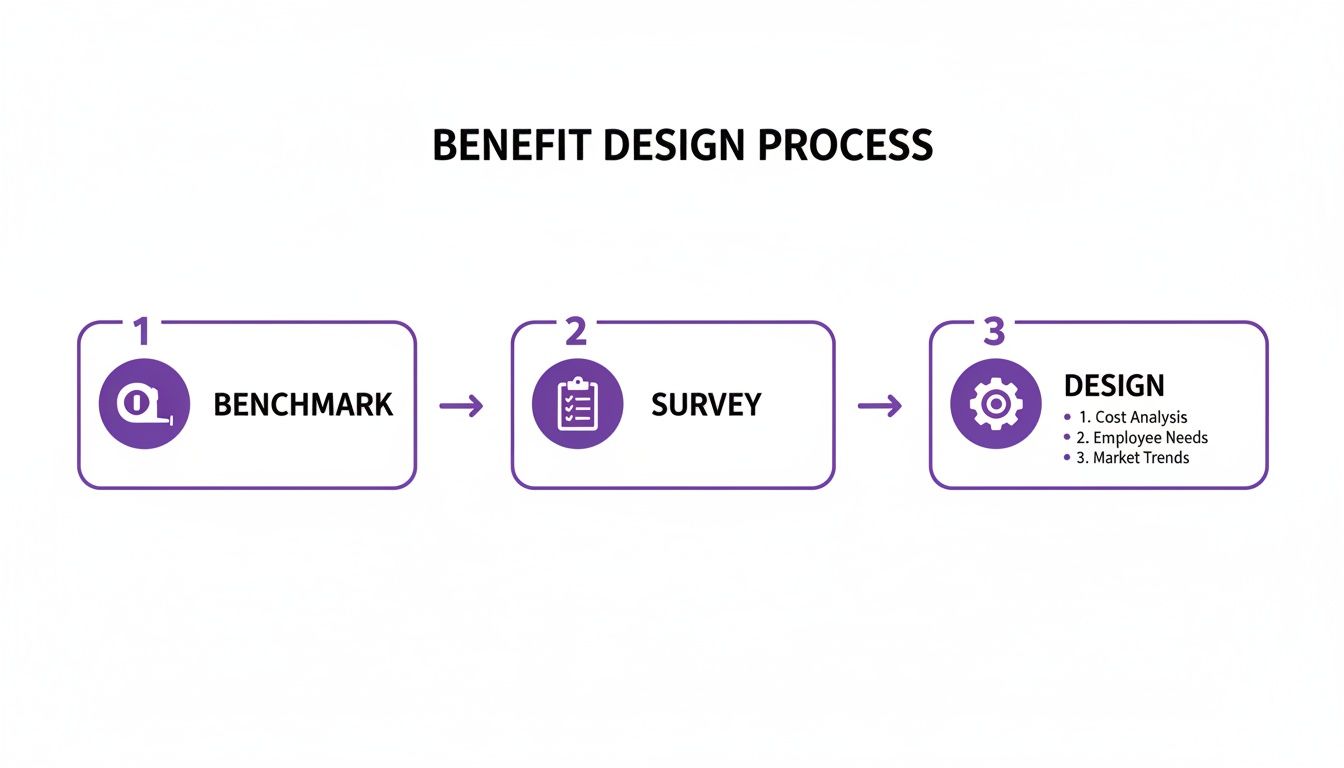
Successfully navigating these design stages is vital, but all that hard work is lost if the final administration is clumsy and inefficient.
The Power of a Centralised HR System
The solution is to bring benefits management into a single, integrated platform. A modern HR system acts as the central hub for your entire benefits programme, automating the complex workflows that bog down your team. This is exactly what Human Resource Management for Dynamics 365, implemented by DynamicsHub, is designed to do.
By building on the Microsoft platform your business likely already uses, it creates a seamless, connected experience. To get a better feel for how this works, it helps to understand what an HRMS system is and the core problems it solves. At its core, it’s about bringing all your people processes into one place.
A centralised HR system turns benefits administration from a manual, error-prone task into an automated, data-rich strategic advantage. It frees your HR team to focus on people, not paperwork.
How Dynamics 365 Transforms Benefits Administration
With a solution like Human Resource Management for Dynamics 365, the administrative chaos simply disappears. The system automates those critical processes, ensuring accuracy and consistency from an employee’s first day to their last.
Here’s how it works in practice:
- Automated Enrolment: As soon as a new employee joins, the system can automatically trigger the benefits enrolment process based on their start date. They can then view their options and make selections through a self-service portal, with all the data flowing directly into their employee record. No more paper forms.
- Complex Eligibility Rules: You can configure the system to manage even the most complex eligibility criteria. Whether a benefit is tied to seniority, location, or a completed probationary period, the platform automatically tracks who qualifies and notifies them when they’re eligible for new perks.
- Seamless Payroll Integration: All benefit selections and deductions—from pension percentages to cycle-to-work schemes—are automatically passed straight to your payroll system. This eliminates manual data entry and drastically reduces the risk of pay errors.
- Powerful Analytics and Reporting: With all your benefits data in one place, you gain incredible insights. HR teams can run reports to monitor uptake rates, analyse the total cost of the package per employee, and see which perks are most popular. This is the kind of data you need to make smart decisions and continuously improve your offering.
We are DynamicsHub.co.uk and we provide transformative HR solutions customised to your unique workflows. Human Resource (HR) Management for Dynamics 365 is the leading hire-to-retire solution for the Microsoft Platform, designed to bring this level of control and insight to your organisation.
Ready to automate your benefits administration and unlock its full strategic value? Phone 01522 508096 today or send us a message to learn more.
So, What’s Next for Your Benefits Strategy?
We’ve covered a lot of ground, and the main takeaway is this: your employee benefits package is far more than just a line item on a spreadsheet. It’s a living, breathing part of your business strategy. The best ones are thoughtfully designed for the people you actually have, communicated clearly, and managed with smart, modern tools.
At the end of the day, a strong benefits package is a clear signal of your company culture and how much you genuinely care about your team’s wellbeing. Get it right, and it becomes a huge draw for new talent and a powerful reason for your best people to stick around. Now’s the time to turn these ideas into action.
The future of work is built on support, flexibility, and real investment in people. Your benefits strategy isn’t just a policy document; it’s the most tangible way you bring your company’s values to life, day in and day out.
At DynamicsHub.co.uk, we specialise in HR solutions that fit how you work. Our Human Resource (HR) Management for Dynamics 365 is the leading hire-to-retire solution built on the Microsoft Platform, giving you everything you need to design, manage, and fine-tune a benefits programme that truly makes a difference.
Ready to build a benefits strategy that will help you attract and keep the best people? Give us a call on 01522 508096 or send us a message to get started.
Common Questions About Employee Benefits
Getting your head around employee benefits can feel a bit daunting, especially when you’re trying to build a package that’s both competitive and compliant. Let’s tackle some of the most common questions UK employers ask.
What are the Absolute Minimum Benefits I Have to Offer?
In the UK, the law sets a clear baseline for employee benefits. Think of these as the non-negotiables – the foundation you build everything else on.
Legally, you must provide:
- A Workplace Pension: You have to automatically enrol your eligible team members into a workplace pension scheme and pay in a minimum contribution.
- Paid Holiday: Every employee is entitled to at least 5.6 weeks of paid holiday each year. This is adjusted on a pro-rata basis for part-time staff.
- Statutory Pay: You’re also on the hook for Statutory Sick Pay (SSP) and statutory pay for maternity (SMP), paternity, adoption, and shared parental leave, assuming your employees meet the criteria.
Anything you offer on top of these legal requirements is a voluntary benefit – the kind that really helps you stand out and keep your best people.
How Can a Small Business Possibly Afford a Good Benefits Package?
This is a big one for smaller companies. The key is to be clever and focus on value, not just volume. You don’t need to match a massive corporation’s list of perks; you just need to offer things your people genuinely care about.
A great starting point is to simply ask your team what they’d value most. Often, high-impact benefits like flexible working hours or the option to work from home don’t cost a thing.
You can also lean into tax-efficient benefits, which are a win-win for everyone. Things like salary sacrifice pension schemes or the Cycle to Work scheme save both the company and your employees money. Group insurance plans for private medical or life assurance are also far more affordable for a business than they are for an individual. It’s all about being strategic.
How Does an HR System Actually Help with Communicating Benefits?
You can offer the best benefits in the world, but if your employees don’t understand or appreciate them, what’s the point? There’s often a huge gap between what companies provide and what their people perceive. For instance, while 50% of employers use online benefits platforms, a staggering 12% of employees say they’re very happy with their package. You can read more about UK benefits trends and employee satisfaction to see the full picture.
This is where a good HR system, like Dynamics 365, really comes into its own. It acts as a single, central hub where your team can log in and see everything in one place – their entire benefits package, all the policy documents, and a clear view of their total compensation. The system can send out automated reminders about enrolment deadlines or new perks, making sure the message gets through without burying your HR team in admin. It makes the whole experience transparent, engaging, and a lot less work for everyone.
We are DynamicsHub.co.uk and we provide transformative HR solutions customised to your unique workflows. Human Resource (HR) Management for Dynamics 365 is the leading hire-to-retire solution for the Microsoft Platform.
Ready to build a benefits strategy that attracts and retains top talent? Phone 01522 508096 today or send us a message.


