

Hiring great people is how you build a successful business, but it’s also about protecting that business from some very real threats. For any UK company, a solid pre-employment checking process isn’t just a “nice-to-have” anymore. It’s a critical part of managing risk and securing your company’s future with every single hire.
Why Pre-Employment Checking is a Business Imperative
When you find a brilliant candidate in a tight job market, the temptation to rush them through the final stages is understandable. But skipping or cutting corners on pre-employment checks is a bit like building a house without checking the foundations first—you’re just storing up problems for later.
Today’s hiring environment is full of challenges that make proper screening an absolute necessity. The goalposts have shifted, driven by everything from stricter legal duties to an unfortunate rise in application fraud. The consequences of getting it wrong have simply never been higher, as one bad hire can cause serious financial, legal, and even cultural damage.
Protecting Your Organisation from Key Risks
At its heart, pre-employment checking is about making sure a candidate is exactly who they claim to be. It’s a structured way to confirm they are legally allowed to work in the UK and actually have the qualifications they’ve listed. Think of it as essential due diligence.
This process tackles several major business vulnerabilities head-on:
- Staying on the Right Side of the Law: UK law is very clear on certain checks, especially the ‘Right to Work’. Getting this wrong can lead to crippling penalties, including fines of up to £60,000 per illegal worker and, in serious cases, a prison sentence.
- Catching Application Fraud: It’s a sad reality that falsified CVs and qualifications are on the rise. Verifying a candidate’s history protects you from the wasted time and money spent on hiring someone who isn’t equipped for the job.
- Protecting Your People and Your Assets: Background checks are also about safeguarding your company culture. They help ensure a new person will fit in with your team’s values and won’t pose a risk to your colleagues, your data, or your property.
At DynamicsHub.co.uk, we provide Transformative HR solutions customised to the unique way you work. Human Resource HR Management for Microsoft Dynamics 365 by Hubdrive is the leading hire-to-retire solution for the Microsoft Platform, designed to handle these exact challenges.
This guide is your roadmap for getting pre-employment screening right in the UK. We’ll cover the checks you must do by law, share best practices for creating a secure process, and show how the right technology can turn this from a manual headache into a real strategic advantage. Our aim is simple: to give you the tools and knowledge to hire with complete confidence.
What Pre-Employment Checks Do You Really Need in the UK?
Figuring out which pre-employment checks you need to run for a new hire in the UK can feel a bit like navigating a maze. It’s not a one-size-fits-all situation. The checks you need depend entirely on the role, the industry, and your legal obligations as an employer.
Things generally fall into two buckets: checks you have to do by law, and checks you should do to protect your business. Getting the balance right is crucial. If you miss a mandatory check, you could face serious legal trouble. On the other hand, collecting too much information you don’t need can land you in hot water with GDPR. It’s all about creating a screening process that’s both thorough and appropriate for the job you’re filling.
The One Check Every UK Employer Must Do
Let’s start with the big one: the Right to Work check. This is completely non-negotiable and applies to every single person you hire, no matter the role or contract type. It’s your legal duty to make sure a potential employee has the legal right to do the job you’re offering before they start working.
This means you have to physically see and take copies of specific original documents, like a passport or a particular combination of other official papers. Don’t take this lightly—the penalties for hiring someone who doesn’t have the right to work in the UK can be staggering, with fines reaching up to £60,000 per illegal worker.
Of course, beyond this universal rule, some sectors have their own set of mandatory checks. The most common example is for roles involving contact with vulnerable people, such as children or adults in care. In these cases, a Disclosure and Barring Service (DBS) check isn’t just a good idea; it’s a legal requirement.
A smart pre-employment checking process isn’t about putting up walls to make hiring harder. It’s about building a foundation of trust and safety from day one—protecting your team, your customers, and your company’s reputation.
Getting to Grips with DBS Checks
DBS checks are a cornerstone of safeguarding, but it’s vital to use the right level for the right role. You can’t just ask for the highest-level check on everyone; doing so can breach data protection laws.
Here’s a quick rundown of the different levels:
- Basic DBS Check: This is the entry-level check and can be requested for any role. It simply reveals any ‘unspent’ convictions a person has.
- Standard DBS Check: This goes a bit deeper and is often needed for roles with a high degree of trust, like certain jobs in finance or law. It shows both spent and unspent convictions, as well as cautions, reprimands, and final warnings.
- Enhanced DBS Check: This is the most detailed check and is reserved for roles with regular, close contact with vulnerable groups—think teachers, doctors, and care workers. It includes everything from a Standard check, plus any other relevant information held by local police that they feel is pertinent to the role.
Below is a quick-reference table summarising the key checks you’ll encounter.
Key Pre-Employment Checks in the UK
| Type of Check | Purpose | When It’s Required |
|---|---|---|
| Right to Work | To verify a candidate has the legal right to work in the UK. | Mandatory for every single hire, before their first day. |
| Identity Check | To confirm the candidate is who they say they are. | Mandatory as part of the Right to Work process. |
| DBS Check (Basic) | To check for unspent criminal convictions. | Recommended for many roles; can be requested by any employer. |
| DBS Check (Standard/Enhanced) | To conduct a more detailed criminal record check for safeguarding purposes. | Mandatory for specific roles, especially those involving children or vulnerable adults (e.g., healthcare, education). |
| Qualification & Certification | To confirm the candidate holds the academic or professional credentials they claim. | Highly recommended for roles where specific qualifications are essential. |
| Employment History & References | To verify past job roles, responsibilities, and performance. | Best practice for almost all hires to gain insight into work ethic and experience. |
| Credit History Check | To assess financial reliability. | Role-dependent; typically for senior finance or FCA-regulated roles. |
Understanding these different layers allows you to build a checking process that is compliant, fair, and perfectly suited to the risks and responsibilities of each individual role.
Other Checks to Consider
Beyond the legal must-haves, there are a few other checks that are just plain good business sense. These help you paint a fuller picture and confirm that the person you’re about to hire is everything they presented on their CV.
Following up on employment history and professional references is fundamental. It’s your chance to verify their experience, skills, and past performance. A good reference can tell you a lot about how someone will fit into your team culture. In the same way, quickly verifying their qualifications ensures they genuinely have the degree or certificate they listed.
Depending on the role, you might need to go a step further:
- Credit History Checks: These are pretty niche and are usually reserved for senior finance roles or jobs where someone has major financial authority.
- Social Media Screening: This can offer a glimpse into a candidate’s professionalism, but you have to tread very carefully here to avoid crossing lines into discrimination or privacy invasion.
By mapping out these different types of checks, you can design a pre-employment screening strategy that’s not only compliant and effective but also tailored to the unique needs of your organisation.
We are DynamicsHub.co.uk. We provide Transformative HR solutions customised to the unique way you work. Human Resource HR Management for Microsoft Dynamics 365 by Hubdrive is the leading hire-to-retire solution for the Microsoft Platform.
Ready to build a secure and efficient hiring process? Phone 01522 508096 today or send us a message.
The Rising Tide of Application Fraud
It’s tempting to see pre-employment checks as just another box to tick on the HR checklist. A bit of admin before the new starter arrives. But that view misses a huge and growing threat: application fraud. The days when you only had to worry about a slightly polished CV are well and truly over.
Today’s HR professionals are on the front line, battling increasingly sophisticated deception. We’re not just talking about minor exaggerations anymore. We’re seeing completely fabricated work histories, bogus qualifications bought online, and expertly forged identity documents.
This isn’t some fringe issue; it’s a mainstream problem with serious teeth. A weak screening process doesn’t just let the wrong person in—it exposes your entire organisation to financial loss, reputational ruin, and even safety risks. This shifts pre-employment checking from a simple task into what it really is: a critical line of defence for your business.
The Scale of the Problem in the UK
The numbers don’t lie, and they paint a pretty grim picture. Fraud has exploded in the UK, now accounting for a staggering 41% of all crime. This wave is crashing right into the world of recruitment.
Last year alone, we saw a 25% jump in people claiming false qualifications or embellishing their CVs. One report dug deeper and found that 36% of all red flags raised during background checks were down to dodgy employment histories, while another 22% related to academic qualifications. These aren’t just abstract statistics; they represent real threats walking through the doors of businesses just like yours.
This puts a huge amount of pressure on hiring teams. Every single fraudulent application that slips through the net is a ticking time bomb. It’s why having a robust, reliable verification process has never been more important.
Failing to properly vet a candidate is no longer just a recruitment misstep; it’s a significant business risk. In today’s climate, assuming honesty is a strategy that can lead to severe operational and financial damage.
From Small Inaccuracies to Major Deception
Application fraud isn’t black and white; it exists on a spectrum. At one end, you have a candidate fudging their employment dates by a month or two. It might seem small, but it’s often a sign of deeper dishonesty.
At the other end, you have outright criminal deception. The most serious threats include:
- Fabricated Qualifications: Candidates presenting degrees from ‘diploma mills’ or inventing professional accreditations to get a job they are completely unqualified for.
- Forged Identity Documents: Modern tech makes it alarmingly easy to create convincing fake passports and ID cards. This is especially dangerous for bypassing mandatory legal requirements, which we cover in detail in our guide on Right to Work checks in the UK.
- Concealed Criminal Records: Applicants might deliberately hide convictions that would disqualify them from roles involving trust, finance, or contact with vulnerable people.
- Falsified References: It’s become common for candidates to list friends as “former managers” who are ready to give a glowing, but completely fake, endorsement.
A key part of the fight against this is building your team’s skills in knowing how to spot fake IDs and verifying that people are who they say they are.
The Business Impact of a Bad Hire
The fallout from hiring a fraudulent applicant can be catastrophic, sending shockwaves through the entire business that go far beyond recruitment costs.
Think about the domino effect:
- Financial Loss: This can be anything from paying the salary of someone who can’t do the job, to direct theft or fraud committed by an employee hired under false pretences.
- Reputational Damage: When you employ someone who acts unethically or illegally, your brand’s reputation with customers, partners, and the public can be permanently tarnished.
- Compromised Safety: In skilled or regulated roles, an unqualified person can create genuinely dangerous situations for colleagues and customers.
- Legal Penalties: Failing to carry out mandatory checks, like Right to Work, can result in crippling fines and even legal action against the company and its directors.
When you weigh up these very real risks, it becomes obvious that a thorough pre-employment checking process isn’t an expense. It’s a vital investment in your company’s security and future.
Staying on the Right Side of GDPR and Data Protection Law
When you run pre-employment checks, you’re not just ticking boxes; you’re handling someone’s personal data. This is a serious legal responsibility. In the UK, the General Data Protection Regulation (GDPR) and the Data Protection Act 2018 lay down strict rules for how you collect, process, and store a candidate’s information. Get it wrong, and you could be looking at hefty fines and a damaged reputation.
Navigating this legal maze really comes down to a clear, consistent approach. You need to treat a candidate’s data with the same care and security you’d give your own company’s most sensitive files. It’s all about being intentional: know what you’re asking for, why you need it, and how long you’re going to keep it.
The Three Pillars of GDPR for Pre-Employment Checks
To build a screening process that holds up to scrutiny, you need to bake three core GDPR principles right into your HR workflows. These aren’t just helpful tips; they’re legal requirements that underpin any fair and lawful hiring process.
Think of them as the foundation of your entire hiring strategy:
- Data Minimisation: Only collect what you genuinely need for the specific role. You have to be able to justify every single piece of information you request. For example, running a credit check on a junior marketing assistant would be hard to defend, but for a senior finance director, it’s a perfectly reasonable step.
- Transparency: Be completely upfront with candidates. Tell them from the get-go what checks you’ll be running, why they’re necessary for the job, and how you’ll handle their data. This should be spelled out clearly in your privacy notices and on your application forms.
- Storage Limitation: You can’t hang onto candidate data forever. You must have a clear data retention policy that states exactly how long you’ll keep information for both successful and unsuccessful applicants, and then you need to follow it by securely deleting the data once that time is up.
Finding Your Lawful Basis for Processing
Before you even start a check, you must have a clear ‘lawful basis’ for processing the data. For most pre-employment checks, this will fall under ‘legitimate interest’ – basically, you have a valid business reason to make sure a candidate is who they say they are and has the right qualifications.
However, the game changes when you’re dealing with more sensitive information, like health records or criminal history from a DBS check. For this ‘special category’ data, the bar is much higher. You’ll typically need an additional, more explicit legal reason, which is often tied to your obligations under employment law or requires the candidate’s explicit consent.
A strong, compliant pre-employment checking process is built on clarity and justification. When you weave GDPR principles into your systems, you’re not just protecting your organisation from legal risk—you’re also building trust with candidates by showing you respect their privacy.
The regulatory landscape is always shifting. A great example is the Economic Crime and Corporate Transparency Act. This legislation means large UK organisations can now face criminal liability if an employee commits fraud, unless the business can prove it had ‘reasonable’ fraud prevention procedures. This elevates pre-employment vetting from a simple compliance task to a critical risk management strategy. You can learn more about how this is rethinking recruitment risk for a new era of employee screening.
Managing Compliance with an Integrated HR System
Trying to juggle all these complex data requirements with spreadsheets and manual trackers is asking for trouble. The risk of human error, accidental data breaches, and falling out of compliance is just too great. This is where an integrated HR system becomes absolutely essential.
The HR solution for Microsoft Dynamics 365, which we implement and support here at DynamicsHub, is designed to handle these challenges. Because all candidate data lives securely within your own Microsoft 365 tenant, you never lose control of it.
This integrated approach helps you prove compliance by:
- Providing secure, auditable storage for every candidate document.
- Automating data retention workflows to make sure information is deleted according to your policy.
- Creating a robust audit trail that shows exactly who accessed what data, and when.
These policies should be communicated clearly to everyone in your organisation. For more guidance on this, take a look at our resources on creating an effective employment handbook template. And remember, it’s always wise to understand the broader compliance and employment law to keep your operations fully compliant.
Building a Modern Screening Process with Dynamics 365
Knowing what pre-employment checks to run is one thing; actually managing them is another. This is where most HR processes start to creak. Chasing candidates for documents, juggling different checks for different roles, and trying to keep it all GDPR-compliant can quickly spiral into a mess of spreadsheets and email chains. It’s not just slow and frustrating—it’s a process loaded with risk and a terrible first impression for your new hire.
A modern screening process shouldn’t feel like a collection of disjointed admin tasks. It should be a single, smooth workflow that uses the technology you already have to tighten up security and shrink your time-to-hire. By building your pre-employment checking process directly within the Microsoft ecosystem, you create a secure, automated, and thoroughly professional journey from the moment an offer is accepted to their first day.
From Manual Chaos to Automated Clarity
Imagine this: a candidate accepts a job offer, and the right checks are triggered instantly, based entirely on the role they’ve accepted. That’s the power of an integrated system. Instead of relying on a hiring manager’s memory or a manual checklist, the logic is built right into your workflow.
When you use the HR Management solution for Microsoft Dynamics 365, your hiring plan becomes a smart, automated process:
- Role-Based Triggers: A candidate accepts an offer for a role tagged ‘Finance’. The system can automatically kick off a credit history check. For a role in ‘Healthcare’, it can start the Enhanced DBS process without anyone needing to lift a finger.
- Automated Candidate Communication: Using Power Automate, you can send professional, branded emails to candidates requesting the specific documents needed for their checks. Nothing gets missed.
- Centralised Information: Every piece of data, from their CV to their Right to Work documents, is stored against a single candidate record in Dynamics 365. This gets rid of risky data silos and creates one reliable source of truth.
This structured approach doesn’t just save countless admin hours; it guarantees that a consistent and compliant process is followed for every single hire, every single time.
To really see the difference, let’s compare the old way with the new.
Manual vs Automated Pre-Employment Checking
| Process Step | Manual Approach (Risks and Delays) | Automated with Dynamics 365 (Benefits) |
|---|---|---|
| Initiating Checks | HR manually reviews the role and a checklist. It’s easy to forget a step or apply the wrong check. | Workflows automatically trigger the correct checks based on job role data. 100% consistency. |
| Requesting Documents | Sending individual emails, often from personal inboxes. It’s slow, hard to track, and looks unprofessional. | Automated, branded emails are sent requesting specific documents. Creates a great candidate experience. |
| Tracking Progress | Using spreadsheets or email flags. Inevitably leads to chasing and delays when things are forgotten. | A central dashboard in Dynamics 365 shows the real-time status of every check for every candidate. |
| Storing Data | Documents saved on local drives, in various email threads, or insecure shared folders. A GDPR nightmare. | All documents are stored securely against the candidate record in SharePoint with proper retention policies. |
| Audit & Reporting | A painful, time-consuming task of piecing together an audit trail from scattered sources. | A full, time-stamped audit trail is automatically created for every action, ready for any compliance check. |
The move to automation isn’t just about being faster; it’s about being safer, more professional, and more reliable.
A Best-Practice Workflow in the Microsoft Ecosystem
Creating a seamless pre-employment checking workflow is all about connecting the tools you use every day. The Human Resource HR Management solution by Hubdrive acts as the central brain, coordinating actions across Dynamics 365, Teams, and SharePoint.
Here’s what a typical automated workflow looks like in practice:
- Offer Accepted in Dynamics 365: The candidate’s status is updated, which acts as the trigger for everything that follows.
- Checks Initiated: The system looks at the job profile, identifies the required checks, and automatically creates tasks for the HR team.
- Secure Communication via Teams: HR can securely chat with the hiring manager in a dedicated Teams channel to confirm details, with the conversation linked back to the candidate’s record.
- Compliant Document Storage: The candidate uploads their documents to a secure portal. They are automatically filed in a designated SharePoint folder with the correct permissions and data retention policies already applied.
This diagram shows the fundamental principles of data handling you must follow during this process.
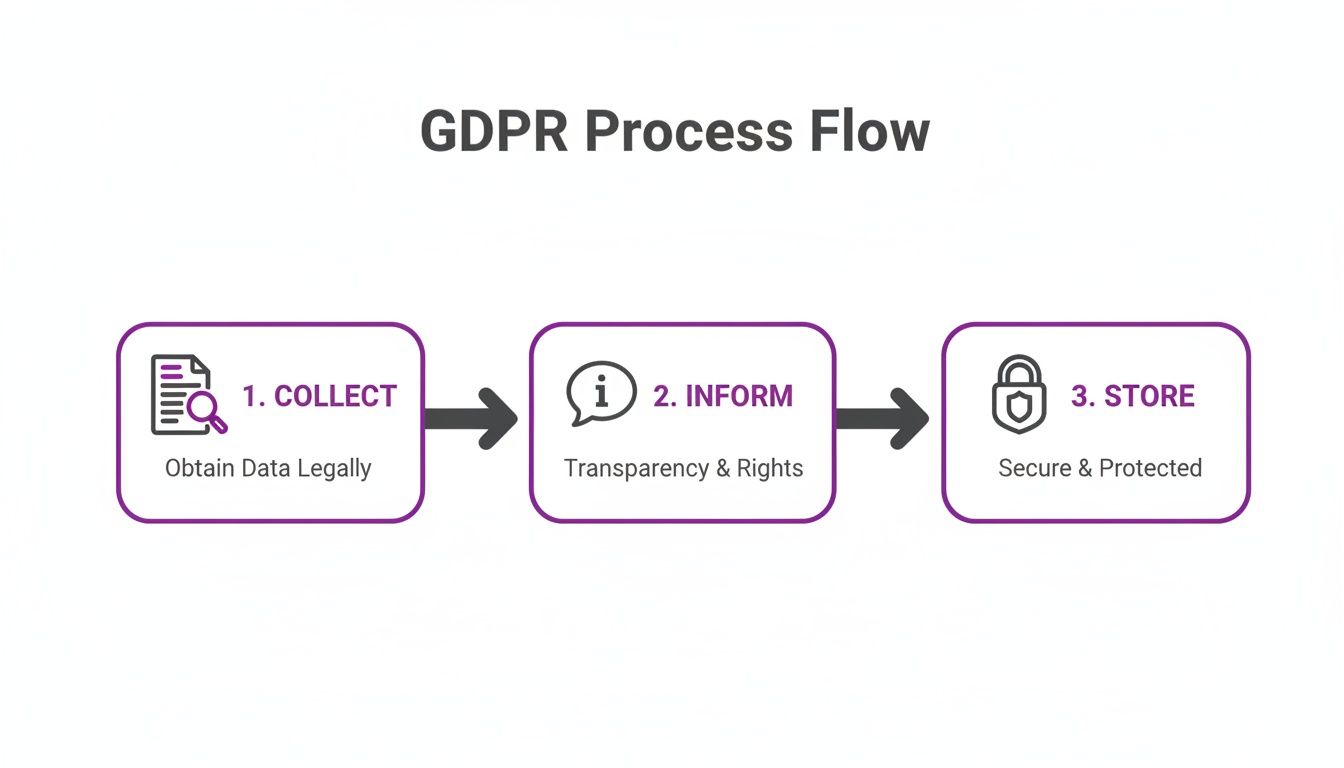
The flow from collecting data, to informing the candidate, and finally storing it securely is the absolute bedrock of a GDPR-compliant screening process.
The Immediate Benefits of an Integrated System
Moving to an automated, integrated approach brings real, measurable results that go far beyond just making life in HR a bit easier. It fundamentally improves the quality and security of your entire hiring function.
By connecting your screening process to your core HR system, you transform it from a reactive, administrative burden into a proactive, strategic function. This ensures compliance, reduces manual errors, and creates a superior experience that helps you secure top talent.
The advantages are clear:
- Reduced Time-to-Hire: Automation slashes the delays caused by manual handovers and forgotten tasks, getting your new hires in the door and productive much faster.
- Enhanced Compliance and Auditability: With every action logged and all data stored securely in your own Microsoft 365 tenant, proving GDPR compliance becomes simple.
- Improved Candidate Experience: Candidates get clear, timely communication and an easy way to provide their information. It shows you’re a professional and organised employer right from the start.
This level of integration is a core part of what we deliver. You can learn more about how we build these connected systems in our guide to Dynamics 365 for HR. By joining these dots, you build a hiring machine that is not just efficient but also secure and impressive to every new candidate.
Taking the Next Step to Secure and Efficient Hiring
Getting your pre-employment checks right isn’t just another box to tick on your HR to-do list. Think of it as the foundation for every single hire you make. It’s about more than just paperwork; it’s about meeting your legal duties here in the UK, sidestepping the very real and growing problem of application fraud, and handling people’s data with the respect it deserves under GDPR.
Ultimately, a solid screening process is what stands between your business and a bad hire. It protects your bottom line, your reputation, and most importantly, your existing team. When you move on from clunky spreadsheets and scattered emails to a more joined-up, automated system, you transform a compliance chore into a real business strength. This isn’t just about defence; it’s about creating a smooth, professional journey for the very people you want to hire.
How We Can Help
Here at DynamicsHub.co.uk, our focus is on practical HR solutions that fit the way you actually work. We know that a secure and efficient hiring process is non-negotiable. That’s why we work with tools like the Human Resource HR Management for Microsoft Dynamics 365 by Hubdrive, a complete hire-to-retire solution built for the Microsoft platform you already use. It’s designed to bring security and clarity to your pre-employment checks and everything else your HR team does.
By bringing these crucial workflows directly into your existing Microsoft setup, we help you cut out the manual errors, keep you on the right side of compliance, and build the kind of trustworthy team your organisation needs. It’s a system designed to protect your business and empower your people, right from day one.
We believe the right technology doesn’t just fix problems—it opens up new possibilities. Getting your hiring process right is the first, and best, chance you have to build a stronger, more resilient organisation.
Ready to bring your HR processes up to date and protect your business from the risks of a bad hire?
Give us a call on 01522 508096 today, or send us a message to find out how we can help you hire with real confidence.
Frequently Asked Questions
When you’re in the thick of hiring, it’s natural for questions about pre-employment checks to pop up. Let’s walk through some of the most common ones we hear from HR teams, giving you clear, practical answers to help you handle screening with confidence.
How Long Does a Pre-Employment Check Take?
This is the million-pound question, and the honest answer is: it depends. The timeline for checks can swing wildly based on how deep you need to go. If you’re just verifying a candidate’s qualifications and ringing a couple of references, you might be done in a few days.
But when you bring in external bodies, the clock starts ticking differently:
- Basic DBS Checks: These are usually pretty quick, often coming back within 24-48 hours.
- Enhanced DBS Checks: This is a much deeper dive. Because it involves checks against police records, you should budget for anywhere between one and four weeks. If information needs to be pulled from multiple police forces, it can sometimes take even longer.
- International Checks: Trying to confirm a degree from a university overseas or get a reference from a manager in another country can really slow things down. You’re dealing with different time zones, languages, and data laws, all of which add complexity.
As a rule of thumb, it’s wise to tell candidates to expect a standard set of checks to take between five and ten working days. The most important thing is to keep the lines of communication open and let them know where things stand.
Do We Need to Get Consent from Candidates?
Yes, you absolutely do. Under GDPR, you can’t just start digging into someone’s background without their knowledge. You have a legal duty to be transparent and tell candidates exactly what checks you plan to run before you start. This needs to be a non-negotiable step in your recruitment process.
Getting explicit consent isn’t just about ticking a legal box; it’s about building a fair and respectful relationship with your potential new hire. Being upfront about the information you’re collecting and why it’s necessary for the role shows you value transparency and builds trust right from the start.
The best way to handle this is to get consent in writing, perhaps as a section in the application form or as part of the formal job offer. This document is a crucial piece of your audit trail, proving you had a legitimate reason for handling their personal data.
What if a Check Reveals Negative Information?
Finding something unexpected or negative during a check doesn’t have to be an immediate deal-breaker. The key is to handle it fairly, consistently, and without jumping to conclusions. Your first step should always be to double-check the information with your screening provider to make sure it’s accurate.
Once confirmed, you should give the candidate a chance to see what has been found and offer an explanation. There might be a perfectly reasonable story behind it, or it could even be a simple error that needs fixing. Your final decision should hinge on one question: is this information directly relevant to the duties and responsibilities of the job? A consistent, well-documented procedure here is your best protection against any accusation of unfair treatment.
At DynamicsHub.co.uk, we provide Transformative HR solutions customised to the unique way you work. Human Resource HR Management for Microsoft Dynamics 365 by Hubdrive is the leading hire-to-retire solution for the Microsoft Platform.
Ready to hire with confidence? Phone 01522 508096 today or send us a message.


