At its core, staff turnover is about one thing: the rate at which people leave your business. It's a simple percentage that tells you how many employees have departed over a certain period, but it reveals so much more about the health of your company.
Some level of turnover is perfectly normal, even healthy. It can bring in fresh perspectives and new skills. The problem arises when that rate starts to climb, hinting at deeper issues with satisfaction, culture, or management that you can't afford to ignore.
What is Staff Turnover? The Leaky Bucket Analogy

Think of your organisation as a bucket you’re trying to keep filled with talented people. Every time an employee leaves, it's like a hole in that bucket, letting valuable talent leak out. This "leakage rate" is what we measure as staff turnover.
Of course, it’s not just about counting who leaves. A small, controlled trickle might be part of your strategy, helping you to manage out underperformers or evolve your team’s skillset. But when that trickle turns into a flood, you have a serious problem on your hands—one that can drain your company of its knowledge, morale, and financial resources.
The Two Sides of the Turnover Coin
To really get to grips with what your turnover rate is telling you, you need to split it into two distinct categories. They each tell a very different story and demand a completely different response from you and your leadership team.
The two main types are:
- Voluntary Turnover: This is when an employee chooses to resign. Their reasons could be anything from a better offer or a career change to being unhappy with their role, manager, or the company culture.
- Involuntary Turnover: This is when the business makes the decision to end the employment. Common examples include dismissals for poor performance, disciplinary action, or redundancies where a role is no longer needed.
While involuntary turnover is an essential tool for managing performance and adapting your business structure, a high level of voluntary turnover is almost always a red flag. It means that good people—the very ones you want to keep—are choosing to walk away.
For any UK business leader or HR director, understanding this difference is the crucial first step. It shifts the focus from just tracking a number to diagnosing the health of the entire employee life cycle. Getting to the bottom of why people are choosing to leave is the key to building a workplace where your best talent decides to stay and thrive. It turns turnover from a reactive HR issue into a core business strategy.
At DynamicsHub.co.uk, we help you experience an HR transformation built around your business. We implement and support Hubdrive’s HR Management for Microsoft Dynamics 365, the premier hire‑to‑retire solution—more powerful, more flexible, and more future‑ready than Microsoft Dynamics 365 HR.
How to Calculate Your Staff Turnover Rate Accurately

Knowing what staff turnover is is one thing, but measuring it is where the real work begins. To get a grip on retention, you have to move past a general feeling of unease and calculate a concrete number. This calculation turns a vague problem into a clear metric you can track, benchmark, and improve upon. Think of it as a vital health check for your organisation.
The most common way to calculate staff turnover is refreshingly simple. It’s a percentage that shows how many people left your company compared to your average workforce size over a set period—usually a month, a quarter, or a full year.
The standard formula looks like this:
(Total Number of Leavers ÷ Average Number of Employees) x 100 = Staff Turnover Rate (%)
The trick, of course, is making sure the numbers you plug into this formula are accurate. Garbage in, garbage out. A flawed calculation will give you a misleading result, which is worse than having no number at all.
Getting Your Numbers Straight
Before you start, you need to be crystal clear on what ‘leavers’ and ‘average employees’ really mean in this context.
- Total Number of Leavers: This is a straightforward headcount of every single employee who left the business during your chosen timeframe. Critically, this includes everyone—both people who resigned and those who were dismissed.
- Average Number of Employees: Using an average gives you a much more stable and realistic baseline than simply plucking a number from the start or end of the year. To find it, just add your headcount at the beginning of the period to your headcount at the end, and then divide by two.
Getting your headcount right is crucial for an accurate rate. If you need a hand with the nuances of this, have a look at our guide on how to calculate full time equivalent employees.
An Annual Staff Turnover Calculation Example
Let's walk through a practical example for a fictional UK mid-market company with an average of 250 employees. We'll calculate their annual turnover for the last financial year.
Here's the data we need:
| Metric | Value | Description |
|---|---|---|
| Employees at Start of Year | 240 | Headcount on 1st April. |
| Employees at End of Year | 260 | Headcount on 31st March of the following year. |
| Number of Leavers | 35 | Total employees who left during the year. |
First, we need to find the average number of employees:
(240 [Start] + 260 [End]) ÷ 2 = 250 Average Employees
With that number sorted, we can now plug everything into the main turnover formula:
(35 [Leavers] ÷ 250 [Average Employees]) x 100 = 14% Annual Staff Turnover Rate
So, the company’s annual staff turnover rate is 14%.
The Real Story: Voluntary vs. Involuntary Turnover
An overall rate of 14% is a great starting point, but it doesn’t tell you why people are leaving. This is where the data gets really interesting. To find the real story, you need to split your turnover into two distinct categories: voluntary and involuntary.
Let’s say that of the 35 people who left our example company, 28 resigned of their own accord (voluntary) and 7 were let go for performance or redundancy reasons (involuntary).
- Voluntary Turnover Rate: (28 ÷ 250) x 100 = 11.2%
- Involuntary Turnover Rate: (7 ÷ 250) x 100 = 2.8%
Suddenly, the picture is much clearer. The 2.8% involuntary rate might be perfectly healthy, but the 11.2% voluntary rate is the number that should grab your attention. This figure represents the talent you wanted to keep but couldn’t. It’s a massive red flag, pointing directly to potential issues with company culture, management style, compensation, or career progression. This is the number that demands action.
The Hidden Costs of Losing Your Best People
When a key member of your team hands in their notice, the immediate problem feels administrative. You’ve got a role to fill. But that’s just the beginning of a story that gets very expensive, very quickly. High staff turnover isn’t just a headache for HR; it’s a quiet profit killer that can seriously stunt your company’s growth.
Seeing retention as a “nice-to-have” is a common mistake. The reality is that it’s a core business strategy. Once you start to properly calculate the financial damage of losing good people, you’ll have a rock-solid business case for investing in the right tools and culture to keep them.
The Direct Financial Hit
Let’s talk about the obvious costs first—the ones you can see on a spreadsheet. Every time someone leaves, your company starts spending money just to stand still.
These are the immediate, out-of-pocket expenses:
- Recruitment Costs: This is the most visible line item. It covers everything from fees for recruitment agencies, which can easily be 15-25% of the first year’s salary, to the budget for advertising on platforms like LinkedIn.
- Interviewing Costs: Time is money, and the hours your managers and HR team spend sifting through CVs, screening candidates, and holding interviews really add up. That’s valuable time they could have spent on their actual jobs.
- Onboarding and Training: The spending doesn’t stop once you’ve found someone. There are costs for setting them up with equipment, admin, and—most importantly—the time your existing team dedicates to training them until they’re fully up to speed.
These direct costs are significant enough on their own. But the real damage lies in the costs you can’t track so easily.
The Invisible Costs That Hurt the Most
The indirect costs of turnover are where the true pain is felt. They might not show up on an invoice, but their impact on your organisation’s health and performance is massive and long-lasting.
The UK’s employee turnover problem is one of the biggest challenges businesses face. As of 2025-2026, the average staff turnover rate across the UK is hovering around 34-35%. That means over a third of the workforce is leaving their job each year, a figure that’s alarmingly higher than the global average of 20%. The financial fallout is staggering: replacing just one employee costs a minimum of 30% of their annual salary, but for a high-performer, that can rocket to 200%. You can explore more on the report showing why UK workers are quitting in 2025.
Let’s put that into perspective. For a UK employee on an average salary of £37,400, the real cost to replace them can be anywhere from £11,200 to a jaw-dropping £74,800. Per person. That’s money walking straight out the door, driven by a few key factors.
The True Cost Breakdown
- Lost Productivity: It’s simple: an empty seat means work isn’t getting done. Projects stall and deadlines slip. Even when you hire a replacement, it can take months for them to reach the same output as the person they replaced. This ‘ramp-up’ period is a huge productivity black hole.
- Departing Knowledge: When a valued employee leaves, they take a library of institutional knowledge with them. Think of all the undocumented processes, key client relationships, and intuitive understanding of your business they’ve built up. That’s experience you can’t just write down in a handover document.
- Team Morale and Burnout: High turnover is contagious. The remaining staff often have to pick up the extra workload, leading to stress, burnout, and a drop in quality. Worse, seeing colleagues leave one after another creates a sense of instability, making your other good people wonder if they should be looking elsewhere too.
When you look at the full financial picture, it becomes incredibly clear. Preventing a valued employee from leaving isn’t just good practice—it’s one of the highest-return investments your business can make.
Benchmarking Your Turnover Against UK Industry Averages
So, you’ve calculated your staff turnover rate. Now what? A number on its own, say 14%, doesn’t tell you much. Is that a cause for concern or a reason to celebrate? The real story only emerges when you hold that number up against the averages in your specific industry.
Without that context, you’re flying blind. Benchmarking turns a simple metric into a genuine strategic insight. It helps you understand whether your employee churn is normal for your sector or a sign of deeper issues that need your attention.
Why Industry Averages Matter
Every industry has its own rhythm. Comparing a tech start-up to a construction firm is like comparing apples and oranges; their workforces, skill sets, and market pressures are completely different. The high staff churn common in hospitality, for instance, would be a five-alarm fire in a stable manufacturing business that relies on long-term expertise.
Knowing these benchmarks stops you from panicking over what might just be the normal ebb and flow for your field. But on the flip side, if your turnover rate is significantly higher than your industry’s average, that’s a clear red flag. It’s a signal that something—be it your company culture, management style, or pay and benefits—isn’t hitting the mark.
UK Staff Turnover: A Sector-by-Sector Breakdown
Looking across the UK, the differences in staff turnover are stark. Some sectors are in a constant state of flux, while others enjoy remarkable stability.
Unsurprisingly, the hospitality and accommodation sector sees the highest churn, with an average rate of 52%. Diving deeper:
- Bars and clubs see around 47% turnover.
- Quick-service restaurants hit 43.2%.
- Cafés sit at 39.1%.
In complete contrast, the manufacturing industry has made huge strides in retention. Its turnover rate plummeted to a decade-low of just 10.85% in 2024—a massive improvement from 20.75% in 2022. If you exclude redundancies, that figure drops to an even more impressive 6.24%.
Other key sectors paint a varied picture. Professional, scientific, and technical services hover around 29.5%, while real estate activities see about 33% turnover. The public sector is particularly complex; while public administration and defence are fairly stable at around 25%, healthcare is a different story. The NHS reports turnover between 15-17%, yet the adult social care sector was wrestling with a 29% rate in mid-2023. And in general practice, the rate for healthcare assistants can climb above 30%.
For HR leaders, systems like Hubdrive’s HR Management for Microsoft Dynamics 365 can provide valuable product information. These industry-specific numbers are gold. They allow you to set realistic targets and configure your analytics to flag genuine problems. You can explore more detailed figures on employee turnover by industry here.
Beyond the percentages, the financial hit is what really brings the issue home.
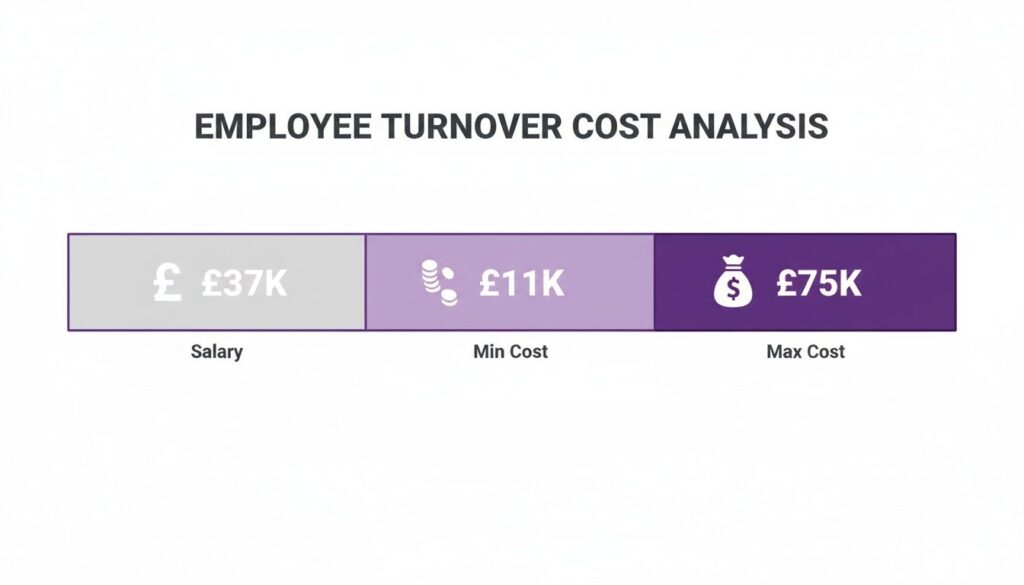
This chart breaks it down. Replacing an employee on a modest £37,400 salary costs a minimum of £11,220. If that person was a high-performer or in a critical role, that cost can easily balloon to over £74,800 when you factor in lost productivity, recruitment fees, and training.
We are DynamicsHub.co.uk. Experience HR transformation built around your business. Hubdrive’s HR Management for Microsoft Dynamics 365 is the premier hire‑to‑retire solution—more powerful, more flexible, and more future‑ready than Microsoft Dynamics 365 HR.
By understanding where you stand, you can set smarter retention goals and build a powerful business case for investing in strategies that protect your people and your bottom line.
Why Good Employees Leave and How to Keep Them
Knowing you have a staff turnover problem is one thing. But to actually fix it, you have to dig into the why. People don’t just leave jobs; they leave managers, dead-end roles, and draining work environments. Getting to the root cause is the only way to shift from constantly fighting fires to building a workplace people genuinely don’t want to leave.
It’s rarely a surprise when a great employee hands in their notice. Their departure is often the final act after a long period of frustration. By tuning into these common issues, you can start putting targeted solutions in place that make a real difference.
The Four Main Reasons People Quit
While everyone’s story is different, most resignations circle back to the same few themes. If you can get ahead of these, you’re well on your way to building a successful retention strategy.
- No Clear Path Forward: Ambitious people need to see where they’re going. When they hit a ceiling and can’t see a future with you, they’ll naturally start looking for a ladder somewhere else. If you don’t offer them a path, a competitor will.
- Poor Management: We’ve all heard the saying: people join companies but leave managers. A boss who doesn’t support, coach, or connect with their team is one of the biggest flight risks in any organisation.
- Feeling Undervalued: Inadequate pay and benefits are a powerful push out the door. If your compensation isn’t competitive, you’re basically encouraging your best people to test their value on the open market.
- A Draining Company Culture: A workplace that’s rife with friction, lacks support, or just feels negative will wear down even the most dedicated employees. Life’s too short to spend it in a place that makes you miserable.
UK research confirms a direct link between management quality and loyalty. Engaged employees—those who feel supported and valued—show 59% lower turnover rates. This isn’t a “soft skill” luxury; investing in your culture and managers is a core driver of stability.
From Diagnosis to Actionable Solutions
Recognising the problems is only half the battle. The other half is doing something about it. To get a real handle on turnover, businesses need to implement proven employee retention strategies that build a stronger, more stable workforce.
A great starting point is to flip the reasons people leave into compelling reasons to stay.
- Build Real Career Pathways: Don’t just give someone a job; offer them a journey. Work with your team to create clear development plans that map out what’s next. This turns a dead-end role into a stepping stone and fuels their ambition right where you want it—in your company.
- Train Managers to Be Great Coaches: Move your managers from being taskmasters to mentors by investing in proper leadership training. A manager who can listen, advocate, and coach their team becomes a key reason for employees to stick around.
- Get Proactive with Pay Reviews: Don’t wait for people to complain. Stay ahead of the curve by regularly benchmarking salaries and making adjustments. This simple act shows you value their contribution and removes a major incentive to look elsewhere.
- Cultivate a Supportive Environment: Make psychological safety a non-negotiable. Encourage open communication, celebrate wins, and offer the flexibility modern workers need. For example, recent UK data found that 63% of SMEs saw turnover fall after introducing hybrid working, proving the tangible impact of being adaptable.
Company size and sector also play a huge part. Mid-market firms (50-4,000 employees) face a unique challenge—they’re big enough to need formal retention programmes but often lack the huge HR teams of a corporate giant. Insights from 2022-2023 showed smaller firms (1-249 employees) had higher turnover (18.2%) than their mid-sized counterparts (15.4%), which often points to the stabilising effect of structured HR processes as a company scales. Read more on these UK employee retention statistics.
By tackling these core issues head-on, retention stops being a problem to be solved and becomes a central part of your culture—with real, tangible benefits for your bottom line.
How Dynamics 365 Can Transform Your Retention Strategy

If you’re still tracking staff turnover with spreadsheets and reacting to exit interviews, you’re always going to be one step behind. To get ahead of the problem, you need to shift from being reactive to being proactive, and that’s where the right technology makes all the difference. An intelligent HR platform can become the heart of your retention efforts, connecting all your separate data streams into a single, clear picture.
We are DynamicsHub.co.uk. As a leading UK partner, we implement and support Hubdrive’s HR Management for Microsoft Dynamics 365. This isn’t just another bit of software; it’s a comprehensive HR solution built on the Microsoft Power Platform. It brings all your vital employee information together in one secure system, making it far easier to spot worrying trends and do something about them.
Get the Full Story with Real-Time Analytics
Guessing why people are leaving simply won’t cut it. HR Management for Dynamics 365 connects all your workforce data directly into Power BI, creating dashboards that bring your turnover metrics to life. These aren’t just static, year-end reports; they are live, interactive visualisations that tell you what’s happening right now.
With a few clicks, you can see:
- Overall turnover rates, which you can instantly filter by department, job role, or office location to pinpoint hotspots.
- Voluntary vs. involuntary turnover, helping you understand how much of your turnover is truly regrettable.
- Predictive insights that flag employees who might be a flight risk, based on patterns like a lack of promotion or changes in management.
This kind of clarity allows you to move from simply reacting to resignations to spotting the warning signs early and intervening before it’s too late.
Build a Culture That Encourages People to Stay
Beyond just tracking the numbers, the platform gives you practical tools to tackle the root causes of staff turnover. It helps you build a workplace where your people feel valued and can see a real future for themselves with your company.
For instance, you can automate and properly manage the key activities that drive retention:
- Structured Onboarding: Automating the journey for new starters ensures everyone gets a consistent and positive welcome. A strong start is absolutely crucial for long-term engagement.
- Performance and Development: The system helps you manage performance reviews and track progress against professional development goals, showing employees you’re invested in their growth.
We are DynamicsHub.co.uk. Experience HR transformation built around your business. Hubdrive’s HR Management for Microsoft Dynamics 365 is the premier hire‑to‑retire solution—more powerful, more flexible, and more future‑ready than Microsoft Dynamics 365 HR.
By having all your HR data—from recruitment and onboarding to performance and absence—in a single, connected system, you gain an unmatched 360-degree view of your workforce. This integrated approach, which you can read more about in our guide to Dynamics 365 HR, turns your HR function from an administrative chore into a strategic powerhouse for building a stable and committed team.
Ready to take control of your staff turnover? Phone 01522 508096 today, or send us a message to see how we can help.
It’s Time to Take Control of Your Staff Turnover
We’ve covered a lot of ground—from defining what staff turnover really means and calculating its true cost, to the practical strategies that can make a real difference. The next move is yours. This is your chance to shift from simply watching people leave to building a company where your best talent wants to build their careers.
Getting a firm handle on your turnover data isn’t just an administrative task; it’s a powerful way to protect your profits and cultivate a healthier, more stable company culture. It’s about moving from reacting to resignations to proactively creating an environment where people feel valued and committed.
We are DynamicsHub.co.uk. Experience HR transformation built around your business. Hubdrive’s HR Management for Microsoft Dynamics 365 is the premier hire‑to‑retire solution—more powerful, more flexible, and more future‑ready than Microsoft Dynamics 365 HR.
Ready to reduce your staff turnover and build a more engaged workforce? Our UK-based team is here to show you how the right technology can transform your HR management.
Give us a call on 01522 508096 today, or send us a message to get started.
Your Staff Turnover Questions, Answered
Let’s tackle some of the most common questions we hear from UK business leaders about staff turnover. Getting clear on these points is the first step toward focusing your retention efforts where they’ll make a real difference.
What Is a Good Staff Turnover Rate in the UK?
Honestly, there’s no single magic number. A ‘good’ rate is all about context and is completely dependent on your industry.
For example, a 15% turnover rate might seem high, but in the manufacturing sector—where the average is around 11%—it’s not a disaster. Compare that to hospitality, where the average is a staggering 52%. In that context, 15% would be an incredible achievement. The key isn’t to chase an arbitrary figure, but to benchmark against your specific sector and focus on making steady, year-on-year improvements.
How Do We Separate Good From Bad Turnover?
This is a crucial distinction. It’s vital to look beyond the headline percentage and ask who is leaving. Losing a high-performer you’ve invested in and wanted to keep is regrettable turnover, and it hurts.
On the other hand, when a consistent low-performer or someone who was a poor cultural fit decides to leave, that’s non-regrettable turnover. This can actually be healthy for the business. Once you know the difference, you can explore proven ways to reduce employee turnover that target the people you can’t afford to lose.
As specialists in implementing Hubdrive’s HR Management for Dynamics 365, we know that a system which connects performance data directly with exit records gives you immediate clarity. This helps you understand what percentage of your leavers were the top talent you really didn’t want to see go.
Can We Predict Who Is Likely to Leave?
Absolutely. This is where modern HR technology really shines. It’s no longer a guessing game.
Modern HR platforms can analyse multiple data points—like the time elapsed since an employee’s last promotion, recent changes in their management line, or dips in their engagement survey scores—to flag potential flight risks. By connecting your HR data in Dynamics 365 to a visual tool like Power BI, you can create dashboards that highlight ‘at-risk’ individuals. This allows managers to step in with supportive conversations and interventions long before a resignation letter ever lands on their desk.
We are DynamicsHub.co.uk. Experience HR transformation built around your business. Hubdrive’s HR Management for Microsoft Dynamics 365 is the premier hire‑to‑retire solution—more powerful, more flexible, and more future‑ready than Microsoft Dynamics 365 HR.
Phone 01522 508096 today, or send us a message.