Getting the contract of employment right is the bedrock of good HR management in the UK. The type of contract you choose—whether it’s permanent, fixed-term, or something more flexible—sets the tone for the entire relationship with your team. It defines everything from legal duties and rights to the practicalities of day-to-day work.
Choosing the Right UK Employment Contract

Think of an employment contract as the blueprint for a professional relationship. You wouldn’t build a garden shed and a skyscraper from the same set of plans, and the same logic applies here. You can’t just use one type of contract for every single role. Each is built for a specific purpose, offering a unique balance of security, flexibility, and commitment for both you and your employee.
This isn’t just about ticking a legal box; it’s about strategically building a workforce that actually helps you achieve your business goals. A growing tech start-up, for example, will want permanent contracts for its core developers to secure long-term commitment. On the other hand, a retail business heading into the Christmas rush will lean on fixed-term or casual staff to handle the surge without overcommitting.
Why Your Contract Choice Matters
This decision has a real impact across your business. A poorly chosen contract can quickly lead to legal headaches, unhappy staff, and a mountain of admin. Getting it right from day one creates clarity and protects everyone involved.
Here’s why it’s so important:
- Legal Compliance: Every contract type has its own set of rules for things like holiday pay, notice periods, and protection from unfair dismissal. You have to get these right.
- Operational Efficiency: The right contract makes life easier. It simplifies payroll, makes rostering a breeze, and clarifies benefits administration—especially if you’re managing it all in a central HR system.
- Financial Planning: Your choice directly affects your bottom line, influencing everything from National Insurance contributions to your auto-enrolment pension duties.
- Employee Engagement: When a contract reflects the reality of the job, it builds trust. It helps you attract the right people and, more importantly, keep them.
It’s no surprise that permanent contracts are the most common arrangement in the UK. Back in 2022, they accounted for 95% of all working-age employees—that’s around 25 million people. Only a small fraction, about 5%, were on temporary contracts.
To help you get your head around the different options, here’s a quick rundown of the main contract types you’ll encounter in the UK.
Quick Overview of UK Employment Contract Types
| Contract Type | Best For | Key Feature |
|---|---|---|
| Permanent | Core, long-term roles and business stability. | No end date; offers maximum job security. |
| Fixed-Term | Covering maternity leave, specific projects, or seasonal peaks. | Ends on a specific date or when a task is complete. |
| Zero-Hours | Unpredictable workloads or when staff are needed on an ad-hoc basis. | No guaranteed hours; work is offered as it becomes available. |
| Agency/Umbrella | Sourcing specialist skills quickly or for short-term cover. | The individual is employed by the agency, not your company. |
| Freelance/Contractor | Engaging self-employed specialists for specific projects or services. | A contract for services, not employment. IR35 rules are critical here. |
This table is just a starting point. Each of these contracts comes with its own set of legal and operational nuances. If you’re trying to decide what’s best for your business, it’s worth exploring a comprehensive comparison of contract, freelance, and full-time roles to see the finer details.
Decoding Permanent and Fixed-Term Contracts
When you’re building a team, you’ll find that permanent and fixed-term contracts are the two main building blocks you’ll work with. Getting to grips with what makes them different is absolutely crucial for creating a workforce that’s stable, compliant, and runs like clockwork. Think of it as the difference between hiring for the long haul versus bringing in a specialist for a specific mission.

Deciding between these types of contract of employment is more than just a box-ticking exercise; it’s a strategic move. One fosters stability and lets people bed into your company culture, while the other gives you targeted expertise without a long-term financial commitment. Let’s break down what each one really means for your business.
The Bedrock of Stability: Permanent Contracts
A permanent contract is the default, the gold standard of employment in the UK. It’s open-ended, meaning it keeps going until either you or the employee decides to end it by giving proper notice. This inherent stability is why it’s the go-to for all your core business roles.
Whether someone works full-time or part-time, a permanent contract gives them the full package of employment rights, although some protections, like unfair dismissal, only kick in after they’ve been with you for a certain amount of time.
Here are the key features you need to know:
- Job Security: This is the big one. Employees have ongoing work, which gives them a huge amount of financial and professional peace of mind.
- Full Employment Rights: They get the works—statutory sick pay, maternity/paternity leave, and protection against unfair dismissal after two years of continuous service.
- Pension Auto-Enrolment: You have a legal duty to enrol your eligible permanent staff into a workplace pension.
- Statutory Notice Periods: Clear, legally defined notice periods apply if either party decides to terminate the contract.
By their very nature, permanent contracts build loyalty and give people the space to grow with the business. They are the only way to build a truly consistent team culture and hold onto that precious institutional knowledge—a massive competitive advantage.
Managing these contracts means you need a system that can handle the entire journey, from onboarding and performance reviews right through to a smooth offboarding process. This is where a proper HR platform becomes indispensable. A solution like Human Resource HR Management for Microsoft Dynamics 365 lets you manage all your permanent employee data, track performance, and handle benefits, all within the familiar Microsoft environment your team probably uses every day.
The Strategic Solution: Fixed-Term Contracts
A fixed-term contract, on the other hand, is designed for a specific timeframe. It has a clear end point: a set date, the completion of a project, or when a particular event happens (like an employee returning from maternity leave).
These contracts are incredibly useful for plugging temporary gaps without adding to your permanent headcount. You might use one to cover a long-term absence, handle a seasonal rush, or bring in specialist skills for a one-off project.
But you have to manage them carefully to stay on the right side of the law. The Fixed-term Employees (Prevention of Less Favourable Treatment) Regulations 2002 exist specifically to protect these workers. In simple terms, you can’t treat a fixed-term employee worse than a comparable permanent employee when it comes to pay, benefits, or training, unless you have a very good, objective reason for doing so.
Preventing Unfair Treatment and Permanent Status
There are two critical rules to keep in mind. First, you must ensure they’re treated equally. For instance, a fixed-term employee should have access to the company pension scheme and be told about any permanent vacancies that come up.
Second, watch out for the “four-year rule.” If you’ve kept someone on a series of back-to-back fixed-term contracts for four years or more, they may automatically become a permanent employee. The only way around this is if you can prove there’s a solid business reason for keeping them on a fixed-term basis.
This automatic conversion is exactly why precise tracking is so important. A good HR system can fire off alerts as a contract end date looms or as an employee gets close to that four-year mark. Within the Hubdrive solution, for example, expiry dates are logged against employee records. This allows HR managers to run reports and set up notifications, so you can proactively manage renewals or transitions to permanent status and avoid any accidental non-compliance.
This kind of proactive management ensures you’re using different types of contract of employment strategically, while treating every single member of your team fairly and legally.
Getting to Grips with Flexible and Atypical Contracts
While permanent and fixed-term contracts are the bedrock of many organisations, the modern workforce is built on agility. Flexible working isn’t just a ‘nice-to-have’ anymore; it’s a core expectation. This has given rise to a whole host of different employment contracts designed to meet that need. Getting your head around these arrangements is the key to building a team that’s both resilient and dynamic.
These contracts break the mould of the traditional 9-to-5 week, offering a more adaptable approach for everyone. They’re particularly powerful in sectors with fluctuating demand – think hospitality, retail, or logistics – or for any business that needs to tap into a talent pool on an as-needed basis.
But with all this flexibility comes a new layer of complexity. Managing payroll, scheduling, and legal rights for a workforce on varied contracts requires a sharp eye and the right systems in place.
Zero-Hours vs. Casual Contracts: What’s the Real Difference?
This is easily one of the most common points of confusion for employers, but the distinction is crucial. While they both offer flexibility and don’t guarantee hours, their legal standing and the expectations they set are worlds apart.
A zero-hours contract is a formal employment arrangement. The employer isn’t obliged to offer a minimum number of hours, and the individual isn’t obliged to accept any work they’re offered. Despite this, people on zero-hours contracts are classed as ‘workers’ and are entitled to statutory rights like the National Minimum Wage and paid holiday.
One vital point to remember is that since 2015, exclusivity clauses in zero-hours contracts have been banned. This means you can’t stop a zero-hours worker from taking on a job with another company.
On the other hand, a casual contract is for people who work for you on a genuinely ad-hoc basis. Imagine a freelance photographer you might call on a few times a year. There’s no ongoing employment relationship or what’s legally termed “mutuality of obligation”—you don’t have to offer them work, and they have no obligation to accept it when you do.
Getting the classification right isn’t just about semantics; it directly impacts an individual’s rights and your legal responsibilities. Misclassifying a casual arrangement as zero-hours, or vice-versa, can lead to some serious compliance headaches down the line.
Other Flexible Working Models
Beyond those two, there are several other types of employment contracts that offer creative ways to structure work.
- Annualised Hours Contracts: Here, an employee agrees to work a set number of hours over a full year, but how those hours are spread out can vary. This is perfect for businesses with predictable seasonal peaks, letting you schedule more hours during busy spells and fewer in quiet periods, all while the employee receives a stable, consistent monthly salary.
- Job Sharing: This is an arrangement where two people split the responsibilities, pay, and hours of a single full-time role. It’s a fantastic way to retain experienced staff who might be looking to reduce their hours, providing seamless cover for the role throughout the week.
The demand for these kinds of setups is soaring. Flexible working hours are now the most common type of flexible employment in the UK, with around 4.23 million employees using this model to strike a better work-life balance. You can dig deeper into this trend by exploring the data on flexible employment contracts.
Turning Complexity into Clarity
Let’s be honest: managing these varied and often complex working arrangements can create major operational headaches. Rostering can feel like a game of Tetris, calculating holiday pay for workers with irregular hours is a minefield, and keeping payroll accurate is a constant battle. This is where a robust, integrated HR system becomes non-negotiable.
At DynamicsHub.co.uk, we provide transformative HR solutions customised to the unique way you work. Human Resource HR Management for Microsoft Dynamics 365 by Hubdrive is the leading hire-to-retire solution built on the Microsoft Platform, designed to handle the complexities of a diverse workforce with ease.
For example, our time and attendance modules can accurately capture every hour worked and feed that data straight into payroll. This wipes out manual errors and ensures everyone is paid correctly and on time, no matter their contract type. What’s more, by using integrated tools like Power BI, HR managers can generate clear reports on workforce distribution, labour costs, and scheduling efficiency. This turns a mountain of complex data into clear, actionable insights, allowing you to manage your flexible workforce fairly, accurately, and strategically.
Navigating Agency and Self-Employed Agreements
Beyond your core team of employees, many UK businesses tap into the flexibility of agency workers and self-employed contractors. These arrangements are fantastic for filling skill gaps, managing unpredictable workloads, or driving specific projects. But they also bring a whole different set of rules and compliance risks to the table. Getting your head around these distinct contract types is vital to protect your business.
The Agency Worker Triangle
Bringing an agency worker on board creates a unique three-way relationship: there’s your business (the hirer), the recruitment agency, and the worker. It’s easy to think that because the worker’s contract is with the agency, you’re off the hook for responsibilities. That’s a common misconception.
The key piece of law you need to know is the Agency Workers Regulations 2010 (AWR). These rules exist to give agency workers the same basic employment conditions as your direct hires after they’ve been in the same role for 12 weeks.
Once that 12-week qualifying period is up, the agency worker is legally entitled to:
- The same rate of pay, including any work-related bonuses or commission.
- The same working hours, overtime rules, and rest breaks.
- The same annual leave allowance as your permanent staff.
Even before the 12 weeks are up, they have rights from day one. This includes access to shared facilities like the staff canteen or car park, and they must be told about any permanent job vacancies in your company.
Diving into the World of Self-Employed Contractors
When you engage a freelancer or a self-employed contractor, you’re entering into a business-to-business agreement. You’re a client paying for a service, not an employer hiring a staff member. This distinction is absolutely crucial.
Genuine contractors are responsible for their own tax and National Insurance. They aren’t entitled to statutory rights like holiday pay or sick pay. The big risk here, however, is misclassification – where someone is treated as self-employed but, in reality, functions more like an employee in the eyes of HMRC. This is where the infamous IR35 rules come into play.
IR35, also known as the ‘off-payroll working rules’, is designed to tackle tax avoidance through what HMRC calls ‘disguised employment’. If a contractor’s working arrangement with a client looks like an employer-employee relationship, then IR35 applies, and they should be taxed accordingly.
Getting this wrong can have serious financial repercussions. For medium and large businesses, the responsibility for determining the contractor’s IR35 status falls on you, the client. An incorrect decision could leave you liable for a hefty bill of unpaid taxes and penalties. For those working as contractors, it’s also important to present this experience professionally; you can find helpful tips on effectively listing self-employment on a resume to showcase your projects.
This decision tree gives a simple way to think through your options when you know you need a more flexible working arrangement.
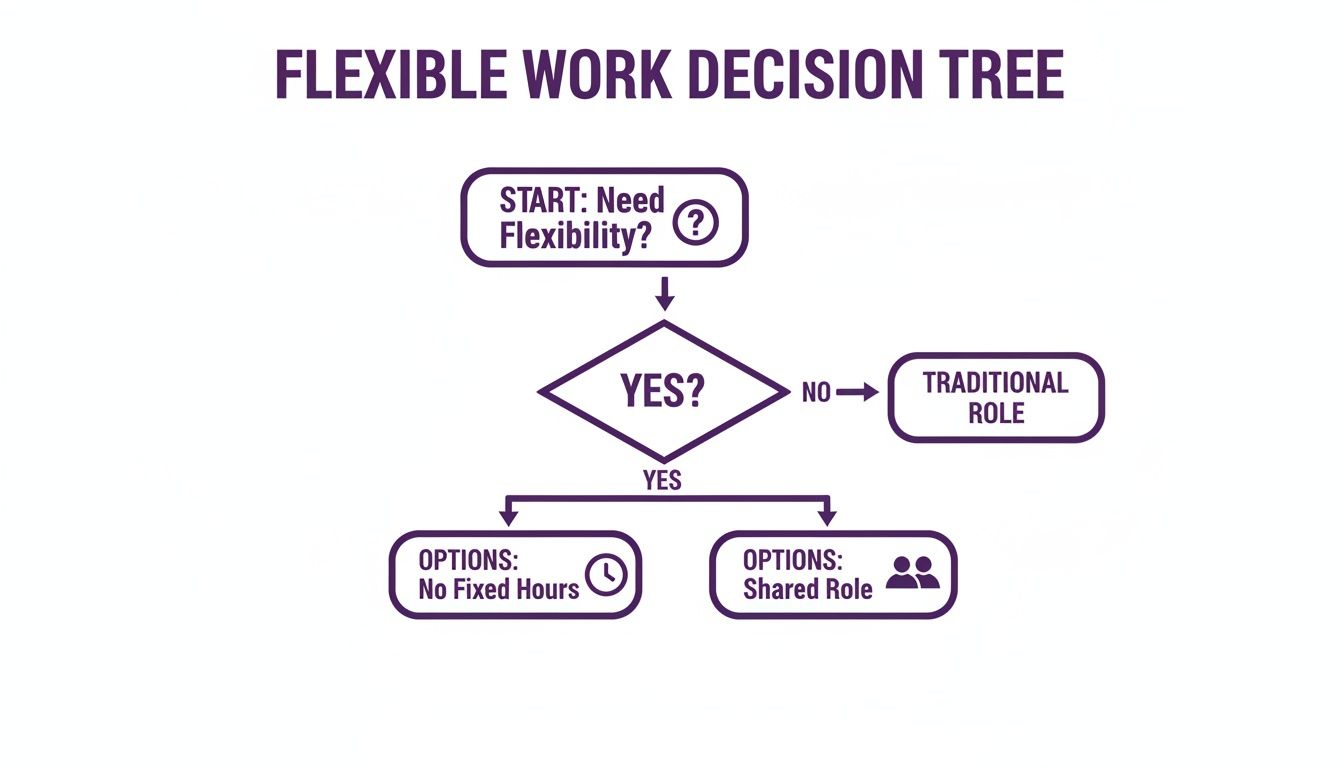
As you can see, once flexibility is the goal, the path splits between changing the hours worked (like a zero-hours contract) or changing the role itself (like a job share).
Mitigating Risks with a Central HR System
Managing the paperwork and compliance for non-permanent workers is a huge administrative task. You need to check their right to work in the UK, handle contracts, and, for contractors, keep detailed records to justify your IR35 decisions.
This is where having a proper system in place can be a game-changer. An HR platform built for this complexity, like Human Resource HR Management for Microsoft Dynamics 365 by Hubdrive, can make all the difference. It includes features like an integrated UK Right to Work module, allowing you to manage all the necessary checks and store documents securely within your own Microsoft 365 environment. This creates a solid audit trail and removes the guesswork.
Using a robust contractor management system allows you to confidently handle the admin that comes with these flexible working models.
Putting Different Contract Types into Practice
Knowing the theory is one thing, but the real test for any HR leader is managing the day-to-day reality of a workforce built on different contract types. The mix of employment contracts you use has a direct ripple effect across all your core HR functions. To keep everything fair, compliant, and running smoothly, you need distinct approaches for everything from recruitment and onboarding to payroll and offboarding.
Think of it this way. Onboarding a permanent, full-time employee is a deep-dive. It’s a comprehensive process involving a thorough induction, setting up long-term benefits, and really embedding them in the company culture. By contrast, getting an agency worker started is a much lighter touch – it’s functional, focused on immediate project needs and getting them the right system access.
Each journey is different, and your HR operations have to be agile enough to handle them all. A one-size-fits-all approach just won’t cut it when you’re juggling permanent staff, fixed-term specialists, and casual workers.
Tailoring HR Processes for Each Contract Type
To effectively manage a diverse workforce, you absolutely have to tailor your core HR processes. This isn’t just about being efficient; it’s about giving everyone a consistent and positive experience, regardless of what their contract says.
Here’s a look at how key functions need to adapt:
- Recruitment and Onboarding: Sourcing a permanent hire means in-depth interviews and careful assessments of cultural fit. For a fixed-term contractor, the focus shifts squarely to their specific project skills. Your onboarding workflows need to reflect this, with automated processes delivering the right information at the right time. For example, thorough background screening is often crucial, and you can learn more about managing these critical pre-employment checks in our detailed guide.
- Time Tracking and Payroll: This is where the complexity really bites. For salaried staff, payroll is relatively straightforward. But for a zero-hours worker, it demands meticulous time tracking to capture every single hour and calculate accrued holiday pay correctly. Get it wrong, and you’re in breach of the law.
- Performance and Engagement: You manage a permanent employee’s performance through long-term development plans and career goals. For a fixed-term worker, it’s all about hitting project milestones on schedule. Your engagement strategies also need to be inclusive, making sure that non-permanent staff feel valued and part of the team.
- Offboarding: When a fixed-term contract ends, it requires proactive management. You need to handle the end date, arrange knowledge transfer, and sort out final payments. For a permanent employee leaving the business, the process is more about exit interviews and final payroll calculations.
The Challenge of Flexible Contracts
Zero-hours contracts, while offering employers ultimate flexibility, bring their own unique management headaches. These arrangements give you no guaranteed minimum hours, which can be a lifeline in uncertain economic times.
However, data from the ONS highlights a trade-off in job quality. Zero-hours workers often report lower satisfaction, higher insecurity, and less access to training. In fact, over 20% cite a poor work-life balance, double the rate for those on standard contracts. You can explore the full findings from the ONS on job quality indicators for zero-hours contracts.
Managing this flexibility without compromising worker well-being is a fine art. It demands fair scheduling practices, clear communication, and robust systems to ensure people are treated equitably and their rights are always protected.
How a Central HR System Gives You Control
Trying to juggle these varied requirements with spreadsheets and manual processes is a recipe for mistakes and compliance nightmares. This is where an integrated HR solution becomes not just helpful, but essential.
The Human Resource HR Management solution for Microsoft Dynamics 365 by Hubdrive, which we implement and support here at DynamicsHub.co.uk, is designed to handle this very complexity. It provides the tools you need to streamline the management of every type of employment contract:
- Automated Onboarding Workflows: You can create custom onboarding checklists for each contract type, making sure every new starter gets the right information and completes the necessary paperwork automatically.
- AI-Assisted Time Management: Simplify time tracking for hourly and flexible workers. The system has features that feed directly into payroll, guaranteeing accuracy and slashing the administrative burden.
- Centralised Employee Records: Maintain a single source of truth for every individual. You get clear visibility of their contract type, key dates, and all their documentation, stored securely within your Microsoft environment.
By automating these processes, you can create a consistent, fair, and positive experience for everyone on your team, no matter how they work with you.
Let’s Get Your Contracts Right with DynamicsHub
Picking the right employment contracts isn’t just an admin task—it’s a core part of your business strategy. It shapes everything from your legal exposure and company culture to your bottom line. Get it wrong, and you’re navigating a minefield of compliance risks. But get it right, and you build a workforce that’s both stable and flexible enough to adapt to anything.
Juggling all these different contract types, rights, and payroll rules quickly outgrows even the most complex spreadsheets. You need a system built for the job.
That’s where we come in. At DynamicsHub.co.uk, we provide transformative HR solutions customised to the unique way you work. Human Resource HR Management for Microsoft Dynamics 365 by Hubdrive is the leading hire-to-retire solution for the Microsoft Platform.
Think about it: one system to handle onboarding, track time, and run payroll for every single contract type, all inside the familiar Microsoft environment your team already knows. No more patching together different tools. Just seamless, compliant, and efficient HR.
If you’re ready to stop wrestling with paperwork and start managing your people with genuine confidence, let’s have a chat.
Phone 01522 508096 today, or send us a message to book a consultation. Let’s build a better way to manage your workforce, together.
Got Questions? We’ve Got Answers
When you’re dealing with the nuts and bolts of employment contracts, a lot of specific questions can pop up. Let’s tackle some of the most common queries we hear from HR managers and business owners across the UK.
What’s the Real Difference Between a ‘Worker’ and an ‘Employee’?
This is a big one, and getting it wrong can be costly. In the UK, the law doesn’t just see people as “employed” or “not employed.” There are actually three main categories: employee, worker, and self-employed. The distinction is crucial because it dictates the rights and protections a person is entitled to.
Think of it as a spectrum of rights. On one end, you have an employee. These are your team members with a full contract of employment. They get the whole package of statutory rights – things like minimum notice periods, statutory redundancy pay, and protection from unfair dismissal after two years.
In the middle, you’ll find the worker. This category often includes people on zero-hours or casual contracts. They agree to do work personally but have fewer rights than an employee. They’re still entitled to the fundamentals, like the National Minimum Wage, paid holidays, and protection from discrimination. What they don’t get are things like statutory redundancy pay or the right to claim unfair dismissal.
Finally, at the other end of the spectrum, you have the self-employed. These individuals are their own boss, running their own business and providing services to clients. Their relationship is based on a contract for services, not a contract of employment, which means they have the fewest employment rights.
Can a Fixed-Term Contract Just… Become Permanent?
Absolutely, and it’s something you need to watch. There’s a piece of legislation called the Fixed-term Employees Regulations 2002, which includes what’s often called the ‘four-year rule’.
Here’s how it works: if you have someone on a series of back-to-back fixed-term contracts, and they hit four years of continuous service, the law automatically treats their contract as a permanent one. The only way around this is if you can show a solid, objective business reason for keeping them on a fixed-term basis.
This automatic switch is a major compliance trap. If you’re not carefully tracking contract end dates and total service length, you could find yourself with permanent employees you hadn’t planned for, which has a real impact on your headcount and budgets.
What Do I Owe Part-Time Staff in Terms of Benefits?
The law here is crystal clear: you cannot treat your part-time workers less favourably than your full-time staff. This isn’t just a nice-to-have; it’s a legal requirement that covers every part of their employment, from pay right through to perks.
This means you must provide benefits on a pro-rata basis. It’s all about fairness and proportionality. For instance:
- Pay: Their hourly rate must be the same as a full-timer doing the same or broadly similar work.
- Holidays: They get the same holiday entitlement, just calculated in proportion to the hours they work.
- Pensions: They must have the same access to your company pension scheme as everyone else.
- Opportunities: They need to be given the same shot at training and promotion.
Falling short on this can easily lead to a discrimination claim at an employment tribunal, so it’s vital to get it right.
We are DynamicsHub.co.uk. We provide transformative HR solutions customised to the unique way you work. Human Resource HR Management for Microsoft Dynamics 365 by Hubdrive is the leading hire-to-retire solution for the Microsoft Platform.
To make managing all your contract types simple and stay fully compliant, phone 01522 508096 today, or send us a message.