Imagine your business loses a key leader tomorrow. Is there a clear successor ready to step in, or would it trigger a scramble to hire externally? That's the million-pound question succession planning answers.
At its core, succession planning is the forward-thinking process of identifying the most crucial roles in your company and intentionally developing your own people to fill them. It’s far more than just having a name in a file for an emergency replacement. It's about systematically building a pipeline of future leaders to ensure your business doesn't just survive, but thrives through any transition.
This strategic approach shifts you from reactive panic-hiring to proactive, thoughtful talent cultivation. You’re building a resilient workforce from the inside out.
Getting to the Heart of Succession Planning
Forget seeing succession planning as a stuffy HR task. Think of it as a living blueprint for your company’s future. It’s a continuous cycle that aligns your people strategy directly with your long-term business objectives. This isn't just about finding the next CEO; it’s about methodically grooming high-potential employees to take on all sorts of vital roles across the entire organisation.
The real goal here is to prevent those crippling leadership vacuums that can derail operations, sink morale, and create widespread instability. By nurturing your future leaders today, you guarantee a smooth, seamless handover tomorrow. This keeps invaluable institutional knowledge within your walls and maintains your competitive momentum.
Why It's Now Mission-Critical for UK Businesses
For businesses across the UK, this kind of strategic foresight is no longer a luxury—it’s a fundamental necessity. We're navigating a tough landscape of skills shortages, an ageing workforce, and fierce competition for talent. Without a solid plan, a company is left dangerously exposed when a key person walks out the door.
A well-executed plan also has a powerful impact on keeping your best people. To build a stronger, more committed team, it's worth exploring proven employee retention strategies.
The statistics paint a worrying picture of an internal talent gap. Recent data shows UK companies are heavily reliant on external hires for top jobs. A staggering 52% of new FTSE 100 chief executives and 62% of FTSE 250 leaders were recruited externally last year. These figures dwarf those in the USA (27%) and Germany (23%), highlighting a serious shortfall in developing leaders from within.
A well-structured succession plan acts as the ultimate insurance policy for your most valuable asset—your people. It secures long-term growth by ensuring you always have the right people with the right skills ready to lead.
To see how this fits into the bigger picture, it helps to understand its link to workforce planning. A modern succession plan is a vital component of a broader strategy, which you can learn more about in our detailed guide on https://www.dynamicshub.co.uk/2025/12/21/workforce-planning-definition/.
The following table provides a quick snapshot of the two different approaches to talent management.
Succession Planning at a Glance
| Component | Proactive Succession Planning (The Goal) | Reactive Hiring (The Risk) |
|---|---|---|
| Focus | Long-term capability & talent pipeline | Short-term vacancy filling |
| Cost | Investment in development & retention | High recruitment fees & onboarding costs |
| Transition | Smooth, planned & seamless | Disruptive, abrupt & risky |
| Culture | Boosts morale, loyalty & engagement | Creates uncertainty & damages morale |
| Knowledge | Institutional knowledge is preserved & transferred | Critical knowledge is often lost |
As you can see, the difference is stark. One is about building a stable future, while the other is about constantly fighting fires.
Key Components of a Modern Plan
A robust succession plan is built on several interconnected pillars:
- Identifying Critical Roles: First, you need to pinpoint the positions whose absence would cause the most significant disruption to your operations or strategy.
- Defining Competencies: What does success look like in these roles? You need to clearly outline the essential skills, experience, and leadership qualities needed—not just for today, but for where the business is headed.
- Assessing Potential: It’s time to evaluate your internal talent pool. This should be based on objective performance data, skill assessments, and a keen eye for leadership potential.
- Creating Development Pathways: Once you've identified your rising stars, you need to design personalised development plans. These often include a mix of formal training, mentorship, and "stretch" assignments to bridge any skill gaps.
- Monitoring and Reviewing: This isn't a one-and-done exercise. The plan needs to be a living document, regularly reviewed to track progress and adapt to evolving business needs.
By weaving this process into the fabric of your organisation, you create a culture of growth and internal mobility. You show your best people that there's a clear path forward for them, which is a powerful motivator to stay and grow with you.
Why Bother With Succession Planning? The Real Business Case
Let's be honest, succession planning can feel like one of those "important but not urgent" tasks that always gets pushed down the to-do list. But thinking of it as just a contingency plan for when someone leaves is missing the point entirely. It’s not a defensive move; it's one of the smartest offensive plays you can make for long-term growth and stability.
When you have a proper plan, you shift from constantly putting out recruitment fires to deliberately cultivating the talent you already have. This is where you start seeing a serious return on your investment.
Think about the direct impact on your budget. Building your next wave of leaders from within means you’re not forking out hefty fees to recruitment agencies, which can easily be 20-30% of a senior hire's annual salary. For a role commanding £80,000, you’ve just saved your business between £16,000 and £24,000 on a single position. On top of that, internal promotions are almost always faster to wrap up than lengthy external searches, meaning you cut down on the time that critical role sits empty and productivity takes a hit.
It’s About More Than Just Filling Seats
A visible commitment to succession planning does wonders for team morale. It sends a clear and powerful message to your people: we see a future for you here. When employees can see a genuine, structured path for their own career progression, their engagement and loyalty go through the roof. It shows you're not just paying them for a job; you're investing in their future.
This is one of the most effective ways to hold onto your best people. Ambitious, high-potential employees are far less likely to have their heads turned by recruiters when they know they're being developed for bigger things right where they are. The result is a more motivated, stable, and ultimately more productive workforce.
A well-communicated succession plan turns the vague idea of a "career ladder" into something tangible and real for your team, creating a culture where people want to grow with you.
This is especially critical for the UK's thousands of family-run businesses. These companies are the backbone of our economy, but the transition of leadership from one generation to the next is often fraught with personal and financial risk. Too many are flying blind.
The statistics are quite telling. While two-thirds of UK family business owners hope to pass the reins to the next generation, only a third have a formal plan to make it happen. Perhaps more alarmingly, nearly 70% have no succession plan at all, despite all the evidence showing that planned businesses are more resilient and grow faster. You can dig into these findings over on SME Today.
Protecting Your Most Valuable—and Fragile—Asset
Beyond the numbers and the morale boost, succession planning acts as the ultimate insurance policy for your company’s institutional knowledge. I'm not just talking about process documents and data. I mean the real-world, hard-won wisdom of "how things actually get done around here"—the critical relationships, the political nuances, and the lessons learned that your key people carry in their heads.
When a seasoned leader walks out the door unexpectedly, that knowledge often goes with them. An external hire, no matter how skilled, can take months or even years to build up that same level of deep-seated understanding. A structured handover, baked right into your succession plan, ensures that invaluable asset is carefully transferred to the next person in line.
This is where modern tools can make a huge difference. For example, a platform like Hubdrive’s HR Management for Microsoft Dynamics 365 helps codify this process. By creating a central hub for performance data, skills tracking, and development plans, it gives you the objective insights needed to spot and groom potential successors. It helps you turn the strategic goal of knowledge transfer into a measurable, manageable reality, so your business continuity is built on solid data, not just wishful thinking.
The Four Core Stages of a Successful Succession Plan
It’s easy to look at succession planning as one giant, intimidating project. That’s a common mistake. A much better way to think about it is as a cycle of four distinct, connected stages. It's less of a straight line and more of a continuous loop that keeps refining and strengthening your leadership pipeline over time.
By breaking it down this way, you can turn a vague strategic goal into something practical and data-driven. Each stage feeds into the next, creating a structured process for spotting, nurturing, and promoting your future leaders. This ensures your plan isn't just a document that gathers dust, but a living strategy that adapts as your organisation evolves.
Stage 1: Identification
The first step is all about getting your bearings. Before you can start developing people, you need to know two things: which roles are absolutely vital for your business, and who has the raw potential to step into them. It all starts with a strategic look at your entire structure.
And this isn't just about the C-suite. We're talking about identifying business-critical roles at every level—the lead engineers, the client-facing specialists, the operational managers whose absence would cause real disruption. Once you’ve mapped those key positions, you can start spotting your high-potential employees (HiPos).
This is where you need to let data do the talking. Relying on a manager's "gut feeling" is a recipe for bias. A modern approach uses hard evidence, pulling from:
- Performance Reviews: Consistent high performance is the bedrock of potential.
- Skills Inventories: What skills does an employee have now versus what a future role will demand?
- Competency Assessments: How do they measure up on things like strategic thinking, problem-solving, and leading others?
Using a central HR system, like Hubdrive’s HR Management for Microsoft Dynamics 365, you can pull all this information into a single talent profile. This lets you run searches for potential successors based on actual data, cutting through the noise and making sure you don’t overlook hidden gems in your teams.
Stage 2: Assessment
Once you have a shortlist of candidates, it’s time to dig deeper and figure out how ready they really are. Assessment goes beyond what they’ve done in the past to what they’re capable of in the future. The big question here is: what’s the gap between this person’s skills today and what the new role will require?
To answer that, you need a solid framework. This usually means having a competency model that clearly lays out the skills, behaviours, and knowledge needed to succeed in your key leadership spots. You can then measure your candidates against this benchmark.
The assessment itself should be fair and multi-dimensional, using different tools to build a complete picture:
- 360-Degree Feedback: Getting honest input from peers, direct reports, and managers gives you a well-rounded view of someone’s leadership style and how they impact those around them.
- Behavioural Interviews: These aren't your typical interviews. They focus on how candidates have handled real-world situations, which is a great indicator of future behaviour.
- Psychometric Testing: Tools that measure cognitive ability and personality traits can add another objective layer to your evaluation.
A crucial output of this stage is a clear picture of specific development needs. This tees you up perfectly for the next stage by helping you build a targeted plan to close any identified skills gaps. We actually have a whole guide on how to conduct a skills gap analysis if you want to dive deeper.
Stage 3: Development
This is where the real work happens. The development stage is usually the longest part of the cycle, where you put personalised plans into action to get your HiPos ready for what’s next. A one-size-fits-all training programme just won’t cut it; every plan needs to be tailored to the individual’s specific needs and career goals.
The best development plans mix and match different kinds of learning experiences:
- Mentoring and Coaching: Pairing a potential successor with a seasoned leader is invaluable. It offers direct guidance, exposure to senior-level thinking, and a safe place to ask tough questions.
- Targeted Training: This could be a formal course on financial management, strategic planning, or public speaking—whatever the assessment stage flagged as a gap.
- Stretch Assignments: Nothing accelerates growth like a tough project outside someone's comfort zone. It’s a real-world test of their abilities and a huge confidence builder.
- Job Rotations: Moving candidates through different parts of the business gives them a much broader understanding of how everything connects, making them more well-rounded leaders.
This infographic neatly sums up the business case for investing in your people's development.
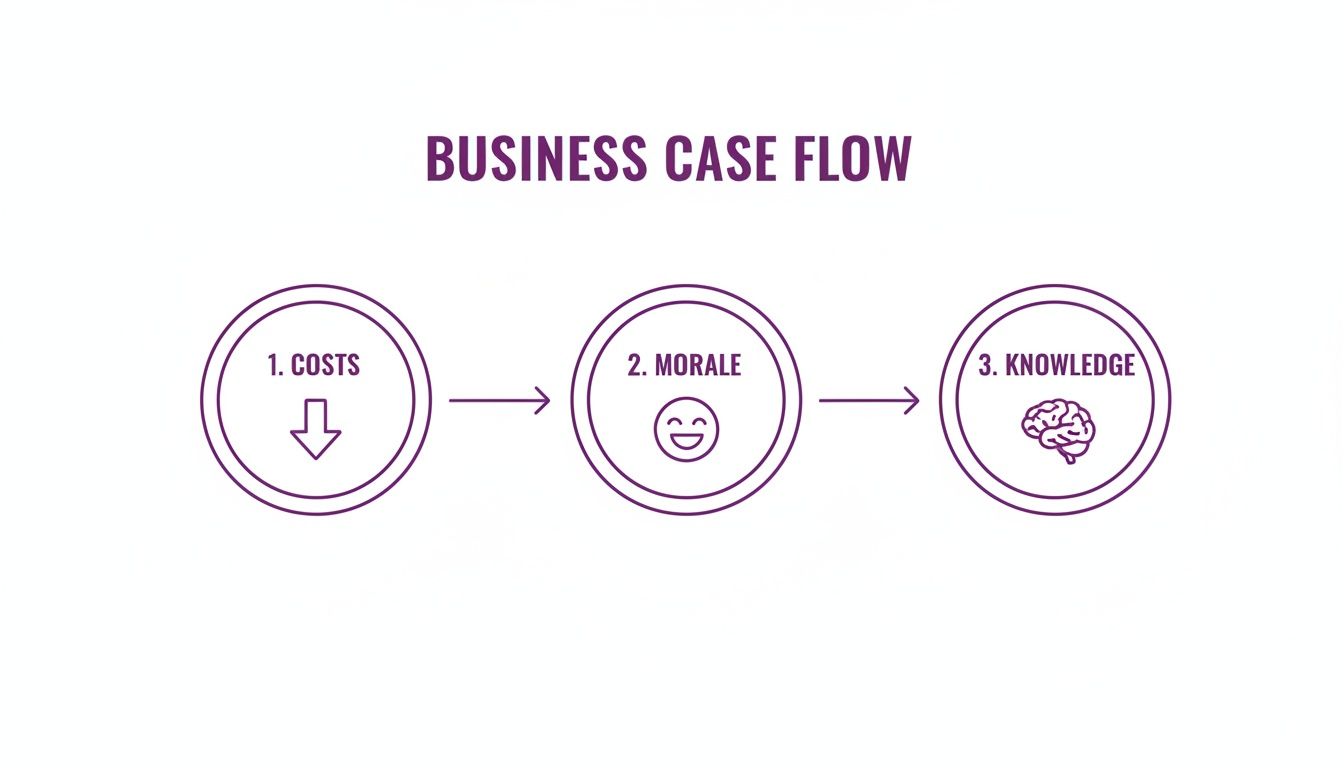
As you can see, a proper development plan does more than just prepare one person. It reduces hiring costs, lifts morale by showing you promote from within, and keeps critical institutional knowledge from walking out the door.
Stage 4: Transition
The final piece of the puzzle is the handover itself. All the work you’ve done leads to this moment, and a smooth transition is absolutely vital for keeping the business on track. A clunky handover can unravel even the best succession plan.
This stage is about more than just announcing a new job title. It’s a carefully managed process that should include:
- A Phased Handover: If you can, have an overlap period where the outgoing leader can transfer crucial knowledge, relationships, and responsibilities directly to their successor.
- Clear Communication: The change needs to be announced clearly to the team, key stakeholders, and clients. This manages expectations and prevents uncertainty.
- Ongoing Support: The new leader will still need support. This often means continued coaching or a formal onboarding plan designed specifically for the leadership level.
By moving through these four stages, succession planning stops being a daunting task and becomes a structured, repeatable process that builds a more resilient and future-ready organisation.
Building Your Leadership Pipeline with Microsoft Dynamics 365
Theory is one thing, but a great succession plan only comes to life when you have the right tools. The first step is to move away from those scattered spreadsheets and static documents. This is where your existing Microsoft environment can become your most powerful asset for managing talent.

With a solution like Hubdrive’s HR Management for Microsoft Dynamics 365, your succession strategy gets embedded directly into the systems your team already uses every day. This approach transforms what can often feel like a theoretical HR exercise into a practical, integrated part of how you do business.
A Single Source of Truth for Talent
The bedrock of any solid succession plan is reliable, centralised data. Without it, you’re flying blind, making critical decisions based on incomplete information or gut feelings. This is where Microsoft Dataverse really shines.
Think of Dataverse as the central nervous system for all your employee information. It creates a complete 360-degree view of each team member by pulling together data from all corners of your organisation:
- Performance Reviews: See who your consistent high-achievers are by tracking historical performance.
- Skills and Competencies: Log qualifications, certifications, and new skills to match expertise with future roles.
- Development Goals: Keep a record of individual career aspirations and see how they're progressing.
- Attendance and Project Data: Gain real insight into reliability and experience on key business initiatives.
This consolidation means that when it’s time to identify potential successors, you’re not hunting through different files and systems. You have one single, reliable source of truth at your fingertips.
Data-Driven Identification and Visualisation
Once your data is all in one place, you can start using it to make genuinely smart decisions. AI-powered features within the system can analyse employee profiles to suggest internal candidates for development, flagging talented people who might have otherwise been overlooked.
This objective, data-led approach is vital for fair and effective planning. It moves the process beyond a simple "manager's choice" and ensures you're considering the entire talent pool based on merit and potential. To take this even further, it’s worth exploring strategies for building a robust talent pipeline, a concept that goes hand-in-hand with effective succession planning.
Things get even better when you integrate this data with Power BI. Suddenly, you're not looking at static reports anymore. You get live, interactive dashboards that visualise your talent pipeline in real-time. You can instantly see:
- The current strength of your leadership bench for critical roles.
- Potential talent gaps that need immediate attention.
- How ready your candidates are in their respective succession pools.
This visual insight allows HR and leadership to shift from reactive problem-solving to proactive, strategic workforce planning. You can spot a potential leadership vacuum months or even years down the line and start doing something about it now.
This trend of embedding planning into day-to-day operations is gaining serious traction across UK sectors. For instance, among Independent Financial Advisers, a significant 73% now include succession planning in their long-term strategies. This shows how an integrated, forward-looking approach gives businesses much better control over their future—a model any company can replicate with the right technology.
Collaboration and Compliance in One Place
Let's be honest, succession planning is a team sport. It requires input from HR, line managers, and senior leadership. Integrating with Microsoft Teams makes this collaboration completely seamless. Development plans can be created, discussed, and managed right inside a dedicated Teams channel, keeping everyone on the same page.
For UK businesses, compliance is absolutely non-negotiable. An integrated HR solution built on the Microsoft stack offers huge advantages here. Important modules, like the UK Right to Work check, are built directly into the system, ensuring you meet Home Office requirements without the headache.
All employee data is managed according to GDPR-aligned retention policies and is secured within your own Microsoft 365 tenant using Microsoft Entra ID. This makes for a compelling case for both HR leaders who need functionality and IT leaders who demand security and compliance. You can learn more about the core platform in our guide on what is Microsoft Dynamics 365.
By using a familiar and secure platform, you turn succession planning into a safe, efficient, and deeply integrated part of your business operations.
Common Pitfalls in Succession Planning and How to Avoid Them
Even with the best of intentions, succession plans can go wrong. It’s one thing to create a plan, but quite another to make it stick. Far too often, a burst of initial energy results in a document that just gathers dust on a server, never to be seen again. Knowing where things typically fall apart is the first step to building a process that actually works.
One of the classic mistakes is to treat succession planning like a top-secret mission. When the process is shrouded in mystery, it does more harm than good. It creates a vacuum of information that quickly fills with anxiety and rumour. If your best people can't see a future for themselves where they are, they’ll start looking for one somewhere else.
Another trap is focusing only on the very top jobs. Yes, planning for the CEO role is crucial, but what about the head of engineering or the regional sales director? Your business depends on critical roles at every level. Ignoring these creates a huge operational risk, leaving you just as vulnerable as you would be with an empty corner office.
Moving from Subjectivity to Strategy
We’ve all seen it happen: succession decisions based more on a manager's "gut feeling" than anything concrete. This is perhaps the most common pitfall of all. Relying on subjective opinion opens the door to bias, favouritism, and ultimately, bad decisions. It’s a sure-fire way to undermine trust and morale across the entire team.
The only way around this is to anchor your decisions in objective data. This is where a modern HR platform becomes indispensable. With a system like Hubdrive’s HR Management for Microsoft Dynamics 365, you can take the guesswork out of the equation. It allows you to:
- Build Standardised Competency Models: You can define precisely what "good" looks like for each key role, creating a clear and consistent yardstick for everyone.
- Track Performance Data Over Time: Look at the history. Analyse performance reviews and 360-degree feedback to spot the people who consistently deliver.
- Maintain a Central Skills Inventory: Get a full picture of what your people can do by logging qualifications, project experience, and training records in one place.
When you use a data-driven approach, you change the conversation entirely. It’s no longer about "who we like," but about "who has the proven skills and potential." This makes the process fair and dramatically improves the quality of your talent pipeline.
Turning Your Plan into a Living Process
The single biggest reason succession plans fail? They’re treated as a one-and-done project. But your business isn't static, and your people aren't either. A succession plan has to be a living, breathing part of how you operate, constantly reviewed and updated as your strategy and your workforce evolve.
The antidote to the "plan and forget" problem is integration. When succession planning isn’t a separate spreadsheet but is baked into your central HR system, it stays relevant. You can see candidate readiness on a live dashboard, update development plans after a performance chat, and keep the whole process visible. This transforms your plan from a forgotten document into an active tool that builds real, lasting strength in your organisation.
Your Next Steps Towards a Resilient Organisation
So, let's pull all of this together. Real succession planning isn't a one-off project you can simply tick off a list. It's a continuous, strategic cycle that is absolutely vital for your organisation's long-term health and resilience. It’s what separates the businesses that navigate change with confidence from those that are left scrambling in uncertainty.
When you proactively identify and develop your next generation of leaders, you build a company that can not only withstand the inevitable shifts but also seize future opportunities. It's about creating a culture where talent is genuinely nurtured, career paths are clear, and institutional knowledge is carefully preserved and passed on. The time to move from understanding to action is now.
Seizing the Initiative
Waiting for a key employee to hand in their notice before you even start thinking about their replacement is a recipe for disruption. The most resilient organisations are those that make this forward-thinking process a core part of their operational rhythm.
This proactive stance creates some powerful advantages:
- Enhanced Stability: You massively reduce the risks that come with unexpected departures, making sure transitions are as seamless as possible.
- Improved Engagement: It clearly shows your best people they have a future within the business, which does wonders for morale and retention.
- Strategic Agility: With a ready pipeline of leaders, your organisation can adapt much more quickly to market changes and new challenges.
This approach stops your workforce from being just an operational cost and transforms it into a constantly appreciating strategic asset.
At DynamicsHub.co.uk, we help you experience an HR transformation built around your business. Hubdrive’s HR Management for Microsoft Dynamics 365 is the premier hire‑to‑retire solution—more powerful, more flexible, and more future‑ready than Microsoft Dynamics 365 HR.
Taking Control of Your Future
Building a future-proof workforce requires the right strategy and, crucially, the right tools. By centralising your talent data and weaving development plans into your daily operations, you turn the abstract idea of succession planning into a tangible, data-driven reality. You get the visibility needed to spot potential, address skills gaps early, and make informed decisions that secure your organisation's legacy.
Don't leave your company’s future to chance. It's time to secure your leadership pipeline and build a workforce that is truly ready for whatever comes next.
To start your journey towards a more resilient organisation, phone us on 01522 508096 today, or send a message through our contact page.
Your Succession Planning Questions, Answered
Getting started can feel like the hardest part. To clear things up and give you a practical starting point, here are my answers to some of the most common questions I hear about succession planning.
How Often Should We Review Our Succession Plan?
Think of your succession plan as a living, breathing part of your business strategy, not some dusty document you file away. As a rule of thumb, you should sit down for a formal review at least once a year, ideally tying it into your main strategic planning cycle. This keeps your talent pipeline perfectly aligned with your commercial ambitions.
That said, you can’t just set a calendar reminder and forget about it. Any major business event should trigger an immediate review. We’re talking about things like a merger, a significant restructuring, or even a big pivot in your market strategy.
This is where having an integrated HR system really pays off. It allows for constant, real-time updates as people develop new skills or change roles. It turns that big annual review from a monumental task into a much simpler, data-led check-in.
What's the Difference Between Succession Planning and Replacement Planning?
This is a really important one, and it’s a point of frequent confusion.
Replacement planning is purely reactive. It’s about damage control. You’re essentially keeping a list of who could step in if a key person suddenly resigned. It’s a short-term fix.
Succession planning is the complete opposite—it’s proactive and strategic. It’s a deliberate, long-term process of nurturing talent across the business to create a deep bench of future leaders. You’re not just thinking about one role; you're thinking about the leadership capabilities the entire organisation will need in three, five, or even ten years.
Simply put, replacement planning finds a patch for a hole that’s just appeared. Succession planning ensures the hole never appears in the first place.
Succession planning is about developing your leaders for tomorrow's challenges, not just filling today's empty seats. It's a strategic investment in your organisation's continuity and growth.
We Have No Process. Where on Earth Do We Start?
Staring at a blank page is always intimidating, but you don’t need to build a perfect, all-encompassing plan overnight. The key is to start small, focus on what matters most, and build from there.
- Step 1: Pinpoint Your Critical Roles. Don't try to plan for everyone at once. Start by identifying the 5-10 roles that are absolutely essential to your business. Ask yourself: "Whose absence would cause the biggest headache for our operations or strategy?"
- Step 2: Define Tomorrow's Skills. Now, for those roles, map out the core skills and competencies required. The crucial part here is to think ahead. Don’t just list what the current person does; think about what the role will demand in the future as your business evolves.
- Step 3: Look at Your Internal Talent. Finally, start assessing your existing team against these future-focused criteria. You can use performance data you already have to get a baseline. This initial look will quickly show you who has high potential and where your biggest gaps are.
This is where a tool like Hubdrive’s HR solution can give you a massive head start. By bringing all your employee data into one place, it provides the tools you need for skills gap analysis from day one, giving you instant, actionable insights to build upon.
At DynamicsHub.co.uk, we are here to help you experience an HR transformation built around your business. Hubdrive’s HR Management for Microsoft Dynamics 365 is the premier hire‑to‑retire solution—more powerful, more flexible, and more future‑ready than Microsoft Dynamics 365 HR.
To secure your organisation's future, phone 01522 508096 today, or send us a message.