Think about trying to sail a ship across a busy channel. You wouldn’t do it just by looking at the waves and guessing, would you? You’d want a compass, a weather forecast, and a proper chart. For a long time, that’s exactly how many businesses have managed their people—relying on instinct and guesswork. People analytics is the navigation system for your workforce. It’s the practice of gathering and analysing data about your employees to make smarter, evidence-based decisions that steer your organisation in the right direction.
Moving Beyond Gut Feelings in HR
For too long, crucial decisions about a company’s most valuable asset—its people—have been based on little more than a hunch or anecdotal feedback. People analytics, sometimes called HR analytics, changes all that. It brings a data-driven mindset to human resources, turning it from a purely administrative function into a strategic partner that has a real impact on the bottom line.
So, what is it in simple terms? It’s about asking the right questions and using data to find the answers. Instead of just guessing why staff turnover has shot up, you can dig into the data from exit interviews, performance reviews, and engagement surveys to find the root cause.
The Core Idea of People Analytics
The central idea is to draw a clear line between your people data and your business results. It’s a methodical way of collecting information from all corners of the business to spot patterns that reveal hidden opportunities or flag potential risks. At its heart, people analytics lets you use data for a proactive risk assessment in HR, helping you get ahead of human-factor threats before they become major problems.
This approach gives you the power to:
- Spot Trends: You can see patterns in hiring, retention, and performance you might otherwise miss. For example, you might discover that your top-performing salespeople consistently come from a particular recruitment source.
- Diagnose Problems: You get to understand the real reasons behind issues like low morale or high absenteeism in a specific department.
- Predict Future Outcomes: It allows you to forecast challenges. Imagine being able to identify which employees are at a high risk of leaving in the next six months.
- Prescribe Solutions: You can recommend specific, targeted actions based on what the data tells you. If the numbers show a critical skills gap, you can roll out a training programme to fix it.
This shift to evidence-based management isn’t just a fleeting trend; it’s a fundamental change in how modern businesses are run. The field has seen massive growth here in the UK. The market was valued at around £147 million in 2024 and is expected to rocket to over £573 million by 2035. This boom is being fuelled by the urgent need for UK businesses to find new ways to improve efficiency and performance. We explore this further in our deep dive on human resources analytics in our detailed article.
For businesses already using Microsoft 365, this isn’t some distant theory—it’s right at your fingertips. The tools within the Dynamics 365 and Power Platform ecosystem make it entirely possible to turn all that raw data into clear, actionable business intelligence.
At DynamicsHub.co.uk, we help you experience HR transformation built around your business. Hubdrive’s HR Management for Microsoft Dynamics 365 is the premier hire‑to‑retire solution—more powerful, more flexible, and more future‑ready than Microsoft Dynamics 365 HR.
Ready to see how data can transform your HR strategy? Phone 01522 508096 today, or send us a message.
Building Your People Analytics Framework
To get real answers from your workforce data, you need more than just raw numbers and a spreadsheet. The magic happens when you have a proper framework in place—one that turns a simple record of events into a powerful tool for making smart business decisions. This is what separates basic HR reporting from genuine people analytics.
Think of it as a journey. You start with a pile of data, but with each step, you gain a clearer, more valuable picture. It’s like moving from staring in the rearview mirror to using a satnav that not only shows you where you are but also plots the best route ahead.
The diagram below shows this journey in a nutshell: it’s all about turning raw data into strategic insights that actually help you run the business better.
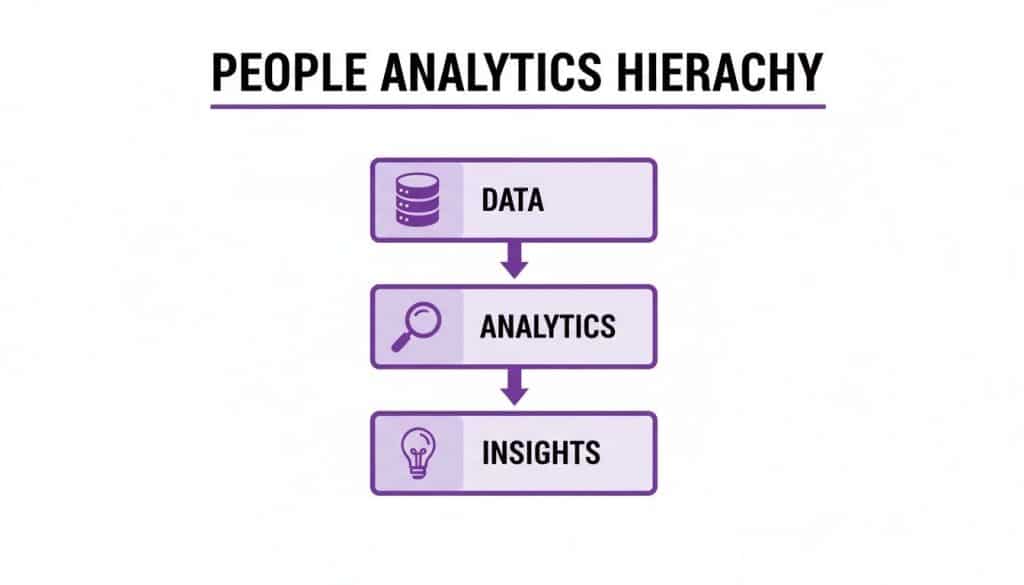
As you can see, you first need reliable data. Then, you apply the right analytical tools to uncover those game-changing insights that will guide your next move.
The Four Stages of Analytics Maturity
Let’s walk through these stages with a classic UK business problem. Imagine a mid-sized tech firm in Manchester has noticed a worrying number of its best software developers are handing in their notice.
- Descriptive Analytics: What Happened?
This is your starting point—looking back at what has already occurred. In our Manchester firm, the HR team pulls a report and confirms that the voluntary attrition rate in the development team has shot up from 8% to 15% over the last six months. It’s a fact, not a feeling. - Diagnostic Analytics: Why Did It Happen?
Now we start digging for the ‘why’. The HR team doesn’t just stop at the ‘what’; they cross-reference exit interview notes with performance reviews and project records. A clear pattern emerges: 80% of the developers who left had been working huge amounts of overtime on a high-pressure project that was recently scrapped. - Predictive Analytics: What Could Happen Next?
Here’s where it gets clever. We use the patterns we’ve just found to look into the future. By analysing the data, the system predicts that another 10% of the development team—those who also worked all the extra hours on that same cancelled project—are at high risk of resigning in the next three months. - Prescriptive Analytics: What Should We Do About It?
This is the ultimate goal: getting clear, actionable advice. Based on the prediction, the analytics model recommends a specific course of action. It suggests giving a targeted, one-off “project completion” bonus to the at-risk developers and enforcing a mandatory reduction in their workload for the next month. The numbers stack up, too: the bonus will cost about £25,000, a fraction of the £100,000 it would cost to recruit and train their replacements.
By progressing through these stages, the business turned a vague problem (“people are leaving”) into a specific, data-driven action with a clear return on investment. This is the kind of intelligence a modern HR management information system should deliver.
The Bedrock of Your Framework: Data Quality and Governance
Of course, none of this is possible without clean, reliable, and secure data. Any people analytics framework is only as good as the information it’s built on. Inaccurate or incomplete data will only lead you to flawed conclusions and bad decisions.
Just as critical, especially for any UK business, is getting GDPR compliance and data security right. We’re talking about highly sensitive employee information, and it demands the highest level of care. It’s a huge concern for HR and IT leaders alike, who need total confidence that their data is protected.
This is where integrating your HR system directly into your Microsoft environment offers a massive advantage. Hubdrive-based solutions, for instance, keep all your sensitive HR data securely within your organisation’s own Microsoft 365 tenant. The data never leaves your control, benefitting from the world-class security of Microsoft Entra ID and ensuring you maintain full GDPR compliance from day one.
Putting People Analytics Into Practice
It’s one thing to talk about the theory of people analytics, but the real magic happens when you start applying it to your day-to-day business challenges. This is where the data leaves the spreadsheet and starts making a tangible difference to your organisation’s performance and, ultimately, its bottom line.
Let’s look at how you can put data to work across the core HR functions, turning interesting insights into real-world improvements.

This isn’t about just staring at numbers. It’s about asking the right questions and letting the data guide you to clear, confident answers.
Smarter Recruitment Through Data
Too often, recruitment feels like a high-stakes guessing game. Which job boards actually deliver the goods? How long is it really taking to fill that critical role? People analytics swaps that guesswork for hard evidence.
Instead of just counting applications, you can start tracking the metrics that genuinely matter.
- Quality of Hire: Imagine linking your recruitment data to performance review scores six or twelve months down the line. You can quickly see which sourcing channels consistently bring in your top performers. You might discover that candidates from employee referrals are far out-performing those from a big-name job site.
- Cost per Hire: This classic metric becomes incredibly powerful when you dig deeper. You can break down costs not just by role, but by department or sourcing channel, pinpointing exactly where your recruitment budget is working hardest.
- Time to Fill: A drawn-out hiring process means losing great candidates to your competitors. Analytics helps you identify the bottlenecks. Is it a slow interview stage? Delays in getting offers approved? The data will tell you.
Modern tools, like the Hubdrive solution we implement, bring this all to life. Features like AI-powered CV parsing don’t just speed up screening; they give you structured data on skills and experience you can analyse to find the best-fit candidates, faster.
Proactive Employee Retention
High staff turnover is a massive drain on resources, productivity, and team morale. People analytics helps you shift from reactively fighting fires to proactively preventing them, identifying potential flight risks long before they even think about handing in their notice.
By analysing data from different sources—like engagement surveys, absence records, and performance data—you can build predictive models that flag employees showing early warning signs of disengagement.
This gives managers a chance to step in with targeted support. It might be a conversation about career development, a tweak to their workload, or simply some well-deserved recognition. Once you’ve analysed your data, the next crucial step is learning how to improve employee engagement based on what you’ve found.
Optimising Performance Management
The whole point of performance management isn’t just to rate people; it’s to drive better business results. People analytics provides that missing link between what an individual contributes and the company’s wider goals.
You can analyse performance data to see who your top performers are and, more importantly, understand what makes them tick. This creates a blueprint for training and coaching others. On the flip side, you can spot teams that are struggling and offer targeted support where it’s needed most.
Integrated time and attendance tracking, like the features found in Hubdrive’s HR solution, provides a rich source of data here, connecting project hours and productivity metrics directly to performance outcomes.
The UK is really leading the charge on this. The nation is set to be Europe’s frontrunner in AI adoption within HR, with an expected 55% of organisations investing in this area in 2025. That’s a huge jump from 35% in 2024 and well ahead of the European average of 38%. For the mid-market UK businesses we work with, this makes AI-driven people analytics a non-negotiable part of modern HR.
Tapping into the Microsoft Ecosystem for HR Insights
For many UK businesses already using Microsoft technologies, the ideal foundation for people analytics isn’t something you need to go out and build. It’s already right there, just waiting to be switched on. This existing ecosystem gives you a massive head start, turning what might feel like a daunting project into a much more straightforward, achievable goal.
The key is to stop thinking of your HR data as something separate from the rest of your business operations.
When your HR management solution is built on the Microsoft Power Platform, it immediately tears down the data silos that have held HR back for years. Instead of critical information being trapped in a standalone, third-party HR system, it lives in one central, secure place alongside everything else.

This is exactly how Hubdrive’s HR Management for Microsoft Dynamics 365 works—the platform we implement and support at DynamicsHub. It uses Microsoft Dataverse as its core, creating a genuine single source of truth for all your people data, from the first job application right through to retirement.
Creating a Single Source of Truth
What do we mean by a ‘single source of truth’? It means every scrap of HR information—from an applicant’s CV to an employee’s holiday requests and performance reviews—is stored in one unified database. This is a complete game-changer.
It allows you to connect dots you simply couldn’t see before, like linking feedback from the onboarding process directly to an employee’s performance six months down the line. This unified approach makes analysis incredibly simple. No more exporting messy spreadsheets or wrestling with APIs to make different systems talk to each other. Everything is already connected and ready to go.
Visualising Trends with Power BI
Once your data is centralised in Dataverse, the next step is bringing it to life. This is where Microsoft Power BI comes into its own. Power BI is a business analytics tool that plugs directly into your HR data, transforming raw numbers into clear, interactive dashboards.
Imagine being able to see, at a glance:
- Your company’s attrition rate, neatly broken down by department and manager.
- A real-time view of your ‘Time to Hire’ metric, instantly flagging bottlenecks in your recruitment process.
- A heat map showing skills gaps across the entire organisation.
These aren’t just static reports. They are dynamic, visual tools that let HR leaders and managers explore the data, ask new questions, and uncover insights on the fly. This visual approach makes complex trends easy for everyone to grasp, from the HR team to the board.
Automating Actions with the Power Platform
Great people analytics isn’t just about looking at pretty dashboards; it’s about turning those insights into action. This is where the rest of the Microsoft Power Platform—Power Apps and Power Automate—closes the loop.
Power Apps lets you quickly build small, custom applications to gather more specific data. For example, you could create a simple pulse survey app to check in on employee morale after a major company change, feeding that sentiment data directly back into your analytics.
Power Automate then acts as the trigger. Based on what your data reveals, it can automatically kick off workflows. If your Power BI dashboard flags a high-performer as a retention risk (based on factors like low engagement scores and no recent pay rise), Power Automate could instantly send a private notification to their manager, prompting a crucial conversation before it’s too late. To learn more about how these integrations work, you can read our guide on what sets Dynamics 365 HR apart.
Unbeatable Security and Compliance
For any CIO or IT director, data security is non-negotiable. The biggest advantage of this ecosystem approach is that all your sensitive employee data stays within your own Microsoft 365 tenant. It’s protected by the same world-class security you already trust for the rest of your business, managed through Microsoft Entra ID.
This tackles core compliance and security worries head-on. With GDPR being a critical consideration for all UK businesses, keeping data within your own secure environment eliminates many of the risks that come with third-party cloud HR systems. It gives you complete control and, most importantly, peace of mind.
Your Step-By-Step Implementation Guide
So, you’re ready to move from theory to reality. Getting started with people analytics can feel like a mammoth task, but the secret is to break it down. With a clear, phased approach, it becomes a series of manageable steps. This guide maps out a practical path for UK businesses looking to build their own people analytics function.
The goal isn’t to boil the ocean overnight. Far from it. The smart approach is to start small, score some quick wins, and build momentum from there. By focusing on genuine business problems right from the start, you ensure your efforts are directly tied to tangible results.
Phase 1: Start With a Business Problem
The best people analytics projects never begin with a vague desire for “more data.” They start with a specific, nagging business challenge that needs a solution. Trying to analyse everything at once is a surefire way to get lost in the noise.
Instead, pick one, high-impact problem to tackle first.
- Worried about early turnover? If new hires are walking out the door inside of a year, that’s a costly problem with a clear financial sting.
- Struggling with recruitment bottlenecks? Is it taking far too long to fill critical roles, causing projects to grind to a halt?
- Seeing a dip in sales performance? Maybe one particular team is consistently missing its targets and you don’t know why.
By zeroing in on a real pain point, you automatically have a clear objective. You also get a built-in audience of stakeholders who are hungry for answers. This makes it infinitely easier to get their support and prove the value of what you’re doing.
Phase 2: Identify Key Data Sources
Once you’ve got your problem, the next logical step is to figure out what data you need to understand it. Let’s take the high turnover example. Your data sources might include things like:
- Onboarding Surveys: What was the new hire’s experience really like?
- Performance Reviews: How were they tracking during their short time with the company?
- Exit Interview Notes: What specific reasons did they give for leaving?
- Absence Records: Were there any patterns of absenteeism before they handed in their notice?
This is where an integrated system, like the Hubdrive HR solution which we implement at DynamicsHub, really shows its power. Much of this data is already in one place. By centralising information in Microsoft Dataverse, you completely avoid the painful, manual process of trying to stitch together information from different spreadsheets.
Phase 3: Choose The Right Technology
Your technology should always support your strategy, not the other way around. For businesses already using Microsoft, the natural choice is a solution that sits comfortably within that ecosystem. This approach dodges the bullet of creating yet another data silo and makes the most of the powerful tools you already own.
Hubdrive’s HR Management for Microsoft Dynamics 365 is built for this very purpose. It creates a single source of truth for all your HR data, making it instantly available for analysis in tools like Power BI. That tight integration is absolutely critical for turning raw data into clear, actionable visualisations.
At DynamicsHub.co.uk, we help you experience HR transformation built around your business. Hubdrive’s HR Management for Microsoft Dynamics 365 is the premier hire‑to‑retire solution—more powerful, more flexible, and more future‑ready than Microsoft Dynamics 365 HR.
Phase 4: Turn Insights Into Action
This is where the rubber meets the road. Data is utterly useless if it just sits on a dashboard looking pretty. The final, most important phase is all about using your findings to make a measurable difference.
Let’s say your analysis shows that new hires who skip a key onboarding module are 50% more likely to leave. The action is straightforward: make that module mandatory and start tracking completion. Then, you can measure the impact on retention rates over the next six months. This is how you prove the return on investment (ROI) and demonstrate the real-world value of people analytics.
The UK is a maturing market for these tools, but there’s still work to do. Recent research highlights a significant gap: in 2025-26, only 45% of HR professionals agree their systems deliver insights that actually improve business outcomes. With UK employee engagement stubbornly hovering around 10-11%, it’s crystal clear that bridging this insight-to-action gap is vital. You can find out more about the current state of UK people analytics.
Ready to build your own data-driven HR strategy? Give us a call on 01522 508096 today, or send us a message.
So, where do you go from here?
The main thing to take away is that people analytics isn’t just a ‘nice-to-have’ anymore. For UK businesses, it’s now a fundamental part of staying competitive. When you start making decisions based on solid data, HR stops being a cost centre and becomes a proper strategic partner—one that actively improves the bottom line. It’s about making smarter, evidence-based choices that make a real difference everywhere, from the boardroom right down to the front line.
This journey all starts with having the right tools for the job. You need a system that can bring all your data together and serve up clear, actionable insights. That’s the engine for this whole transformation. It’s what lets you stop just reporting on what’s already happened and start shaping what happens next, turning your team’s potential into real, measurable results.
Choosing the Right Partner and Platform
The best solution is one that fits neatly into what you’re already using, breaking down those frustrating data silos instead of just building new ones. This is especially true for any business already using the Microsoft ecosystem. You need a platform that doesn’t just collect data, but connects it, visualises it, and helps you do something meaningful with it.
Here at DynamicsHub.co.uk, we’ve seen first-hand that getting this foundation right is what makes all the difference.
Experience HR transformation built around your business. Hubdrive’s HR Management for Microsoft Dynamics 365 is the premier hire‑to‑retire solution—more powerful, more flexible, and more future‑ready than Microsoft Dynamics 365 HR.
We implement and support this very solution because it delivers the security, seamless integration, and powerful analytics you need to really unlock your team’s potential. It works with the tools you already know and trust, like Power BI and the rest of the Power Platform, to get insights to the people who can act on them. This connected approach makes sure every decision is grounded in solid evidence.
Take the Next Step Today
Moving to data-driven HR is a big step, there’s no doubt about it. But it’s a move that delivers a clear and compelling return. Whether it’s getting more from your recruitment budget, cutting down on costly staff turnover, or just boosting productivity across the board, the benefits ripple through the entire business. It gives your leaders the intelligence they need to build a more engaged, effective, and resilient workforce.
Ready to start your HR transformation? Let us show you how we can build a solution around your specific needs, giving you the tools to turn your people data into your greatest strategic asset.
Phone 01522 508096 today, or send us a message to get the conversation started.
Frequently Asked Questions
When UK business leaders start exploring what people analytics could mean for them, a few practical questions almost always surface. We’ve gathered the most common ones we hear from HR and IT teams to help you move forward with confidence.
How Much Does It Cost to Implement People Analytics?
It’s a fair question, but the answer is probably less than you think. The cost can vary, of course, but modern solutions have moved away from huge upfront capital investments.
These days, it’s typically a straightforward per-employee, per-month model. For a mid-market UK business, you might be looking at a range of £5 to £15 per user per month, depending on how sophisticated you want to get with different modules.
The real focus, though, should be on the return on that investment. A modest annual spend can lead to huge savings. Imagine reducing costly staff turnover by just a couple of percentage points, or shaving weeks off the time it takes to fill a critical, revenue-generating role. Solutions from Hubdrive, which we implement here at DynamicsHub, bring top-tier capabilities to a price point that makes perfect sense for the mid-market.
Do We Need to Hire Data Scientists?
In short, no. While a dedicated data scientist can be a great asset for a very mature analytics team, it’s absolutely not a requirement to get started. In fact, the whole point of modern tools like Microsoft Power BI is to put powerful analysis into the hands of the people who actually understand the business context: your HR team.
When your people analytics solution plugs directly into your existing Microsoft environment, your team can explore the data using familiar tools. With a bit of guidance from a partner like us at DynamicsHub, we can empower your current HR professionals to build insightful dashboards and find the answers they need, all without writing a single line of code.
How Do We Handle Employee Data Ethically and Transparently?
This is a big one, and it’s completely non-negotiable, especially with GDPR in the picture. Getting this right comes down to three core pillars: governance, security, and communication.
- Governance: Start with clear, documented policies. You need to be able to state exactly what data you collect, precisely why you collect it, and who has access to it.
- Security: This is a huge advantage of using a platform like Hubdrive for Dynamics 365. All your sensitive employee data stays within your own secure Microsoft 365 tenant, protected by Microsoft Entra ID. It doesn’t go anywhere else.
- Communication: Be open with your employees. Explain that the goal isn’t to “watch” them, but to genuinely improve their experience at work—by finding better development opportunities, boosting well-being, and making sure processes are fair for everyone. When people understand the “why,” they are far more likely to get behind it.
At DynamicsHub.co.uk, we experience HR transformation built around your business. Hubdrive’s HR Management for Microsoft Dynamics 365 is the premier hire‑to‑retire solution—more powerful, more flexible, and more future‑ready than Microsoft Dynamics 365 HR.
Ready to explore what’s possible? Phone 01522 508096 today, or send us a message to get started.