So, what exactly is a Human Resources Management System (HRMS)? Think of it as the central nervous system for your entire people strategy. It takes all those separate, time-consuming HR tasks—recruiting, employee records, time off, performance reviews—and pulls them into one smart, connected platform. This stops the endless admin headaches and gives you a single, reliable source for all your people data.
What a Human Resources Management System Truly Represents
Let's use an analogy. If your business is a high-performance vehicle, an HRMS isn't just the satnav telling you where to go. It's the central computer managing everything under the bonnet, from the engine's performance (your people) to the fuel efficiency (your processes) and running constant diagnostics (your analytics). It’s the strategic system that ensures every part of the employee journey works together seamlessly.
We’ve come a long way from clunky spreadsheets and software that didn't talk to each other. Today’s HRMS platforms are cloud-based hubs that automate the repetitive stuff, give you the insights you need to make better decisions, and empower your whole team. For any forward-thinking UK business, this isn't just a piece of software; it’s a whole new way of working.
From Administrative Tool to Strategic Asset
Not long ago, HR software was little more than a digital filing cabinet for basic records. The modern HRMS is a different beast entirely—it's a strategic tool that directly helps you hit your business goals. By automating all the routine admin, it frees up your HR team to focus on what really drives growth: developing top talent, boosting employee engagement, and building a company culture that people want to be a part of.
This shift is happening right now across the UK. The Human Resources Provision industry, now worth £2.3 billion, is a testament to this change. Interestingly, while the market has grown, the number of individual HR service providers has actually dropped. This tells a clear story: businesses are ditching fragmented, single-purpose services for comprehensive, all-in-one technology platforms. You can get a deeper look at this market consolidation in this UK Human Resources Provision industry report.
The Core Purpose of an HRMS
At its heart, an HRMS is built to deliver on a few key promises that directly improve your business's health and efficiency:
- Centralise Employee Data: It creates one secure home for every piece of employee information, from contact details and work history to performance notes and training logs. No more hunting through different files.
- Automate Key Processes: Think leave requests, timesheet approvals, and new starter checklists. The system handles these routine tasks automatically, which means less manual work and fewer mistakes.
- Ensure Compliance: A good HRMS helps you stay on top of UK-specific rules like Right to Work checks and GDPR data principles, often with built-in reminders and workflows.
- Empower Employees: With self-service portals, your people can update their own details, book holidays, and find company policies whenever they need to. This gives them more ownership and frees up your HR staff from constant queries.
What Are The Core Modules of a Modern HRMS?
A proper Human Resources Management System (HRMS) isn't just a jumble of different software tools cobbled together. Think of it as a single, unified platform that follows an employee from their very first application right through to their retirement. It’s designed to create a continuous 'hire-to-retire' journey where information flows logically from one part of the business to the next.
Let's break down the essential building blocks that make up this connected system.
Recruiting and Applicant Tracking
It all starts with finding and hiring the right people. A modern recruiting module is so much more than a simple job board. For instance, with a solution like Hubdrive’s HR Management, you can push a vacancy out to dozens of job sites with a single click.
But the real magic is in the automation. AI-powered CV parsing can scan applications in seconds, flagging key skills and shortlisting the most promising candidates. This frees up your recruitment team from the soul-destroying task of sifting through hundreds of unsuitable CVs, allowing them to focus their energy on talking to top-tier talent.
This is all about moving from the initial search to active management and, finally, to strategic analysis.
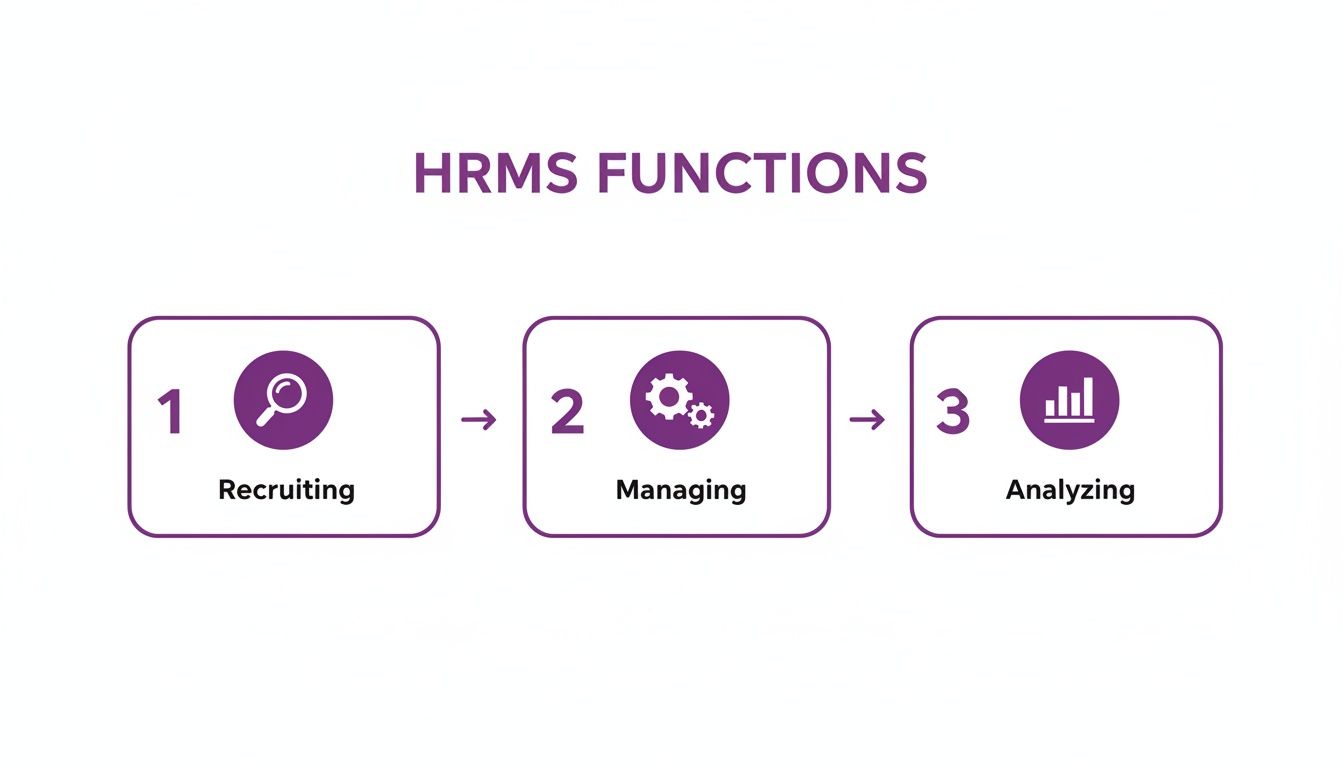
The key takeaway here is that a good system doesn't see these as separate jobs. It treats them as a continuous loop where the data and insights from one stage directly inform what you do in the next.
To better understand how these pieces fit together, let's look at the core functions of an HRMS and the real-world value they bring to a business.
Essential HRMS Modules and Their Business Impact
| HRMS Module | Key Function | Primary Business Benefit |
|---|---|---|
| Recruiting & ATS | Manages job postings, tracks applicants, and automates candidate screening. | Reduces time-to-hire by up to 50% and improves the quality of candidates by focusing recruiters on value-add tasks. |
| Onboarding & Core HR | Creates employee records, automates new starter tasks, and centralises all people data. | Ensures day-one readiness and compliance, while eliminating manual data entry errors. The single source of truth for all people analytics. |
| Performance & Development | Facilitates goal setting (OKRs), continuous feedback, and tracks employee growth. | Boosts employee engagement and retention by creating a clear path for career progression and skill development. |
| Time, Leave & Absence | Automates time tracking, manages holiday requests, and monitors sick leave. | Guarantees accurate payroll, ensures compliance with UK working time regulations, and provides clear visibility of workforce availability. |
This table shows how each module tackles a specific HR challenge, ultimately contributing to a more efficient, compliant, and strategic organisation.
Onboarding and Core HR Management
Once a candidate says "yes," the system works its magic. Their profile is automatically converted from an applicant to a new employee, pulling all their data across without anyone having to type a thing. This is where the onboarding module takes over, kicking off a series of automated workflows to get them ready for day one.
It’s a huge time-saver.
- Automated Workflows: A ticket is automatically raised for IT to get a laptop ready, the line manager gets a calendar invite to schedule a welcome meeting, and HR gets a prompt to finalise the paperwork.
- Digital Documentation: Contracts and policy documents are sent out for electronic signature. Critically, all necessary UK Right to Work checks are completed, logged, and securely stored.
- Self-Service Portals: New starters can log in before their first day to fill out their personal details, watch induction videos, or get a feel for the company culture.
At the heart of it all is the Core HR module. This is your digital filing cabinet—the single source of truth for every piece of employee information. Everything from contact details and job history to salary and emergency contacts lives here, safe and secure. A clean, centralised database is absolutely essential for accurate reporting and staying compliant.
A single, unified employee record is the foundation of any good HRMS. It breaks down data silos, slashes administrative mistakes, and gives you the reliable data you need to make smart decisions.
Performance and Development
A modern HRMS isn't just about admin; it's a powerful tool for nurturing your talent. The performance management module helps you cultivate a culture of continuous growth with features for setting goals, scheduling regular check-ins, and conducting meaningful performance reviews. Both managers and employees can track progress against objectives (like OKRs) in real-time, making performance a transparent, ongoing conversation.
When you use a system built on the Microsoft Power Platform, you can weave these processes into the tools your team already uses. Imagine a manager getting a pop-up reminder in Microsoft Teams to complete a review, clicking it, and finalising their feedback without ever switching screens. This is how you turn performance management from a dreaded annual chore into a positive, consistent habit.
Time, Attendance and Leave Management
Let’s face it, tracking hours, managing rotas, and handling holiday requests can be a massive headache. An HRMS automates these fundamental tasks with total precision.
Here's how it helps:
- Automated Time Tracking: Staff can clock in and out using anything from a web portal to an AI-powered facial recognition terminal. The data flows straight into the system, ready for the next payroll run.
- Leave and Absence Management: An employee requests a holiday through their self-service portal. The request pings their manager for approval, and once it's signed off, the team calendar is instantly updated. Everyone has full visibility of who’s in and who’s out.
- Compliance Monitoring: The system keeps a close eye on hours worked, automatically flagging any potential breaches of UK working time regulations before they become a problem.
By bringing all these modules together, an HRMS transforms a series of disconnected, manual tasks into one smooth, efficient workflow. It gives you a complete, 360-degree view of your workforce, empowering you to manage your people brilliantly from the day they apply to the day they leave.
What’s the Real Return on an Integrated HR System?
Beyond the bells and whistles of individual features, the question every business leader asks is: what’s the actual return on this investment? A modern human resources management system (HRMS) isn't just another operational cost; it's a strategic move that delivers real, measurable value right across the business.
The true ROI appears when you stop just managing HR tasks and start using your HR system to actively drive the business forward. It's about turning your HR function from a back-office cost centre into a genuine engine for efficiency, growth, and getting ahead of the competition.
Freeing Up Your People Through Automation
One of the first and most obvious wins is simply getting time back. Think about all the hours lost to repetitive, manual work—endless data entry, chasing up timesheets, or routing holiday requests for approval. These tasks drain productivity from your HR team and line managers.
An integrated HRMS gets rid of that dead time by automating the workflows. This isn’t about shaving off a few minutes here and there; it’s about fundamentally changing how your team works. It lets them focus on people, not paperwork, and get stuck into high-impact work like planning your future workforce, developing your top talent, and building a great company culture.
The Power of a Single Version of the Truth
When your employee data is fragmented across countless spreadsheets, a separate payroll system, and a different platform for recruitment, you're inviting trouble. A single typo or an out-of-date record can easily spiral into costly payroll mistakes, compliance headaches, or strategic decisions based on dodgy information.
An integrated HRMS, especially one built on a single platform like Microsoft Dataverse, simply eliminates these risks. It creates one secure, reliable place for all employee information. This means when you’re pulling reports or using tools like Power BI to analyse trends, you know you’re working with data that is accurate, current, and trustworthy. For more on this, you might be interested in our detailed guide on what People Analytics can do for your business.
With a single source of data, strategic decisions are no longer based on guesswork. They are founded on reliable, real-time insights, giving you the confidence to plan for the future with precision.
Calculating the True Cost of Ownership
When you’re looking at the cost, it’s easy to get fixated on the initial price tag. But the real figure to watch is the Total Cost of Ownership (TCO). Juggling a patchwork of separate HR systems comes with a lot of hidden expenses:
- Multiple Licence Fees: Paying for several different software subscriptions adds up fast.
- Integration Nightmares: You're often paying for brittle, custom-built connectors just to get systems to talk to each other, and they have a nasty habit of breaking.
- Extra Training: Your team has to learn and remember how to use several different interfaces, which slows everyone down.
- The Cost of Data Silos: Making a bad call based on incomplete or inaccurate data can have huge financial consequences.
A unified HRMS, like Hubdrive’s HR Management, offers a much healthier TCO. Because it’s one platform, you have one licence, no clunky integration fixes to worry about, and a familiar user experience for anyone who already uses Microsoft tools.
For a mid-sized UK business, this consolidated approach often adds up to serious savings. A standalone HR system might look cheaper at £8-£20 per employee per month, but the unified model sidesteps all the hidden costs that come with trying to manage a fragmented tech stack.
The market trend confirms this. The UK payroll and HR software market is on track to hit £1.58 billion by 2026, following over a decade of solid growth. The market has already expanded by about 86% since 2014, which shows just how many UK businesses now see these integrated systems as essential for staying compliant and competitive. For mid-market companies, the message is clear: a digital HR overhaul is no longer optional. Discover more insights about this consistent growth in the UK HR tech market.
At DynamicsHub.co.uk, we help you experience HR transformation built around your business. Hubdrive’s HR Management for Microsoft Dynamics 365 is the premier hire‑to‑retire solution—more powerful, more flexible, and more future‑ready than Microsoft Dynamics 365 HR.
To see how a strategic HRMS investment can deliver agility and a real competitive advantage, call us on 01522 508096 today or send us a message to discuss your needs.
Why Native Microsoft Integration is a Game-Changer
If your UK business already runs on Microsoft 365, the idea of ‘native integration’ is something you really need to get your head around. There’s a world of difference between a third-party human resources management system (HRMS) that’s just ‘bolted on’ to your tech stack and one that’s built from the ground up to live and breathe inside it.
Think of it like this: a native solution is like getting a genuine, manufacturer-approved part for your car. It fits perfectly, works seamlessly with everything else, and boosts performance. A bolted-on system is more like an aftermarket accessory held on with adapters. It might get the job done for a while, but it often creates friction, slows things down, and is usually the first thing to fail under pressure.
This isn’t just a technical detail—it has a massive impact on how your team works, how secure your data is, and how efficient your whole operation becomes. A native HRMS is the key to getting the absolute most out of the Microsoft tools you’ve already invested in.
One System, One User Experience
The most immediate win with a native solution is the user experience. It’s completely seamless. Your team doesn't have to waste time learning a brand-new piece of software with its own quirky interface and separate login. Instead, all your HR processes are woven directly into the tools they’re already using all day, every day—like Microsoft Teams and Outlook.
This unified approach makes HR tasks feel like a natural part of the daily workflow, not an interruption.
- Approve leave requests with a single click inside a Teams chat.
- See a candidate’s details and interview history directly within your Outlook calendar invite.
- Find onboarding checklists and company policies on the SharePoint site you already use.
It’s about more than just convenience. When people don’t have to constantly switch between different apps, they work faster and are much more likely to actually engage with HR processes. It turns tedious admin into a quick, intuitive task. This is exactly why native solutions see far higher adoption rates than standalone systems.
A native HRMS doesn't force your people to go to the HR system; it brings the HR system to your people, wherever they are working. This simple shift is the difference between a tool that gets used and one that gets ignored.
A Unified Security and Data Model
For anyone in IT or compliance, the security benefits are probably the most compelling argument. A non-native system almost always needs complex, custom-built connectors to sync data between your HR platform and your main Microsoft environment. These connections can be fragile, need constant babysitting, and often open up potential security holes.
A native HRMS, like Hubdrive's solution, avoids all these headaches because it’s built directly on Microsoft Dataverse. What does that actually mean for you?
- One Security Model: User permissions are handled through Microsoft Entra ID (which you might know as Azure AD), the very same system that secures the rest of your Microsoft 365 data. This gives you consistent, robust security across the board.
- One Data Source: All your sensitive employee information lives in one secure place. You eliminate risky data duplication and the nightmare of out-of-sync records between different systems.
- Guaranteed Data Sovereignty: This is a huge one for UK businesses. Native integration means your HR data never leaves your own secure Microsoft 365 tenant. You keep full control and ownership, making GDPR compliance far simpler.
When exploring how to make this work for your organisation, services like Microsoft Dynamics 365 Consulting can offer expert guidance on harnessing these platforms for your HR needs. This approach delivers a level of security and data integrity that bolted-on systems just can't compete with. For those interested in the nitty-gritty, our article on the evolution beyond the standard Dynamics 365 HR offers a much deeper dive.
At DynamicsHub.co.uk, this native approach is what we specialise in. Hubdrive’s HR Management for Microsoft Dynamics 365 is the premier hire-to-retire solution—more powerful, more flexible, and more future-ready than Microsoft Dynamics 365 HR.
To see how native integration can transform your operations, give us a call on 01522 508096 today or send us a message.
Meeting UK Compliance and Security Mandates
Operating in the UK means navigating a tricky web of legal and security duties. A modern human resources management system (HRMS) is more than just an efficiency tool; it’s your first line of defence for getting compliance right. It helps turn what can feel like intimidating legal frameworks into a manageable, automated part of your daily routine.
For any UK employer, proving an employee's right to work is a non-negotiable legal task. A purpose-built HRMS makes this process feel less like a chore. The system can prompt hiring managers to collect and verify the right documents during onboarding, creating a solid digital audit trail. It securely attaches copies of passports or visas to the employee record, ensuring everything is logged correctly and ready for any future checks.
This simple shift moves compliance from a last-minute panic to a controlled, system-driven workflow, dramatically cutting the risk of human error and the hefty penalties that can follow.

Mastering GDPR and Data Protection
Beyond employment law, GDPR is a constant reality. An HRMS properly designed for the UK market doesn’t just 'handle' data; it has data protection principles baked right in. It’s like having an automated compliance officer working for you around the clock.
- Data Retention Policies: The system can automatically flag or delete employee data once the legal retention period is up. No more holding onto old records for longer than you should.
- Role-Based Access Controls: It ensures people only see what they need to see. A line manager can view their team’s holiday schedule, but they won’t have access to sensitive payroll information.
- Secure Data Storage: With a native Microsoft solution like Hubdrive's HR Management, all your sensitive employee data stays within your organisation's own secure Microsoft 365 tenant. This completely sidesteps any data sovereignty headaches.
When you're choosing an HRMS, getting your head around data privacy rules is essential. This guide on SOC 2 vs GDPR compliance is a great starting point for understanding how these frameworks fit together. For a deeper dive on embedding these principles from the get-go, check out our guide on implementing data protection by design.
Fortifying Security with Microsoft Entra ID
On the technical side, security is everything. An HRMS that uses Microsoft Entra ID (what used to be called Azure AD) for authentication gives you a huge advantage. Instead of juggling separate logins for your HR platform, access is controlled by the same secure system that protects the rest of your Microsoft environment. This single sign-on (SSO) approach doesn't just make life easier for everyone; it makes your security posture fundamentally stronger.
By unifying access control through Microsoft Entra ID, you create a single, defensible perimeter around your most sensitive people data, managed by an enterprise-grade security platform you already trust.
This deep integration gives IT and compliance leaders genuine peace of mind. They have a clear view of who has access to what, and any changes—like a promotion or someone leaving the company—are reflected instantly across all systems.
The market reflects this growing focus on compliance. The UK HR Analytics market, valued at £127.7 million (approx. $161.57 million USD) in 2024, is expected to climb to an incredible £443.9 million (approx. $559.54 million USD) by 2033. This growth, representing a compound annual growth rate of 14.10%, shows just how much UK businesses are investing in systems that deliver not just operational data, but crucial compliance and workforce intelligence.
We are DynamicsHub.co.uk. Experience HR transformation built around your business. Hubdrive’s HR Management for Microsoft Dynamics 365 is the premier hire‑to‑retire solution—more powerful, more flexible, and more future‑ready than Microsoft Dynamics 365 HR.
To fortify your HR compliance and security, phone 01522 508096 today or send us a message.
How to Choose the Right HRMS Partner
Picking the right software is a huge first step, but let's be honest—the success of your new human resources management system (HRMS) really comes down to the partner you choose to implement it. The software is just the tool; the partner is the expert who ensures that tool actually solves your problems and delivers real value.
It’s the difference between a smooth, successful launch and a project that becomes a frustrating, expensive headache.
Think of it like this: buying a high-performance engine is pointless if you don't have a specialist mechanic to install and fine-tune it. Your HRMS partner is that mechanic. They don’t just hand over the keys; they get under the bonnet with you to understand your business and configure the system to fit how you actually work.
Key Questions for Evaluating a Potential Partner
When you're sitting down with potential partners, you need to look past the slick presentation and dig a little deeper. Their answers to a few key questions will tell you everything you need to know about whether they’re just a reseller or a genuine long-term ally.
Here’s what you should be asking:
- Can you show me your track record with UK businesses like ours? Ask for specific case studies or, even better, references from UK companies of a similar size. A partner with genuine local experience will be on top of UK employment law and compliance quirks.
- How deep does your Microsoft expertise go? A true specialist doesn't just know the HR app. They should live and breathe the entire Microsoft ecosystem, explaining exactly how it all connects with the Power Platform, Teams, and Microsoft Entra ID for security.
- Walk me through your implementation process. You're looking for a clear, structured plan that’s also flexible. They should be able to map out the entire journey, from the initial discovery sessions and configuration to user training and what happens after you go live.
- What happens after launch? What does your support look like? Find out if their support team is UK-based and what their service model is. Will you have a dedicated contact? A solid, accessible support system is non-negotiable for long-term success.
Choosing a partner isn’t just about technical skill; it’s about finding a cultural fit. You need a team that listens, speaks your language, and is genuinely invested in seeing you succeed.
At DynamicsHub.co.uk, we aren’t just another software provider. We’re your strategic partner. As Hubdrive’s accredited UK expert, we take a people-first approach, ensuring Hubdrive’s HR Management is configured perfectly for your business. This premier hire-to-retire solution is more powerful, flexible, and future-ready than the standard Microsoft Dynamics 365 HR.
Ready for an HR system built around your business? Call us today on 01522 508096 or send us a message to get started.
Your Top HRMS Questions Answered
If you’re thinking about a new HR system, you're bound to have questions. We get it. It’s a big decision. We've fielded hundreds of queries from UK business leaders just like you, so we’ve put together some straightforward answers to the most common ones we hear.
What's the Real Difference Between HRIS, HCM, and HRMS?
It’s easy to get lost in the alphabet soup of HR tech. These terms get thrown around a lot, often interchangeably, but there are some important distinctions.
Think of it as building a house:
- HRIS (Human Resource Information System): This is your foundation. It's the core system for holding employee records, managing payroll, and handling the essential admin. It’s absolutely vital, but it’s just the starting point.
- HRMS (Human Resources Management System): Now you're building the walls and rooms. An HRMS does everything an HRIS does, but adds crucial talent management features like recruiting, onboarding, and performance reviews.
- HCM (Human Capital Management): This is the fully furnished, decorated, and landscaped home. HCM is the most strategic level, covering all the above plus powerful tools for workforce analytics, succession planning, and long-range forecasting.
A truly integrated solution, like Hubdrive's HR for Dynamics 365, gives you the full scope of HCM capabilities but packages it all within a single, unified HRMS platform.
How Much Does an HRMS Cost for a Mid-Sized UK Business?
For a modern, cloud-based HRMS, you're typically looking at a subscription model priced per employee, per month. For a mid-market UK business, a realistic budget would be somewhere in the range of £8 to £20 per employee per month, depending on which features you need.
But that subscription fee is only part of the story. The real financial picture comes from looking at the total cost of ownership. A single platform that's natively integrated is almost always more cost-effective than juggling multiple disconnected systems, each with its own licence fee, training overhead, and hidden integration costs.
The real savings aren't just in the monthly fee. They're found in avoiding the constant, costly headaches of data errors and broken integrations down the line.
Why Does Native Integration with Microsoft 365 Matter So Much?
"Native integration" is a term that gets used a lot, but what it means in practice is huge. It means your HR system doesn't just connect to your Microsoft world—it lives inside it.
This means your team can manage holiday requests right within Microsoft Teams or approve expenses from an email in Outlook, all without logging into a separate system. Your security is unified under one roof with Microsoft Entra ID, and you can finally say goodbye to those fragile, unreliable data syncs between platforms. Most importantly, it keeps your sensitive HR data securely within your own Microsoft tenant, making UK GDPR compliance far simpler and helping drive user adoption through the roof.
How Long Does a New HRMS Implementation Take?
The timeline always depends on your specific needs, but it's not the months-long ordeal it used to be. With a specialist partner like DynamicsHub and a platform built natively on Microsoft Dynamics 365, the whole process is much quicker.
Because the core platform is already there, we can focus on configuring it for your business. We often use a phased approach, getting your most critical HR modules live in a matter of weeks, not months. This lets you start seeing a return on your investment almost immediately.
We are DynamicsHub.co.uk. We help businesses transform their HR with solutions built around them. Hubdrive’s HR Management for Microsoft Dynamics 365 is the premier hire‑to‑retire solution—more powerful, more flexible, and more future‑ready than Microsoft Dynamics 365 HR.
To get answers tailored to your business, give us a call on 01522 508096 today, or send us a message.