

Succession management isn't just about finding a replacement when the CEO decides to retire. Think of it more like a Premier League football club carefully nurturing its youth academy. It's a continuous, proactive strategy to spot and develop your own talent to fill critical roles across the entire organisation, ensuring you always have skilled players ready to step up, no matter the position.
What Is Succession Management, Really?

To really get to grips with succession management, you have to see it as a forward-thinking business strategy. It's the crucial difference between a frantic, reactive scramble to fill a sudden vacancy and the calm, strategic building of a resilient internal leadership pipeline. This approach is worlds away from simple replacement hiring; it’s fundamentally about securing your organisation's long-term health and stability.
For UK businesses, the stakes are particularly high. Failing to plan for leadership and key role transitions can lead to some serious risks. We're talking about the loss of priceless institutional knowledge when experienced people walk out the door, operational instability, and a damaging leadership vacuum that can halt growth in its tracks. It’s a common challenge, but thankfully, one with a clear solution.
The Proactive Advantage
A robust succession strategy ensures business keeps running smoothly by preparing talented individuals for future responsibilities long before they're actually needed. This deliberate process isn't complicated, but it does require focus. It involves:
- Identifying critical roles: This means pinpointing the positions essential for your operational success and strategic direction—and that's not just the C-suite.
- Developing talent pools: You're creating groups of high-potential employees who are then nurtured through targeted training, mentoring, and varied job experiences.
- Aligning with business goals: It's about making sure your talent development directly supports where the company is headed, whether that's market expansion or digital transformation.
This process is deeply connected to broader HR strategies. For the full picture, it's helpful to see how this fits with our guide on the definition of workforce planning.
To put it in context, it's helpful to see just how different this is from simply hiring a replacement.
Succession Planning vs Replacement Hiring
| Aspect | Succession Planning (Proactive) | Replacement Hiring (Reactive) |
|---|---|---|
| Timing | Long-term, ongoing process. | Short-term, triggered by a vacancy. |
| Focus | Developing internal talent for future needs. | Filling an immediate, empty role. |
| Scope | Broad, covering multiple critical roles. | Narrow, focused on a single position. |
| Risk | Mitigates disruption and knowledge loss. | High risk of operational gaps and culture clash. |
| Outcome | Builds leadership pipeline and boosts morale. | Solves an immediate problem, often with higher costs. |
As you can see, one is about building for the future, while the other is about patching a hole in the present.
The Cost of Inaction for UK Businesses
Despite its obvious importance, a surprising number of UK businesses are lagging. Research shows that over a quarter of UK business owners haven't put any kind of succession plan in place. This hesitation doesn't just put a company's future at risk; it threatens its very stability and long-term survival.
On the flip side, the data also shows a compelling reason to act. A significant 74% of family businesses with a succession plan report it has made them stronger and helped them grow. For more on this, check out this in-depth look at UK succession planning challenges.
At DynamicsHub, we specialise in helping UK businesses build these future-ready HR frameworks. It's about turning a potential crisis into a genuine competitive advantage, securing your organisation's future in the process. For a deeper dive into current trends and discussions in talent and AI, explore the Parakeet AI blog for further insights.
Building Your Succession Strategy Framework

Alright, let's get practical. It's one thing to talk about succession management in theory, but making it happen requires a solid plan. A good strategy isn't a dusty document you file away; it's a living, breathing system that evolves with your business. The first step is to build a clear, actionable framework.
Think of this framework as the blueprint for your talent pipeline. It gives you the structure needed to stop just spotting potential and start actively building your next generation of leaders, ensuring every decision is deliberate and points towards your long-term goals.
Identify Your Critical Roles
Right off the bat, a common mistake is thinking this is just for the C-suite. That’s far too narrow. Instead, you need to pinpoint any role that's tough to fill and has a real impact on your company's performance, strategy, or bottom line. These are your mission-critical roles.
It's easy to get fixated on executive titles, but often the true linchpins are the people with deep institutional knowledge or unbreakable client relationships. Don't overlook the vital roles tucked away in different departments.
To get this right, ask yourself: which empty seats would cause the biggest headache? This isn't about seniority; it’s about impact. A brilliant senior engineer or a top-performing regional sales manager could be just as crucial to your success as a director.
Define Future-Fit Competencies
Once you’ve mapped out the critical roles, the next job is to define what it takes to succeed in them. And I don’t just mean for today. You need to look ahead. Where will your industry and your company be in three to five years?
- Strategic Thinking: Will your future leaders need to crack new markets or get to grips with emerging tech?
- Digital Fluency: What level of technical savvy will they need to lead their teams well?
- Adaptability and Resilience: How will they steer the ship through inevitable change and uncertainty?
Getting clear on these competencies gives your development programmes a precise target. For instance, using a system like Hubdrive’s HR Management for Microsoft Dynamics 365 allows you to map these skills directly to employee profiles. Suddenly, you have a data-rich picture of your talent landscape, which is exactly what you need to create meaningful development plans.
With these building blocks in place, you can move beyond a simple list of names. You’re now cultivating a dynamic talent pool—a group of high-potential people getting the specific training, mentorship, and experiences they need to be ready for what's next. It’s a smarter way to work, ensuring you’re not just filling roles, but shaping the right leaders for your company’s future.
Cultivating an Internal UK Talent Pipeline
It’s a familiar story for many UK businesses: a senior role opens up, and the immediate instinct is to look outside the company. This reactive scramble is not only costly but also a huge gamble. All too often, it leads to cultural mismatches, a painfully slow onboarding process for the new leader, and a missed chance to reward your own loyal, high-performing people.
There is a much better way: deliberately ‘growing your own’ leaders.
This is about more than just spotting potential. It’s about actively building an internal talent pipeline. When you invest in the people you already have, you create a more resilient organisation. You hang onto crucial institutional knowledge, and leadership handovers become far smoother and more predictable. This isn't just fluffy HR theory; it’s a serious competitive advantage in the UK market.
One of the biggest hurdles for UK companies is their heavy reliance on external hires for the top jobs. The numbers are quite telling. Research shows a stark difference with international counterparts, revealing that a staggering 58% of all FTSE 350 CEOs are appointed from outside their organisations. That figure is more than double the rate seen in the US S&P 500.
This trend points to a fundamental problem: a lack of confidence in internal talent to navigate major change or drive growth.
A Roadmap for Growing Your Own Leaders
To reverse this trend and build a strong internal pipeline, you need a considered, multi-faceted approach to developing your people. It’s a strategy that has to combine real-world, practical experience with targeted upskilling.
Here are a few key strategies that really work:
- Mentoring Programmes: There's immense power in pairing high-potential employees with seasoned leaders. It’s one of the best ways to pass on that invaluable institutional knowledge, cultural understanding, and leadership wisdom you simply can't learn from a textbook.
- Cross-Functional Projects: Get your promising people involved in projects outside their day-to-day roles. This gives them a much broader view of the business, helps them build internal networks, and really tests their ability to adapt and lead in new situations.
- Targeted Training: Use data to pinpoint specific skills gaps. Once you know what’s missing, you can bring in focused training, coaching, or formal qualifications to give your future leaders the precise tools they’ll need to step into a bigger role.
Closing the Skills Gap Proactively
Of course, before you can develop anyone, you need a clear picture of where the gaps are. A systematic skills analysis is the bedrock of any successful internal development programme. By mapping the skills you have today against those you'll need tomorrow, you can create individual development plans that are based on solid evidence, not guesswork.
To get this right, check out our detailed guide on how to conduct a skills gap analysis.
This kind of proactive investment builds incredible loyalty and dramatically cuts down on hiring costs and risks. But perhaps most importantly, it ensures your next generation of leaders are already living and breathing your company's vision and values from day one.
How Technology Changes the Game for Succession Management
Trying to manage your succession strategy with spreadsheets and manual documents is a bit like trying to navigate London with a paper A-to-Z map in the age of GPS. You might get there eventually, but it's going to be slow, clunky, and you'll probably miss a few crucial turn-offs. Modern technology, particularly an integrated HR platform, completely rewrites the rules, making the entire process smarter, faster, and part of your daily rhythm.
When you bring everything into one unified system, you create a single source of truth for all your talent data. No more digging through scattered files or questioning if you have the latest version. It’s the difference between a static plan gathering dust and a living, breathing strategy.
Making Decisions Based on Facts, Not Guesses
An integrated HR solution lets you connect the dots in ways you simply couldn't before. Picture this: using Microsoft Power BI to bring your leadership pipeline to life with a dynamic '9-box grid'. It plots employee performance against their potential using real-time data, so you’re not looking at a quarterly report that was out of date the second it was printed. You're looking at a live dashboard that supports sharp, strategic decisions.
This is where a robust platform like Hubdrive’s HR Management for Microsoft Dynamics 365, which we implement and support, really shines. It uses Microsoft Dataverse to centralise every scrap of crucial information:
- Skills and Competencies: A single, clear view of every employee's qualifications, certifications, and skills.
- Performance History: Easy access to past reviews and performance data to spot your consistent high-flyers.
- Career Aspirations: A log of what your people actually want, helping you align their ambitions with business needs.
- Development Plans: Real-time tracking of who is doing what training, and how they are progressing.
This kind of integrated data is what makes it possible to define succession management as a core business function, not just an HR admin task. You can get a better feel for how this works by exploring our overview of Dynamics 365 for HR.
Weaving Succession into Your Everyday Work
The real magic happens when this technology blends into the tools your teams use every single day. Succession planning stops being a separate, once-a-year headache and becomes part of the organisation's natural pulse. Increasingly, AI and automation technologies are also playing a part, making it easier to spot, develop, and keep future leaders.
Think about managers using Microsoft Teams for a talent review meeting, securely sharing live data pulled straight from the HR system. Or imagine building a simple Power App that lets them nominate high-potential team members right from their phone. It’s about making the process frictionless, engaging, and far more efficient.
This map gives you a good idea of how the different development pathways feed into your internal talent pipeline.
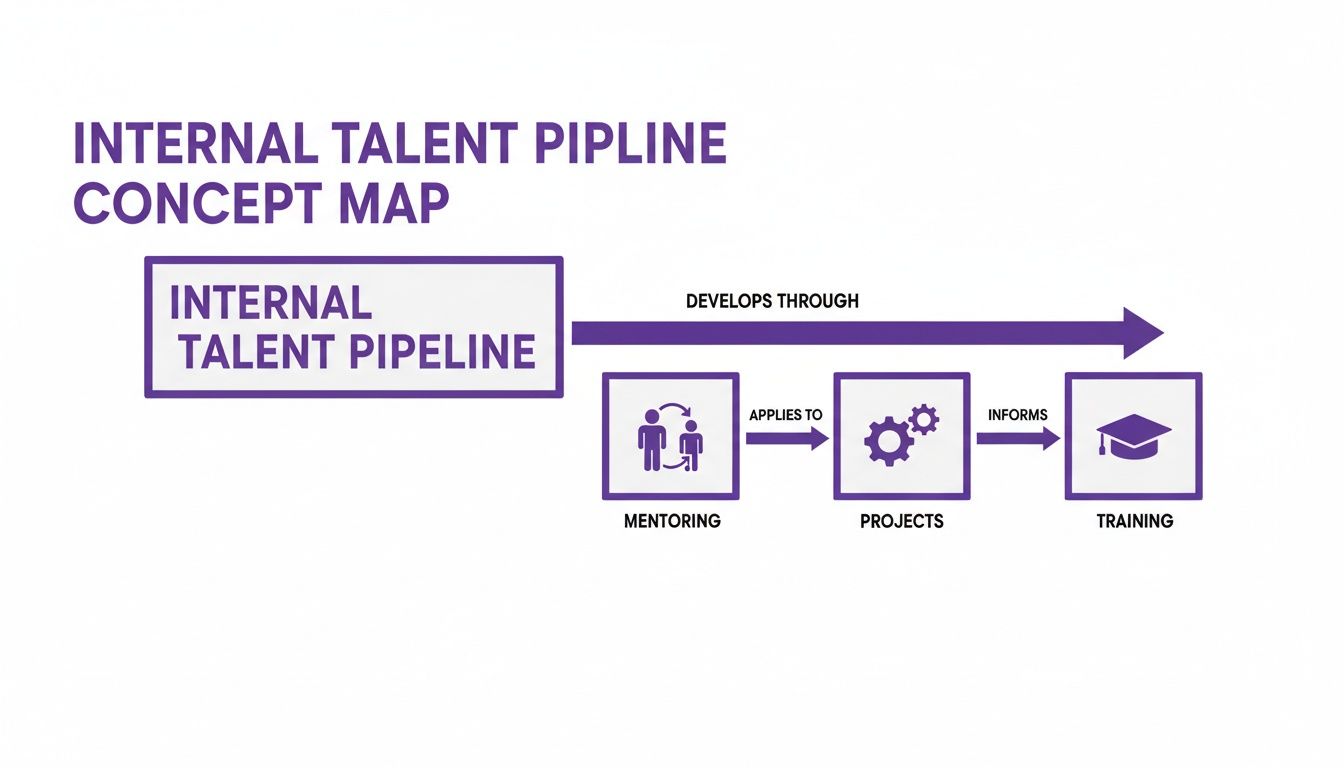
It shows how mentoring, hands-on project experience, and formal training all work in tandem to develop well-rounded, ready-to-go successors. When you use technology to track and manage all these moving parts, you’re creating a powerful, data-rich engine for growing leaders from within—all powered by the Microsoft ecosystem that so many UK businesses already have in place.
Avoiding Common Succession Management Pitfalls
Even the most carefully crafted succession management strategy can go off the rails. It’s one thing to have a plan on paper, but it’s another thing entirely to navigate the real-world challenges that come with putting it into practice. Knowing what these common pitfalls are is the first step to building a process that actually works.
One of the most destructive habits is creating the ‘secret list’. This is where a handful of senior leaders quietly decide who’s next in line for key roles. It might seem efficient, but this secrecy breeds mistrust and kills motivation for anyone not on the list. It creates a culture of favouritism, not one where the best people rise to the top.
The Problem with Bias and Stale Plans
Another major hurdle is unconscious bias. It’s human nature. Without clear, objective criteria, managers often lean towards promoting people who are just like them. This unintentionally pushes diverse, high-potential talent to the side and narrows the leadership pipeline, which ultimately makes the organisation less adaptable.
Then there’s the ‘set-and-forget’ trap. A succession plan isn't a document you create once and file away. Business goals change, markets shift, and people develop new skills. If your plan isn't treated as a living, breathing part of your strategy, it will be out of date within a year.
The real goal of succession management isn’t just about filling an empty chair. It’s about securing the long-term health and stability of the entire business. Moving past these pitfalls means shifting from a secretive, static checklist to an open, dynamic culture of continuous development.
Staying Ahead in a Fast-Changing Landscape
Recent data from the UK really drives home the high cost of getting succession wrong. With more companies promoting from within, CEO tenure has hit a new low. One report found the average tenure fell to just 6.8 years—the lowest since they started tracking it in 2018. Other studies show it’s even lower, at around 5.2 years.
These numbers are a stark warning for UK firms. Leadership transitions are happening faster than ever, making structured processes and integrated HR technology essential for stability.
By building your process around objective, data-driven competency frameworks within your HR system, you can actively fight bias and ensure a level playing field. And by talking openly about development opportunities, you turn what could be a divisive process into a powerful way to engage your team and strengthen the whole organisation.
So, What's Your Next Move?
We've walked through what succession management really is – not just a last-minute scramble to fill a vacancy, but a continuous, strategic way to future-proof your business. For any UK firm, building that strong internal pipeline of talent isn't just a 'nice to have'; it's a serious competitive edge. It keeps your institutional knowledge safe and shows your best people you're invested in their future.
This is the perfect moment to take a hard look at your own process. Are you actively spotting those crucial roles and nurturing your next generation of leaders? Or are you still in reactive mode, waiting for a key person to hand in their notice? Does the system you have right now give you the clarity and insight you need to make smart decisions about your people?
A truly resilient business isn't one that dodges change. It's one that's ready for it. Solid succession management is what gets you ready, turning what could be a disruptive exit into a brilliant opportunity to promote from within.
When you weave succession management into the very fabric of how you operate, you’re doing more than just planning for future job titles. You’re building a stronger, more stable, and ultimately more successful organisation.
Your Questions Answered
When UK businesses first start thinking about succession management, a few common questions always pop up. Let's tackle them head-on to give you a clearer picture of how to build a strategy that actually works for your organisation.
How Small Is Too Small for Succession Management?
Honestly, no business is ever too small to think about its future leadership. It's a common misconception that this is only for large corporations. At its heart, succession management is simply about ensuring your business can carry on, whether you have 10 employees or 1,000.
Of course, the process looks different. For a smaller company, it's not about mapping out every single position. The key is to scale it to your reality. Start by focusing on the one or two roles that are absolutely critical to your survival and growth.
How Do We Identify High-Potential Employees Without Causing Resentment?
This is a delicate one, and the best way to handle it is with transparency and objectivity. Forget about secret lists of 'the chosen ones'. Instead, build a clear competency framework that everyone in the company can see and understand.
It's crucial to communicate that this process is about creating development opportunities for everyone, not just crowning a select few.
The secret to fostering a positive culture is to frame succession management as a fair and inclusive talent development initiative. It shouldn't feel like a competition for a handful of promotions.
When you use objective data from your HR system, performance reviews, and 360-degree feedback, you start identifying potential based on solid evidence, not just a manager's gut feeling. This data-driven approach is what builds real trust in the process.
What Is the Role of the Board in Succession Planning?
The board's role is absolutely crucial, especially when it comes to the top jobs. They are the ultimate guardians of the process, responsible for governance and oversight. Their job is to make sure a formal process exists, to regularly review the talent pipeline for executive roles, and often, to provide mentorship to those high-potential leaders.
This isn't something they do in isolation; they need to work hand-in-glove with the CEO and HR. This partnership ensures that the entire succession strategy is perfectly aligned with the company’s long-term vision. At the end of the day, the board is accountable for having leaders ready to step up when needed.
We are DynamicsHub.co.uk. Experience HR transformation built around your business. Hubdrive’s HR Management for Microsoft Dynamics 365 is the premier hire‑to‑retire solution—more powerful, more flexible, and more future‑ready than Microsoft Dynamics 365 HR.
Phone 01522 508096 today, or send us a message to start building your resilient future.


